88 Corporations, $105 Billion in Profits, Zero Federal Income Tax
At least 88 of the largest corporations in America paid no federal corporate income taxes in their most recent fiscal year despite enjoying substantial pretax profits in the U.S. While the biggest U.S. corporations have avoided taxes in this way for decades, it appears that corporate tax avoidance has increased in the most recent year. This is at least in part due to two separate packages of corporate tax cuts pushed through by the Trump administration: last year’s “One Big Beautiful Bill Act” and the 2017 Tax Cuts and Jobs Act (TCJA).
These tax-avoiding corporations represent a variety of industries and together enjoyed more than $105 billion in U.S. pretax income in 2025. The statutory federal income tax rate for corporate profits is 21 percent, which means these 88 corporations would have paid a collective total of $22.1 billion for the year had they paid that rate on their 2025 income. Instead, they received $4.7 billion in tax rebates. This means the total federal corporate income tax breaks enjoyed by these companies comes to $26.7 billion when measured against the 21 percent statutory rate. Measured against the 35 percent corporate income tax rate that was in effect before the two corporate tax cuts pushed through by Republicans and President Trump since 2017, these companies collectively cut their income taxes by $41 billion in 2025 alone.
These findings are based on ITEP’s analysis of the annual financial reports filed by the nation’s largest publicly traded U.S.-based corporations in their most recent fiscal year. All data presented here come directly from the income tax notes of these reports.
This is far from a comprehensive list of the new tax law’s large corporate beneficiaries: many companies with fiscal years that don’t align with the calendar year have not yet filed such reports for 2025, making it impossible to know the extent of their tax breaks. Some companies with substantial tax savings are excluded from this list because they are not part of the S&P 500 or Fortune 500. Large privately-held corporations are not required to disclose income tax expense and are excluded as well. This report also excludes some corporations that reported zero federal income tax on large profits in 2025 because they relied overwhelmingly on net operating losses from prior years to zero out their 2025 income tax.
Which Companies Paid Zero Federal Income Tax in 2025?
The companies avoiding all federal income tax in 2025 represent a broad cross-section of the U.S. economy, from manufacturing to services.
- The automaker Tesla reported zero federal income tax paid on almost $5.7 billion of U.S. income in 2025.
- Southwest Airlines avoided all federal income tax on $561 million of income last year; its competitor United Airlines achieved the same zero-tax result on almost $4.3 billion of U.S. income.
- The entertainment company Live Nation Entertainment paid zero federal income tax on $98 million of U.S. income.
- Yum! Brands, the parent company of the fast-food chains KFC, Taco Bell, and Pizza Hut, paid no federal income tax on over $1 billion of U.S. pretax profits last year.
- Three tech companies that specialize in digital payments—PayPal, Toast, and Block—collectively paid zero federal income tax on $3.2 billion of U.S. income.
These 88 Profitable Companies Paid $0 in Federal Income Tax in 2025
Corporate Tax Avoidance Hurts State Budgets Too
Because state corporate income tax rules generally are based on federal income definitions, tax breaks that are claimed at the federal level are routinely available against state tax as well. The nationwide state tax rates paid by these 88 companies bear that out: the corporations collectively reported an effective state income tax rate of just 1.4 percent. Since the nationwide weighted-average state corporate tax rate is closer to 6 percent, that implies that these companies may be avoiding state income taxes on close to three-quarters of their U.S. income.
Corporate Tax Avoidance Relies on a Variety of Tax Breaks
Because the tax returns of these corporations are not public, it’s impossible to know exactly how the companies are avoiding all tax liability. But the Securities and Exchange Commission requires publicly traded companies to disclose, in their annual reports to shareholders, basic information about their U.S. pretax income, and the federal and state income tax paid on that income. Annual reports released starting this year, covering calendar year 2025, are subject to new, more detailed disclosure rules that also require companies to list categories of tax provisions that have a significant effect on their income tax expense each year. For this reason, we can generally describe the tax breaks used by many of these 88 companies to get their tax expense to zero.
The most universally relied-on tax break in our sample is accelerated depreciation. A provision in the 2025 tax law allowing companies to immediately write off capital investments—the most extreme version of tax depreciation—helped more than half of these companies reduce their federal income tax last year. 3M, Cheniere Energy, Southwest Airlines, Duke Energy, Venture Global, and Tesla all used depreciation tax breaks to substantially reduce current income tax expense, as did several dozen other companies on this list. (Many other companies on the list likely used depreciation tax breaks but did not separately disclose them.) The 88 companies collectively reported reducing their income taxes by $11.4 billion in 2025 through accelerated depreciation.
At least 40 of these companies used the federal research and experimentation (R&E) credit to substantially reduce their federal income taxes in 2025. These include Honeywell, HP, CVS Health, PayPal, Walt Disney, Block, and Tesla. These companies collectively disclosed $1.6 billion of R&D credits in 2025.
More than 30 zero-tax companies achieved this in part by taking advantage of a new tax break created by Republican leaders in Congress last year. Retroactive to January of 2025, the new tax law allows companies to immediately write off their research and development expenses, rather than amortizing them over time as economic depreciation would require. While the required disclosures don’t give a precise amount, these companies appear to have reduced their 2025 income taxes by at least $4.4 billion using the new research expensing provision.
At least 10 of the companies used the Foreign-Derived Deduction Eligible Income (FDDEI) deduction to reduce their income taxes. The FDDEI deduction, expanded retroactively by last year’s Trump tax cuts, is designed to lower the federal corporate tax rate on some profits generated from exports, meaning sales to customers in foreign countries. The deduction, which now stands at 33.34 percent of eligible profits, is the successor to the deduction for Foreign-Derived Intangible Income (FDII), which was introduced by the Trump tax law enacted in 2017. Among the beneficiaries of this tax break were HP, Halliburton, Walt Disney, Yum! Brands, and the defense contractors L3Harris and KBR.
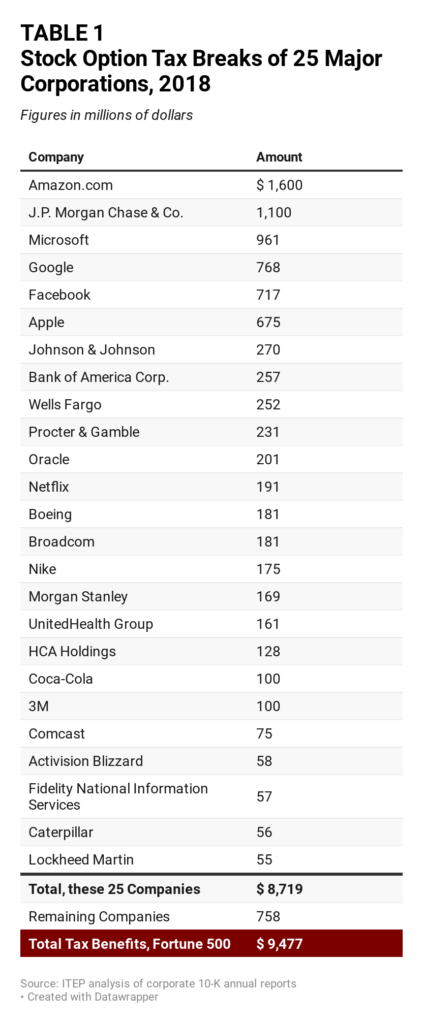
More than a dozen companies used a tax break for executive stock options to sharply reduce their income taxes last year. These include Palantir, Tesla, Coinbase, Walt Disney, and Venture Global. This tax break allows companies to write off stock-option related expenses for tax purposes that go far beyond expenses they report to investors.
It’s impossible to know what fraction of the federal income tax breaks reported by these companies is attributable to last year’s corporate tax cuts. This is mainly because for several of the largest tax breaks, especially depreciation and the FDDEI tax break, the companies’ disclosures don’t separate the tax break that would have existed absent last year’s tax cuts from the incremental amount the “One Big Beautiful Bill Act” provided. But it’s unquestionably true that these companies’ federal income tax bills were far lower in 2025 than they would have been absent the two rounds of corporate tax cuts pushed through by Republican leaders and the Trump administration in 2017 and 2025.