
Rhode Island

Making the Wealthy Pay their Fair Share is the Way to Preserve Vacation Towns
• By Rita Jefferson
Rhode Island lawmakers created a new surcharge on second homes worth more than $1 million as part of the budget enacted this spring.
Wall Street Journal: Blue States Hunt for Ways to Wring More Taxes From the Wealthy
August 14, 2025
A growing number of blue cities and states across the country, from Washington state to Rhode Island, are looking at ways to wring more revenue from their richest taxpayers.

State Tax Action in 2025: Amid Uncertainty, Tax Cuts and New Revenue
• By Aidan Davis, Neva Butkus, Marco Guzman
Federal policy choices on tariffs, taxes, and spending cuts will be deeply felt by all states, which will have less money available to fund key priorities. This year some states raised revenue to ensure that their coffers were well-funded, some proceeded with warranted caution, and many others passed large regressive tax cuts that pile on to the massive tax cuts the wealthiest just received under the federal megabill.
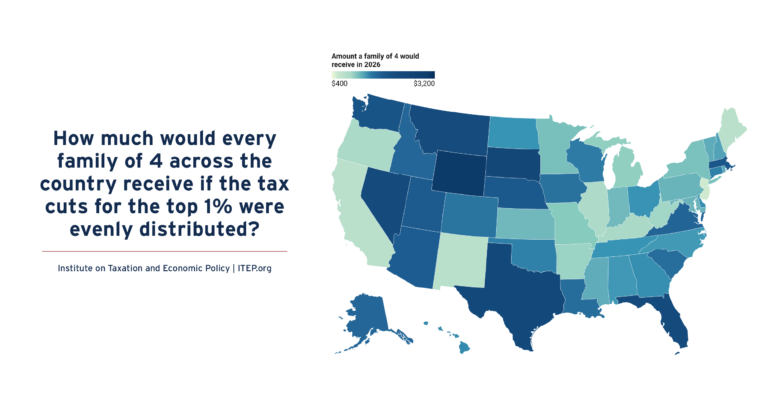
How Much Would Every Family in Every State Get if the Megabill’s Tax Cuts Given to the Rich Had Instead Been Evenly Divided?
• By Michael Ettlinger
If instead of giving $117 billion to the richest 1 percent, that money had been evenly divided among all Americans, we'd each get $343 - or nearly $1,400 for a family of four.

Analysis of Tax Provisions in the Trump Megabill as Signed into Law: National and State Level Estimates
• By Steve Wamhoff, Carl Davis, Joe Hughes, Jessica Vela
President Trump has signed into law the tax and spending “megabill” that largely favors the richest taxpayers and provides working-class Americans with relatively small tax cuts that will in many cases be more than offset by Trump's tariffs.

Trump Megabill Will Give $117 Billion in Tax Cuts to the Top 1% in 2026. How Much In Your State?
• By Michael Ettlinger
The predominant feature of the tax and spending bill working its way through Congress is a massive tax cut for the richest 1 percent — a $114 billion benefit to the wealthiest people in the country in 2026 alone.

How Much Do the Top 1% in Each State Get from the Trump Megabill?
• By Carl Davis
The Senate tax bill under debate right now would bring very large tax cuts to very high-income people. In total, the richest 1 percent would receive $114 billion in tax cuts next year alone. That would amount to nearly $61,000 for each of these affluent households.

State Rundown 6/25: The Numbers Don’t Lie, State Budget Edition
• By ITEP Staff
Many states are reaching their end-of-June budget deadlines, and major tax policy changes look to have big implications as states are forced, per federal policy, to do more with less.
State Rundown 6/20: Federal tax policy heats up, states wrap sessions and weigh impacts
• By ITEP Staff
As state legislative sessions come to a close, decisions on tax policy are being made. Several southern states have cut taxes, while the northeast is making some more measured reforms.

Analysis of Tax Provisions in the House Reconciliation Bill: National and State Level Estimates
• By Carl Davis, Jessica Vela, Joe Hughes, Steve Wamhoff
The poorest fifth of Americans would receive 1 percent of the House reconciliation bill's net tax cuts in 2026 while the richest fifth of Americans would receive two-thirds of the tax cuts. The richest 5 percent alone would receive a little less than half of the net tax cuts that year.
State Rundown 5/15: State Tax Debates Carry On in the Midst of Chaotic Federal Tax Landscape
• By ITEP Staff
Even as most major headlines have been about the ever-changing landscape of federal tax policy, the latest “ideas of the week," and now the House tax bill, state tax policy continues to be a priority for lawmakers.
ITEP Testimony: Miles Trinidad on Rhode Island’s High-Earner Income Tax Surcharge
• By Miles Trinidad
This written testimony was submitted to the Rhode Island House Finance Committee on May 6, 2025. Thank you for the opportunity to provide testimony in support of H-5473, a bill to create a 3 percent surcharge on those earning over $625,000 a year. My name is Miles Trinidad. I am an analyst at the Institute […]

Trump 2025 Tax Law: Research and Resources
• By ITEP Staff
Want to know more about the tax and spending megabill that President Trump recently signed into law? We've got you covered.

IRS Cooperation with ICE Will Damage Public Trust, Putting Tax Revenues in Jeopardy
• By Marco Guzman
Attempts by the Department of Homeland Security to secure private information from the IRS on people who file taxes with an Individual Taxpayer Identification Number is a violation of federal privacy laws that protect taxpayers. It is also a change that could seriously damage public trust in the IRS, which could jeopardize billions of dollars in tax payments by hardworking immigrant families.
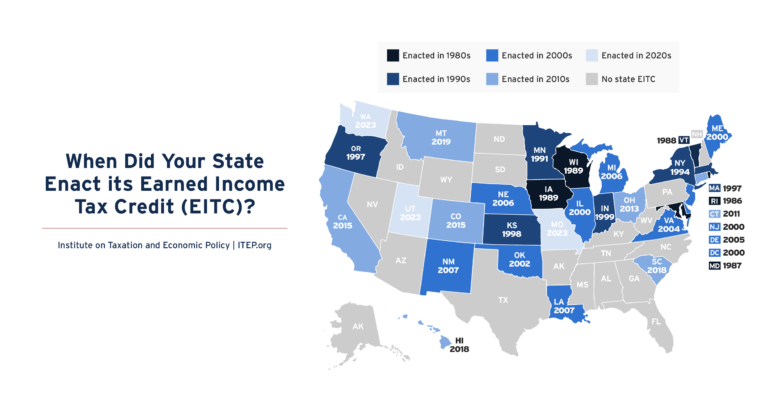
When Did Your State Enact an Earned Income Tax Credit (EITC)?
• By ITEP Staff
The Earned Income Tax Credit (EITC) supports millions of workers and families and continues to grow in states and localities across the country. Today, 31 states plus the District of Columbia and Puerto Rico offer EITCs. Local EITCs can also now be found in Montgomery County, Maryland, New York City, and San Francisco, where they benefited 700,000 households in 2023.

Celebrating 50 Years of the Earned Income Tax Credit
• By Neva Butkus
This week, we celebrate 50 years of the federal Earned Income Tax Credit (EITC) and the impact it's had on millions of workers and families. In 2023 alone, the latest year of available data, the federal EITC alongside the refundable portion of the Child Tax Credit lifted 6.4 million people and 3.4 million children out of poverty.

Wide-Ranging 2025 State Tax Debates Come into Focus
• By Aidan Davis
In the face of immense uncertainty around looming federal tax and budget decisions, many of which could threaten state budgets, state lawmakers have an opportunity to show up for their constituents by raising and protecting the revenue needed to fund shared priorities. Lawmakers have a choice: advance tax policies that improve equity and help communities thrive, or push tax policies that disproportionately benefit the wealthy, drain funding for critical public services, and make it harder…

A Revenue Analysis of Worldwide Combined Reporting in the States
• By Carl Davis, Matthew Gardner, Michael Mazerov
Universal adoption of mandatory worldwide combined reporting would boost state corporate income tax revenues by roughly 14 percent. Thirty-eight states and the District of Columbia would experience revenue increases totaling $19.1 billion.
Turning IRS Agents to Deportation Will Reduce Public Revenues
• By Carl Davis, Jon Whiten
The Trump Administration’s plan to turn IRS agents into deportation agents will result in lower tax collections in addition to the harm done to the families and communities directly affected by deportations.

The (Mostly Untapped) Power of Local Income Taxes
• By Rita Jefferson
Local income taxes can be an important progressive revenue raiser, as they ask more of higher-income households and are connected to ability to pay. They can raise substantial revenue to fund key public services to make cities and regions better off.
State Rundown 1/22: Tax Policy, Affordability, and Where It Misses the Mark
• By ITEP Staff
As state legislative sessions ramp up many lawmakers discuss their prioritization of affordability of necessities like food and housing as they craft their legislative agendas. Arkansas, Mississippi and Utah are looking to reduce or fully exempt groceries from their state sales taxes. Meanwhile, multiple proposals to reduce property taxes are making their way around state […]
State Rundown 1/15: Tax Debates Heat Up Despite Winter Weather
• By ITEP Staff
While frigid temperatures expected across a large swath of the country, major tax proposals are heating up in the states. Governors are giving their State of the State addresses and state lawmakers have begun to convene for 2025. New York Gov. Kathy Hochul announced plans to expand the state’s Child Tax Credit earlier this year and has since announced nearly $1 billion in income tax cuts. Maryland Gov. Wes Moore unveiled a new tax proposal…
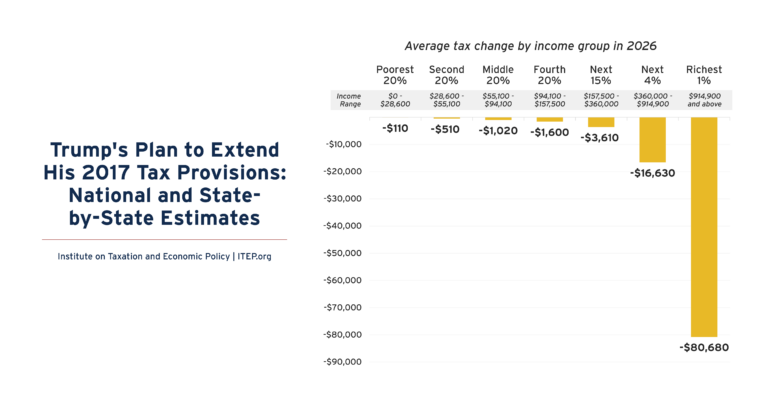
Trump’s Plan to Extend His 2017 Tax Provisions: Updated National and State-by-State Estimates
• By Steve Wamhoff
Trump’s plan to make most of the temporary provisions of his 2017 tax law permanent would disproportionately benefit the richest Americans. This includes all major provisions except the $10,000 cap on deductions for state and local taxes (SALT) paid.
On Election Day, Voters Across the Country Chose to Invest in Their States & Communities
• By Kamolika Das
On election day, voters across the country — in states red and blue and communities rural and urban — approved a wide range of state and local ballot measures on taxation and public investment. The success of these measures clearly shows that voters are willing to invest in public priorities that feel tangible and close to home.
Extending Temporary Provisions of the 2017 Trump Tax Law: Updated National and State-by-State Estimates
• By Steve Wamhoff
The TCJA Permanency Act would make permanent the provisions of the Tax Cuts and Jobs Act of 2017 that are set to expire at the end of 2025. The legislation would disproportionately benefit the richest Americans. Below are graphics for each state that show the effects of making TCJA permanent across income groups. See ITEP’s […]

Institute on Taxation
and Economic Policy
ITEP is a non-profit, non-partisan tax policy organization. We conduct rigorous analyses of tax and economic proposals and provide data-driven recommendations to shape equitable and sustainable tax systems.
Subscribe to ITEP Emails
Tax research and policy news in your inbox.
Promote Fair Tax Policy
Your gift to ITEP promotes tax justice. With your help, we do research that supports taxing millionaires and billionaires, taxing big corporations and raising revenue for the things our people, our communities and our planet need.
Together, we can create a country with more economic justice, more racial justice, more climate justice… and more tax justice.