
South Dakota
In the face of immense uncertainty around looming federal tax and budget decisions, many of which could threaten state budgets, state lawmakers have an opportunity to show up for their constituents by raising and protecting the revenue needed to fund shared priorities. Lawmakers have a choice: advance tax policies that improve equity and help communities thrive, or push tax policies that disproportionately benefit the wealthy, drain funding for critical public services, and make it harder for most families to get ahead.
State Rundown 2/12: State Tax Policy Heats Up as Winter Storms Sweep Much of the Country
February 12, 2025 • By ITEP Staff
Tax policy proposals are a hot topic of conversation across the country. Both North and South Dakota are considering property taxes cuts, while proposed cuts in Florida, Mississippi, and Texas are percolating. Meanwhile, fiscal conditions are tight in states like Alaska, Tennessee, Oklahoma, and West Virginia. None are on the cusp of passing new revenue, but years of recent tax cuts and inflation have caught up to states and many lawmakers have revenue gaps to close.
Turning IRS Agents to Deportation Will Reduce Public Revenues
February 11, 2025 • By Carl Davis, Jon Whiten
The Trump Administration’s plan to turn IRS agents into deportation agents will result in lower tax collections in addition to the harm done to the families and communities directly affected by deportations.
State Rundown 1/15: Tax Debates Heat Up Despite Winter Weather
January 15, 2025 • By ITEP Staff
While frigid temperatures expected across a large swath of the country, major tax proposals are heating up in the states. Governors are giving their State of the State addresses and state lawmakers have begun to convene for 2025. New York Gov. Kathy Hochul announced plans to expand the state’s Child Tax Credit earlier this year and has since announced nearly $1 billion in income tax cuts. Maryland Gov. Wes Moore unveiled a new tax proposal aimed at helping close the state’s looming revenue shortfall. The plan would increase taxes on the wealthy and cut taxes for many low- and middle-income…
Policymakers Unwisely Propose Cutting Property Taxes in Favor of Sales Taxes
January 14, 2025 • By Rita Jefferson

Lawmakers across the country are taking aim at property taxes with a new strategy: raising sales taxes instead. Doing so would create a regressive tax shift that puts unfair burdens on renters and reduces the strength of local government revenues.
Trump’s Plan to Extend His 2017 Tax Provisions: Updated National and State-by-State Estimates
January 8, 2025 • By Steve Wamhoff
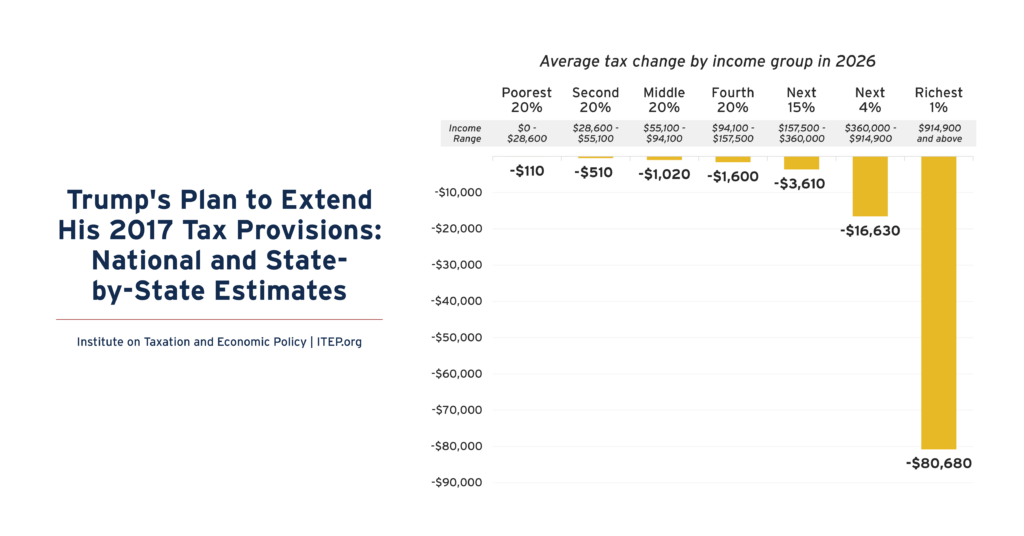
Trump’s plan to make most of the temporary provisions of his 2017 tax law permanent would disproportionately benefit the richest Americans. This includes all major provisions except the $10,000 cap on deductions for state and local taxes (SALT) paid.
The anti-tax playbook has been on full display in recent weeks as state policymakers run their offenses against public services and shared priorities. As the playbook dictates, if you have a little breathing room in your budget, propose cuts to the one major tax (personal income tax) that tends to ask more of those who […]
State Rundown 12/3: Some States Cast Away Fiscal Responsibility as They Plan for 2025
December 3, 2024 • By ITEP Staff
The 2025 legislative season will be here before we know it, and state lawmakers have begun unveiling their priorities and proposals. Unfortunately, despite stagnating revenue growth, many lawmakers continue to push for deep, regressive tax cuts - often before the full impact of previous tax cuts is felt.
Tax policy results are mixed across the country as many voters weigh in on state and local ballot measures. For example, Washington state voted to maintain its new progressive tax on capital gains; Georgia voters capped growth in property tax assessments; Illinois voters approved a call for a millionaires’ tax; North Dakota voters rejected property […]
2024 State Tax Ballot Questions: Voters to Weigh in on Tax Changes Big and Small
October 17, 2024 • By Jon Whiten

As we approach November’s election, voters in several states will be weighing in on tax policy changes. The outcomes will impact the equity of state and local tax systems and the adequacy of the revenue those systems are able to raise to fund public services.
Extending Temporary Provisions of the 2017 Trump Tax Law: Updated National and State-by-State Estimates
September 13, 2024 • By Steve Wamhoff

The TCJA Permanency Act would make permanent the provisions of the Tax Cuts and Jobs Act of 2017 that are set to expire at the end of 2025. The legislation would disproportionately benefit the richest Americans. Below are graphics for each state that show the effects of making TCJA permanent across income groups. See ITEP’s […]
The IRS has opened its free tax filing service called Direct File to every state for the 2025 tax filing season. Direct File was made possible by President Biden’s Inflation Reduction Act, which provided new resources for the IRS to improve customer service and ensure taxpayers claim the benefits and deductions for which they are […]

Undocumented immigrants paid $96.7 billion in federal, state, and local taxes in 2022. Providing access to work authorization for undocumented immigrants would increase their tax contributions both because their wages would rise and because their rates of tax compliance would increase.
Improving Refundable Tax Credits by Making Them Immigrant-Inclusive
July 17, 2024 • By Emma Sifre, Marco Guzman
Undocumented immigrants who work and pay taxes but don't have a valid Social Security number for either themselves or their children are excluded from federal EITC and CTC benefits. Fortunately, several states have stepped in to ensure undocumented immigrants are not left behind by the gaps in the federal EITC and CTC. State lawmakers should continue to ensure that immigrants who are otherwise eligible for these tax credits receive them.
States Should Opt Into IRS Direct File as the Program is Made Permanent
May 30, 2024 • By Jon Whiten
While there is plenty of room to expand Direct File at the federal level, states can take matters into their own hands and bring this benefit to their residents by opting into the program.

There are a variety of factors that affect teacher pay. But one often overlooked factor is progressive tax policies that allow states to raise and provide the funding educators and their students deserve.
Fairness Matters: A Chart Book on Who Pays State and Local Taxes
April 11, 2024 • By ITEP Staff
State and local tax codes can do a lot to reduce inequality. But they add to the nation’s growing income inequality problem when they capture a greater share of income from low- or moderate-income taxpayers. These regressive tax codes also result in higher tax rates on communities of color, further worsening racial income and wealth divides.
State Rundown 3/28: Tax Cut Madness, But Our Brackets Bet on Tax Fairness
March 28, 2024 • By ITEP Staff
While madness is typically reserved for basketball in March, several high-profile, regressive tax cuts are making their way through state legislatures this week...
Congress Should Enhance – Not Diminish – IRS Capability this Tax Season
March 28, 2024 • By Joe Hughes
While funding cuts to the IRS may have been necessary as a political matter to avoid harmful agency shutdowns, they are severely misguided as a policy matter. By all serious accounts, cuts to IRS funding increase the deficit due to uncollected taxes – mostly from big businesses and the very wealthy.
Many state legislative sessions are in the final stretch...
Anti-tax interests finally found the end of the tax cutting appetite in a few states this week...
State legislative sessions are in full swing with New Jersey and Oklahoma both particularly active this week...
State Tax Watch 2024
January 23, 2024 • By ITEP Staff
Updated July 15, 2024 In 2024, state lawmakers have a choice: advance tax policy that improves equity and helps communities thrive, or push tax policies that disproportionately benefit the wealthy, drain funding for critical public services, and make it harder for low-income and working families to get ahead. Despite worsening state fiscal conditions, we expect […]

The findings of Who Pays? go a long way toward explaining why so many states are failing to raise the amount of revenue needed to provide full and robust support for our public schools.
Tax policy themes have begun to crop up in states as governors give their yearly addresses and legislators lay out their plans for the 2024 legislative season...

Institute on Taxation
and Economic Policy
ITEP is a non-profit, non-partisan tax policy organization. We conduct rigorous analyses of tax and economic proposals and provide data-driven recommendations to shape equitable and sustainable tax systems.
Subscribe to ITEP Emails
Tax research and policy news in your inbox.
Promote Fair Tax Policy
Your gift to ITEP promotes tax justice. With your help, we do research that supports taxing millionaires and billionaires, taxing big corporations and raising revenue for the things our people, our communities and our planet need.
Together, we can create a country with more economic justice, more racial justice, more climate justice… and more tax justice.