
Virginia

As the Washington, D.C. region heads toward a likely recession, local policymakers will need to look to new revenue sources to help lessen the pain. In D.C., lawmakers ought to adopt a simple reform that would raise substantial revenue and make the District’s business tax system fairer.
West Virginia Center on Budget & Policy: Big Beautiful Bill’s Tax Cuts Overwhelmingly Favor the Wealthiest in West Virginia Even Before Accounting for Tariffs and Benefit Cuts
May 31, 2025
Earlier this month the U.S. House of Representatives passed a major new tax and spending bill that not only represents the largest cuts to Medicaid and SNAP in history, taking away SNAP and Medicaid benefits from millions of recipients including tens of thousands in West Virginia, but also includes tax provisions that would overwhelmingly favor the richest taxpayers in […]
Analysis of Tax Provisions in the House Reconciliation Bill: National and State Level Estimates
May 22, 2025 • By Carl Davis, Jessica Vela, Joe Hughes, Steve Wamhoff
The poorest fifth of Americans would receive 1 percent of the House reconciliation bill's net tax cuts in 2026 while the richest fifth of Americans would receive two-thirds of the tax cuts. The richest 5 percent alone would receive a little less than half of the net tax cuts that year.
Want to know more about the tax and spending megabill that President Trump recently signed into law? We've got you covered.
IRS Cooperation with ICE Will Damage Public Trust, Putting Tax Revenues in Jeopardy
April 10, 2025 • By Marco Guzman

Attempts by the Department of Homeland Security to secure private information from the IRS on people who file taxes with an Individual Taxpayer Identification Number is a violation of federal privacy laws that protect taxpayers. It is also a change that could seriously damage public trust in the IRS, which could jeopardize billions of dollars in tax payments by hardworking immigrant families.
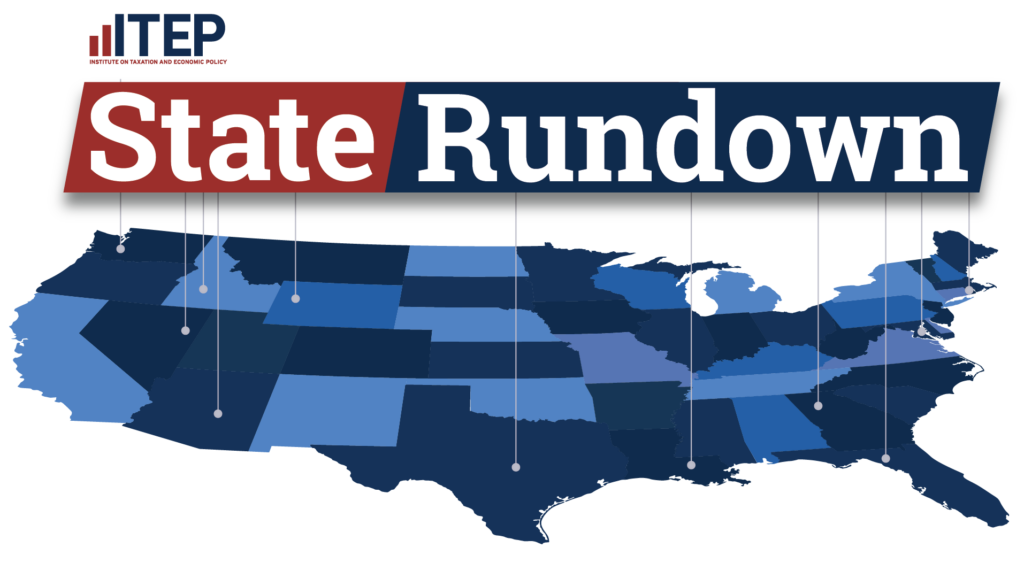
Residents and state lawmakers across the country are pushing back against anti-tax measures and are looking for ways to protect revenue and advance proposals that would raise revenue in progressive ways. This comes at a time when federal policy brings significant risks for state tax revenue.
Sharp Turn in Federal Policy Brings Significant Risks for State Tax Revenues
April 9, 2025 • By Carl Davis

Summary The new presidential administration and Congress have indicated that they intend to bring about a dramatic federal retreat in funding for health care, food assistance, education, and other services that will push more of the responsibility for providing these essential services to the states. Meeting these new obligations would be a challenging task for […]
State Rundown 4/3: Amidst Tariff Uncertainty, State Lawmakers Talk Taxes
April 3, 2025 • By ITEP Staff
While all eyes are on the Trump administration’s tariffs on foreign imports, state lawmakers are moving forward with a mix of deep, regressive tax cuts and progressive revenue raisers.

This week, we celebrate 50 years of the federal Earned Income Tax Credit (EITC) and the impact it's had on millions of workers and families. In 2023 alone, the latest year of available data, the federal EITC alongside the refundable portion of the Child Tax Credit lifted 6.4 million people and 3.4 million children out of poverty.
Below is a list of tax expenditure reports published in the states.
State Rundown 2/26: House Budget Plan Could Further Strain State Budgets
February 26, 2025 • By ITEP Staff
States would be wise to keep a close eye on happenings in Washington, D.C. Republicans in the House of Representatives recently passed their budget resolution, which could spell trouble for state budgets. The plan tees up major cuts to Medicaid, SNAP, and college tuition assistance—all likely to allow for tax cuts that will overwhelmingly benefit the wealthy. If approved, trillions of dollars would be cut from programs supported by federal dollars and states and localities could bear the brunt of those shifting costs. Many states are already facing delicate fiscal outlooks and those considering cutting taxes further should seriously reconsider.…
Revenue Effect of Mandatory Worldwide Combined Reporting by State
February 21, 2025 • By ITEP Staff
Universal adoption of mandatory worldwide combined reporting (WWCR) in states with corporate income taxes would boost state tax revenue by $18.7 billion per year. The revenue effects of mandatory WWCR would vary across states. We estimate that 38 states and the District of Columbia would experience revenue increases totaling $19.1 billion. The top 10 states […]

In the face of immense uncertainty around looming federal tax and budget decisions, many of which could threaten state budgets, state lawmakers have an opportunity to show up for their constituents by raising and protecting the revenue needed to fund shared priorities. Lawmakers have a choice: advance tax policies that improve equity and help communities thrive, or push tax policies that disproportionately benefit the wealthy, drain funding for critical public services, and make it harder for most families to get ahead.
States Could Raise $19 Billion a Year with One Policy Change Targeting Corporate Tax Avoidance
February 20, 2025 • By ITEP Staff
Worldwide combined reporting negates the tax benefits of shifting corporate income offshore Public polling has consistently shown for decades that most people believe big multinational corporations are paying too little in taxes. Closing the loopholes these corporations use to avoid taxes is one of the most effective – and popular – solutions to this problem. […]
A Revenue Analysis of Worldwide Combined Reporting in the States
February 20, 2025 • By Carl Davis, Matthew Gardner, Michael Mazerov

Universal adoption of mandatory worldwide combined reporting would boost state corporate income tax revenues by roughly 14 percent. Thirty-eight states and the District of Columbia would experience revenue increases totaling $19.1 billion.
State Rundown 2/12: State Tax Policy Heats Up as Winter Storms Sweep Much of the Country
February 12, 2025 • By ITEP Staff
Tax policy proposals are a hot topic of conversation across the country. Both North and South Dakota are considering property taxes cuts, while proposed cuts in Florida, Mississippi, and Texas are percolating. Meanwhile, fiscal conditions are tight in states like Alaska, Tennessee, Oklahoma, and West Virginia. None are on the cusp of passing new revenue, but years of recent tax cuts and inflation have caught up to states and many lawmakers have revenue gaps to close.
Turning IRS Agents to Deportation Will Reduce Public Revenues
February 11, 2025 • By Carl Davis, Jon Whiten
The Trump Administration’s plan to turn IRS agents into deportation agents will result in lower tax collections in addition to the harm done to the families and communities directly affected by deportations.
Tax changes have been proposed or are nearing the finish line in many states. Kentucky is poised to enact an income tax cut as a bill heads to the governor’s desk. In Pennsylvania, Gov. Josh Shapiro’s budget proposal called to accelerate existing corporate tax cuts while closing corporate tax loopholes by enacting combined reporting. Ohio Gov. Mike DeWine proposed a new credit for children of working parents. And Virginia Democrats countered Gov. Glenn Youngkin’s proposed tax cuts with a plan of their own that includes an increase to the state’s Earned Income Tax Credit (EITC) and a one-time, nonrefundable tax…

Local income taxes can be an important progressive revenue raiser, as they ask more of higher-income households and are connected to ability to pay. They can raise substantial revenue to fund key public services to make cities and regions better off.
State Rundown 1/15: Tax Debates Heat Up Despite Winter Weather
January 15, 2025 • By ITEP Staff
While frigid temperatures expected across a large swath of the country, major tax proposals are heating up in the states. Governors are giving their State of the State addresses and state lawmakers have begun to convene for 2025. New York Gov. Kathy Hochul announced plans to expand the state’s Child Tax Credit earlier this year and has since announced nearly $1 billion in income tax cuts. Maryland Gov. Wes Moore unveiled a new tax proposal aimed at helping close the state’s looming revenue shortfall. The plan would increase taxes on the wealthy and cut taxes for many low- and middle-income…
Nick Johnson
January 15, 2025 • By ITEP Staff

Nick serves as a Senior Fellow with ITEP’s state and local policy teams. He brings three decades of expertise in state and local tax policy to advance economic justice and sustainable public finance. Most recently, he led the District of Columbia Tax Revision Commission as Executive Director, where he guided the independent, decennial commission’s comprehensive […]
Trump’s Plan to Extend His 2017 Tax Provisions: Updated National and State-by-State Estimates
January 8, 2025 • By Steve Wamhoff
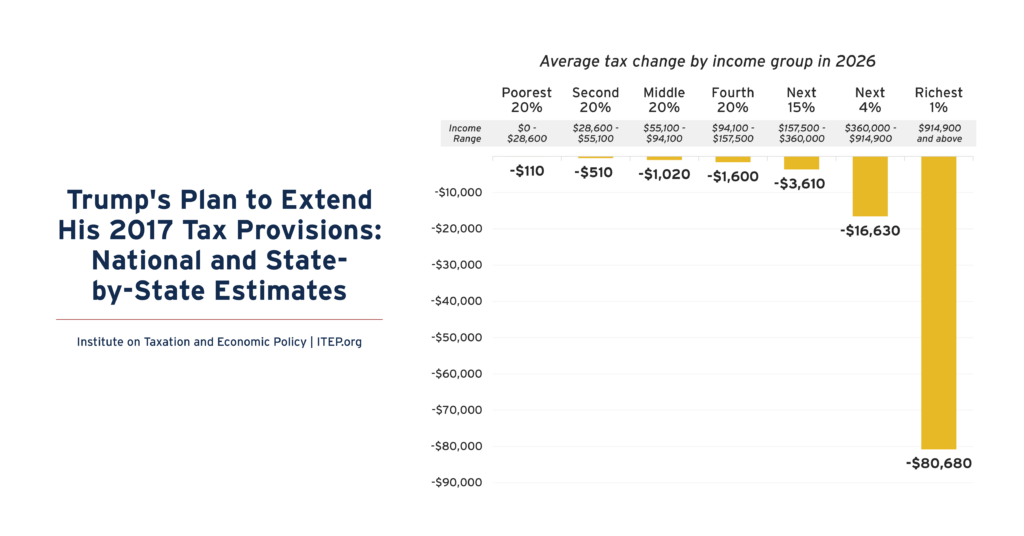
Trump’s plan to make most of the temporary provisions of his 2017 tax law permanent would disproportionately benefit the richest Americans. This includes all major provisions except the $10,000 cap on deductions for state and local taxes (SALT) paid.
The anti-tax playbook has been on full display in recent weeks as state policymakers run their offenses against public services and shared priorities. As the playbook dictates, if you have a little breathing room in your budget, propose cuts to the one major tax (personal income tax) that tends to ask more of those who […]
Louisiana Gov. Jeff Landry is proposing a regressive tax reform package that would enact a flat personal and corporate income tax while expanding the state’s sales tax base and eliminating certain exemptions to make up for a portion of the lost revenue. West Virginia continues to chip away at its personal income tax, one of the state’s few progressive revenue options. And advocates in New York are rallying around a package of progressive tax legislation that would tax capital gains at higher rates, enact higher income tax brackets on multi-millionaires, and tax unrealized capital gains of billionaires.
2024 State Tax Ballot Questions: Voters to Weigh in on Tax Changes Big and Small
October 17, 2024 • By Jon Whiten

As we approach November’s election, voters in several states will be weighing in on tax policy changes. The outcomes will impact the equity of state and local tax systems and the adequacy of the revenue those systems are able to raise to fund public services.

Institute on Taxation
and Economic Policy
ITEP is a non-profit, non-partisan tax policy organization. We conduct rigorous analyses of tax and economic proposals and provide data-driven recommendations to shape equitable and sustainable tax systems.
Subscribe to ITEP Emails
Tax research and policy news in your inbox.
Promote Fair Tax Policy
Your gift to ITEP promotes tax justice. With your help, we do research that supports taxing millionaires and billionaires, taxing big corporations and raising revenue for the things our people, our communities and our planet need.
Together, we can create a country with more economic justice, more racial justice, more climate justice… and more tax justice.