
Washington
Washington Post: Is the Trump Tax Cut Good or Bad for the Middle-Class?
January 12, 2018
A state-by-state analysis produced by the Institute on Taxation and Economic Policy, a liberal-leaning group, show the vast majority will get some kind of tax cut in Missouri in 2019, but then as much of a third will experience tax increases in 2027. Even more striking is how even the tax cuts shrink. In the […]
The Walmart Smiley Face Is Lying: Corporate Tax Cuts Are Not Causing Pay Raises and Bonuses
January 12, 2018 • By Steve Wamhoff

Last night, Yahoo reported that 81 corporations had announced pay raises and bonuses that they claim result from the Trump-GOP tax law’s reduction in the official corporate tax rate from 35 percent to 21 percent. Of these 81 corporations, 13 were included in ITEP’s most recent corporate tax study, which focuses on the Fortune 500 companies that were profitable every year from 2008 through 2015. These 13 companies had a combined effective tax rate of just 19.1 percent, which undermines the idea that the federal corporate tax rate was holding back their ability to pay workers.
State Rundown 1/12: Tax Cut Tunnel Vision Threatens to Bore State Budget Holes Even Deeper
January 12, 2018 • By ITEP Staff
As states continue to sift through wreckage of the federal tax cut bill to try to determine how they will be affected, two things should be clear to everyone: the richest people in every state just got a massive federal tax cut, and federal funding for shared priorities like education and health care is certain to continue to decline. State leaders who care about those priorities should consider asking those wealthy beneficiaries of the federal cuts to pay more to the state in order to minimize the damage of the looming federal funding cuts, but so far policymakers in Idaho,…
State Rundown 1/4: Will States Show Resolve in a Challenging Year?
January 4, 2018 • By ITEP Staff
This week marks the beginning of what is bound to be a wild year for state tax and budget debates. Essentially every state is already working to sort through the complicated ramifications of the federal tax cuts passed in December, including Kansas, Michigan, Montana, and New Jersey highlighted below. These and other states will have important decisions to make about how to incorporate, reject, or mitigate various aspects of the new federal law, and will need considerable resolve to improve state tax policy to be more fair and more adequate – even as federal taxes become less so.
Select state coverage of ITEP’s analyses of Republican tax Plans
January 1, 2018
Burlington County Times: Will Phil Murphy raise NJ’s taxes (and 4 other political questions for .. Kaplan Herald: This chart exhibits how the GOP tax plan will hit your pockets Wiscnews: Tax cuts increase inequity Patch.com: MacArthur Touts Tax Reform; Will It Help NJ As Much As He Says? NJ.com: Long lines spring up as […]
Washington Post: The Finance 202: Trump pledged to slash a key break for investment managers. Here’s the inside story of how he failed.
December 22, 2017
From the Institute on Taxation and Economic Policy: AT&T’s Tax Rate for Past 8 Years: 8.1% Boeing’s Tax Rate for Past 8 Years: 5.4% The idea that a new lower tax rate is really driving their recent PR stunts is nonsense Read more
Final Tax Bill Hits Parents of College Students Harder than Other Taxpayers
December 19, 2017 • By Steve Wamhoff

While many provisions targeting higher education in previous versions of the tax plan were eventually dropped, little thought has been given to how the bill still raises taxes on parents at the time they are trying to pay for college tuition.
The Trump-GOP’s Big Giveaway to Multinational Corporations
December 19, 2017 • By Richard Phillips

The tax bill just approved by Congress was a golden opportunity to solve these problems for good—but turned out to be a colossal missed opportunity. Instead of addressing the hundreds of billions in lost federal tax revenue due to offshore tax avoidance schemes, the Trump-GOP tax bill would forgive most of the taxes owed on the profits held offshore right now and open the floodgates to even more offshore profit-shifting in the future.
Washington Post: The Tax Bill Is Worse Than Bad, It’s Corrupt
December 19, 2017
For most taxpayers who use the existing deduction, this doesn’t solve their problem. One estimate from the Institute on Taxation and Economic Policy found that 1.89 million Californians would still see their taxes rise under the new provision, only a modest drop from the 2.36 million who would have had a tax increase under the […]
Bloomberg: These Are the Tricks States May Use to Get Around the SALT Deduction
December 19, 2017
Republican Senate and House negotiators in Washington agreed last week on a $10,000 cap on state and local tax deductions, or SALT. In high-tax states, that’s bad news. Personal taxes are poised to rise for 13 percent of New Yorkers and 11 percent of California and New Jersey residents, according to an analysis by left-leaning […]
New Republic: The Republican Tax Bill Is a Gift to the Washington Blob
December 19, 2017
Corker, who is already under federal investigation for alleged insider trading involving a real-estate firm, spent the weekend making a series of less-than-convincing statements justifying his switch. He first told IBT that he hadn’t read the bill. Then he wrote an angry letter to Senate leaders questioning how this provision got into the bill. As […]
BBC: Will Trumps Plan Trigger a Tax War?
December 19, 2017
To offset the revenue losses, the US is imposing a one-time tax on profits held abroad, levied at 15.5% for cash and 8% for illiquid assets. Depending on your perspective, the measure either captures tax that firms otherwise would have avoided, or provides companies with a major break on what they would have otherwise owed. […]
BBC: Will Trump’s Tax Plan Trigger a Tax War?
December 17, 2017
Depending on your perspective, the measure either captures tax that firms otherwise would have avoided, or provides companies with a major break on what they would have otherwise owed. “Allowing them to pay a low rate is basically a get-out-of-jail halfway free card,” said Matthew Gardner, senior fellow at the Institute on Taxation and Economic […]
How the Final GOP-Trump Tax Bill Would Affect Washington Residents’ Federal Taxes
December 16, 2017 • By ITEP Staff
The final tax bill that Republicans in Congress are poised to approve would provide most of its benefits to high-income households and foreign investors while raising taxes on many low- and middle-income Americans. The bill would go into effect in 2018 but the provisions directly affecting families and individuals would all expire after 2025, with […]
ITEP researchers have produced new reports and analyses that look at various pieces of the tax bill, including: the share of tax cuts that will go to foreign investors; how the plans would affect the number of taxpayers that take the mortgage interest deduction or write off charitable contributions, and remaining problems with the bill in spite of proposed compromises on state and local tax deductions.
What voters want—the people who put elected officials in office—matters. Members of Congress should take pause before proceeding with their profoundly unpopular tax bill that the vast majority of voters have said lawmakers should not pass.
Who Is “America First” Under the Tax Plan? The Rich First, Foreign Investors Second, Then the Rest of Us.
December 12, 2017 • By Steve Wamhoff
In his inaugural speech, President Trump told the world that Washington would be driven by a principle of “America First.” But the tax plans moving through Congress only put the richest Americans first. Everyone else comes after foreign investors.
Reuters: Millions Would Stop Bothering with Mortgage, Charity and Property Tax Deductions
December 8, 2017
Millions of households would no longer benefit from federal tax deductions for charity donations, mortgage interest payments and property tax under Republican tax plans being debated in the U.S. Congress, a think tank said on Thursday. The left-leaning Institute on Taxation and Economic Policy said that up to 29 million U.S. households now writing off […]
State Rundown 12/7: States Try to Plan While Awaiting Federal Tax Decisions
December 7, 2017 • By ITEP Staff
Though most eyes were on Congress rather than states this week, several states have been taking stock of their fiscal situations. Wyoming lawmakers considered ways to resolve budget shortfalls, Kansas and New Mexico legislators got some minor good news about their states' revenues, their counterparts in Minnesota and Vermont grappled with less encouraging revenue news, and those in West Virginia were just happy to hear their revenues had at least met expectations for once.
How the House and Senate Tax Bills Would Affect Washington Residents’ Federal Taxes
December 6, 2017 • By ITEP Staff
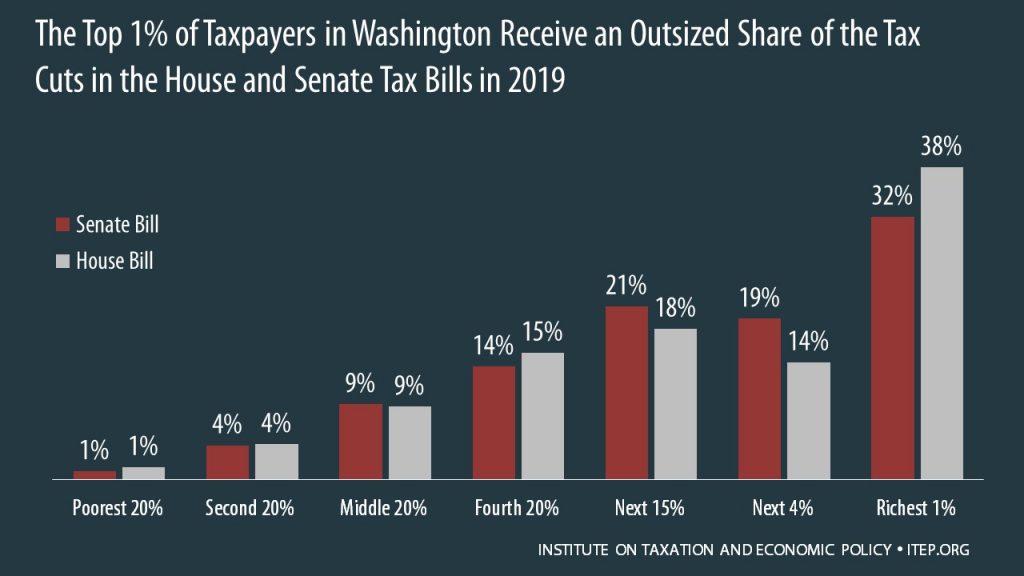
The House passed its “Tax Cuts and Jobs Act” November 16th and the Senate passed its version December 2nd. Both bills would raise taxes on many low- and middle-income families in every state and provide the wealthiest Americans and foreign investors substantial tax cuts, while adding more than $1.4 trillion to the deficit over ten years. The graph below shows that both bills are skewed to the richest 1 percent of Washington residents.
Lawmakers Are Allowing Monied Interests to Trump the Voices of Their Constituents
November 30, 2017 • By Alan Essig

George Washington is said to have described the U.S. Senate as the body that cools the passions of an impulsive House of Representatives just as a saucer cools tea. But current Senate leaders appear to think of themselves as more of a Bunsen burner.
The State Rundown is back from Thanksgiving break with a heaping helping of leftover state tax news, but beware, some of it may be rotten.
The Senate Tax Plan’s Big Giveaway to Multinational Corporations
November 21, 2017 • By Richard Phillips

Instead of addressing the hundreds of billions in lost federal tax revenue due to offshore tax avoidance schemes, the Senate tax bill would forgive most of the taxes owed on these profits and open the floodgates to even more offshore profit-shifting in the future.
Washington Post: For Some GOP Women, the Ultimate Women’s Issue Right Now Is the GOP Tax Plan
November 20, 2017
However, according to the Institute on Taxation and Economic Policy, Alabama voters may be taking a bit of a risk by assuming that a vote for the GOP tax plan is in their best interest. According to the non-profit, non-partisan research organization, nearly half — 48 percent — of the federal tax cuts would go to the […]
Washington Post: Almost Third of Marylanders Are Set to Pay Higher Taxes
November 18, 2017
The Institute on Taxation and Economic Policy has determined that 30.5 percent of Marylanders would pay substantially higher taxes under the Republican plan. The capping of deductions for state and local taxes would make this bill onerous to Maryland residents. The removal of the tax deduction for student loan interest is mean-spirited and anti-education. Read […]

Institute on Taxation
and Economic Policy
ITEP is a non-profit, non-partisan tax policy organization. We conduct rigorous analyses of tax and economic proposals and provide data-driven recommendations to shape equitable and sustainable tax systems.
Subscribe to ITEP Emails
Tax research and policy news in your inbox.
Promote Fair Tax Policy
Your gift to ITEP promotes tax justice. With your help, we do research that supports taxing millionaires and billionaires, taxing big corporations and raising revenue for the things our people, our communities and our planet need.
Together, we can create a country with more economic justice, more racial justice, more climate justice… and more tax justice.