Download national and state-by-state estimates
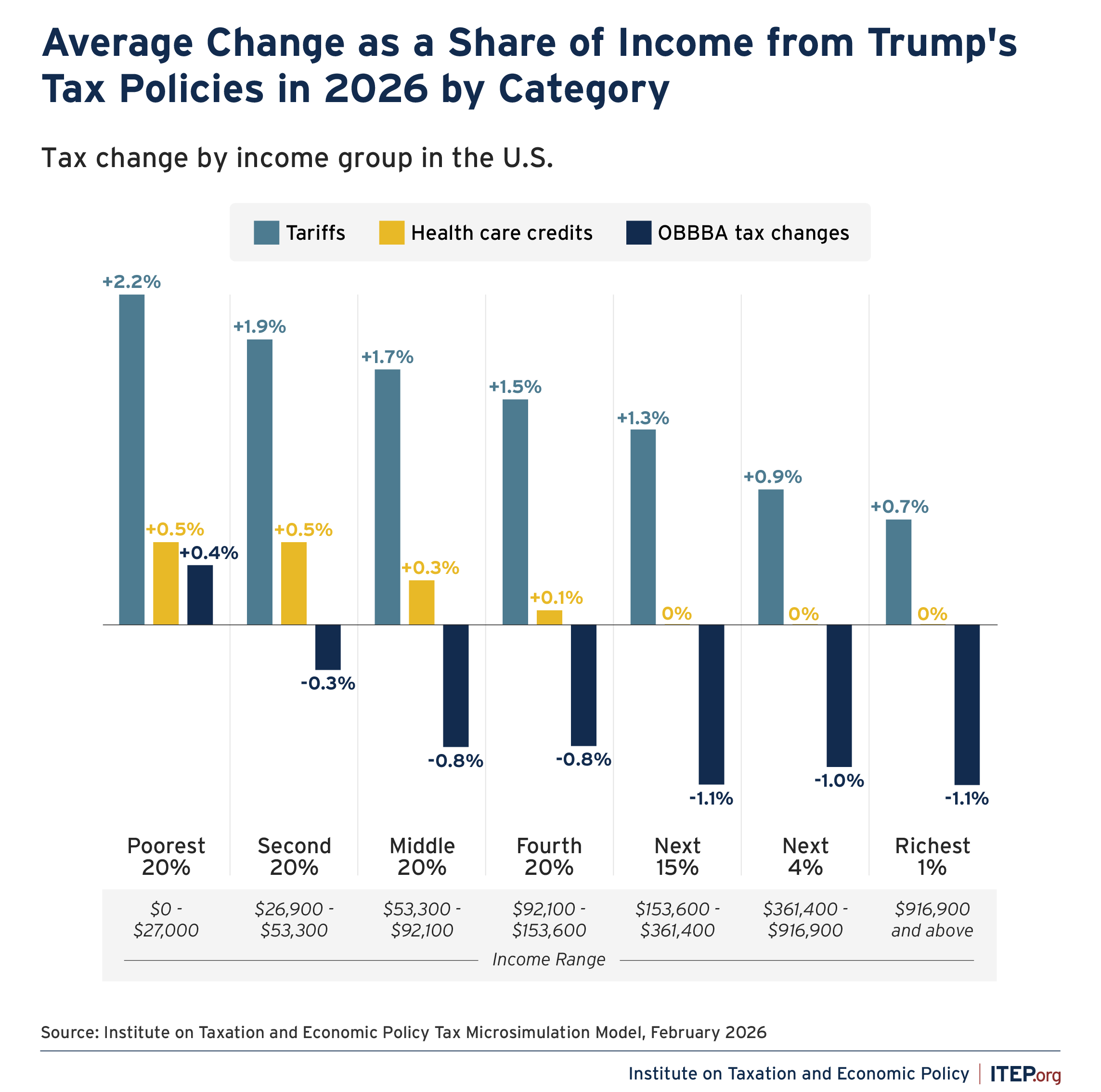
Taking all the policies of President Trump and the Republican majority in Congress into account, all but the richest Americans are paying higher taxes on average in 2026 than they did last year. These policies include:
- Dramatically increased tariffs on goods from abroad, a tax that economists widely agree is mostly borne by American consumers.
- The termination of the Enhanced Premium Tax Credit (EPTC), which had made health care more affordable for millions of people.
- The so-called One Big Beautiful Bill Act (OBBBA), which overwhelmingly benefits the rich and corporations.
The combined impact of these policies in 2026 is a tax increase for the average American in all income groups except the richest 5 percent. This is illustrated in Figure 1 below. The richest 1 percent, in particular, receive a noticeable tax cut compared to all other groups.
Figure 1
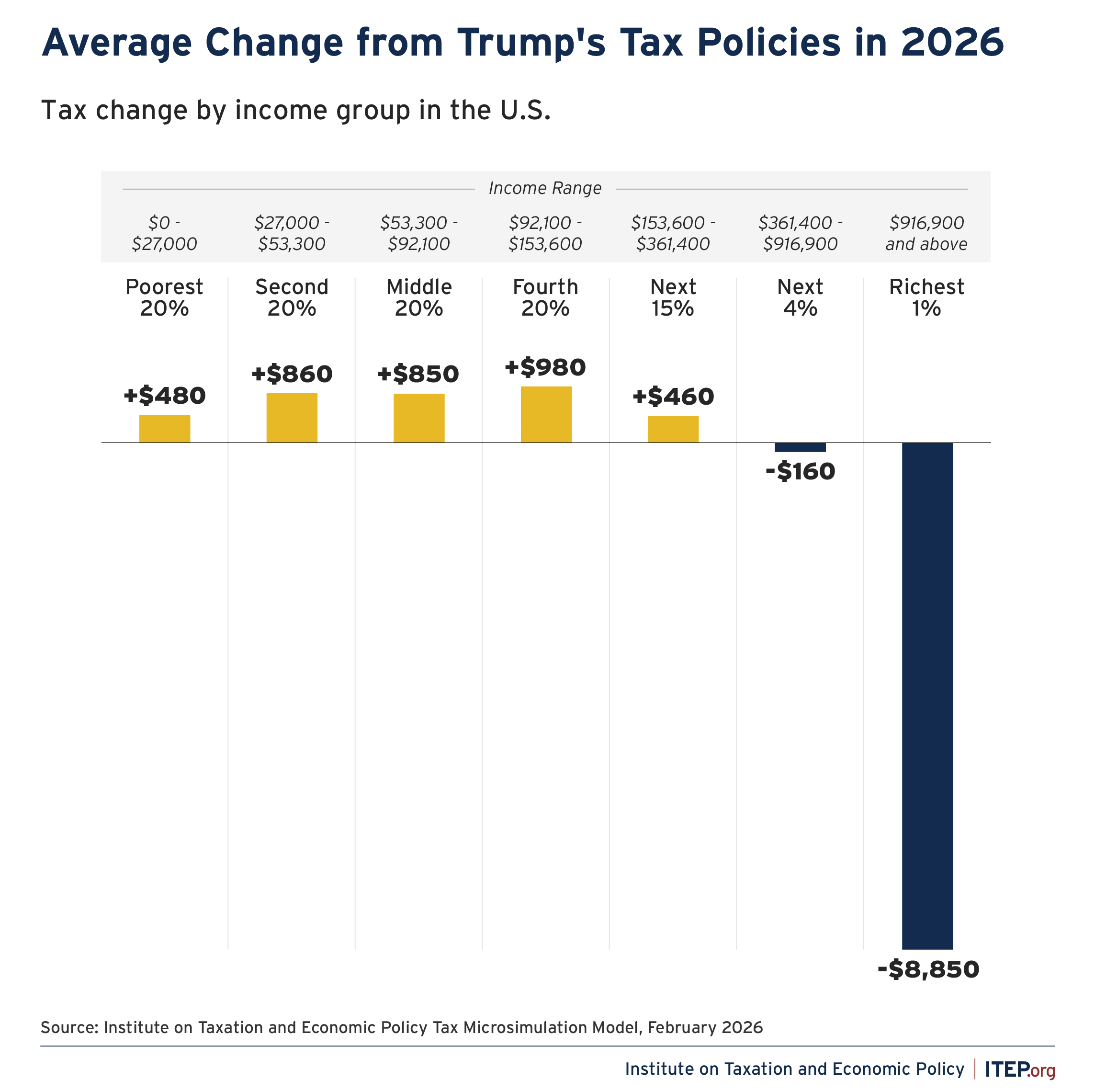
The figures illustrate tax changes resulting from these policies compared to what would have happened if Congress had simply extended all the tax policies that were in effect before Trump began his second term in office.
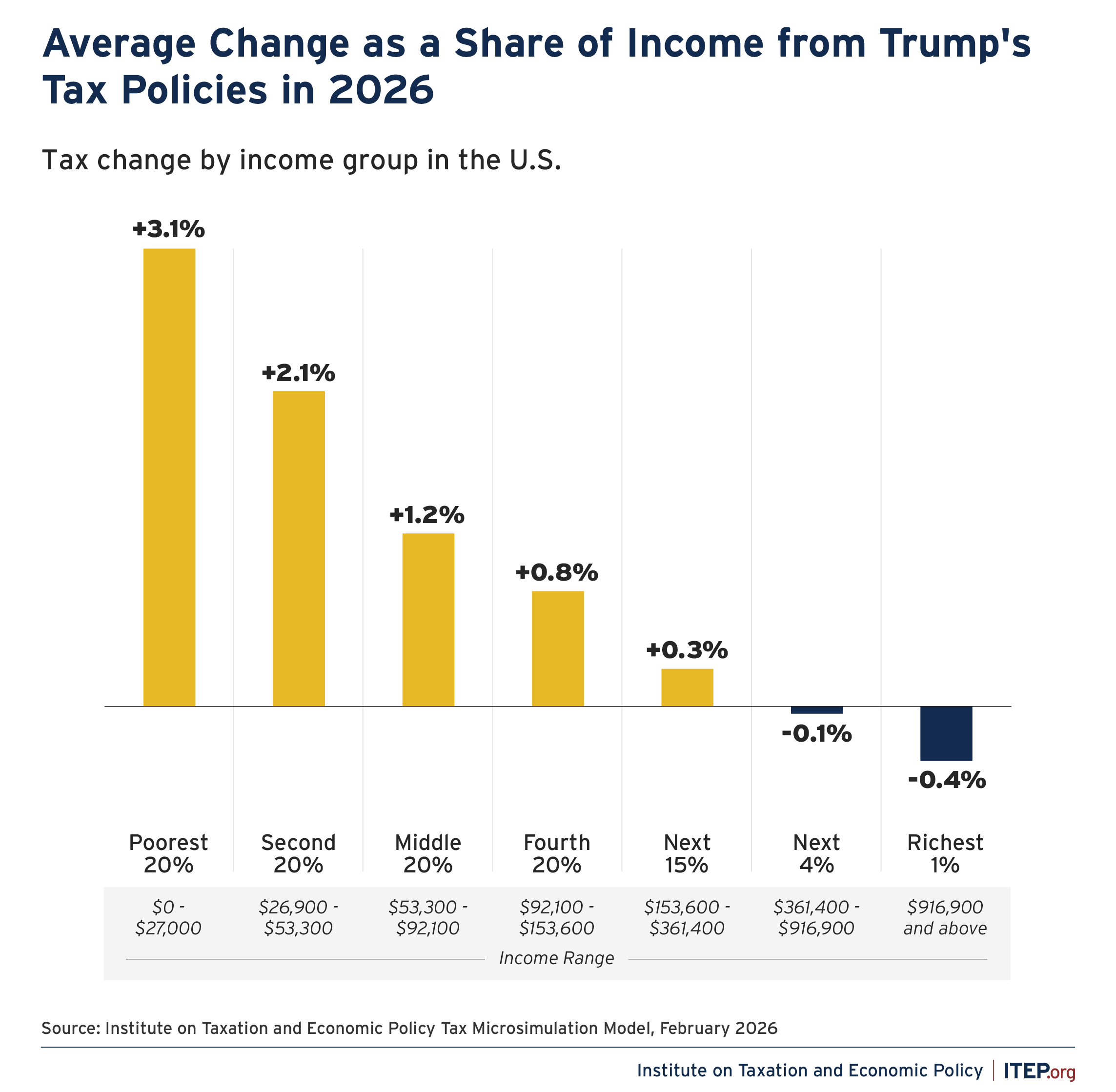
The more modest one’s income is, the more harmful these policies are, as illustrated in Figure 2. The resulting tax hike takes a larger bite of income from families lower on the income ladder.
Figure 2
For a large majority of Americans, the tax increase resulting from Trump’s tariffs, along with the ending of the health care tax credits, more than offsets any tax cuts provided by OBBBA. The exception is the richest 5 percent of Americans, particularly the richest 1 percent, for whom the net result is a tax cut on average. This is illustrated in Figure 3.
Figure 3
More Details About These Trump-GOP Policies
Tariffs
- Trump’s tariffs are the biggest tax increase on Americans (measured as a share of the economy) since 1982. In theory, tariffs could be a small part of a broader set of tools that are used surgically to address narrow problems in trade policy, but that is far from how the Trump administration is using tariffs.
- While President Trump claims that foreigners pay the tariffs, the claim is not taken seriously by any independent analysts. Even U.S. corporations admit Americans are paying them. In recent corporate disclosures, industry executives have publicly told investors they are protecting profits by passing the costs of tariffs on to consumers.
- The Trump administration has made clear that it will impose tariffs that are essentially the same as those struck down by the Supreme Court. It will do so under different statutes that provide clearer authority to the president and which are far less likely to be questioned by the courts. While this may be more burdensome and time-consuming for administration officials, the ultimate effect will be tariffs as significant as those overturned.
Expiration of Enhanced Premium Tax Credit (EPTC)
- The EPTC was an expanded version of an existing tax credit that helps individuals pay premiums on health insurance they obtain through the Affordable Care Marketplace. The EPTC was signed into law by President Biden 2021 and the next year it was extended through 2025.
- As a result of the EPTC’s expiration, millions of working people face higher taxes and an estimated 4 million will go uninsured. This is the result a choice made by President Trump and Congressional Republicans to end the EPTC.
The One Big Beautiful Bill Act (OBBBA)
- Including the law’s extensions of tax provisions enacted under Trump in 2017, OBBBA will provide $1 trillion in tax cuts for the richest 1 percent over a decade while cutting Medicaid by almost as much over the same period. Overall, the law cuts taxes mainly for the richest Americans and corporations and cuts spending for working people.
- President Trump and Republicans describe OBBBA’s tax breaks for tips, overtime, car loan interest, and seniors as boons for the middle-class but these parts of OBBBA combined only make up about a tenth of its net tax cuts in 2026.
- Several corporations are already reporting that they paid little or nothing in taxes last year, largely because of tax cuts provided by OBBBA. Four of the corporations whose CEOs flanked President Trump at his January 2025 inauguration ceremony (Amazon, Alphabet, Meta and Tesla) have now disclosed that they collectively received $51 billion in federal tax breaks in 2025 and consequently paid an effective tax rate of just 4.9 percent. Other companies are reporting zero-tax years (or close to it) nearly every day as their annual disclosures come out.
President Trump Has Particularly Focused on Helping Corporations with Tax Cuts that Provide No Benefit to Regular Americans
- The tax laws enacted by Trump have not made Americans businesses more competitive; they have simply cut their taxes. In 2017, Trump and his Congressional allies argued that the tax code put American corporations at a competitive disadvantage that could only be resolved with tax cuts. This was not true. Prior to enactment of the first Trump tax law in 2017, U.S. corporations already had a massive competitive advantage in the global economy. That advantage remains virtually unchanged today.
- Tax laws enacted by Trump did not address the problem of American corporations moving offshore. American corporations have not used maneuvers to recharacterize themselves as “foreign” companies after the 2017 law was enacted largely because that law simply gave multinational corporations everything they wanted in terms of tax cuts so that they no longer had the incentive to escape the U.S. tax system in the same way.
The Trump Administration Is Now Breaking the Law to Provide Unfair Tax Cuts Beyond What Is Included In This Analysis
- The Trump administration is unilaterally cutting corporate taxes for billion-dollar corporations. The Treasury Department is issuing regulations that ignore the statutes they claim to implement, directly violating the Constitutional requirement that tax law is made by Congress and not by the President alone.
- Most recently, the Treasury Department issued regulations inventing an exception to a 2022 law that limits corporate tax breaks after Meta reported that it would reduce benefits the company expected from OBBBA by about $16 billion.