As states prepare to enter a new fiscal year, their finances are at risk. The federal government is slashing aid for state-provided services like Medicaid and food assistance. Meanwhile, there’s a lot of uncertainty in the forecast for states’ own tax revenues. Many states must either find new revenue or else make cuts to schools, healthcare, and other services that will undermine communities’ ability to thrive.
A good strategy is for states to eliminate unwarranted tax breaks. Helpfully, a new ITEP paper provides one specific good idea: tax advertising.
Most states exempt advertising from their sales taxes. This policy made some sense in the past when it was supporting local newspapers and TV stations. Today, though, it mostly means sending billions of dollars to Alphabet, Meta, and Amazon. If states ended that exemption, they could collectively raise between $16 billion and $27 billion a year, depending on how broadly they define the tax base.
An advertising tax offers a way to raise significant money from a sector of the economy that has been getting a free ride for decades.
The Numbers Are Big
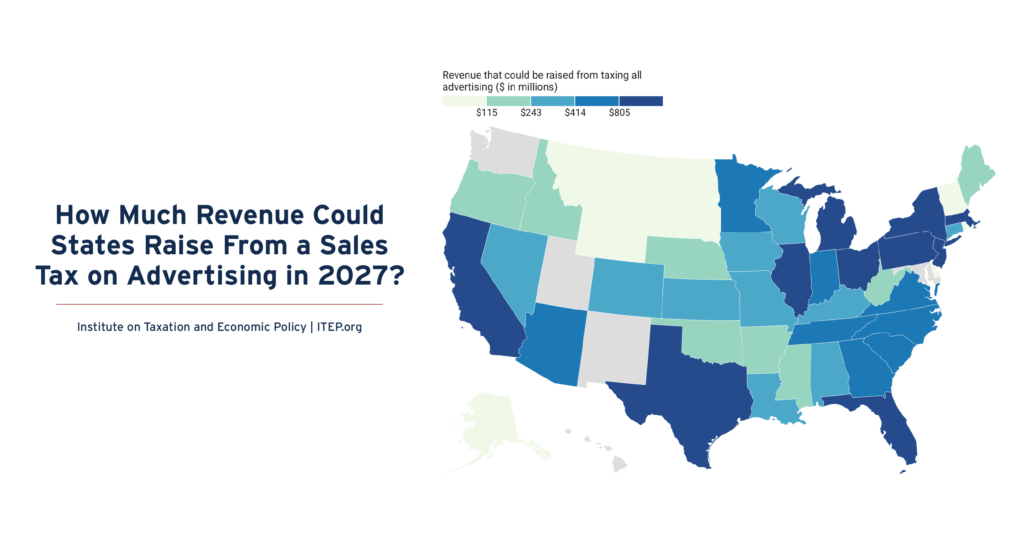
The revenue potential varies considerably by state, for the obvious reason that bigger states have more advertising activity. California could raise $4.8 billion a year from a broad-based advertising tax at its current sales tax rate. Texas could raise $2.7 billion and Florida, $2.3 billion. But even smaller states would see meaningful revenue: Virginia could raise $579 million, and Connecticut $390 million.
Those estimates are based on taxing all advertising. Alternatively, states could more narrowly tax just programmatic and search advertising, the auction-based, data-driven ads that dominate the market today. This would still raise $15.6 billion a year collectively across states not already taxing advertising.
States could also choose to tax only the biggest platforms. Collections from Meta, Alphabet, and Amazon could yield over $13 billion a year nationally.
Click here to see how much each state could raise from each version of the tax.
Other States Are Already Doing This
As our new paper explains, some states are already collecting such taxes.
Hawaiʻi and New Mexico have taxed advertising for decades under their broad-based sales taxes, without controversy. Maryland enacted a standalone digital advertising tax in 2021 and has raised $418 million since then. Washington extended its sales tax to advertising in 2025 and expects to collect over $600 million annually. Utah enacted a targeted advertising tax earlier this year. Other states, like Illinois and Minnesota, are moving in this direction too.
The Case for Acting Now
States have long exempted advertising from sales taxes. But those exemptions date to an era when most advertising meant a local car dealer buying a spot on the evening news.
Today, over half of all U.S. advertising dollars flow through just three large platforms, mostly in the form of targeted, programmatic advertising based on users’ personal data. The exemption that once made sense as support for local media now functions as a massive subsidy to some of the wealthiest corporations in the world.
At the same time, most states that tax paid streaming subscriptions don’t tax the advertising that lets someone access similar content for free. So in many places, Netflix collects sales tax, while TikTok doesn’t. Consumers that pay cash for YouTube subscriptions pay sales tax, but those that use the ad-supported version don’t. That inconsistency is hard to defend.
Instead of cutting public services like healthcare and education, states facing budget pressures should consider ending this decades-old giveaway to the biggest players in the information economy.