
2,364 posts
New Jersey Policy Perspective: Reforming New Jersey’s Income Tax Would Help Build Shared Prosperity
• By ITEP Staff
These reforms would also make New Jersey’s tax system more equitable, but it would not undo the tax code’s upside-down nature, in which low-income and middle-class New Jerseyans pay greater shares of their incomes to state and local taxes than wealthy residents. With these changes, this inequity would be slightly evened out. The share paid by the top 1 percent would rise to 7.7 percent from 7.1 percent, but that would still be lower than…

Reducing the Cost of Child Care Through State Tax Codes in 2017
• By ITEP Staff
Low- and middle-income working parents spend a significant portion of their income on child care. As the number of parents working outside of the home continues to rise, child care expenses have become an unavoidable and increasingly unaffordable expense. This policy brief examines state tax policy tools that can be used to make child care more affordable: a dependent care tax credit modeled after the federal program and a deduction for child care expenses.

Property Tax Circuit Breakers in 2017
• By ITEP Staff
State lawmakers seeking to make residential property taxes more affordable have two broad options: across-the-board tax cuts for taxpayers at all income levels, such as a homestead exemption or a tax cap, and targeted tax breaks that are given only to particular groups of low- and middle-income taxpayers. One such targeted program to reduce property taxes is called a “circuit breaker” because it protects taxpayers from a property tax “overload” just like an electric circuit…

Options for a Less Regressive Sales Tax in 2017
• By ITEP Staff
Sales taxes are one of the most important revenue sources for state and local governments; however, they are also among the most unfair taxes, falling more heavily on low- and middle-income households. Therefore, it is important that policymakers nationwide find ways to make sales taxes more equitable while preserving this important source of funding for public services. This policy brief discusses two approaches to a less regressive sales tax: broad-based exemptions and targeted sales tax…
Rewarding Work Through State Earned Income Tax Credits in 2017
• By ITEP Staff
The Earned Income Tax Credit (EITC) is a policy designed to bolster the earnings of low-wage workers and offset some of the taxes they pay, providing the opportunity for struggling families to step up and out of poverty toward meaningful economic security. The federal EITC has kept millions of Americans out of poverty since its enactment in the mid-1970s. Over the past several decades, the effectiveness of the EITC has been magnified as many states…
Arkansas Advocates for Children and Families: The Trump Tax Plan: What Would It Mean for Arkansas?
• By ITEP Staff
Who benefits and who loses under the Trump tax plan? An analysis by the Institute on Taxation and Economic Policy (ITEP) estimates that Arkansas would fare worse under the plan compared to other states. Relative to our share of the U.S. population, we would be one of the 12 states receiving the lowest share of the total Trump tax cut.
New Mexico Voices for Children: The Trump Tax Plan Isn’t ‘Reform.’ Here’s Why:
• By ITEP Staff
In April the Trump administration released a sketchy outline of their half-baked ideas for tax changes. An analysis by the Washington, D.C.-based Institute for Taxation and Economic Policy (ITEP) of that back-of-the-envelope ‘plan’ found that nearly half (48 percent) of Trump’s proposed tax cuts would go to millionaires. Millionaires make up only 0.5 percent of the U.S. population.
New Mexico Voices for Children: Trump Tax Plan Does Little for NM’s Middle Class
• By ITEP Staff
Average New Mexicans would not benefit much from President Trump’s tax reform proposal, which would give the biggest tax breaks to New Mexico’s millionaires. That’s according to a report released recently by the Institute on Taxation and Economic Policy (ITEP).
Maryland Center on Economic Policy: Trump Tax Framework Would Give Away Trillions in Tax Breaks to Millionaires
• By ITEP Staff
The Trump administration and congressional leaders are gearing up to overhaul the federal tax code this fall. While many of the details remain fuzzy, one thing is clear: the administration’s top priority is to hand out big tax breaks to millionaires.
Budget and Tax Center: Costly Tax Cuts in New State Budget Continue Precarious Road Ahead for North Carolina
• By ITEP Staff
The new two-year state budget passed by lawmakers included another package of tax cuts that will further limit the amount of revenue available for public investments. The latest tax cuts will reduce annual available revenue by $900 million and, when combined with tax cuts passed since 2013, result in an estimated $3.5 billion in less annual revenue compared to the tax system that was in place prior to tax changes in 2013.
Maine Center for Economic Policy: Maine Millionaires Primary Recipients of Proposed Trump Tax Breaks
• By ITEP Staff
New analysis from the Institute on Taxation and Economic Policy (ITEP) shows Maine’s millionaires would get an average tax cut of $135,220 under President Trump’s proposed tax plan. Maine millionaires represent only 0.3 percent of all Maine households, yet would receive more than a quarter of all tax breaks.
Indiana Institute for Working Families: Trump Tax Plan Would Shortchange Indiana, Middle Class & Working Families (But Would Let Them Eat Cake)
• By ITEP Staff
A new analysis of the Trump tax plan from the Institute for Taxation and Economic Policy shows that Indiana would only get an 87% share of tax cuts relative to the state’s ratio of the U.S. population. This is the 23rd-smallest share among states. In part because the plan is aimed at high-income households and Indiana is a poorer state, no matter how you slice it, Indiana gets shortchanged compared to the average state by…
Sound Tax Policy Made a Comeback in 2017
• By ITEP Staff
2017 marked a sea change in state tax policy and a stark departure from the current federal tax debate as dubious supply-side economic theories began to lose their grip on statehouses. Compared to the predominant trend in recent years of emphasizing top-heavy income tax cuts and shifting to more regressive consumption taxes in the hopes […]
Rewarding Work Through State Earned Income Tax Credits
• By Aidan Davis
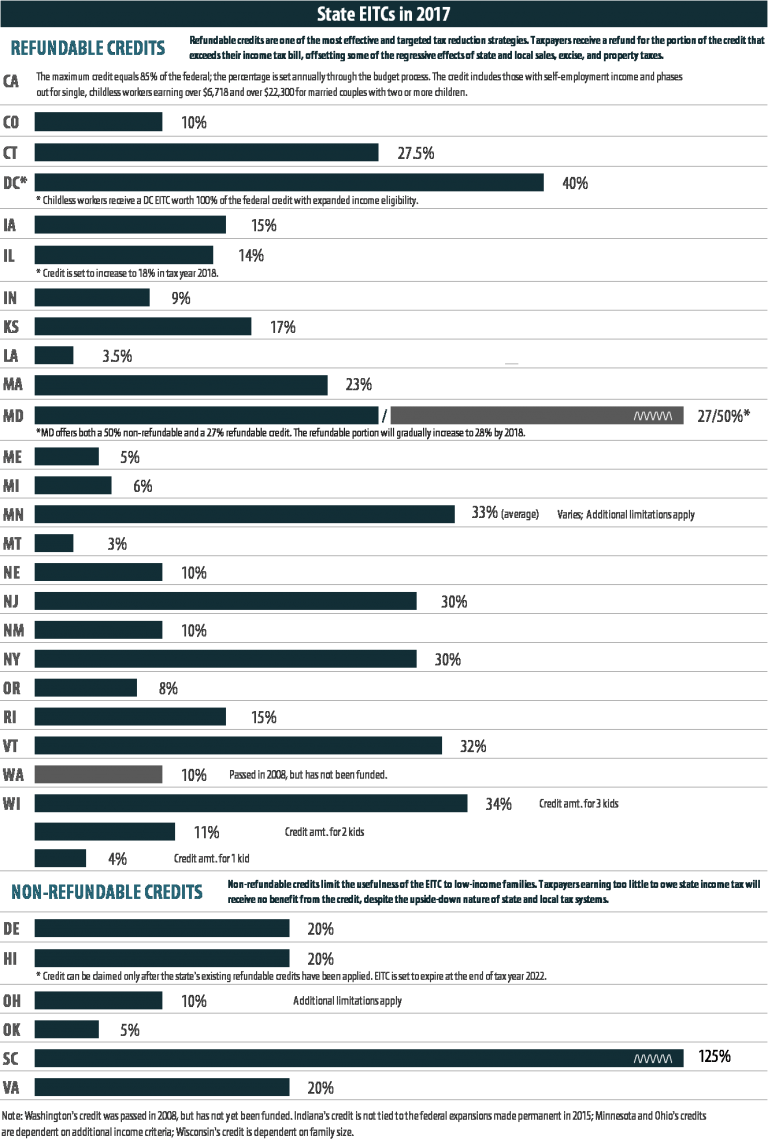
The Earned Income Tax Credit (EITC) is a policy designed to bolster the earnings of low-wage workers and offset some of the taxes they pay, providing the opportunity for struggling families to step up and out of poverty toward meaningful economic security. The federal EITC has kept millions of Americans out of poverty since its enactment in the mid-1970s. Over the past several decades, the effectiveness of the EITC has been magnified as many states…
Florida Policy Institute: The Growing Divide: Federal Tax Plan Would Give Massive Tax Cuts to Wealthy Floridians as the Poorest Americans Continue to Struggle
• By ITEP Staff
The federal tax plan broadly outlined by the current administration would do very little to create opportunities for Floridians struggling to make ends meet. Instead, the tax plan would provide massive tax cuts for Florida’s highest income earners, accordingly to a recent report by the Institute on Taxation and Economic Policy (ITEP). Broadly outlined, the plan is likely to make an already unfair tax system that favors the wealthy even worse.
New Jersey Policy Perspectives: Trump Tax Plan: A Boon for the Wealthiest New Jerseyans
• By ITEP Staff
A federal tax package based on President Trump’s April outline would fail to deliver on its promise of mostly helping the middle class, instead showering most of its help to the richest 1 percent, according to a new 50-state analysis from the Institute on Taxation and Economic Policy released today.

Hope Policy Institute: Mississippi’s Wealthiest Get the Most Benefit under New Federal Tax Cut Proposal
• By ITEP Staff
New research from the Institute on Taxation and Economic Policy (ITEP) looks at the potential effects of a tax cut proposal from the Trump Administration on families in the 50 states. The tax cut proposal would reduce the tax rate on corporate income from 35 percent to 15 percent, would repeal the estate tax, replace the current income tax brackets with three brackets at 10 percent, 25 percent, and 35 percent, eliminate most itemized deductions,…

Kentucky Center for Economic Policy: Trump Tax Plan Would Be a Windfall for Only the Wealthiest Kentuckians
• By ITEP Staff
The wealthiest Kentuckians would be winners from the $4.8 trillion in federal tax cuts President Donald Trump has proposed, as shown by a new report from the Institute on Taxation and Economic Policy (ITEP). But as a poor state the tax cuts — coupled as they are with huge federal budget cuts to programs and […]
West Virginia Center on Budget & Policy: New Report Shows Trump Tax Plan Benefits Wealthy, Fails to Help Middle Class
• By ITEP Staff
A new analysis from the Institute on Taxation and Economic Policy reveals a federal tax reform plan based on President Trump’s April outline would fail to deliver on its promise of largely helping middle-class taxpayers, showering 61.4 percent of the total tax cut on the richest 1 percent nationwide. In West Virginia, the top 1 percent of the state’s residents would receive an average tax cut of $51,600 compared with an average tax cut of $720 for…
Economic Progress Institute: Trump Tax Plan Would Mostly Benefit Wealthiest Rhode Island Taxpayers
• By ITEP Staff
A new analysis from the Institute on Taxation and Economic Policy reveals a federal tax reform plan based on President Trump’s April outline would fail to deliver on its promise of largely helping middle-class taxpayers, showering 61.4 percent of the total tax cut on the richest 1 percent nationwide. In Rhode Island, the top 1 percent of the state’s residents would receive an average tax cut of $86,610 compared with an average tax cut of…
Maine Center for Economic Policy: Trump Tax Plan Would Give Richest Maine Taxpayers an Average $53,000 Tax Cut and Trigger Deep Cuts to Federal Dollars for Maine
• By ITEP Staff
A new analysis from the Institute on Taxation and Economic Policy reveals a federal tax reform plan based on President Trump’s April outline would fail to deliver on its promise of helping middle-class taxpayers, showering three out of every five dollars of the total tax cut on the richest 1 percent nationwide. In Maine, the top 1 percent of the state’s residents would receive an average tax cut of $53,000 compared with an average tax cut of $400 for the bottom 60 percent of taxpayers in the state.
Trump Tax Proposals Would Provide Richest One Percent in Nebraska with 52.6 Percent of the State’s Tax Cuts
• By ITEP Staff
Earlier this year, the Trump administration released some broadly outlined proposals to overhaul the federal tax code. Households in Nebraska would not benefit equally from these proposals. The richest one percent of the state’s taxpayers are projected to make an average income of $1,572,200 in 2018. They would receive 52.6 percent of the tax cuts that go to Nebraska’s residents and would enjoy an average cut of $128,300 in 2018 alone.
Trump Tax Proposals Would Provide Richest One Percent in North Carolina with 46.5 Percent of the State’s Tax Cuts
• By ITEP Staff
Earlier this year, the Trump administration released some broadly outlined proposals to overhaul the federal tax code. Households in North Carolina would not benefit equally from these proposals. The richest one percent of the state’s taxpayers are projected to make an average income of $1,541,500 in 2018. They would receive 46.5 percent of the tax cuts that go to North Carolina’s residents and would enjoy an average cut of $78,880 in 2018 alone.
Trump Tax Proposals Would Provide Richest One Percent in Vermont with 39.1 Percent of the State’s Tax Cuts
• By ITEP Staff
Earlier this year, the Trump administration released some broadly outlined proposals to overhaul the federal tax code. Households in Vermont would not benefit equally from these proposals. The richest one percent of the state’s taxpayers are projected to make an average income of $1,192,800 in 2018.
Trump Tax Proposals Would Provide Richest One Percent in New Hampshire with 41.3 Percent of the State’s Tax Cuts
• By ITEP Staff
Earlier this year, the Trump administration released some broadly outlined proposals to overhaul the federal tax code. Households in New Hampshire would not benefit equally from these proposals. The richest one percent of the state’s taxpayers are projected to make an average income of $1,668,100 in 2018. They would receive 41.3 percent of the tax cuts that go to New Hampshire’s residents and would enjoy an average cut of $98,940 in 2018 alone.

Institute on Taxation
and Economic Policy
ITEP is a non-profit, non-partisan tax policy organization. We conduct rigorous analyses of tax and economic proposals and provide data-driven recommendations to shape equitable and sustainable tax systems.
Subscribe to ITEP Emails
Tax research and policy news in your inbox.
Promote Fair Tax Policy
Your gift to ITEP promotes tax justice. With your help, we do research that supports taxing millionaires and billionaires, taxing big corporations and raising revenue for the things our people, our communities and our planet need.
Together, we can create a country with more economic justice, more racial justice, more climate justice… and more tax justice.