
2,364 posts
Trump Tax Proposals Would Provide Richest One Percent in Minnesota with 50.8 Percent of the State’s Tax Cuts
• By ITEP Staff
Earlier this year, the Trump administration released some broadly outlined proposals to overhaul the federal tax code. Households in Minnesota would not benefit equally from these proposals. The richest one percent of the state’s taxpayers are projected to make an average income of $2,589,800 in 2018. They would receive 50.8 percent of the tax cuts that go to Minnesota’s residents and would enjoy an average cut of $120,420 in 2018 alone.

Trump Tax Proposals Would Provide Richest One Percent in Maryland with 69.7 Percent of the State’s Tax Cuts
• By ITEP Staff
Earlier this year, the Trump administration released some broadly outlined proposals to overhaul the federal tax code. Households in Maryland would not benefit equally from these proposals. The richest one percent of the state’s taxpayers are projected to make an average income of $1,802,700 in 2018. They would receive 69.7 percent of the tax cuts that go to Maryland’s residents and would enjoy an average cut of $123,720 in 2018 alone.
Trump Tax Proposals Would Provide Richest One Percent in Massachusetts with 63.2 Percent of the State’s Tax Cuts
• By ITEP Staff
Earlier this year, the Trump administration released some broadly outlined proposals to overhaul the federal tax code. Households in Massachusetts would not benefit equally from these proposals. The richest one percent of the state’s taxpayers are projected to make an average income of $3,010,300 in 2018. They would receive 63.2 percent of the tax cuts that go to Massachusetts’s residents and would enjoy an average cut of $215,670 in 2018 alone.
Trump Tax Proposals Would Provide Richest One Percent in New Mexico with 42 Percent of the State’s Tax Cuts
• By ITEP Staff
Earlier this year, the Trump administration released some broadly outlined proposals to overhaul the federal tax code. Households in New Mexico would not benefit equally from these proposals. The richest one percent of the state’s taxpayers are projected to make an average income of $1,264,600 in 2018. They would receive 42 percent of the tax cuts that go to New Mexico’s residents and would enjoy an average cut of $73,070 in 2018 alone.
Trump Tax Proposals Would Provide Richest One Percent in Kentucky with 42.8 Percent of the State’s Tax Cuts
• By ITEP Staff
Earlier this year, the Trump administration released some broadly outlined proposals to overhaul the federal tax code. Households in Kentucky would not benefit equally from these proposals. The richest one percent of the state’s taxpayers are projected to make an average income of $1,313,400 in 2018. They would receive 42.8 percent of the tax cuts that go to Kentucky’s residents and would enjoy an average cut of $68,550 in 2018 alone.
Maine Center for Economic Policy: What Happens When Those with the Most Pay the Least Taxes?
• By ITEP Staff
With the 3 percent surcharge repealed, the state’s tax code is out of balance. Those with the most are asked to pay the least. This means a middle-class family keeps 91 cents on average after state and local taxes for each dollar earned, versus 93 cents kept by the wealthiest in the state. This preferential tax treatment of wealthy Maine household also comes at a cost to roads, public health, and quality education that low…
Wisconsin Budget Project: Missing Out: Recent Tax Cuts Slanted in Favor of those with Highest Incomes
• By ITEP Staff
Since 2011, Wisconsin state lawmakers have made it a high priority to cut taxes, particularly personal income and property taxes. The tax cuts they have passed have disproportionately gone to Wisconsin residents with the highest incomes. Middle-class residents received less than the wealthy, and residents with low incomes received the smallest tax cut. Read more […]
Minnesota Budget Project: DACA recipients make important tax contributions to Minnesota
• By ITEP Staff
Minnesota’s Deferred Action for Childhood Arrival (DACA) recipients pay an estimated $15 million in state and local taxes, according to a report from the Institute on Taxation and Economic Policy (ITEP). They are contributing to our communities and our economy, and the report shows they would contribute even more if given the opportunity to apply […]
Failed Tax-Cut Experiment (in North Carolina) Will Continue Under Final Budget Agreement, Pushes Fiscal Reckoning Down the Line
• By ITEP Staff
The final budget agreement from leaders of the House and Senate puts North Carolina on precarious fiscal footing, The tax changes that leaders agreed to—which were less a compromise and more of a decision to combine the tax cuts in both chambers’ proposals—make the cost of these tax cuts bigger than what either chamber proposed. Including the new tax cuts,approximately 80 percent of the net tax cut since 2013 will have gone to the top…
Oregon Center for Public Policy: Reason to Hope for a Commercial Activities Tax (CAT) Accompanied by a CAT Fairness Credit
• By ITEP Staff
The CAT Fairness Credit would be a credit on personal income taxes based on family size and income. It would cost about the same as the combined impact of the personal income tax changes and EITC increase, and would target relief to low- and middle-income taxpayers.
Maine Center for Economic Policy: Senate Republican Vote Defies Will of Voters, Compromises Current and Future School Funding to Give Tax Cuts to Wealthy
• By ITEP Staff
According to the Institute on Taxation and Economic Policy, repealing the citizen approved surcharge would give a $16,300 tax break on average to the top 1% of Maine households and cost the state over $300 million in school funding over current and future biennia.
Oregon Center for Public Policy: Commercial Activities Tax Fairness Credit Would Strengthen the Tax Reform Package
• By ITEP Staff
Analysis by the Institute on Taxation and Economic Policy (ITEP) shows that, all else being equal, a tax reform package with a CAT Fairness Credit would be more progressive than a tax reform package with an income tax rate reduction.

A Better Wyoming: Guess Which Sparsely Populated Mineral Rich State is Getting an Income Tax…
• By ITEP Staff
Alaska stopped collecting income taxes 35 years ago, and Wyoming has never remotely considered implementing one in the 82 years since it decided instead to charge state and local sales taxes. The Institute on Taxation and Economic Policy (ITEP) discovered recently that nearly 82 percent of Alaskans could expect to pay less under a progressive income tax than they would under a sales tax designed to generate an identical level of revenue.
Kentucky Center for Economic Policy: Troubling Hints About Direction for Tax Reform
• By ITEP Staff
The corporate tax cuts described above mean profitable businesses chip in less for the public services that help them succeed. And the result of less reliance on income and inheritance taxes is clear (see graph below): those at the top in Tennessee and Indiana pay an even smaller share of their income in state and local taxes than the wealthiest Kentuckians do, and their lowest-income residents pay an even higher share than the poorest Kentuckians.
State Rundown 6/7: Kansas Success Story and Other State News
• By ITEP Staff
This week, we celebrate a victory in Kansas where lawmakers rolled back Brownback's tax cuts for the richest taxpayers. Governors in West Virginia and Alaska promote compromise tax plans. Texas heads into special session and Vermont faces another budget veto, while Louisiana and New Mexico are on the verge of wrapping up. Voters in Massachusetts may soon be able to weigh in on a millionaire's tax, the California Senate passed single-payer health care, and more!
A Better Wyoming: Everything You Know About Wyoming Taxes is Wrong
• By ITEP Staff
Wrong. According to the Institute on Taxation and Economic Policy (ITEP), a D.C. think tank that studies state tax policy, Wyoming’s wealthiest residents pay the lowest tax rate in the country. Meanwhile, people at the bottom 20 percent of Wyoming’s shaky economic ladder pay taxes at seven-times the rate that the top one percent of earners do. That’s the largest tax rate discrepancy between rich and poor in the United States.

Oklahoma’s Budget Signed by Governor, but Long-Run Challenges Remain
• By Aidan Davis
On the last day of their legislative session, Oklahoma lawmakers finalized a $6.8 billion budget bill that was later signed by Gov. Mary Fallin. In the governor's statement on the bill, she noted that state agencies will be hard hit by the agreement--"it leaves many agencies facing cuts for the sixth year in a row"--and that while it does include some recurring revenue, it does not address the state's long-run structural budget challenges.
The Cost Of Trickle-Down Economics For North Carolina
• By ITEP Staff
Since 2013, state lawmakers have passed significant income tax cuts that largely benefit the state’s highest income earners and profitable corporations. These costly tax cuts have made the state’s tax system more upside-down by delivering the greatest income tax cuts to the state’s highest income taxpayers, while maintaining a heavier tax load on low- and […]
Evidence Counts: Senate Tax Plan Punches More Holes Into Budget (Updated)
• By ITEP Staff
Similar to previous tax plans from the Senate, this plan increase taxes on most West Virginians while lowering them for higher-income residents. According to the Institute on Taxation and Economic Policy, the Senate tax plan increases taxes on 60 percent of West Virginia households while lowering taxes on the top 40 percent of households. This is because lower income West Virginians pay more in sales taxes than income taxes, while the opposite is true for…
New Hampshire Fiscal Policy Institute: Revenue in Review: An Overview of New Hampshire’s Tax System and Major Revenue Sources
• By ITEP Staff
New Hampshire’s revenue system is relatively unique in the United States, as it lacks broad-based income and sales taxes and instead relies on a diversity of more narrowly-based taxes, fees, and other revenue sources to fund public services. This system presents both advantages and disadvantages to stable, adequate, and sustainable revenue generation.
Kentucky Center for Economic Policy: Any Way You Slice It, A Shift To Consumption Taxes Will Hurt Kentucky
• By ITEP Staff
According to ITEP, replacing all of Kentucky’s income tax revenue with sales tax revenue would require an increase in our sales tax rate to 13.3 percent – more than double the current 6 percent rate and by far the highest state sales tax rate in the country (next highest is California at 7.5 percent). But […]
Florida Policy Institute: New Report Finds Shortcomings in Florida’s Scholarship Tax Credit Program
• By ITEP Staff
State tax policies are undermining high-quality public education by redirecting public dollars for K-12 education toward private schools via tuition tax credits, according to a new report published by the Institute of Taxation and Economic Policy (ITEP) and the School Superintendents Association (AASA). In the case of Florida, the scholarship tax credit program failed to […]

Investors and Corporations Would Profit from a Federal Private School Voucher Tax Credit
• By Carl Davis
A new report by the Institute on Taxation and Economic Policy (ITEP) and AASA, the School Superintendents Association, details how tax subsidies that funnel money toward private schools are being used as profitable tax shelters by high-income taxpayers. By exploiting interactions between federal and state tax law, high-income taxpayers in nine states are currently able […]
Public Loss Private Gain: How School Voucher Tax Shelters Undermine Public Education
• By Carl Davis, Sasha Pudelski
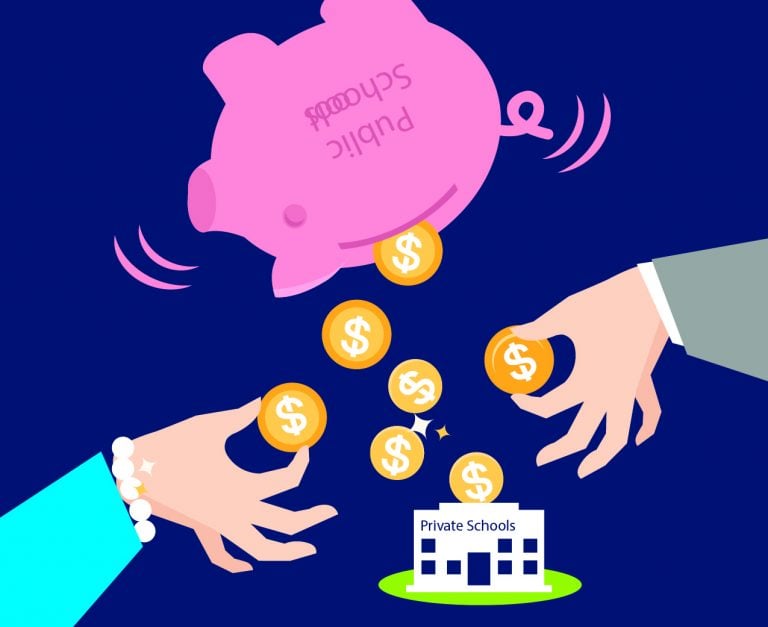
One of the most important functions of government is to maintain a high-quality public education system. In many states, however, this objective is being undermined by tax policies that redirect public dollars for K-12 education toward private schools.
West Virginia Metro News: West Virginia Has Miserable Company When It Comes to Budget Troubles
May 14, 2017
If there’s a bright side to West Virginia’s state budget troubles — in a misery-loves-company kind of way — it’s that plenty of other states have been having trouble too. “West Virginia is not unique this year or even in recent years in taking a little longer than usual to agree on a budget, largely […]

Institute on Taxation
and Economic Policy
ITEP is a non-profit, non-partisan tax policy organization. We conduct rigorous analyses of tax and economic proposals and provide data-driven recommendations to shape equitable and sustainable tax systems.
Subscribe to ITEP Emails
Tax research and policy news in your inbox.
Promote Fair Tax Policy
Your gift to ITEP promotes tax justice. With your help, we do research that supports taxing millionaires and billionaires, taxing big corporations and raising revenue for the things our people, our communities and our planet need.
Together, we can create a country with more economic justice, more racial justice, more climate justice… and more tax justice.