
Blog
138 posts
State Rundown 4/1: No Fooling Around Anymore in Washington, But Cruel Pranks in South Carolina
April 1, 2026 • By ITEP Staff
In Washington, Gov. Bob Ferguson and lawmakers decided to stop fooling around with one of the nation’s most upside-down tax codes and finally brought to life a new millionaires’ tax, the first new income tax created in a state since 1991.
State Rundown 3/18: New Mexico Enacts Most Significant Corporate Tax Reform of the Year
March 18, 2026 • By ITEP Staff
As states lawmakers continue to weigh their linkages to the federal tax code in light of the recent federal tax law, New Mexico provides a blueprint for limiting multinational corporate tax avoidance.
State Rundown 3/12: Washington Lawmakers Pass Millionaires’ Tax, Expand Working Families Tax Credit
March 12, 2026 • By ITEP Staff
Washington is on its way to making history after the legislature approved the “millionaires’ tax,” a 9.9 percent tax on income over $1 million. The bill, which is expected to raise more than $3 billion a year, making significant investments in public education and childcare, will also expand the Working Families Tax Credit – the […]
As many state legislative sessions near or cross the halfway point, lawmakers are facing tough choices.
State Rundown 2/19: Necktie (NCTI) Offers a Way Out of a Knotty Situation
February 19, 2026 • By ITEP Staff
State lawmakers are grappling with a range of challenges as their fiscal outlooks deteriorate, federal tax enforcement wanes (after the Trump administration cut the IRS workforce by 25 percent), and a rewritten federal tax code sends states scrambling to decide what changes they might want to make in their own codes.
State Rundown 2/11: This Valentine’s Day, Conscious Decoupling Is Our Love Language
February 11, 2026 • By ITEP Staff
While some may be excited for a romantic Valentine’s Day this weekend, many state lawmakers are breaking up and decoupling from recent federal tax changes that are poised to leave states with revenue shortfalls – much like a bad date who forgets their wallet and asks you to pick up the tab.
Despite wintry conditions across much of the country, that hasn’t stopped state lawmakers from debating major tax policy changes.
As state legislative sessions ramp up across the country, property taxes are one of many issues dominating tax policy conversations in statehouses.
Local Governments Are Increasingly Strapped: 2026 Will Bring New Challenges and New Opportunities
January 21, 2026 • By Kamolika Das

2025 saw an intensification of state and local tax fights across the country, as well as growing experimentation with local-option taxes, levies, fees, and tourism taxes aimed at keeping budgets afloat while also navigating political constraints imposed by state legislatures.
State Rundown 1/14: New Year Brings New Resolutions for Funding Key Priorities
January 14, 2026 • By ITEP Staff
State governors are beginning to lay out their top priorities as legislatures reconvene in statehouses around the country.
State Rundown 12/17: Tax Policy ‘Naughty or Nice’ List Has Late Entrants
December 17, 2025 • By ITEP Staff
With a little over a week left, some states are solidifying their spots on the tax policy “naughty or nice” list.
State Rundown 11/24: States Say ‘No Thank You’ to Federal Tax Cuts Reducing State Revenue
November 24, 2025 • By ITEP Staff
Lawmakers in two more states have wisely said “no thank you” to federal tax cuts that would have flowed through to their state tax codes and undermined funding for their priorities
Despite being an off-year election, voters made a call for shared public investments at the polls.
States across the nation are debating how best to respond to costly new federal tax cuts.
State Rundown 9/18: Lawmakers Confront Revenue Loss from Federal Policy Changes
September 18, 2025 • By ITEP Staff
Some states are trying to avoid revenue loss while others are welcoming it and doubling down.
The Trump Megabill Hands the Rich a Gift — and Sends the Bill to Young Americans
August 21, 2025 • By Angie Sumo

Trump's megabill directs most benefits to the wealthy, while leaving younger generations with higher taxes, more debt, and fewer opportunities. For Millennials and Gen Z, it means reduced public investment and an economy less likely to work in their favor.
State Tax Action in 2025: Amid Uncertainty, Tax Cuts and New Revenue
July 28, 2025 • By Aidan Davis, Neva Butkus, Marco Guzman

Federal policy choices on tariffs, taxes, and spending cuts will be deeply felt by all states, which will have less money available to fund key priorities. This year some states raised revenue to ensure that their coffers were well-funded, some proceeded with warranted caution, and many others passed large regressive tax cuts that pile on to the massive tax cuts the wealthiest just received under the federal megabill.

Refundable tax credits were a big part of state tax policy conversations this year. In 2025, nine states improved or created Child Tax Credits or Earned Income Tax Credits.
How Much Would Every Family in Every State Get if the Megabill’s Tax Cuts Given to the Rich Had Instead Been Evenly Divided?
July 14, 2025 • By Michael Ettlinger
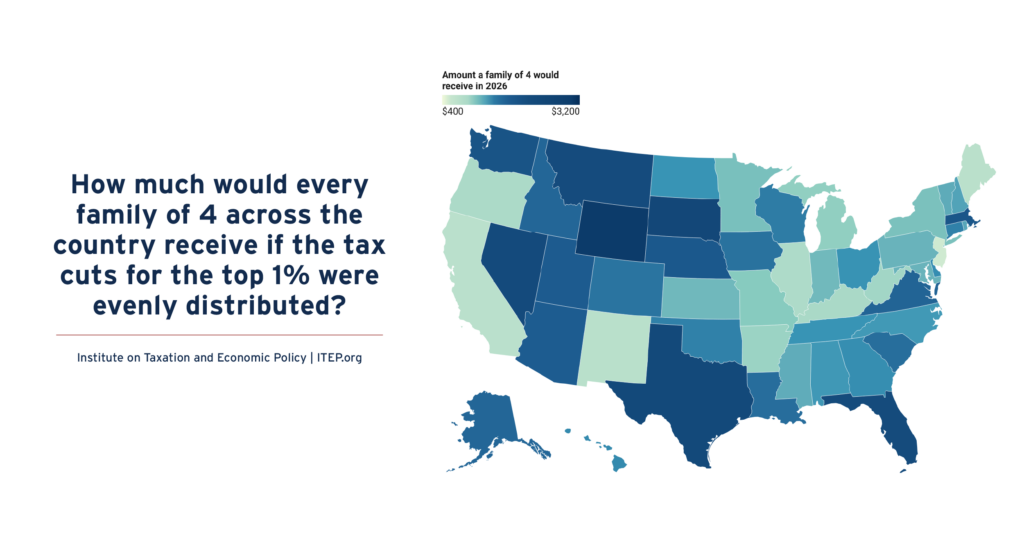
If instead of giving $117 billion to the richest 1 percent, that money had been evenly divided among all Americans, we'd each get $343 - or nearly $1,400 for a family of four.

As federal aid ends and economic uncertainty grows, local governments face tough budget choices. Now is the time for localities to protect vulnerable residents and build stronger, more equitable fiscal foundations.
Trump Megabill Will Give $117 Billion in Tax Cuts to the Top 1% in 2026. How Much In Your State?
June 30, 2025 • By Michael Ettlinger

The predominant feature of the tax and spending bill working its way through Congress is a massive tax cut for the richest 1 percent — a $114 billion benefit to the wealthiest people in the country in 2026 alone.
How Much Do the Top 1% in Each State Get from the Trump Megabill?
June 30, 2025 • By Carl Davis

The Senate tax bill under debate right now would bring very large tax cuts to very high-income people. In total, the richest 1 percent would receive $114 billion in tax cuts next year alone. That would amount to nearly $61,000 for each of these affluent households.
IRS Cooperation with ICE Will Damage Public Trust, Putting Tax Revenues in Jeopardy
April 10, 2025 • By Marco Guzman

Attempts by the Department of Homeland Security to secure private information from the IRS on people who file taxes with an Individual Taxpayer Identification Number is a violation of federal privacy laws that protect taxpayers. It is also a change that could seriously damage public trust in the IRS, which could jeopardize billions of dollars in tax payments by hardworking immigrant families.
Residents and state lawmakers across the country are pushing back against anti-tax measures and are looking for ways to protect revenue and advance proposals that would raise revenue in progressive ways. This comes at a time when federal policy brings significant risks for state tax revenue.
State Rundown 4/3: Amidst Tariff Uncertainty, State Lawmakers Talk Taxes
April 3, 2025 • By ITEP Staff
While all eyes are on the Trump administration’s tariffs on foreign imports, state lawmakers are moving forward with a mix of deep, regressive tax cuts and progressive revenue raisers.
Blog Categories

Institute on Taxation
and Economic Policy
ITEP is a non-profit, non-partisan tax policy organization. We conduct rigorous analyses of tax and economic proposals and provide data-driven recommendations to shape equitable and sustainable tax systems.
Subscribe to ITEP Emails
Tax research and policy news in your inbox.
Promote Fair Tax Policy
Your gift to ITEP promotes tax justice. With your help, we do research that supports taxing millionaires and billionaires, taxing big corporations and raising revenue for the things our people, our communities and our planet need.
Together, we can create a country with more economic justice, more racial justice, more climate justice… and more tax justice.