
Publications

State Earned Income Tax Credits Will Support Families and Workers in 2027
• By Neva Butkus
Nearly two-thirds of states (plus the District of Columbia and Puerto Rico) have an Earned Income Tax Credit. These credits boost low-paid workers’ incomes and offset some of the taxes they pay, helping working class families achieve greater economic security.

The Impact of Proposed New Tax Credit Restrictions for Immigrant Filers: An Updated Analysis of the DACA Recipient Population
• By Carl Davis, Erika Frankel, Emma Sifre
New Treasury Department public regulations would drastically reduce tax credit claims by DACA recipients and their families, among others. We find that 158,000 people in households with at least one DACA recipient will suffer financial harm, and that more than half of the impacted individuals are U.S. citizens.
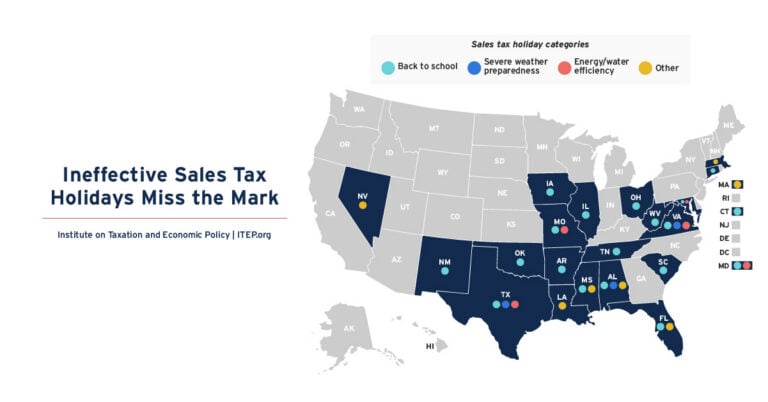
Ineffective Sales Tax Holidays Miss the Mark
• By Miles Trinidad
Twenty states have sales tax holidays in 2026. These sales tax holidays will cost states and localities nearly $600 million in lost revenue this year, and they're poorly targeted and too temporary to meaningfully change the regressive nature of a state’s tax system.
The Impact of Proposed New Tax Credit Restrictions for Immigrant Filers: An Analysis of the DACA Recipient Population
• By Carl Davis, Erika Frankel, Emma Sifre
We find that 337,000 people in households with at least one DACA recipient will suffer financial harm, and that nearly two-thirds (66 percent) of the impacted individuals are U.S. citizens.
The Impact of Proposed New Tax Credit Restrictions for Immigrant Filers: An Analysis of State EITCs
• By Neva Butkus
Immigrants and their families in as many as 30 states are at risk of seeing their state tax credits such as the Earned Income Tax Credit (EITC) and Child Tax Credit (CTC) reduced unless state lawmakers act.

New EITC Proposal Would Help Families Dealing with Rising Costs
• By Joe Hughes
A new proposal in Congress to expand the Earned Income Tax Credit (EITC) would help families with the costs of raising children. The Working Parents Tax Relief Act is one of the latest approaches to help working-class families deal with an ongoing affordability crisis.

While States Debate New Trump Tax Changes, Equity Must Be at the Core
• By Brakeyshia Samms
States continue to debate whether and how to link their state tax codes to the 2025 federal tax law. This is not just a technical debate.

South Carolina’s Expensive, Regressive Tax Law Will Eliminate State’s Income Tax
• By Neva Butkus, Dylan Grundman O'Neill
South Carolina signed into law a regressive tax cut that will disproportionately benefit the state’s highest-income residents while simultaneously jeopardizing the state’s ability to pay for basic public services in the years to come.

Analysis of Sen. Chris Van Hollen’s Approach to Tax Policy
• By Steve Wamhoff
Sen. Chris Van Hollen has recently introduced the Working Americans’ Tax Cut Act, which offers a generous middle-class tax cut paid for with a new tax on millionaires.

State Earned Income Tax Credits Support Families and Workers in 2025
• By Neva Butkus
Nearly two-thirds of states now have an Earned Income Tax Credit (EITC). Momentum continues to build on these credits that boost low-paid workers’ incomes and offset some of the taxes they pay, helping lower-income families achieve greater economic security.

Advantaging Affluence: A Distributional Analysis of Missouri HB 798’s Uneven Tax Cuts for Wealth and Work
• By Aidan Davis, Carl Davis, Dylan Grundman O'Neill, Eli Byerly-Duke, Matthew Gardner
Missouri House Bill 798 would reduce personal and corporate income tax rates, fully eliminate taxes on capital gains income from sale of assets, and eliminates the state’s modest Earned Income Tax Credit that assists many working people in lower-paid jobs. HB 798 would radically transform Missouri’s income tax code into a system that privileges income from wealth over income from work, leaving many middle-income families to pay a higher income tax rate than wealthy people…
Improving Refundable Tax Credits by Making Them Immigrant-Inclusive
• By Emma Sifre, Marco Guzman
Undocumented immigrants who work and pay taxes but don't have a valid Social Security number for either themselves or their children are excluded from federal EITC and CTC benefits. Fortunately, several states have stepped in to ensure undocumented immigrants are not left behind by the gaps in the federal EITC and CTC. State lawmakers should continue to ensure that immigrants who are otherwise eligible for these tax credits receive them.
Local Earned Income Tax Credits: How Localities Are Boosting Economic Security and Advancing Equity with EITCs
• By Andrew Boardman, Galen Hendricks, Kamolika Das
Leading localities are using refundable EITCs to boost incomes and reduce taxes for workers and families with low and moderate incomes. These local credits build on the success of EITCs at the federal and state levels, reduce economic hardship and improve the fairness of the tax code.

Boosting Incomes, Improving Equity: State Earned Income Tax Credits in 2023
• By Aidan Davis, Neva Butkus
Nearly two-thirds of states (31 plus the District of Columbia and Puerto Rico) have an Earned Income Tax Credit, an effective tool that boosts low-paid workers’ incomes and helps lower-income families achieve greater economic security. This year, 12 states expanded and improved EITCs.
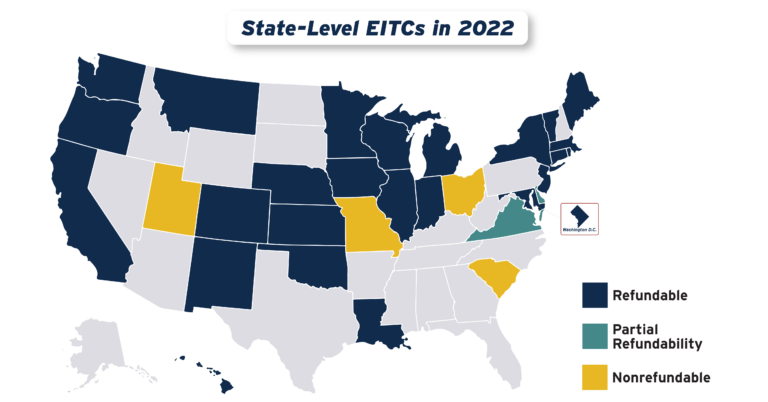
Boosting Incomes and Improving Tax Equity with State Earned Income Tax Credits in 2022
• By Aidan Davis
States continued their recent trend of advancing EITCs in 2022, with nine states plus the District of Columbia either creating or improving their credits. Utah enacted a 15 percent nonrefundable EITC, while the District of Columbia, Hawaii, Illinois, Maine, Vermont and Virginia expanded existing credits. Meanwhile, Connecticut, New York and Oregon provided one-time boosts to their EITC-eligible populations.

Abortion-Restricting States Do Least for Children
• By Amy Hanauer
Lawmakers have passed laws in 22 states that either immediately or soon will greatly restrict women’s rights to decide whether and when to have children. These states have some of the worst tax, spending and labor market policies for families in the U.S.

Federal EITC Enhancements Help More Than One in Three Young Workers
• By Aidan Davis
More than one in three young adults would benefit from workers without children being eligible to receive the federal EITC. This policy change would bolster young adults’ economic security.

Boosting Incomes and Improving Tax Equity with State Earned Income Tax Credits in 2021
• By Aidan Davis
The EITC benefits low-income people of all races and ethnicities. But it is particularly impactful in historically excluded Black and Hispanic communities where discrimination in the labor market, inequitable educational systems, and countless other inequities have relegated a disproportionate share of people to low-wage jobs.

Institute on Taxation
and Economic Policy
ITEP is a non-profit, non-partisan tax policy organization. We conduct rigorous analyses of tax and economic proposals and provide data-driven recommendations to shape equitable and sustainable tax systems.
Subscribe to ITEP Emails
Tax research and policy news in your inbox.
Promote Fair Tax Policy
Your gift to ITEP promotes tax justice. With your help, we do research that supports taxing millionaires and billionaires, taxing big corporations and raising revenue for the things our people, our communities and our planet need.
Together, we can create a country with more economic justice, more racial justice, more climate justice… and more tax justice.