
Colorado
State Rundown 8/2: Legislative Tax Debates Wind Down as Ballot Initiative Efforts Ramp Up
• By ITEP Staff
Budget deliberations continue in earnest this week in Alaska, Connecticut, Pennsylvania, and Rhode Island. In South Dakota and Utah, the focus is on gearing up for ballot initiative efforts to raise needed revenue, though be sure to read about legislators nullifying voter-approved initiatives in Maine and elsewhere in our "what we're reading" section.
State Rundown 7/27: State Legislative Debates Winding Down but Tax Talk Continues
• By ITEP Staff
While only a few states still remain mired in overtime budget debates, there is plenty of budget and tax news from around the country this week. Efforts are underway to repeal gas tax increases in California and challenge a local income tax in Seattle, Washington. And New Jersey legislators' law to modernize its tax code to tax Airbnb rentals has been vetoed for now.
50-State Analysis of Trump’s Tax Outline: Poorer Taxpayers and Poorer States are Disadvantaged
• By Alan Essig
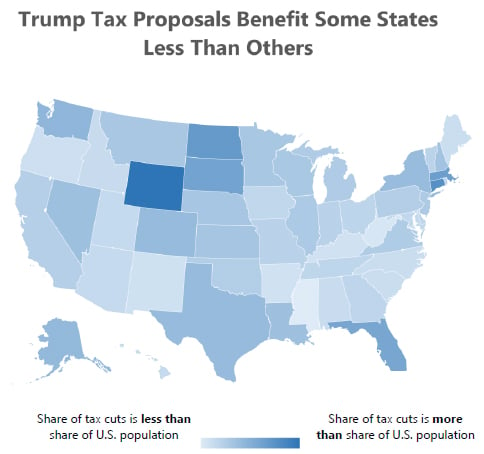
Not only would President Trump’s proposed tax plan fail to deliver on its promise of largely helping middle-class taxpayers, it also would shower a disproportionate share of the total tax cut on taxpayers in some of the richest states while southern and a few other states would receive a smaller share of the tax cut […]
Trump Tax Proposals Would Provide Richest One Percent in Colorado with 52.5 Percent of the State’s Tax Cuts
• By ITEP Staff
Earlier this year, the Trump administration released some broadly outlined proposals to overhaul the federal tax code. Households in Colorado would not benefit equally from these proposals. The richest one percent of the state’s taxpayers are projected to make an average income of $1,845,700 in 2018. They would receive 52.5 percent of the tax cuts that go to Colorado’s residents and would enjoy an average cut of $142,190 in 2018 alone.
Trump’s $4.8 Trillion Tax Proposals Would Not Benefit All States or Taxpayers Equally
• By Matthew Gardner, Steve Wamhoff
The broadly outlined tax proposals released by the Trump administration would not benefit all taxpayers equally and they would not benefit all states equally either. Several states would receive a share of the total resulting tax cuts that is less than their share of the U.S. population. Of the dozen states receiving the least by this measure, seven are in the South. The others are New Mexico, Oregon, Maine, Idaho and Hawaii.

Explaining our Analysis of Washington State’s Highly Regressive Tax Code
• By Carl Davis
Supporters of creating a local personal income tax in Seattle are rightly concerned about the lopsided nature of their state’s tax code. In a 50-state study titled Who Pays?, produced using our microsimulation tax model, we found that Washington State’s tax system is the most regressive in the nation.
3 Percent and Dropping: State Corporate Tax Avoidance in the Fortune 500, 2008 to 2015
• By Aidan Davis, Matthew Gardner, Richard Phillips
The trend is clear: states are experiencing a rapid decline in state corporate income tax revenue. Despite rebounding and even booming bottom lines for many corporations, this downward trend has become increasingly apparent in recent years. Since our last analysis of these data, in 2014, the state effective corporate tax rate paid by profitable Fortune 500 corporations has declined, dropping from 3.1 percent to 2.9 percent of their U.S. profits. A number of factors are…

State Rundown 4/27: States Finally Reaching Resolution on Gas Taxes
• By ITEP Staff
This week, transportation funding debates finally concluded with gas tax updates in Indiana, Montana, and Tennessee, and appear to be nearing an end in South Carolina. Meanwhile, Louisiana and Oregon lawmakers debated new Gross Receipts Taxes, and Texas legislators considered eliminating the state’s franchise tax. — Meg Wiehe, ITEP Deputy Director, @megwiehe Louisiana Gov. Bel Edward’s Commercial Activities Tax (CAT) was pulled from committee early this week without a vote due to opposition, […]
The Fiscal Times: Tax-Free Shopping on Amazon Is Over
April 11, 2017
As recently as 2011, Amazon was collecting sales tax in just five states, home to 11 percent of the country’s population, according to Carl Davis of the Institute on Taxation and Economic Policy. But a few years ago, as Amazon began to pursue a strategy of expanding its network of distribution and data centers to improve its […]

State Rundown 4/5: Focus on Major Tax Bills Intensifies
• By ITEP Staff
This week in state tax news we saw a destructive tax cut effort defeated in Georgia, a state shutdown avoided in New York, and lawmakers hone in on major tax debates in Massachusetts, Nebraska, South Carolina, and WestVirginia. State efforts to collect taxes owed on online purchases continue to heat up as well. — Meg […]

Tax Justice Digest: Offshore Cash, Gas Tax and BAT
• By ITEP Staff
In the Tax Justice Digest we recap the latest reports, blog posts, and analyses from Citizens for Tax Justice and the Institute on Taxation and Economic Policy. Here’s a rundown of what we’ve been working on lately. Corporations Offshore Cash Hoard Grows to $2.6 Trillion U.S. corporations now hold a record $2.6 trillion offshore, a […]
What to Watch in the States: State Earned Income Tax Credits (EITC) on the Move
• By Misha Hill
While every state’s tax system is regressive, meaning lower income people pay a higher tax rate than the rich, some states aim to improve tax fairness through a state Earned Income Tax Credit (EITC). Federal lawmakers established the in 1975 to bolster the earnings of low-wage workers, especially workers with children and offset some of […]
GOP Healthcare Bill Cuts Insurance Coverage for Millions to Pay for Tax Cuts for the Wealthy; ITEP State-By-State Estimates
• By Richard Phillips
The House GOP’s American Health Care Act is being pushed quickly through the legislative process, with a vote on the House floor scheduled for as early as Thursday. The Republican legislation seeks to pay for the cost of repealing highly progressive taxes enacted as part of the Affordable Care Act by making substantial cuts to […]
State Rundown 3/15: Responses to Revenue Shortfalls Vary Widely
• By ITEP Staff
State tax debates have been very active this week. Efforts to eliminate the income tax continue in West Virginia. Policymakers in many states are responding to revenue shortfalls in very different ways: some in Iowa, Mississippi, and Nebraska seek to dig the hole even deeper with tax cuts, while the Missouri House’s response has been […]
The Gazzette: Study Maintains Undocumented Immigrants Pay Their Fair Share in Taxes
March 8, 2017
Colorado’s 163,000 undocumented immigrants pay plenty in taxes, according to a new report by the Institute on Taxation and Economic Policy. The nonprofit think tank on state and federal tax policy estimates undocumented residents contributed $21.4 million in personal income taxes, $35.8 million in property taxes and $82.2 million in sales and excise taxes to […]
News 7: Undocumented people would be able to use Social Security card to get license in Colo. under bill
March 8, 2017
The bill comes at the same time that a report from the Institute on Taxation and Economic Policy, a nonpartisan nonprofit based in Washington, that says Colorado has an estimated 163,000 undocumented immigrants who contributed $139.5 million to the state in income, property, sales and excise taxes in 2015. Read more

State Rundown 3/1: Will Tax Cut Proposals Be “In Like a Lion, Out Like A Lamb”?
• By ITEP Staff
Tax cuts have been proposed in many states already this year, but amid so much uncertainty, it remains to be seen how successful those efforts will be. This week saw one dangerous, largely regressive tax cut proposal move in Georgia, new budget proposals in Louisiana and New Jersey, a new plan to close West Virginia‘s […]
Undocumented Immigrants’ State & Local Tax Contributions
• By Lisa Christensen Gee, Meg Wiehe, Misha Hill
Public debates over federal immigration reform, specifically around undocumented immigrants, often suffer from insufficient and inaccurate information about the tax contributions of undocumented immigrants, particularly at the state level. The truth is that undocumented immigrants living in the United States paybillions of dollars each year in state and local taxes. Further, these tax contributions would increase significantly if all undocumented immigrants currently living in the United States were granted a pathway to citizenship as part…

What to Watch in the States: Modernizing Sales Taxes for a 21st Century Economy
• By Misha Hill
This is the fourth installment of our six-part series on 2017 state tax trends. The introduction to this series is available here. State lawmakers often find themselves looking for ways to raise revenue to fund vital public services, fill budget gaps, or pay for the elimination or weakening of progressive taxes. Lately, that search has […]
The Denver Post: 19 states have raised gas taxes since 2013. In Colorado, Republicans want to cut them
February 8, 2017
“This is highly unusual, what’s being talked about in Colorado right now,” said Carl Davis, research director with the Institute on Taxation and Economic Policy. And it can largely be explained by one thing: TABOR. Read more

What to Watch in the States: Gas Tax Hikes and Swaps
• By Carl Davis
This is the second installment of our six part series on 2017 state tax trends. The introduction to this series is available here. State tax policy can be a divisive issue, but no area has generated more agreement among lawmakers across the country than the need to raise new revenues to fund infrastructure improvements. The […]
State Tax & Revenue Information
• By ITEP Staff
Below is a list of notable resources for information on state taxes and revenues: Alabama Alabama Department of Revenue Alabama Department of Finance – Executive Budget Office Alabama Department of Revenue – Tax Incentives for Industry Alabama Legislative Fiscal Office Alaska Alaska Department of Revenue – Tax Division Alaska Office of Management & Budget Alaska […]
What to Watch in the States Series: Tax Policy 2017
• By Lisa Christensen Gee
Over the next few weeks we will be blogging about what we’re watching in state tax policy during 2017 legislative sessions. In this “What to Watch in the States” series, we will look at the following: State responses to short- and long-term revenue deficits Boosting funding for infrastructure, though sometimes at the expense of other […]
Governing: Despite Budget Shortfalls, Some Governors Call for Tax Cuts
January 26, 2017
In both Colorado and Kansas, the tax increases would help cover projected budget deficits. That can be a dangerous habit, said Meg Wiehe of the progressive-leaning Institute on Taxation and Economic Policy, because such tax increases tend to discourage consumption. “Politically speaking they’re low-hanging fruit,” she said. “The problem in relying on this is it […]
Fairness Matters: A Chart Book on Who Pays State and Local Taxes
• By Carl Davis, Meg Wiehe
When states shy away from personal income taxes in favor of higher sales and excise taxes, high-income taxpayers benefit at the expense of low- and moderate-income families who often face above-average tax rates to pick up the slack. This chart book demonstrates this basic reality by examining the distribution of taxes in states that have pursued these types of policies. Given the detrimental impact that regressive tax policies have on economic opportunity, income inequality, revenue…
