
District of Columbia
Newsweek: Major Tax Disruption Faces Over 300,000 Taxpayers—’Sabotage’
February 4, 2026
Workers in Washington, D.C., many of whom have federal roles, could be set to experience major disruption over their tax returns this year, as Congress seems likely to pass a joint resolution that would override the district’s tax law—n the middle of the tax season. Read more.

States Can Push Back Against Reckless Federal Tax Policy. Here’s How.
• By Aidan Davis, Wesley Tharpe
They should take steps to protect and boost their own revenues. And they should take a second look at their own tax cuts.

Pennsylvania Just Gave Low-Income Workers a Tax Credit Boost. Now It’s Philadelphia’s Turn.
• By Kamolika Das
In the same way states are building upon federal tax credits, localities should consider building on state tax credits.

States Can Create or Expand Refundable Credits by Taxing Wealth, Addressing Federal Conformity
• By Zachary Sarver
Many states already recognize the potential of these credits to boost low- and moderate-income households. Other states should follow suit.

No, Scott Bessent: States Aren’t Taking Away Anyone’s Tax Cuts
• By Nick Johnson
It’s wildly inappropriate for a U.S. Treasury Secretary to lean on states to adopt or not adopt specific federal provisions in their own state tax codes.

Linking to Tipped and Overtime Income Deductions Would Worsen State Shortfalls, Do Little to Help Workers
• By Neva Butkus, Galen Hendricks
State deductions for tips and overtime are not only ineffective at supporting working-class people, it will come at a substantial cost to state budgets.

Conforming to the ‘No Tax on Tips’ Gimmick Just Got Riskier and Costlier for States
• By Nick Johnson
An unknown number of workers who previously were assumed to be ineligible for the tax break may nonetheless claim it.

Re-Examining 529 Plans: Stopping State Subsidies to Private Schools After New Trump Tax Law
• By Miles Trinidad, Nick Johnson
The 2025 federal tax law risks making 529 plans more costly for states by increasing tax avoidance and allowing wealthy families to use these funds for private and religious K-12 schools.

Local Vacancy Taxes: A Tool but Not a Panacea
• By Rita Jefferson
Vacancy taxes will not single-handedly solve problems in cities, but they are worth considering to address housing shortages, land use, and building thriving communities.

States Begin Decoupling from Flawed ‘QSBS’ Tax Break
• By Nick Johnson, Sarah Austin
A costly tax break for wealthy venture capitalists is drawing some critical attention from state policymakers.

State Rundown 11/5: Voters Say “Yes!” to Public Investments
• By ITEP Staff
Despite being an off-year election, voters made a call for shared public investments at the polls.
Local Child Tax Credits: The Next Frontier in the Reduction of Child Poverty
• By ITEP Staff
Contact: Jon Whiten (jon@itep.org) Child Tax Credits have been the focus of increased lawmaker attention over the past few years, especially following the dramatic success of the 2021 federal CTC expansion in reducing child poverty and the subsequent resurgence of pre-pandemic child poverty levels. While 15 states now supplement the federal credit with their own […]

Quite Some BS: Expanded ‘QSBS’ Giveaway in Trump Tax Law Threatens State Revenues and Enriches the Wealthy
• By Sarah Austin, Nick Johnson
States should decouple from the federal Qualified Small Business Stock (QSBS) exemption.

State Tax Credits Continued to Grow in 2025
• By ITEP Staff
A pair of new briefs from the Institute on Taxation and Economic Policy (ITEP) illustrate the growing power of state Earned Income Tax Credits (EITCs) and Child Tax Credits (CTCs). In all, we find: Nearly two-thirds of states (31 plus the District of Columbia and Puerto Rico) have an Earned Income Tax Credit (EITC). These […]

State Earned Income Tax Credits Support Families and Workers in 2025
• By Neva Butkus
Nearly two-thirds of states now have an Earned Income Tax Credit (EITC). Momentum continues to build on these credits that boost low-paid workers’ incomes and offset some of the taxes they pay, helping lower-income families achieve greater economic security.

State Child Tax Credits Boosted Financial Security for Families and Children in 2025
• By Neva Butkus
Child Tax Credits (CTCs) are effective tools to bolster the economic security of low- and middle-income families and position the next generation for success.
State Rundown 8/6: Tax Policy is Hot in the Middle of Summer
• By ITEP Staff
As states prepare for the revenue loss and disruption resulting from the federal tax bill, tax policy is being considered in legislatures across the country.

Which States Expanded Refundable Credits in 2025?
• By Neva Butkus
Refundable tax credits were a big part of state tax policy conversations this year. In 2025, nine states improved or created Child Tax Credits or Earned Income Tax Credits.
State Rundown 7/24: States Begin Preparing for Federal Megabill Fallout
• By ITEP Staff
All eyes in statehouses in recent weeks have been on federal budget negotiations, and now that the “megabill” has passed, they are focused in on their own budgets in search of ways to cope with the enormous consequences coming their way. All states will see fewer federal dollars flowing through their coffers, higher needs due […]

How Will the Trump Megabill Change Americans’ Taxes in 2026?
• By Steve Wamhoff, Michael Ettlinger, Carl Davis, Jon Whiten
The megabill will raise taxes on the poorest 40 percent of Americans, barely cut them for the middle 20 percent, and cut them tremendously for the wealthiest Americans next year.

Sales Tax Holidays Miss the Mark When it Comes to Effective Sales Tax Reform
• By Miles Trinidad
Sales tax holidays are often marketed as relief for everyday families, but they do little to address the deeper inequities of regressive sales taxes. In 2025, 18 states offer these holidays at a collective cost of $1.3 billion.

States Should Move Quickly to Chart Their Own Course on SALT Deductions
• By Dylan Grundman O'Neill, Nick Johnson
While a federal SALT cap is hotly debated, capping deductibility at $10,000 was an unambiguously good idea at the state level. States would be smart to stick with the current cap or, better yet, go even farther and repeal SALT deductions outright. Going along with a higher federal SALT cap would double down on a regressive tax cut that will mostly benefit a small number of relatively wealthy state residents and cost states significant revenue.

Anti-Tax Revolts Backfire: What We’ve Learned from 50 Years of Property Tax Limits
• By Rita Jefferson
Across-the-board property tax cuts create less fair local tax systems in the long run. State legislators and local governments should prioritize the residents who can least afford their property taxes, not the residents and businesses who can.
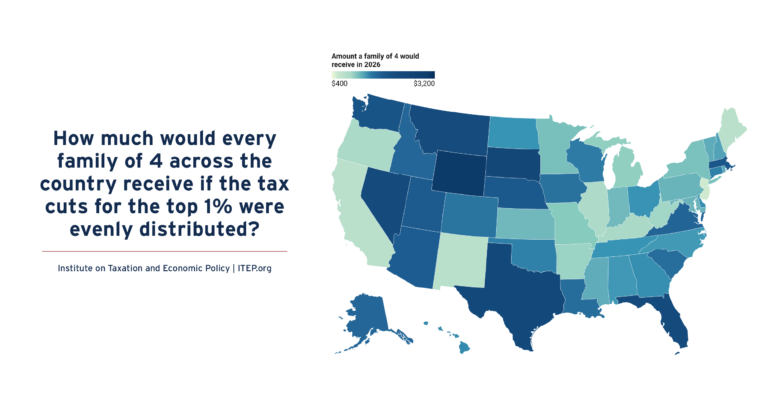
How Much Would Every Family in Every State Get if the Megabill’s Tax Cuts Given to the Rich Had Instead Been Evenly Divided?
• By Michael Ettlinger
If instead of giving $117 billion to the richest 1 percent, that money had been evenly divided among all Americans, we'd each get $343 - or nearly $1,400 for a family of four.

Analysis of Tax Provisions in the Trump Megabill as Signed into Law: National and State Level Estimates
• By Steve Wamhoff, Carl Davis, Joe Hughes, Jessica Vela
President Trump has signed into law the tax and spending “megabill” that largely favors the richest taxpayers and provides working-class Americans with relatively small tax cuts that will in many cases be more than offset by Trump's tariffs.
