
Hawaii
New State Taxes on the Wealthy Raise Revenue and Rebalance Tax Codes, Advancing Racial Justice
• By Brakeyshia Samms
Taxing the rich is proven fiscal policy – it raises revenue for vital public services and makes tax codes fairer. But a part of the debate that rarely gets enough attention: taxing the rich is also one of the most effective tools available for advancing racial equity.
Yahoo News: Hawaii’s new ‘millionaire tax’ rivals top tax rate among other states
July 13, 2026
Nick Johnson, senior fellow at the Institute on Taxation and Economic Policy, another Washington, D.C.-based nonprofit and nonpartisan tax policy organization, told the Hawaii Tax Review Commission during a June 16 meeting that the state's personal income tax is "quite progressive" given its graduated rate structure and low-income tax credits.

A Growing Number of States Are Taxing the Sale of Advertising
• By Nick Johnson
ITEP’s report on taxing advertising identifies some reasons why states are curtailing longstanding sales tax exemptions for the ad sector.
Reuters: Hawaii Considers Gasoline Tax Suspension as Pump Prices Soar
June 11, 2026
Hawaii Governor Josh Green said he is considering pausing the state's gasoline tax as pump prices surge three months into the Iran war.

States Can Raise Billions by Ending a Tax Giveaway to Big Tech
• By Nick Johnson
An advertising tax offers a way to raise significant money from a sector of the economy that has been getting a free ride for decades.

State Rundown 6/4: Fiscal Flowers and Weeds Bloom in June
• By ITEP Staff
A veritable superbloom of tax and budget policies occurred over these last few weeks, including both flowers worth admiring and weeds worth fighting back.

NYC and Montana Lead the Way on Second-Home Taxes
• By Rita Jefferson
Second home taxes make a lot of sense for communities struggling with housing costs for full-time residents. They can raise real revenues too, which can be used to support further affordable housing development.
As Inequality Grows, More States Look to Tax the Rich
• By Alex Welch
From surcharges on the income of high-earners to higher taxes on second homes, here are recent steps states have taken to tax the rich.

Taxing Advertising Would Modernize State Sales Tax Bases for the Information Age
• By Nick Johnson
Most states questionably exempt advertising from sales taxes. States that extend their sales taxes to advertising and/or enact an excise tax stand to raise billions in revenue while correcting a structural bias in their tax codes that implicitly subsidizes some of the most profitable corporations in human history.
State Rundown 4/30: Aloha to Tax Cuts, Hawaiʻi Lawmakers Address Revenue Gap with High-End Tax Changes
• By ITEP Staff
This week Hawaiʻi lawmakers reached a compromise to balance the state budget and maintain tax cuts for most residents by, in part, raising rates on the richest Hawaiians. Other states are working to generate revenue from their wealthiest residents, too.
State Rundown 4/23: While Some States Stop Digging, Others Move Full Steam Ahead with Anti-Affordability Agendas
• By ITEP Staff
Missouri lawmakers passed legislation that will have residents vote on a proposal at the ballot box. The ask: for them to pay more in sales taxes to offset cuts – and the possible elimination – of the state's individual income tax, which makes up nearly two-thirds of Missouri’s general fund.
State Rundown 3/18: New Mexico Enacts Most Significant Corporate Tax Reform of the Year
• By ITEP Staff
As states lawmakers continue to weigh their linkages to the federal tax code in light of the recent federal tax law, New Mexico provides a blueprint for limiting multinational corporate tax avoidance.
State Rundown 2/25: Sausage-Making Season Is Upon Us
• By ITEP Staff
National Sausage Month isn’t until October, but now is the time of year when state lawmakers are really diving into their sausage-making processes, as separate legislative houses and oftentimes political parties send competing bills, budgets, and visions back and forth to grind out their differences.

Hawai’i Appleseed Center for Law and Economic Justice: A Fairer Tax Code for a Thriving Hawaiʻi
• By ITEP Staff
Hawaiʻi stands at a crossroads. The path we choose now will define our islands for generations. We can either accept a future of diminishing public goods and deepening inequality, or we can choose to build one of shared prosperity and collective resilience. Read more.

States Can Push Back Against Reckless Federal Tax Policy. Here’s How.
• By Aidan Davis, Wesley Tharpe
They should take steps to protect and boost their own revenues. And they should take a second look at their own tax cuts.
State Rundown 1/7: New Year, New Opportunities for Progressive Revenue
• By ITEP Staff
As we kick off a new year, several states are facing revenue shortfalls. Some lawmakers are approaching the challenge with sustainable and equitable solutions.
Associated Press: Governor Suggests Hawaii May Scale Back on Income Tax Cuts, Tap Reserves To Help Balance Budget
December 10, 2025
Some critics questioned the structure of the tax cuts from the beginning, citing analysis by the Institute on Taxation and Economic Policy that concluded nearly half of the savings from the income tax cuts would go to the top the top 20% of earners, meaning people who earn more than $147,000 annually. It now appears Green may be taking […]

Re-Examining 529 Plans: Stopping State Subsidies to Private Schools After New Trump Tax Law
• By Miles Trinidad, Nick Johnson
The 2025 federal tax law risks making 529 plans more costly for states by increasing tax avoidance and allowing wealthy families to use these funds for private and religious K-12 schools.

States Should Move Quickly to Chart Their Own Course on SALT Deductions
• By Dylan Grundman O'Neill, Nick Johnson
While a federal SALT cap is hotly debated, capping deductibility at $10,000 was an unambiguously good idea at the state level. States would be smart to stick with the current cap or, better yet, go even farther and repeal SALT deductions outright. Going along with a higher federal SALT cap would double down on a regressive tax cut that will mostly benefit a small number of relatively wealthy state residents and cost states significant revenue.
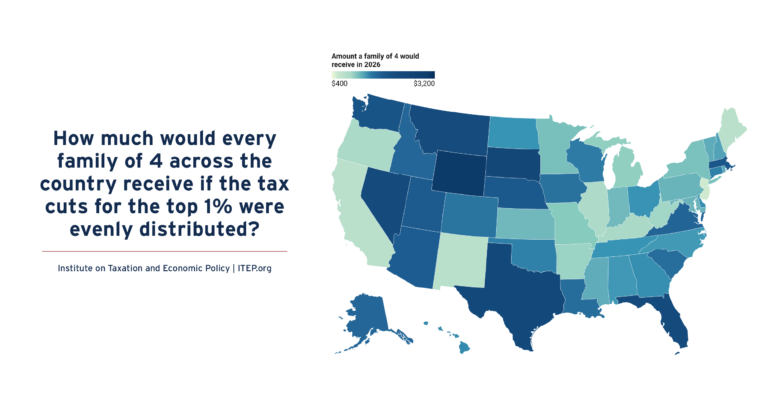
How Much Would Every Family in Every State Get if the Megabill’s Tax Cuts Given to the Rich Had Instead Been Evenly Divided?
• By Michael Ettlinger
If instead of giving $117 billion to the richest 1 percent, that money had been evenly divided among all Americans, we'd each get $343 - or nearly $1,400 for a family of four.

Analysis of Tax Provisions in the Trump Megabill as Signed into Law: National and State Level Estimates
• By Steve Wamhoff, Carl Davis, Joe Hughes, Jessica Vela
President Trump has signed into law the tax and spending “megabill” that largely favors the richest taxpayers and provides working-class Americans with relatively small tax cuts that will in many cases be more than offset by Trump's tariffs.

Trump Megabill Will Give $117 Billion in Tax Cuts to the Top 1% in 2026. How Much In Your State?
• By Michael Ettlinger
The predominant feature of the tax and spending bill working its way through Congress is a massive tax cut for the richest 1 percent — a $114 billion benefit to the wealthiest people in the country in 2026 alone.

How Much Do the Top 1% in Each State Get from the Trump Megabill?
• By Carl Davis
The Senate tax bill under debate right now would bring very large tax cuts to very high-income people. In total, the richest 1 percent would receive $114 billion in tax cuts next year alone. That would amount to nearly $61,000 for each of these affluent households.
Analysis of Tax Provisions in the House Reconciliation Bill: National and State Level Estimates
• By Carl Davis, Jessica Vela, Joe Hughes, Steve Wamhoff
The poorest fifth of Americans would receive 1 percent of the House reconciliation bill's net tax cuts in 2026 while the richest fifth of Americans would receive two-thirds of the tax cuts. The richest 5 percent alone would receive a little less than half of the net tax cuts that year.
Trump 2025 Tax Law: Research and Resources
• By ITEP Staff
Want to know more about the tax and spending megabill that President Trump recently signed into law? We've got you covered.
