
Illinois
State Rundown 6/13: Budget Crunch Time Sets in as State Fiscal Years Come to Close
• By ITEP Staff
With many state fiscal years ending June 30th, budget negotiations were completed recently in California, Illinois, Michigan, and North Carolina. New Jersey remains a state to watch as a government shutdown looms but leaders continue to disagree about a proposed millionaires tax, corporate taxes, and school funding. In other states looking to wealthy individuals and large corporations for needed revenues, Arizona's teacher pay crisis could be solved with a tax on its highest-income residents and…
Urban Milwaukee: What’s Wrong with Illinois?
May 30, 2018
Although Illinois is widely viewed as a blue state because of its recent record of supporting Democratic presidential candidates, from a “who pays” angle it looks much more like a red state, collecting a much higher proportion of taxes from low earners than high earners. The next chart, based on data developed by the Institute […]

SALT/Charitable Workaround Credits Require a Broad Fix, Not a Narrow One
• By Carl Davis
The federal Tax Cuts and Jobs Act (TCJA) enacted last year temporarily capped deductions for state and local tax (SALT) payments at $10,000 per year. The cap, which expires at the end of 2025, disproportionately impacts taxpayers in higher-income states and in states and localities more reliant on income or property taxes, as opposed to sales taxes. Increasingly, lawmakers in those states who feel their residents were unfairly targeted by the federal law are debating…
State Rundown 5/17: Don’t Bet on Legal Sports Betting Solving State Budget Woes
• By ITEP Staff
This week the U.S. Supreme Court opened the door to legal sports gambling in the states (see our What We're Reading section), which will surely be a hot topic in state legislative chambers, but most states currently have more pressing matters before them. The teacher pay crisis made news in North Carolina, Alabama, and nationally. Louisiana, Oregon, and Vermont lawmakers are headed for special sessions over tax and budget issues. And several other states have recently reached or are very near the end of their legislative sessions.
State Rundown 5/3: Progressive Revenue Solutions to Fiscal Woes Gaining Traction
• By ITEP Staff
This week, Arizona teachers continued to strike over pay issues and advocates unveiled a progressive revenue solution they hope to put before voters, while a progressive income tax also gained support as part of a resolution to Illinois's budget troubles. Iowa and Missouri legislators continued to try to push through unsustainable tax cuts before their sessions end. And Minnesota and South Carolina focused on responding to the federal tax-cut bill.
Center for Tax and Budget Accountability: Cutting Taxes for the Middle Class and Shrinking the Deficit
• By ITEP Staff
According to the Institute for Taxation and Economic Policy, Illinois ranks as the fifth-most-regressive state and local tax system in the country — and the most regressive in the Midwest. In Illinois, the top one percent of income earners pay just 4.6 percent of their income in state and local taxes, while the middle 20 percent of workers pay more than double that, coming in at 10.8 percent of income, and the bottom 20 percent of earners…
Trends We’re Watching in 2018, Part 5: 21st Century Consumption Taxes
• By Misha Hill
We're highlighting the progress of a few newer trends in consumption taxation. This includes using the tax code to discourage consumption of everything from plastic bags to carbon and collecting revenue from emerging industries like ride sharing services and legalized cannabis sales.

What to Expect if the Supreme Court Allows for Online Sales Tax Collection
• By Carl Davis
Online shopping is hardly a new phenomenon. And yet states and localities still lack the authority to require many Internet retailers to collect the sales taxes that their locally based, brick and mortar competitors have been collecting for decades.
State Rundown 4/5: Education Funding Issues Take Center Stage
• By ITEP Staff
This week, Kentucky legislators passed a bill shifting taxes onto low- and middle-income families, Oklahoma legislators reached a deal on education funding, and their counterparts in Kansas proffered multiple proposals for their education funding needs. Meanwhile, tax debates are coming down to the wire in Iowa, Missouri, and Nebraska, and responses to the federal tax-cut bill were settled on in Maryland, New York, and Wisconsin.
State Rundown 3/30: Several Major Tax Debates Will March on into April
• By ITEP Staff
This week, after the recent teacher strike in West Virginia, teacher pay crises brought on by years of irresponsible tax cuts also made headlines in Arizona and Oklahoma. Maine and New York lawmakers continue to hash out how they will respond to the federal tax bill. And their counterparts in Missouri and Nebraska attempt to push forward their tax cutting agendas.

Amazon and Other E-Retailers Get a Free Pass from Some Local-Level Sales Taxes
• By Carl Davis
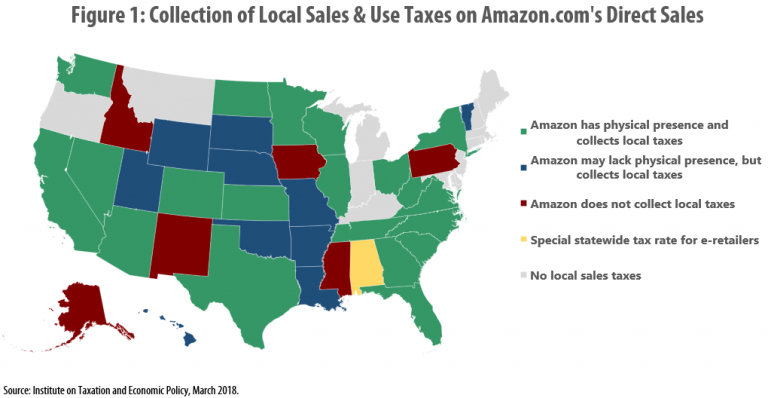
A new ITEP analysis reveals that in seven states (Alabama, Alaska, Idaho, Iowa, Mississippi, New Mexico, and Pennsylvania), the nation’s largest e-retailer, Amazon.com, is either not collecting local-level sales taxes or is charging a lower tax rate than local retailers. In other states, such as Colorado and Illinois, Amazon is collecting local tax because it has an in-state presence, but localities cannot collect taxes from other e-retailers based outside the state.
Many Localities Are Unprepared to Collect Taxes on Online Purchases: Amazon.com and other E-Retailers Receive Tax Advantage Over Local Businesses
• By Carl Davis
Online retailer Amazon.com made headlines last year when it began collecting every state-level sales tax on its direct sales. Savvy observers quickly noted that this change did not affect the company’s large and growing “marketplace” business, where it conducts sales in partnership with third-parties and rarely collects tax. But far fewer have noticed that even on its direct sales, Amazon is still not collecting some local-level taxes.
Trends We’re Watching in 2018, Part 2: State Revenue Shortfalls and the Impact on Education and Other Services
• By Aidan Davis
Many states struggle with a need for revenue, yet their lawmakers show little will to raise taxes to fund public services. Revenue shortfalls can prove to be a moving target. Some states with expected shortfalls are now seeing rosier forecasts. But as estimates come in above or below projections, states continue to grapple with how and whether to raise the revenue necessary to adequately fund key programs. Here are a few trends that are leading to less than cushy…
State Rundown 3/8: March Tax Debates “In Like a Lion”
• By ITEP Staff
This week was very active for state tax debates. Georgia, Idaho, and Oregon passed bills reacting to the federal tax cut, as Maryland and other states made headway on their own responses. Florida lawmakers sent a harmful "supermajority" constitutional amendment to voters. New Jersey now has two progressive revenue raising proposals on the table (and a need for both). Louisiana ended one special session with talks of yet another. And online sales taxes continued to…
Trends We’re Watching in 2018, Part 1: State Responses to Federal Tax Cut Bill
• By Dylan Grundman O'Neill
Over the next few weeks we will be blogging about what we’re watching in state tax policy during 2018 legislative sessions. And there is no trend more pervasive in states this year than the need to sort through and react to the state-level impact of federal tax changes enacted late last year.
State Rundown 2/22: State Tax Debates Grind On
• By ITEP Staff
This week, major tax packages relating to the federal tax-cut bill made news in Georgia, Iowa, and Louisiana, as Minnesota and Oregon lawmakers also continue to work out how their states will be affected. New Mexico's legislative session has finished without significant tax changes, while Idaho and Illinois's sessions are beginning to heat up, and Vermont's school funding system is under the microscope.
What the Tax Cuts and Jobs Act Means for States – A Guide to Impacts and Options
• By ITEP Staff
The recently enacted Tax Cuts and Jobs Act (TCJA) has major implications for budgets and taxes in every state, ranging from immediate to long-term, from automatic to optional, from straightforward to indirect, from certain to unknown, and from revenue positive to negative. And every state can expect reduced federal investments in shared public priorities like health care, education, public safety, and basic infrastructure, as well as a reduced federal commitment to reducing economic inequality and…
CBS St. Louis: Metro East Gubernatorial Candidate Wants Progressive Income Tax
January 4, 2018
Democrat Bob Daiber, currently Madison County’s Regional Superintendent of Schools, claims Illinois’ tax system is fifth most regressive in the nation — citing the Institute on Taxation and Economic Policy. “There’s an old saying ‘you can’t squeeze blood from a turnip,’ but we continue to try,” Daiber told reporters during a Chicago news conference. “I […]
How the Final GOP-Trump Tax Bill Would Affect Illinois Residents’ Federal Taxes
• By ITEP Staff
The final tax bill that Republicans in Congress are poised to approve would provide most of its benefits to high-income households and foreign investors while raising taxes on many low- and middle-income Americans. The bill would go into effect in 2018 but the provisions directly affecting families and individuals would all expire after 2025, with […]
The Final Trump-GOP Tax Plan: National and 50-State Estimates for 2019 & 2027
• By ITEP Staff
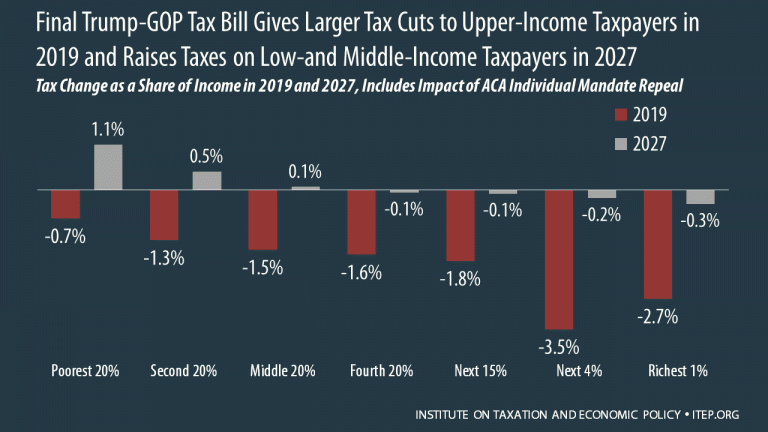
The final Trump-GOP tax law provides most of its benefits to high-income households and foreign investors while raising taxes on many low- and middle-income Americans. The bill goes into effect in 2018 but the provisions directly affecting families and individuals all expire after 2025, with the exception of one provision that would raise their taxes. To get an idea of how the bill will affect Americans at different income levels in different years, this analysis…

All I Want for Christmas is a Clean DREAM Act
• By Misha Hill
As 2017 draws to close, Congress has yet to take legislative action to protect Dreamers. The young undocumented immigrants who were brought to the United States as children, and are largely working or in school, were protected by President Obama’s 2012 executive action, Deferred Action for Childhood Arrivals (DACA). But in September, President Trump announced that he would end DACA in March 2018. Instead of honoring the work authorizations and protection from deportation that currently…
State Rundown 12/7: States Try to Plan While Awaiting Federal Tax Decisions
• By ITEP Staff
Though most eyes were on Congress rather than states this week, several states have been taking stock of their fiscal situations. Wyoming lawmakers considered ways to resolve budget shortfalls, Kansas and New Mexico legislators got some minor good news about their states' revenues, their counterparts in Minnesota and Vermont grappled with less encouraging revenue news, and those in West Virginia were just happy to hear their revenues had at least met expectations for once.
How the House and Senate Tax Bills Would Affect Illinois Residents’ Federal Taxes
• By ITEP Staff
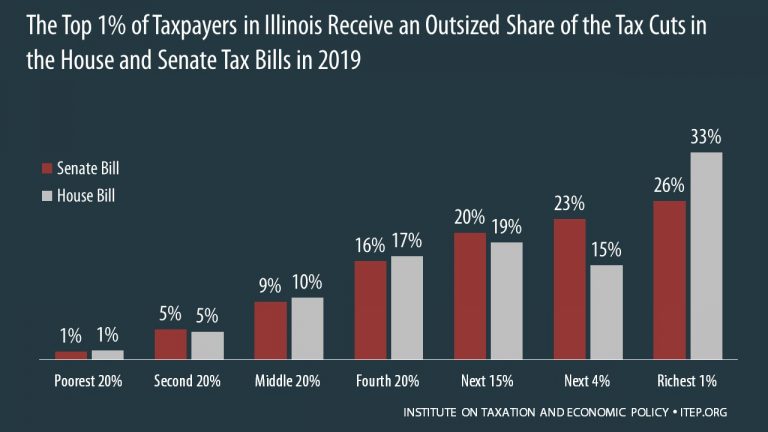
The House passed its “Tax Cuts and Jobs Act” November 16th and the Senate passed its version December 2nd. Both bills would raise taxes on many low- and middle-income families in every state and provide the wealthiest Americans and foreign investors substantial tax cuts, while adding more than $1.4 trillion to the deficit over ten years. The graph below shows that both bills are skewed to the richest 1 percent of Illinois residents.
National and 50-State Impacts of House and Senate Tax Bills in 2019 and 2027
• By ITEP Staff
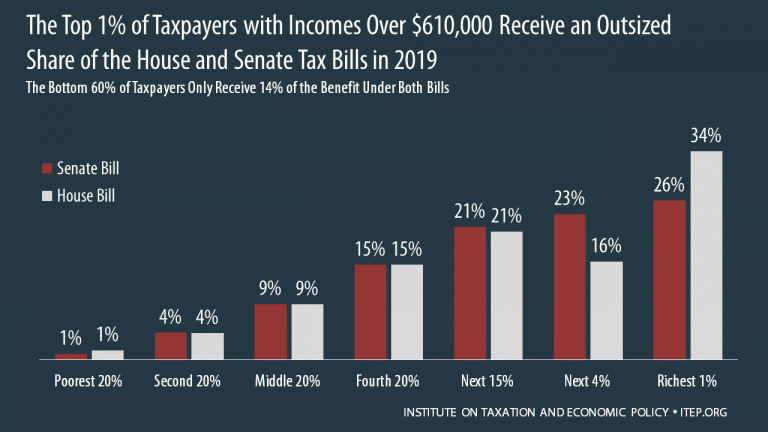
The House passed its “Tax Cuts and Jobs Act” November 16th and the Senate passed its version December 2nd. Both bills would raise taxes on many low- and middle-income families in every state and provide the wealthiest Americans and foreign investors substantial tax cuts, while adding more than $1.4 trillion to the deficit over ten years. National and 50-State data available to download.
State Rundown 11/29: Thanksgiving Leftovers Edition
• By ITEP Staff
The State Rundown is back from Thanksgiving break with a heaping helping of leftover state tax news, but beware, some of it may be rotten.
