
Maine
State Earned Income Tax Credits Support Families and Workers in 2024
September 12, 2024 • By Neva Butkus
Nearly two-thirds of states (31 plus the District of Columbia and Puerto Rico) have an Earned Income Tax Credit. These credits boost low-paid workers’ incomes and offset some of the taxes they pay, helping lower-income families achieve greater economic security.
State Child Tax Credits Boosted Financial Security for Families and Children in 2024
September 12, 2024 • By Neva Butkus
Fifteen states plus the District of Columbia provide Child Tax Credits to reduce poverty, boost economic security, and invest in children. This year alone, lawmakers in three states – Colorado, New York, and Utah – expanded their Child Tax Credits while lawmakers in the District of Columbia created a new credit that will take effect in 2025.

Many cities, counties, and townships across the country are in a difficult, or at least unstable, budgetary position. Localities are responding to these financial pressures in a variety of ways with some charging ahead with enacting innovative reforms like short-term rental and vacancy taxes, and others setting up local tax commissions to study the problem.
Video: ITEP’s Marco Guzman on the Tax Contribution of Maine’s Undocumented Immigrants
July 31, 2024
A new national study is shedding light on the economic contributions made by undocumented immigrants in Maine and throughout the United States, WMTW-TV in Maine reports. Watch the clip or read the story here.

Undocumented immigrants paid $96.7 billion in federal, state, and local taxes in 2022. Providing access to work authorization for undocumented immigrants would increase their tax contributions both because their wages would rise and because their rates of tax compliance would increase.
Improving Refundable Tax Credits by Making Them Immigrant-Inclusive
July 17, 2024 • By Emma Sifre, Marco Guzman
Undocumented immigrants who work and pay taxes but don't have a valid Social Security number for either themselves or their children are excluded from federal EITC and CTC benefits. Fortunately, several states have stepped in to ensure undocumented immigrants are not left behind by the gaps in the federal EITC and CTC. State lawmakers should continue to ensure that immigrants who are otherwise eligible for these tax credits receive them.
Property Tax Circuit Breakers Can Help States Create More Equitable Tax Codes
June 24, 2024 • By Brakeyshia Samms
Well-designed property tax circuit breaker programs allow states to reduce the impact that property taxes have on the upside-down tilt of their tax codes.
Iowa Flat Tax Shows Why Such Policies Are a Problem Everywhere
May 9, 2024 • By Eli Byerly-Duke

As Iowa lawmakers change the state’s graduated personal income tax to a single flat rate, they are designing a state tax code where the rich will pay a lower rate overall than families with modest means.
This week, many states took steps toward enacting tax cuts...
State Rundown 4/17: Tax Cut Proposals and the Consequences of Bad Tax Cuts
April 17, 2024 • By ITEP Staff
Happy (belated) Tax Day!
Maine Center for Economic Policy: Tax Fairness — an Explainer
April 15, 2024
Taxes help pay for things that benefit everyone, like good schools, clean air and water, and safe roads. Businesses also need these things to succeed, along with a healthy, housed, and educated workforce, modern infrastructure, and affordable energy. Fair taxes mean everyone pitches in according to their means, so those who have less pay less, and those who have more pay more. Unfortunately, the vast majority of states still have upside-down tax structures, meaning that families with wealth pay a smaller portion of their income in taxes than families with low income. That’s not fair.
Fairness Matters: A Chart Book on Who Pays State and Local Taxes
April 11, 2024 • By ITEP Staff
State and local tax codes can do a lot to reduce inequality. But they add to the nation’s growing income inequality problem when they capture a greater share of income from low- or moderate-income taxpayers. These regressive tax codes also result in higher tax rates on communities of color, further worsening racial income and wealth divides.
Every child deserves the opportunity to succeed in society – and tax policy has a huge role to play in making that happen. Better tax policy can help prepare our young children with skills to become successful and thriving adults.
Maine Center for Economic Policy: The Case for Corporate Transparency
March 13, 2024
Mainers work hard to support themselves and their communities. They pay taxes to fund the services communities need to thrive, like education, health care, and infrastructure. But it is increasingly clear that big corporations aren’t holding up their end of the bargain by contributing their fair share. They deploy complicated tax loopholes and accounting schemes to avoid paying what they owe, using their money and power to ensure laws in place don’t expose the tricks they’re playing.
ITEP’s Marco Guzman Testifies in Favor of Tax Fairness Bills in Connecticut
March 11, 2024
Good afternoon, Senator Fonfara, Representative Horn, and members of the Committee, and thank you for this opportunity to testify. My name is Marco Guzman and I'm a senior policy analyst with the Institute on Taxation and Economic Policy, or ITEP, and we’re a nonprofit research organization that focuses on state, local, and federal tax policy issues.
ITEP’s Kamolika Das Testifies on Pennsylvania’s Upside-Down Tax Code
March 4, 2024
Below is written testimony delivered by ITEP Local Policy Director Kamolika Das before the Pennsylvania House Finance Subcommittee on Tax Modernization & Reform on March 1, 2024. Good afternoon and thank you for this opportunity to testify. My name is Kamolika Das, I live in South Philly, and I’m the Local Tax Policy Director at […]
State Tax Watch 2024
January 23, 2024 • By ITEP Staff
Updated July 15, 2024 In 2024, state lawmakers have a choice: advance tax policy that improves equity and helps communities thrive, or push tax policies that disproportionately benefit the wealthy, drain funding for critical public services, and make it harder for low-income and working families to get ahead. Despite worsening state fiscal conditions, we expect […]

The findings of Who Pays? go a long way toward explaining why so many states are failing to raise the amount of revenue needed to provide full and robust support for our public schools.
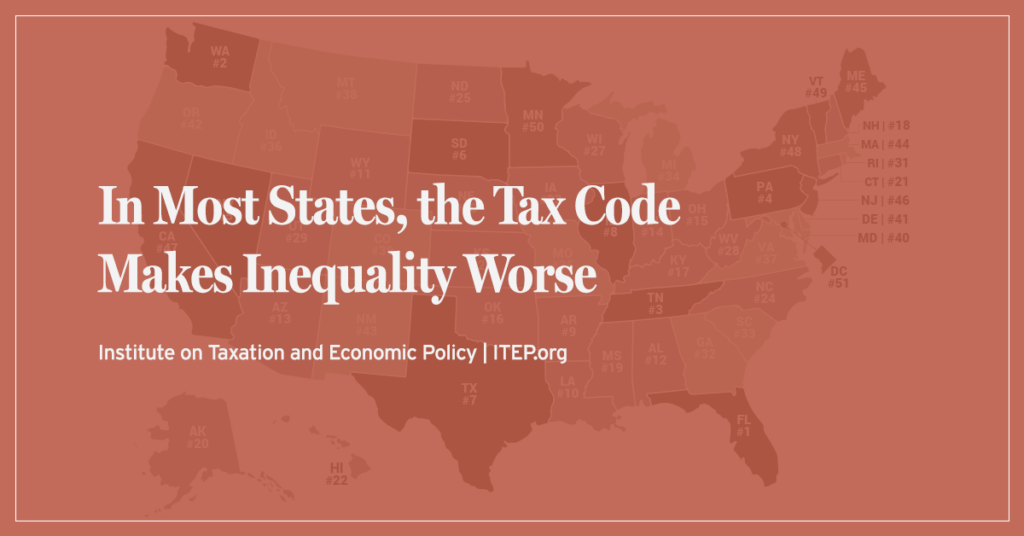
The vast majority of state and local tax systems are upside-down, with the wealthy paying a far lesser share of their income in taxes than low- and middle-income families. Yet a few states have made strides to buck that trend and have tax codes that are somewhat progressive and therefore do not worsen inequality.
Tax Systems in 44 States Exacerbate Inequality, In-Depth ‘Who Pays?’ Study Finds
January 9, 2024 • By ITEP Staff
The vast majority of state and local tax systems are upside-down, with the wealthy paying a far lesser share of their income in taxes than low- and middle-income families. That’s according to the latest edition of the Institute on Taxation and Economic Policy’s Who Pays?, the only distributional analysis of tax systems in all 50 states and the District of Columbia.
Maine: Who Pays? 7th Edition
January 9, 2024 • By ITEP Staff
Maine Download PDF All figures and charts show 2024 tax law in Maine, presented at 2023 income levels. Senior taxpayers are excluded for reasons detailed in the methodology. Our analysis includes nearly all (99.8 percent) state and local tax revenue collected in Maine. State and local tax shares of family income Top 20% Income Group […]
Hidden in Plain Sight: Race and Tax Policy in 2023 State Legislative Sessions
November 21, 2023 • By Brakeyshia Samms
Race was front and center in a lot of state policy debates this year, from battles over what’s being taught in schools to disagreements over new voting laws. Less visible, but also extremely important, were the racial implications of tax policy changes. What states accomplished this year – both good and bad – will acutely affect people and families of color.

States differ dramatically in how much they allow families to make choices about whether and when to have children and how much support they provide when families do. But there is a clear pattern: the states that compel childbirth spend less to help children once they are born.
State Tax Credits Have Transformative Power to Improve Economic Security
September 12, 2023 • By Aidan Davis
The latest analysis from the U.S. Census Bureau provides an important reminder of the compelling link between public investments and families’ economic well-being. Policy decisions can drastically reduce poverty and improve family economic stability for low- and middle-income families alike, as today’s data release shows.
States are Boosting Economic Security with Child Tax Credits in 2023
September 12, 2023 • By Aidan Davis, Neva Butkus

Fourteen states now provide Child Tax Credits to reduce poverty, boost economic security, and invest in children. This year alone, lawmakers in three states created new Child Tax Credits while lawmakers in seven states expanded existing credits. To maximize impact, lawmakers should consider making their credits fully refundable, not including an earnings requirement, setting a maximum amount per child instead of per household, setting state-specific phase-out ranges that target low- and middle-income families, indexing to inflation, and offering the option of advanced payments.
