
Minnesota
State Tax Watch 2026
April 8, 2026 • By ITEP Staff
ITEP tracks tax discussions in legislatures across the country and uses our unique data capacity to analyze the revenue, distributional, and racial and ethnic impacts of many of these proposals. State Tax Watch offers the latest news and movement from each state.
Testimony: ITEP’s Brakeyshia Samms on Why Evanston Should Adopt a Property Tax Circuit Breaker
March 9, 2026
Members of the City Council, Thank you for the opportunity to testify today about property tax circuit breakers. My name is Brakeyshia Samms, and I am a senior analyst with the Institute on Taxation and Economic Policy, a nonprofit and nonpartisan research organization that focuses on local, state, and federal tax policy issues with an emphasis on revenue sustainability and […]
As many state legislative sessions near or cross the halfway point, lawmakers are facing tough choices.
States Can Push Back Against Reckless Federal Tax Policy. Here’s How.
January 22, 2026 • By Aidan Davis, Wesley Tharpe

They should take steps to protect and boost their own revenues. And they should take a second look at their own tax cuts.
States Can Create or Expand Refundable Credits by Taxing Wealth, Addressing Federal Conformity
December 19, 2025 • By Zachary Sarver

Many states already recognize the potential of these credits to boost low- and moderate-income households. Other states should follow suit.
State Rundown 12/17: Tax Policy ‘Naughty or Nice’ List Has Late Entrants
December 17, 2025 • By ITEP Staff
With a little over a week left, some states are solidifying their spots on the tax policy “naughty or nice” list.
Re-Examining 529 Plans: Stopping State Subsidies to Private Schools After New Trump Tax Law
November 20, 2025 • By Miles Trinidad, Nick Johnson

The 2025 federal tax law risks making 529 plans more costly for states by increasing tax avoidance and allowing wealthy families to use these funds for private and religious K-12 schools.
New Report Shows How States Can Raise Billions by Taxing the Wealthy
October 30, 2025 • By ITEP Staff
Contact: Jon Whiten ([email protected]) Taxing the proceeds generated by wealth – such as capital gains, dividends, and passive business income – through a new Wealth Proceeds Tax is a simple way for states to raise billions in new revenue and improve the fairness of their tax systems, according to a new report by the Institute […]
The Wealth Proceeds Tax: A Simple Way for States to Tax the Wealthy
October 30, 2025 • By Sarah Austin, Carl Davis

Taxing the proceeds generated by wealth through a new Wealth Proceeds Tax is a simple way for states to raise billions in new revenue and improve the fairness of their tax systems.
Local Child Tax Credits: The Next Frontier in the Reduction of Child Poverty
October 9, 2025 • By ITEP Staff
Contact: Jon Whiten ([email protected]) Child Tax Credits have been the focus of increased lawmaker attention over the past few years, especially following the dramatic success of the 2021 federal CTC expansion in reducing child poverty and the subsequent resurgence of pre-pandemic child poverty levels. While 15 states now supplement the federal credit with their own […]
The Potential of Local Child Tax Credits to Reduce Child Poverty
October 8, 2025 • By Kamolika Das, Aidan Davis, Galen Hendricks, Rita Jefferson

Local governments have a critical role to play in reducing child poverty. Local Child Tax Credits could provide large tax cuts to families at the bottom of the income scale, lessening the overall regressivity of state and local tax systems.
Quite Some BS: Expanded ‘QSBS’ Giveaway in Trump Tax Law Threatens State Revenues and Enriches the Wealthy
October 2, 2025 • By Sarah Austin, Nick Johnson
States should decouple from the federal Qualified Small Business Stock (QSBS) exemption.
State Rundown 9/18: Lawmakers Confront Revenue Loss from Federal Policy Changes
September 18, 2025 • By ITEP Staff
Some states are trying to avoid revenue loss while others are welcoming it and doubling down.
State Earned Income Tax Credits Support Families and Workers in 2025
September 11, 2025 • By Neva Butkus

Nearly two-thirds of states now have an Earned Income Tax Credit (EITC). Momentum continues to build on these credits that boost low-paid workers’ incomes and offset some of the taxes they pay, helping lower-income families achieve greater economic security.
State Child Tax Credits Boosted Financial Security for Families and Children in 2025
September 11, 2025 • By Neva Butkus

Child Tax Credits (CTCs) are effective tools to bolster the economic security of low- and middle-income families and position the next generation for success.
Trump’s Tax Law Clobbers State Budgets. Now’s the Time to Prepare.
August 13, 2025 • By ITEP Staff
The Trump megabill hands the richest 1% a trillion-dollar windfall while gutting funding for health care, education, and disaster relief — leaving communities to pick up the pieces. State and local leaders must step up, tax the wealthiest fairly, and safeguard the essentials that keep America healthy, educated, and safe.
As states prepare for the revenue loss and disruption resulting from the federal tax bill, tax policy is being considered in legislatures across the country.

Refundable tax credits were a big part of state tax policy conversations this year. In 2025, nine states improved or created Child Tax Credits or Earned Income Tax Credits.
State Rundown 7/24: States Begin Preparing for Federal Megabill Fallout
July 24, 2025 • By ITEP Staff
All eyes in statehouses in recent weeks have been on federal budget negotiations, and now that the “megabill” has passed, they are focused in on their own budgets in search of ways to cope with the enormous consequences coming their way. All states will see fewer federal dollars flowing through their coffers, higher needs due […]
How Will the Trump Megabill Change Americans’ Taxes in 2026?
July 22, 2025 • By Steve Wamhoff, Michael Ettlinger, Carl Davis, Jon Whiten

The megabill will raise taxes on the poorest 40 percent of Americans, barely cut them for the middle 20 percent, and cut them tremendously for the wealthiest Americans next year.
How Much Would Every Family in Every State Get if the Megabill’s Tax Cuts Given to the Rich Had Instead Been Evenly Divided?
July 14, 2025 • By Michael Ettlinger
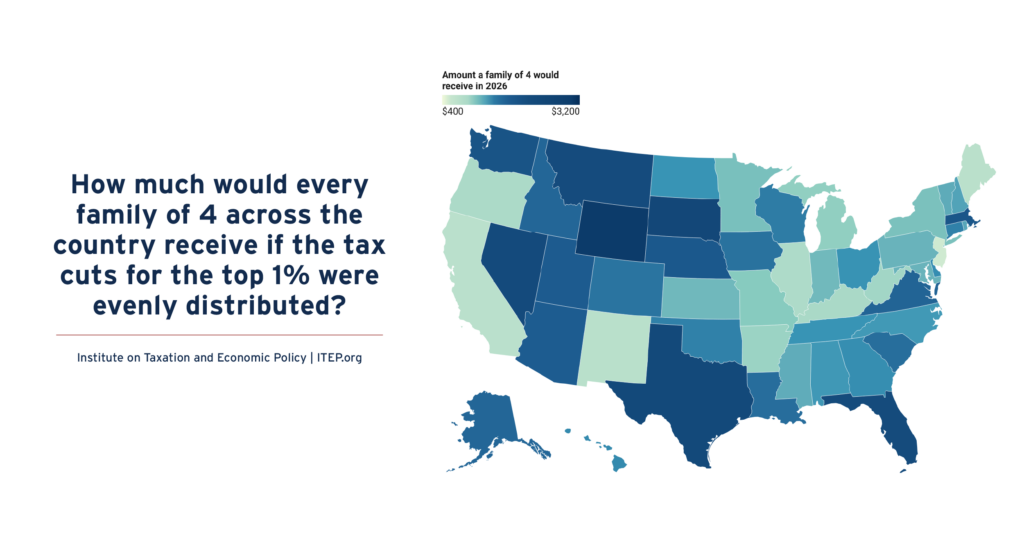
If instead of giving $117 billion to the richest 1 percent, that money had been evenly divided among all Americans, we'd each get $343 - or nearly $1,400 for a family of four.
Analysis of Tax Provisions in the Trump Megabill as Signed into Law: National and State Level Estimates
July 7, 2025 • By Steve Wamhoff, Carl Davis, Joe Hughes, Jessica Vela

President Trump has signed into law the tax and spending “megabill” that largely favors the richest taxpayers and provides working-class Americans with relatively small tax cuts that will in many cases be more than offset by Trump's tariffs.
Trump Megabill Will Give $117 Billion in Tax Cuts to the Top 1% in 2026. How Much In Your State?
June 30, 2025 • By Michael Ettlinger

The predominant feature of the tax and spending bill working its way through Congress is a massive tax cut for the richest 1 percent — a $114 billion benefit to the wealthiest people in the country in 2026 alone.
How Much Do the Top 1% in Each State Get from the Trump Megabill?
June 30, 2025 • By Carl Davis

The Senate tax bill under debate right now would bring very large tax cuts to very high-income people. In total, the richest 1 percent would receive $114 billion in tax cuts next year alone. That would amount to nearly $61,000 for each of these affluent households.
State legislatures are enjoying a relatively quiet period right now, though it is merely a temporary calm before the storm of the federal tax and budget debate begins raging again.
