
Alaska
POLITICO: Cannabis Was Supposed to Be a Tax Windfall for States. The Reality Has Been Different.
October 14, 2019
In all, five of the nine states that have set up tax systems for legalized marijuana employ cultivation levies on growers, while all but Alaska charge an excise tax specifically on cannabis sales. Five states also charge the general sales tax, though not the same exact group that has a cultivator tax. The actual effective […]
State Rundown 10/10: Always Something Old, Something New in State Tax Debates
October 10, 2019 • By ITEP Staff
Creative thinking from Pennsylvania lawmakers has helped them discover that the Wayfair ruling allowing states to collect sales tax from online retailers can also help them identify and tax corporate profits earned in their borders. Similarly, New York leaders had the vision to put bold environmental goals in place and identify a carbon price as a potential pay-for. Gubernatorial candidates in Mississippi and Kentucky showed less ingenuity, proposing tax cuts even though Mississippi is still phasing in a massive tax cut from a few years ago and Kentucky’s next election isn’t until 2020. Meanwhile, the old idea of eliminating income…
State Rundown 9/12: Work Continues to Flip the Script on Backwards Tax Codes
September 12, 2019 • By ITEP Staff
Residents of several states are spending their palindrome week reading ballot initiatives forwards and backwards to decide whether or not to support them, including measures to improve education funding in California and Idaho, allow Alaska and Colorado to invest more in public services, and constitutionally prohibit income taxation in Texas. New Jersey lawmakers are giving the same thorough treatment to the state’s corporate tax subsidies. And advocates in Chicago, Illinois, have a bold proposal to flip the script on upside-down taxes there. But devotees of good policy and honest government in North Carolina won’t want to re-read yesterday’s news in…
The hottest, stickiest month of the year has left a grimy feeling on several state tax debates, as Idaho lawmakers find themselves unable to fund the state’s priorities after years of cutting taxes, Alaskans express their support for public investments to their governor’s polling office and then watch the governor slash them anyway, New Jersey lawmakers go to bat for ineffective and corrupt business tax subsidies, and residents of North Carolina watch their representatives pursue cheap political points over sound investments and thoughtful policy. Nonetheless, residents and advocates on the other side of these and other debates have fought long…
State Rundown 8/15: A Tax-Subsidy Cease-Fire in Kansas and Missouri
August 15, 2019 • By ITEP Staff
Over the last couple of weeks, leaders in Kansas and Missouri reached a historic agreement to stop giving away tax subsidies just to entice companies a couple of miles across their shared state line. Meanwhile, policymakers in Alaska resolved a stand-off over education funding...by cutting education funding slightly less. And California voters may be voting in 2020 on a stronger reform to the notoriously inequitable property tax effects of “Proposition 13.”
Associated Press: Oil Unease: Alaska Faces Tough Budget Decisions
August 8, 2019
Carl Davis, research director with the Washington, D.C.-based Institute on Taxation and Economic Policy, said cutting the dividend is regressive, hitting lower-income families particularly hard. He sees no conflict between paying a dividend and taxing residents. While some Democrats want to debate oil taxes and whether companies are paying enough, Dunleavy has focused on cutting […]
State and Local Cannabis Tax Revenue on Pace for $1.6 Billion in 2019
August 7, 2019 • By Carl Davis
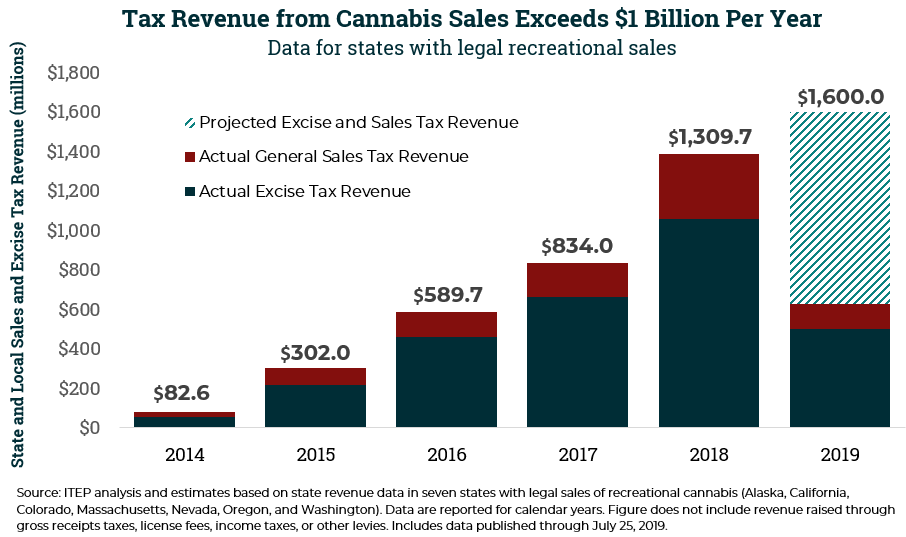
Cannabis tax revenue is becoming more significant as legal sales grow. The tax is far from a budgetary panacea, but an ITEP analysis of revenue data reported by the seven states with legal cannabis sales underway suggests that excise and sales tax revenues from the sale of the drug could reach $1.6 billion this year.
Anchorage Daily News: As Alaska’s Budget Uproar Rolls on, a Top Dunleavy Adviser Has Seen It Before
July 24, 2019
Arduin, Laffer & Moore has been criticized by economists for what some see as less than rigorous methods. One Oklahoma study on eliminating the state’s personal income tax produced by the firm was trashed as not “meeting professional standards” and including “biased and greatly exaggerated estimates” by University of Oklahoma and Oklahoma State University economists. […]
State Rundown 6/12: Progress in Taxing the Rich, Expanding EITCs, and Taming Tax Subsidies
June 12, 2019 • By ITEP Staff
This week saw lawmakers in Ohio propose significant harmful tax cuts, leaders in California and Oregon work toward strengthening the state Earned Income Tax Credits (EITCs), and governors in Missouri and Kansas declare a truce to end the practice of bribing businesses in the Kansas City area with tax cuts to move from one side of the state line to the other. Meanwhile, Massachusetts leaders are discussing ways of raising taxes on their richest households, which our latest Just Taxes blog post notes is a promising trend this year across many states.
State Rundown 5/22: (Some) State Lawmakers Can (Partly) Relax This Weekend
May 22, 2019 • By ITEP Staff
Lawmakers and advocates can enjoy their barbeques with only one eye on their work email this weekend in states that have essentially finished their budget debates such as Alaska, Minnesota, Nebraska, and Oklahoma, though both Alaska and Minnesota require special sessions to wrap things up. Getting to those barbeques may be a bumpy ride in Louisiana, Michigan, and other states still working to modernize outdated and inadequate gas taxes.
Gas Taxes Have Gone Up in Most States, but Decades-Long Procrastinators Remain
May 21, 2019 • By Carl Davis

The upcoming Memorial Day weekend marks the start of the traditional summer driving season. In most states, summer road-trippers are paying more gas tax than they did a few years ago and are benefiting from smoother and safer roads as a result. In total, 30 states have raised or reformed their gas taxes in the last six years.
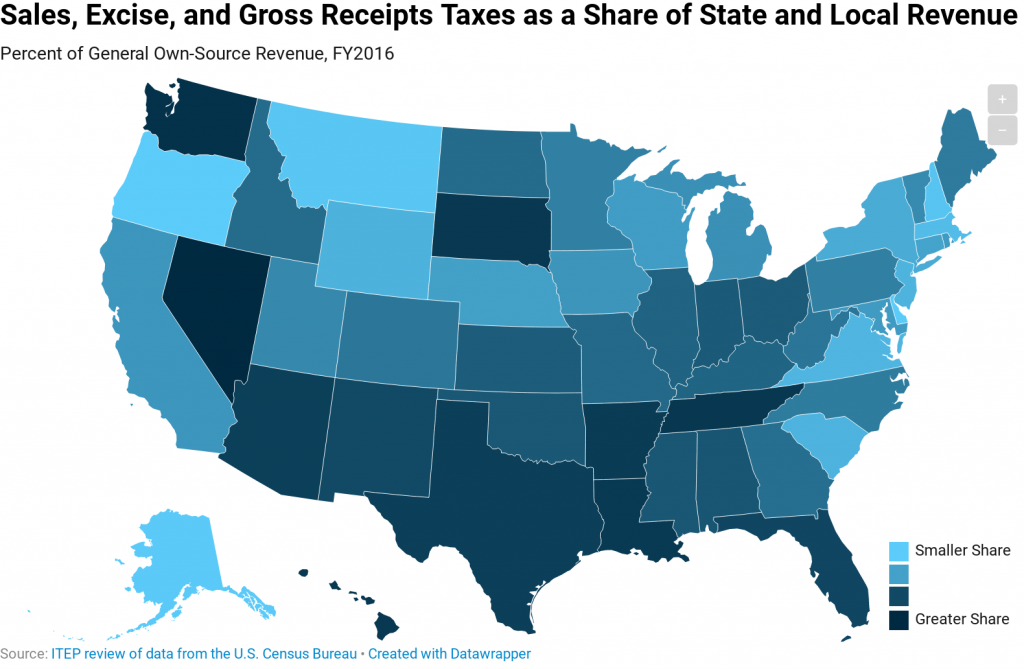
Consumption taxes (including general sales taxes, excise taxes on specific products, and gross receipts taxes) are an important revenue source for state and local governments. While five states lack state-level general sales taxes (Alaska, Delaware, Montana, New Hampshire, and Oregon), every state levies taxes on some types of consumption.
State Rundown 5/16: Tensions Remain High Over Budgets and School Finances in Several States
May 16, 2019 • By ITEP Staff
Tax and budget negotiations remain at standstills in Louisiana and Minnesota, as school funding debates and teacher protests again captured headlines in several states. Oregon lawmakers, for example, finally passed a mixed-bag tax package that won’t improve tax equity but will raise much-needed revenue for education. Meanwhile their counterparts in Nebraska continue to debate highly […]
State Rundown 4/26: Capital Gains Taxes Make Gains and Regressive Proposals Regress
April 26, 2019 • By ITEP Staff
Progressive capital gains tax proposals made news this week in Connecticut and Massachusetts, while Nebraskans came out in force to oppose a regressive tax shift, and North Carolina teachers prepare to rally over their legislature’s proclivity to cut taxes on wealthy households while underfunding schools.
The Case for Extending State-Level Child Tax Credits to Those Left Out: A 50-State Analysis
April 17, 2019 • By Aidan Davis, Meg Wiehe
As of 2017, 11.5 million children in the United States were living in poverty. A national, fully-refundable Child Tax Credit (CTC) would effectively address persistently high child poverty rates at the national and state levels. The federal CTC in its current form falls short of achieving this goal due to its earnings requirement and lack of full refundability. Fortunately, states have options to make state-level improvements in the absence of federal policy change. A state-level CTC is a tool that states can employ to remedy inequalities created by the current structure of the federal CTC. State-level CTCs would significantly reduce…
Fairness Matters: A Chart Book on Who Pays State and Local Taxes
March 6, 2019 • By ITEP Staff
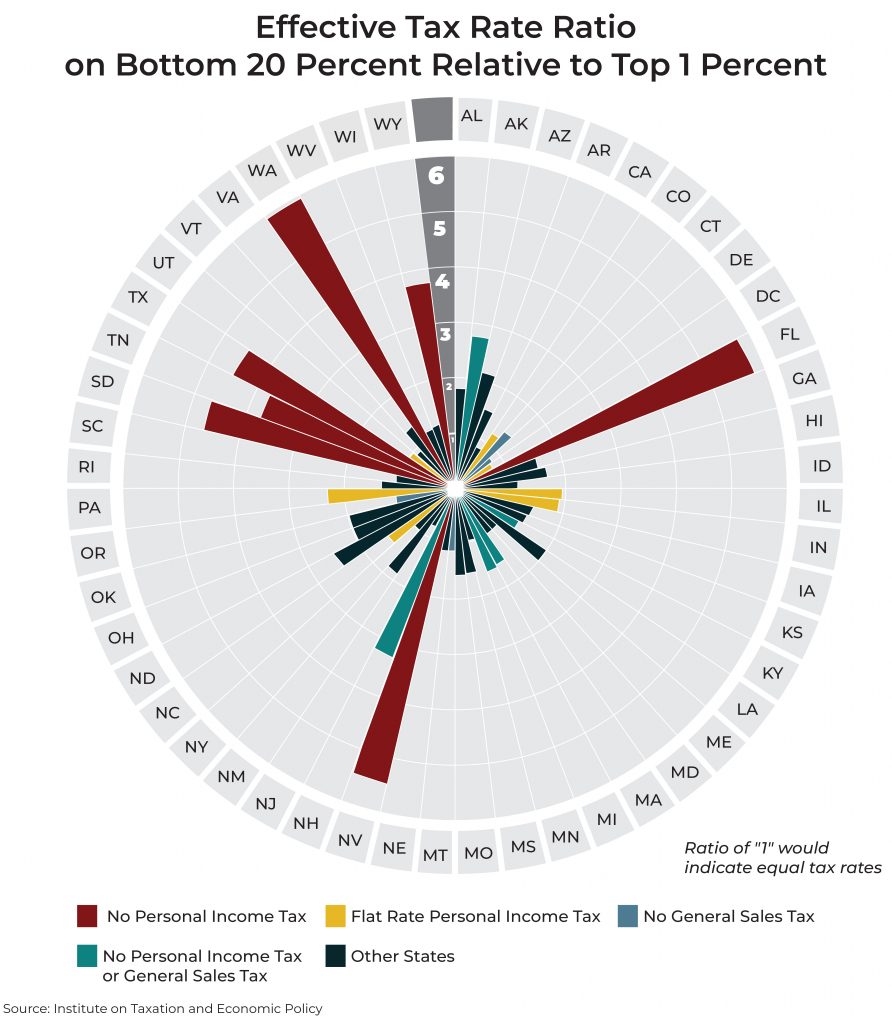
There is significant room for improvement in state and local tax codes. State tax codes are filled with top-heavy exemptions and deductions and often fail to tax higher incomes at higher rates. States and localities have come to rely too heavily on regressive sales taxes that fail to reflect the modern economy. And overall tax collections are often inadequate in the short-run and unsustainable in the long-run. These types of shortcomings provide compelling reason to pursue state and local tax reforms to make these systems more equitable, adequate, and sustainable.
Trends We’re Watching in 2019: Cannabis Tax Implementation and Reform
February 7, 2019 • By Carl Davis
Few areas of state tax policy have evolved as rapidly as cannabis taxation over the last few years. The first legal, taxable sale of recreational cannabis in modern U.S. history did not occur until 2014. Now, just five years later, a new ITEP report estimates that recreational cannabis is generating more than $1 billion annually in excise tax revenues and $300 million more in general sales tax dollars.
City Lab: The Airbnb Effect: It’s Not Just Rising Home Prices
February 4, 2019
And cities with less stringent Airbnb regulations might also be losing out on a lot of tax revenue. Traditional lodging entities (when combining city, state, and county taxes), are taxed at an average rate of 13 percent in the 150 largest cities. But Airbnb is treated differently in different jurisdictions, and is trusted to self-report […]
State Rundown 1/24: States Reflect on MLK’s Dream and Teacher Uprisings
January 24, 2019 • By ITEP Staff
This week, as Americans in every state celebrated Martin Luther King Jr. Day and reflected on his dream of peaceful protest and racial and economic justice, many eyes were on the teachers’ strike pressing for parts of this dream amid the “curvaceous slopes of California.” Governors and lawmakers in many states—including Arizona, Georgia, Indiana, Louisiana, Nevada, New Mexico, South Carolina, and Wisconsin—discussed ways to raise pay for teachers and/or enhance education investments generally.
Bloomberg: Cannabis Excise Tax Revenue Could Eclipse Alcohol Revenue in 2019
January 23, 2019
Excise tax revenue from marijuana sales is expected to surpass alcohol excise collections in 2019, according to the co-author of a new report. Carl Davis, a research director at the Institute on Taxation and Economic Policy, noted in his report that state and local retail marijuana excise tax collections already rivaled alcohol tax collections in […]
Five Years in, Cannabis Tax Haul Rivals or Exceeds Alcohol Taxes in Many States
January 23, 2019 • By ITEP Staff
A first-of-its-kind look at state excise taxes on legal cannabis sales finds that taxing the substance can be a meaningful source of state revenue but cautions that achieving sustainable revenues over time will be difficult under the price-based tax structures adopted in most states thus far.
State policy toward cannabis is evolving rapidly. While much of the debate around legalization has rightly focused on potential health and criminal justice impacts, legalization also has revenue implications for state and local governments that choose to regulate and tax cannabis sales. This report describes the various options for structuring state and local taxes on cannabis and identifies approaches currently in use. It also undertakes an in-depth exploration of state cannabis tax revenue performance and offers a glimpse into what may lie ahead for these taxes.
Cannabis Tax Debates are Ramping Up; Here’s What We’ve Learned from Five Years of Cannabis Taxation Thus Far
January 23, 2019 • By Carl Davis
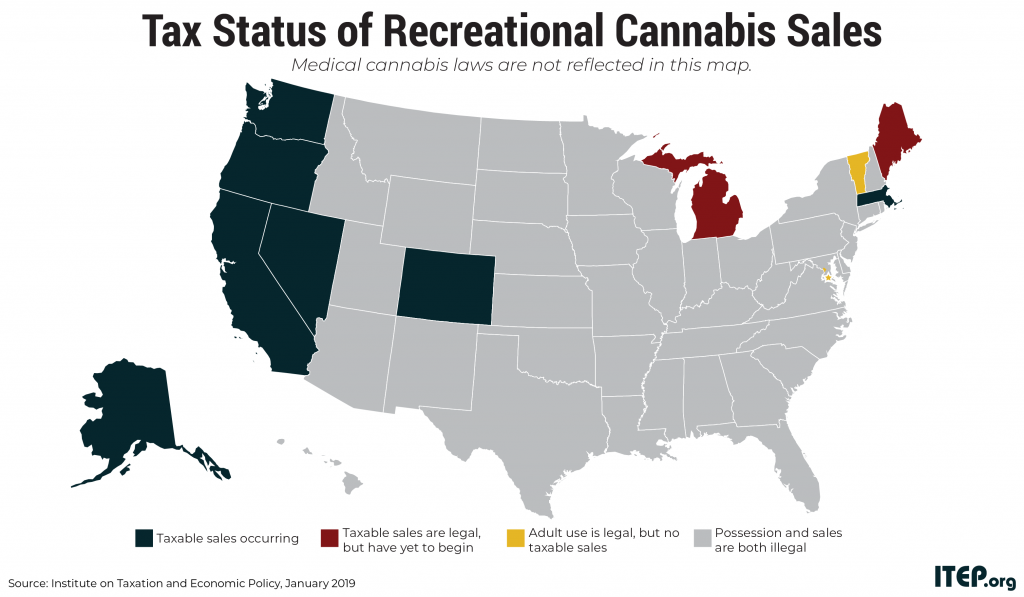
This year lawmakers in Connecticut, Delaware, Hawaii, Illinois, New Jersey, New York, Rhode Island, and Vermont will all be debating the taxation of recreational cannabis. A new ITEP report reviews the track record of recreational cannabis taxes thus far and offers recommendations for structuring cannabis taxes to achieve stable revenue growth over the long haul.
A Simple Fix for a $17 Billion Loophole: How States Can Reclaim Revenue Lost to Tax Havens
January 17, 2019 • By Richard Phillips
Enacting Worldwide Combined Reporting or Complete Reporting in all states, this report calculates, would increase state tax revenue by $17.04 billion dollars. Of that total, $2.85 billion would be raised through domestic Combined Reporting improvements, and $14.19 billion would be raised by addressing offshore tax dodging (see Table 1). Enacting Combined Reporting and including known tax havens would result in $7.75 billion in annual tax revenue, $4.9 billion from income booked offshore.
State Rundown 12/19: Time to Rest and Recharge for Big Year Ahead
December 19, 2018 • By ITEP Staff
With many people enjoying time off over the next couple weeks, and the longest nights of the year coming over the weekend, now is a good time to get plenty of rest and relaxation in advance of what is likely to be a very busy 2019 for state fiscal policy and other debates. Among those debates, Kentucky lawmakers will be returning to topics they could not resolve in a brief special session held this week, New Jersey and New York will both be deciding how to legalize and tax cannabis, and gas tax updates will be on the agenda in…

Institute on Taxation
and Economic Policy
ITEP is a non-profit, non-partisan tax policy organization. We conduct rigorous analyses of tax and economic proposals and provide data-driven recommendations to shape equitable and sustainable tax systems.
Subscribe to ITEP Emails
Tax research and policy news in your inbox.
Promote Fair Tax Policy
Your gift to ITEP promotes tax justice. With your help, we do research that supports taxing millionaires and billionaires, taxing big corporations and raising revenue for the things our people, our communities and our planet need.
Together, we can create a country with more economic justice, more racial justice, more climate justice… and more tax justice.