
Ohio
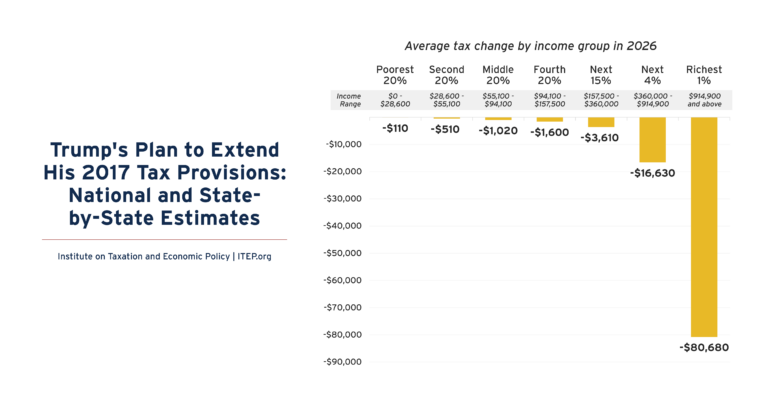
Trump’s Plan to Extend His 2017 Tax Provisions: Updated National and State-by-State Estimates
• By Steve Wamhoff
Trump’s plan to make most of the temporary provisions of his 2017 tax law permanent would disproportionately benefit the richest Americans. This includes all major provisions except the $10,000 cap on deductions for state and local taxes (SALT) paid.
On Election Day, Voters Across the Country Chose to Invest in Their States & Communities
• By Kamolika Das
On election day, voters across the country — in states red and blue and communities rural and urban — approved a wide range of state and local ballot measures on taxation and public investment. The success of these measures clearly shows that voters are willing to invest in public priorities that feel tangible and close to home.
Tax Justice in the Crosshairs
• By Amy Hanauer
Billionaires and businesses have too much power in Washington. Tax revenue is needed to pay for things we all need. If we want economic justice, racial justice and climate justice, we must have tax justice.
2024 Local Tax Ballot Measures: Voters in Dozens of Communities Will Shape Local Policy
• By Rita Jefferson
Next month, voters across the country will weigh in on many local ballot measures that will have a profound effect on the adequacy of our local tax systems and whether cities and communities can fund public needs. These are in addition to statewide ballot questions, many of which have local implications this year.
Policy Matters Ohio: The Great Ohio Tax Shift, 2024
• By ITEP Staff
Major tax policy changes enacted by Ohio lawmakers since Governor Taft’s 2005 State Budget Bill ask families with the lowest incomes to pay more, the wealthy to pay less, and the state to forgo the resources it needs to ensure the prosperity of its residents. Those are the conclusions of a new analysis conducted for Policy Matters by the Institute on Taxation and Economic Policy (ITEP).

Extending Temporary Provisions of the 2017 Trump Tax Law: Updated National and State-by-State Estimates
• By Steve Wamhoff
The TCJA Permanency Act would make permanent the provisions of the Tax Cuts and Jobs Act of 2017 that are set to expire at the end of 2025. The legislation would disproportionately benefit the richest Americans. Below are graphics for each state that show the effects of making TCJA permanent across income groups. See ITEP’s […]
State Earned Income Tax Credits Support Families and Workers in 2024
• By Neva Butkus
Nearly two-thirds of states (31 plus the District of Columbia and Puerto Rico) have an Earned Income Tax Credit. These credits boost low-paid workers’ incomes and offset some of the taxes they pay, helping lower-income families achieve greater economic security.

Sales Tax Holidays Miss the Mark When it Comes to Effective Sales Tax Reform
• By Marco Guzman
Nineteen states have sales tax holidays on the books in 2024. These suspensions combined will cost states and localities over $1.3 billion in lost revenue this year. Sales tax holidays are poorly targeted and too temporary to meaningfully change the regressive nature of a state’s tax system.

Tax Payments by Undocumented Immigrants
• By ITEP Staff
Undocumented immigrants paid $96.7 billion in federal, state, and local taxes in 2022. Providing access to work authorization for undocumented immigrants would increase their tax contributions both because their wages would rise and because their rates of tax compliance would increase.

Five Tax Takeaways from 2024 State Legislative Sessions
• By Aidan Davis
Major tax cuts were largely rejected this year, but states continue to chip away at income taxes. And while property tax cuts were a hot topic across the country, many states failed to deliver effective solutions to affordability issues.
Improving Refundable Tax Credits by Making Them Immigrant-Inclusive
• By Emma Sifre, Marco Guzman
Undocumented immigrants who work and pay taxes but don't have a valid Social Security number for either themselves or their children are excluded from federal EITC and CTC benefits. Fortunately, several states have stepped in to ensure undocumented immigrants are not left behind by the gaps in the federal EITC and CTC. State lawmakers should continue to ensure that immigrants who are otherwise eligible for these tax credits receive them.
State Rundown 7/11: Mansion Taxes in the Spotlight
• By ITEP Staff
While Massachusetts legislators recently dropped a real estate transfer tax from their major housing bill, the District of Columbia council sent a budget to the mayor that includes a mansion tax that would increase the tax rate on properties valued over $2.5 million. Meanwhile, lawmakers in New Jersey and South Carolina continue to, respectively, raise and reduce needed revenues.

States Should Enact, Expand Mansion Taxes to Advance Fairness and Shared Prosperity
• By Carl Davis, Erika Frankel
The report was produced in partnership with the Center on Budget and Policy Priorities and co-authored by CBPP’s Deputy Director of State Policy Research Samantha Waxman.[1] Click here to use our State Mansion Tax Estimator A historically large share of the nation’s wealth is concentrated in the hands of a few, a reality glaring in […]
State Rundown 6/13: Decisions are falling into place, but some states will come back for more
• By ITEP Staff
State budgets are falling into place as lawmakers near the end of their legislative sessions...
Policy Matters Ohio: Income Tax Extremism Is a Gift to the Wealthy. Repairing the Damage Would Cost Us All
• By ITEP Staff
Ohioans deserve an equitable tax system that supports the public goods and services that enable all of us to thrive. Unfortunately, that is not the system we have today. After two decades of tax handouts to corporations and the rich, our upside-down tax system increasingly perpetuates inequality while failing to adequately fund services like education and health care. This all pales in comparison to the extreme proposal from lawmakers that would eliminate the state’s personal…
State Rundown 5/15: The Merry Merry Month of May(be)
• By ITEP Staff
Uncertainty abounds in state tax debates lately...
State Rundown 4/17: Tax Cut Proposals and the Consequences of Bad Tax Cuts
• By ITEP Staff
Happy (belated) Tax Day!
Eliminating Income Taxes Would Be an Expensive Giveaway
• By Aidan Davis
Governors and legislative leaders in a dozen states have made calls to fully eliminate their taxes on personal or corporate income, after many states already deeply slashed them over the past few years. The public deserves to know the true impact of these plans, which would inevitably result in an outsized windfall to states’ richest taxpayers, more power in the hands of wealthy households and corporations, extreme cuts to basic public services, and more deeply inequitable state…
Audio: ITEP’s Carl Davis Talks to Ohio Newsroom About That State’s Upside-Down Tax Code
February 20, 2024
Ohio’s poorest residents pay a greater percentage of their income to state and local taxes than the richest Ohioans, according to a recent report from the nonpartisan Institute on Taxation and Economic Policy. It found that Ohio has the 15th most unequal tax system in the country.
Policy Matters Ohio: New Data Show Just How Upside-Down Ohio’s Tax Code Is
• By ITEP Staff
In 2023, the lowest-paid Ohioans spent more than twice as much of their income on state and local taxes than the highest-paid, according to a new study by the Institute on Taxation and Economic Policy (ITEP).
State Tax Watch 2024
• By ITEP Staff
Updated July 15, 2024 In 2024, state lawmakers have a choice: advance tax policy that improves equity and helps communities thrive, or push tax policies that disproportionately benefit the wealthy, drain funding for critical public services, and make it harder for low-income and working families to get ahead. Despite worsening state fiscal conditions, we expect […]
Ohio: Who Pays? 7th Edition
• By ITEP Staff
Ohio Download PDF All figures and charts show 2024 tax law in Ohio, presented at 2023 income levels. Senior taxpayers are excluded for reasons detailed in the methodology. Our analysis includes nearly all (99.6 percent) state and local tax revenue collected in Ohio. State and local tax shares of family income Top 20% Income Group […]
State Rundown 12/14: Tax Policy Debates Ramp Up for 2024
• By ITEP Staff
Even as revenue collections slow in many states, some are starting the push for 2024 tax cuts early. For instance, policymakers in Georgia and Utah are already making the case for deeper income tax cuts. Meanwhile, Arizona lawmakers are now facing a significant deficit, the consequence of their recent top-heavy tax cuts. There is another […]
State Rundown 11/29: Thankful for Good Tax Policy
• By ITEP Staff
Though Turkey Day has passed, lawmakers in states across the U.S. have yet to get their fill of delicious tax policy goodness...
Hidden in Plain Sight: Race and Tax Policy in 2023 State Legislative Sessions
• By Brakeyshia Samms
Race was front and center in a lot of state policy debates this year, from battles over what’s being taught in schools to disagreements over new voting laws. Less visible, but also extremely important, were the racial implications of tax policy changes. What states accomplished this year – both good and bad – will acutely affect people and families of color.

Institute on Taxation
and Economic Policy
ITEP is a non-profit, non-partisan tax policy organization. We conduct rigorous analyses of tax and economic proposals and provide data-driven recommendations to shape equitable and sustainable tax systems.
Subscribe to ITEP Emails
Tax research and policy news in your inbox.
Promote Fair Tax Policy
Your gift to ITEP promotes tax justice. With your help, we do research that supports taxing millionaires and billionaires, taxing big corporations and raising revenue for the things our people, our communities and our planet need.
Together, we can create a country with more economic justice, more racial justice, more climate justice… and more tax justice.