
Oregon
State Rundown 6/28: States Scramble to Finish Budgets Before July Deadlines
June 28, 2017 • By ITEP Staff
This week, several states attempt to wrap up their budget debates before new fiscal years (and holiday vacations) begin in July. Lawmakers reached at least short-term agreement on budgets in Alaska, New Hampshire, Rhode Island, and Vermont, but such resolution remains elusive in Connecticut, Delaware, Illinois, Maine, Pennsylvania, Washington, and Wisconsin.
Explaining our Analysis of Washington State’s Highly Regressive Tax Code
June 22, 2017 • By Carl Davis
Supporters of creating a local personal income tax in Seattle are rightly concerned about the lopsided nature of their state’s tax code. In a 50-state study titled Who Pays?, produced using our microsimulation tax model, we found that Washington State’s tax system is the most regressive in the nation.
State Rundown 6/21: Crunch Time for Many States with New Fiscal Year on Horizon
June 21, 2017 • By Meg Wiehe
This week several states rush to finalize their budget and tax debates before the start of most state fiscal years on July 1. West Virginia lawmakers considered tax increases as part of a balanced approach to closing the state’s budget gap but took a funding-cuts-only approach in the end. Delaware legislators face a similar choice, […]
Oregon Center for Public Policy: Reason to Hope for a Commercial Activities Tax (CAT) Accompanied by a CAT Fairness Credit
June 21, 2017
The CAT Fairness Credit would be a credit on personal income taxes based on family size and income. It would cost about the same as the combined impact of the personal income tax changes and EITC increase, and would target relief to low- and middle-income taxpayers.
Oregon Center for Public Policy: Commercial Activities Tax Fairness Credit Would Strengthen the Tax Reform Package
June 9, 2017
Analysis by the Institute on Taxation and Economic Policy (ITEP) shows that, all else being equal, a tax reform package with a CAT Fairness Credit would be more progressive than a tax reform package with an income tax rate reduction.
State Rundown 5/31: Budget Woes Spurring Special Legislative Sessions
May 31, 2017 • By ITEP Staff
This week, special legislative sessions featuring tax and budget debates are underway or in the works in Kentucky, Minnesota, New Mexico, and West Virginia, as lawmakers are also running up against regular session deadlines in Illinois, Kansas, and Oklahoma. Meanwhile, a legislative study in Wyoming and an independent analysis in New Jersey are both calling for tax increases to overcome budget shortfalls.
This week saw tax debates heat up in many states. Late-session discovered revenue shortfalls, for example, are creating friction in Delaware, New Jersey, and Oklahoma, while special sessions featuring tax debates continue in Louisiana, New Mexico, and West Virginia. Meanwhile the effort to revive Alaska's personal income tax has cooled off.
State Rundown 5/10: Spring Tax Debates at Different Stages in Different States
May 10, 2017 • By Meg Wiehe
This week saw a springtime mix of state tax debates in all stages of life. In West Virginia and Louisiana, debates over income tax reductions and comprehensive tax reform are full of vigor. Other debates that bloomed earlier are now settled, such as Florida‘s now-complete budget debate and the more florid debates over gas taxes […]
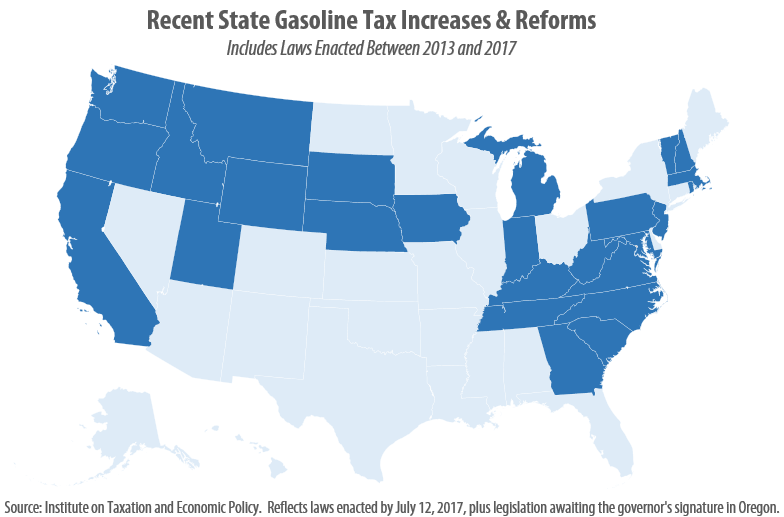
This post was updated July 12, 2017 to reflect recent gas tax increases in Oregon and West Virginia. As expected, 2017 has brought a flurry of action relating to state gasoline taxes. As of this writing, eight states (California, Indiana, Montana, Oregon, South Carolina, Tennessee, Utah, and West Virginia) have enacted gas tax increases this year, bringing the total number of states that have raised or reformed their gas taxes to 26 since 2013.
Bloomberg BNA: Q and A with ITEP’s Meg Wiehe
May 10, 2017
Bloomberg BNA: Tell us a little bit about yourself and your work at the Institute on Taxation and Economic Policy (ITEP)? Wiehe: I am ITEP Deputy Director, my primary responsibility being to plan and execute state policy work, so I have a real bird’s eye view for what is happening in all 50 states, plus […]
Time to Repeal State Deductions for Federal Income Taxes
May 1, 2017 • By Dylan Grundman O'Neill
Three of the biggest needs facing state policymakers right now are new revenues to fund their priorities in the face of budget shortfalls and federal funding cuts, ways to insulate those revenue streams from unpredictable tax changes at the federal level, and approaches to meet these needs without leaning even more heavily on low- and […]
Why States That Offer the Deduction for Federal Income Taxes Paid Get It Wrong
May 1, 2017 • By Dylan Grundman O'Neill
With many states currently facing budget shortfalls—whether due to weak economic recovery after the Great Recession, struggling commodity prices, or self-inflicted tax cuts—and all states bracing for possible federal budget cuts in areas from education to health care to infrastructure, states are unlikely to be able to continue providing high-quality services to their residents without raising new revenue. In this context, states must find ways to generate additional revenue without increasing taxes on individuals and families who are already struggling to make ends meet and may bear the biggest brunt of federal funding cuts.
Oregon Center for Public Policy: State corporate income taxes continue to shrink
April 27, 2017
As Oregon lawmakers consider raising corporate taxes to prevent cuts to schools and other public services, a new report finds that many of the nation’s largest corporations are paying little or nothing in state income taxes across the country. Despite reporting large profits to shareholders, these corporations are paying less to states in income taxes […]
3 Percent and Dropping: State Corporate Tax Avoidance in the Fortune 500, 2008 to 2015
April 27, 2017 • By Aidan Davis, Matthew Gardner, Richard Phillips
The trend is clear: states are experiencing a rapid decline in state corporate income tax revenue. Despite rebounding and even booming bottom lines for many corporations, this downward trend has become increasingly apparent in recent years. Since our last analysis of these data, in 2014, the state effective corporate tax rate paid by profitable Fortune 500 corporations has declined, dropping from 3.1 percent to 2.9 percent of their U.S. profits. A number of factors are driving this decline, including: a race to the bottom by states providing significant “incentives” for specific companies to relocate or stay put; blatant manipulation of…
State Rundown 4/27: States Finally Reaching Resolution on Gas Taxes
April 27, 2017 • By ITEP Staff
This week, transportation funding debates finally concluded with gas tax updates in Indiana, Montana, and Tennessee, and appear to be nearing an end in South Carolina. Meanwhile, Louisiana and Oregon lawmakers debated new Gross Receipts Taxes, and Texas legislators considered eliminating the state’s franchise tax. — Meg Wiehe, ITEP Deputy Director, @megwiehe Louisiana Gov. Bel Edward’s Commercial Activities Tax (CAT) was pulled from committee early this week without a vote due to opposition, […]
Tax Justice Digest: Trickle-down revived, corps aren’t paying state taxes, young immigrants and taxes, etc.
April 27, 2017 • By ITEP Staff
In the Tax Justice Digest we recap the latest reports, blog posts, and analyses from Citizens for Tax Justice and the Institute on Taxation and Economic Policy. Here’s a rundown of what we’ve been working on lately. Here we go again The Trump Administration on Wednesday released a tax sketch that is a roadmap for […]
Oregon Center for Public Policy: Undocumented Workers Pay Millions in Oregon Taxes and Would Pay Millions More Under Immigration Reform
April 17, 2017
Undocumented Oregonians pay taxes. The millions in taxes they pay to help fund schools and other public services that strengthen Oregon’s economy. Oregon would collect even more tax revenue under comprehensive immigration reform that would open a path to citizenship for undocumented workers. Under such a scenario, these immigrant Oregonians and aspiring citizens would contribute […]
Testimony before the Alaska House Labor & Commerce Committee On House Bill 36
April 4, 2017 • By Matthew Gardner
Thank you for the opportunity to testify on the changes House Bill 36 would make to Alaska's tax treatment of pass-through income. The taxation of pass-through business entities has been a focal point of state and federal tax reform debates for over a quarter century, with a dual focus on minimizing the role of tax laws in determining the choice of business entity and on ensuring that the income of all business entities is subject to at least a minimal tax. My testimony makes two main points: 1. Alaska is one of a small number of states that do not…
State tax debates have been very active this week. Efforts to eliminate the income tax continue in West Virginia. Policymakers in many states are responding to revenue shortfalls in very different ways: some in Iowa, Mississippi, and Nebraska seek to dig the hole even deeper with tax cuts, while the Missouri House’s response has been […]
The Oregonian: Bills would force Oregon companies to share tax information
March 9, 2017
Ryan Deckert, president of the Oregon Business Association, said competitors in other states would use the information to get a leg up on the competition. According to the Institute on Taxation and Economic Policy, few states require companies to share tax information, but Massachusetts, per its state website, requires disclosure of sales, profits, taxes paid, […]
Undocumented Immigrants’ State & Local Tax Contributions
March 1, 2017 • By Lisa Christensen Gee, Meg Wiehe, Misha Hill
Public debates over federal immigration reform, specifically around undocumented immigrants, often suffer from insufficient and inaccurate information about the tax contributions of undocumented immigrants, particularly at the state level. The truth is that undocumented immigrants living in the United States paybillions of dollars each year in state and local taxes. Further, these tax contributions would increase significantly if all undocumented immigrants currently living in the United States were granted a pathway to citizenship as part of comprehensive immigration reform. Or put in the reverse, if undocumented immigrants are deported in high numbers, state and local revenues could take a substantial…
The Register Guard: Deportation Plan Will Have Major Impact on Oregon
February 28, 2017
Also facing deportation are homeowners, entrepreneurs (an estimated 5,700 in Oregon) who have created jobs, community volunteers and young people who were born in Mexico but have been educated in Oregon public schools. In some cases, minor children born in the United States will face the loss of one or both parents — or de […]
This week saw a nearly successful attempt to right the fiscal ship in Kansas; regressive tax proposals introduced in WestVirginia, Georgia, and Missouri; ongoing gas tax fights in Indiana, South Carolina, and Tennessee; and further tax and budget wrangling in Illinois, New Mexico, Oklahoma, and beyond. — Meg Wiehe, ITEP State Policy Director, @megwiehe Both […]
This week we are following a number of significant proposals being debated or introduced including reinstating the income tax in Alaska and eliminating the tax in West Virginia, establishing a regressive tax-cut trigger in Nebraska, restructuring the Illinois sales tax, moving New Mexico to a flat income tax and broader gross receipts tax, and updating […]
This is the second installment of our six part series on 2017 state tax trends. The introduction to this series is available here. State tax policy can be a divisive issue, but no area has generated more agreement among lawmakers across the country than the need to raise new revenues to fund infrastructure improvements. The […]

Institute on Taxation
and Economic Policy
ITEP is a non-profit, non-partisan tax policy organization. We conduct rigorous analyses of tax and economic proposals and provide data-driven recommendations to shape equitable and sustainable tax systems.
Subscribe to ITEP Emails
Tax research and policy news in your inbox.
Promote Fair Tax Policy
Your gift to ITEP promotes tax justice. With your help, we do research that supports taxing millionaires and billionaires, taxing big corporations and raising revenue for the things our people, our communities and our planet need.
Together, we can create a country with more economic justice, more racial justice, more climate justice… and more tax justice.