
Tennessee

State Rundown 2/22: Some Top-Heavy Tax Cut Proposals are Getting the Chop
• By ITEP Staff
With many state legislatures now in full swing with activity heating up, some tax cut proposals have lost steam...
The ‘Low-Tax’ Lie: States Hyped for Low Taxes Usually Only Low-Tax for the Rich
• By Jon Whiten
It’s hard to go a week without seeing a politician or a news article hype up a state as the place that everyone is moving to – or should move to – because of low taxes. However, there’s a big problem with these proclamations: they aren’t true.
State Rundown 2/8: Flowers, Chocolates, and Tax Cuts for the Wealthy?
• By ITEP Staff
While we were hoping to get progressive tax policy wins for Valentine’s Day, many state lawmakers have another idea in mind...
State Rundown 2/1: Black History Month Begins as Tax Debates Heat Up Nationwide
• By ITEP Staff
This week the showdown between the Kansas legislature and governor continued as Gov. Kelly vetoed the legislature’s latest attempt to pass a flat personal income tax. Elsewhere, the focus is on doing more for working families through proposals to expand refundable credits in Maryland and adding a millionaire tax bracket in Rhode Island. Meanwhile, there’s […]
State Rundown 1/26: Wealth Taxes Drawing Interest Early in Legislative Sessions
• By ITEP Staff
Bills are moving and state legislative sessions are picking up across the country, giving elected officials the opportunity to consider two distinct paths when it comes to tax policy...
State Tax Watch 2024
• By ITEP Staff
Updated July 15, 2024 In 2024, state lawmakers have a choice: advance tax policy that improves equity and helps communities thrive, or push tax policies that disproportionately benefit the wealthy, drain funding for critical public services, and make it harder for low-income and working families to get ahead. Despite worsening state fiscal conditions, we expect […]

How the Fairness of State Tax Codes Affects Public Education
• By Carl Davis
The findings of Who Pays? go a long way toward explaining why so many states are failing to raise the amount of revenue needed to provide full and robust support for our public schools.
MarketWatch: Moving to Florida Might Not Be the Tax Play It’s Cracked Up to Be — Unless You’re Loaded
January 12, 2024
Florida, Texas and Tennessee have become hot real-estate markets in recent years, in part because they offer the allure of low taxes and cheap living costs. But a new analysis of how much state and local taxes cost rich and poor residents in those states throws cold water on the assumption that moving to states like Florida […]
State Rundown 1/11: Sounding the Alarm on Regressive State & Local Tax Codes
• By ITEP Staff
States got a wake-up call this week as ITEP released the latest edition of our flagship Who Pays? report...
In Most States, the Tax Code Makes Inequality Worse
• By Carl Davis
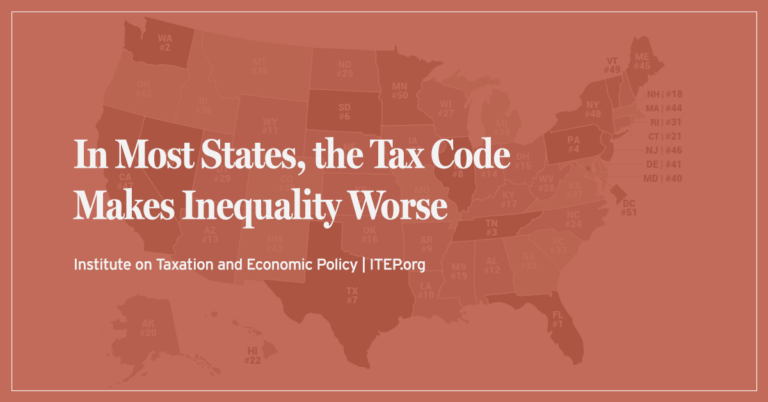
The vast majority of state and local tax systems are upside-down, with the wealthy paying a far lesser share of their income in taxes than low- and middle-income families. Yet a few states have made strides to buck that trend and have tax codes that are somewhat progressive and therefore do not worsen inequality.
Tax Systems in 44 States Exacerbate Inequality, In-Depth ‘Who Pays?’ Study Finds
• By ITEP Staff
The vast majority of state and local tax systems are upside-down, with the wealthy paying a far lesser share of their income in taxes than low- and middle-income families. That’s according to the latest edition of the Institute on Taxation and Economic Policy’s Who Pays?, the only distributional analysis of tax systems in all 50 states and the District of Columbia.
Tennessee: Who Pays? 7th Edition
• By ITEP Staff
Tennessee Download PDF All figures and charts show 2024 tax law in Tennessee, presented at 2023 income levels. Senior taxpayers are excluded for reasons detailed in the methodology. Our analysis includes nearly all (99.3 percent) state and local tax revenue collected in Tennessee. State and local tax shares of family income Top 20% Income Group […]

Abortion-Restricting States Skimp on Funding for Children
• By Amy Hanauer
States differ dramatically in how much they allow families to make choices about whether and when to have children and how much support they provide when families do. But there is a clear pattern: the states that compel childbirth spend less to help children once they are born.
State Rundown 11/8: Election Results Bring Victories, Opportunities for More Common-Sense Tax Reform
• By ITEP Staff
Voters had the chance to impact tax policy across the country on election day, and some chose to enact common-sense reforms to raise revenue...
State Rundown 8/10: Pump the ‘Breaks’ on Sales Tax Holiday Celebrations
• By ITEP Staff
August is here, school is starting, and with that comes back to school shopping...
Gimmicky Sales Tax Holidays to Cost States & Localities $1.6 Billion This Year
• By ITEP Staff
Sales tax holidays are bad policies that have too often been used as a substitute for more meaningful, permanent reform.
Sales Tax Holidays: An Ineffective Alternative to Real Sales Tax Reform
• By Marco Guzman
Nineteen states have sales tax holidays on the books in 2023, and these suspensions will cost nearly $1.6 billion in lost revenue this year. Sales tax holidays are poorly targeted and too temporary to meaningfully change the regressive nature of a state’s tax system. Overall, the benefits of sales tax holidays are minimal while their downsides are significant.

States and Localities are Making Progress on Curbing Unjust Fees and Fines
• By Andrew Boardman
Too many state and local governments tap legal-system collections, rather than adequate tax systems, to fund shared essentials like public safety and education. But a growing number of states and localities are choosing a better approach. Momentum for change has continued to build in 2023, with no fewer than seven states enacting substantial improvements.
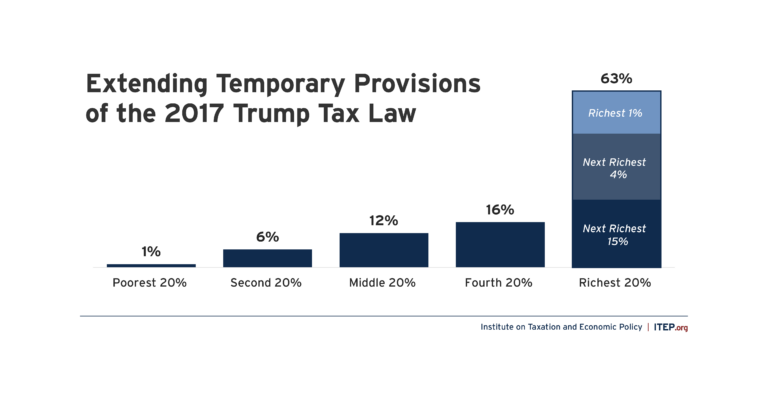
Extending Temporary Provisions of the 2017 Trump Tax Law: National and State-by-State Estimates
• By Joe Hughes, Matthew Gardner, Steve Wamhoff
The push by Congressional Republicans to make the provisions of the 2017 Tax Cuts and Jobs Act permanent would cost nearly $300 billion in the first year and deliver the bulk of the tax benefits to the wealthiest Americans.

8 Things to Know About State Taxes
• By Jon Whiten
As Tax Day approaches, it’s worth thinking about not only the taxes that we individually pay but the overall condition of our tax code as well. State tax codes, while perhaps less discussed than the federal system, are critically important. Depending on how they are designed, state taxes can improve or worsen economic and racial […]
State Rundown 2/9: We <3 Taxes
• By ITEP Staff
The great women’s philosopher, Pat Benatar, once said “love is a battlefield,” and there’s no greater test of our love for state tax policy than following the ups and downs of state legislative sessions...
State Rundown 2/1: February Brings New (and Some Old) Tax Policy Conversations
• By ITEP Staff
Tax bills across the U.S. are winding their way through state legislatures and governors continue to set the tone for this year’s legislative sessions...

State Child Tax Credits and Child Poverty: A 50-State Analysis
• By Aidan Davis
Regardless of future Child Tax Credit developments at the federal level, state policies can supplement the federal credit to deliver additional benefits to children and families. State credits can be specifically tailored to meet the needs of local populations while also producing long-term benefits for society as a whole

State Rundown 6/22: Southern States Edition
• By ITEP Staff
With many state legislative sessions wrapped or wrapping up, we at ITEP want to take a moment to direct your attention south, and specifically, to the American South...
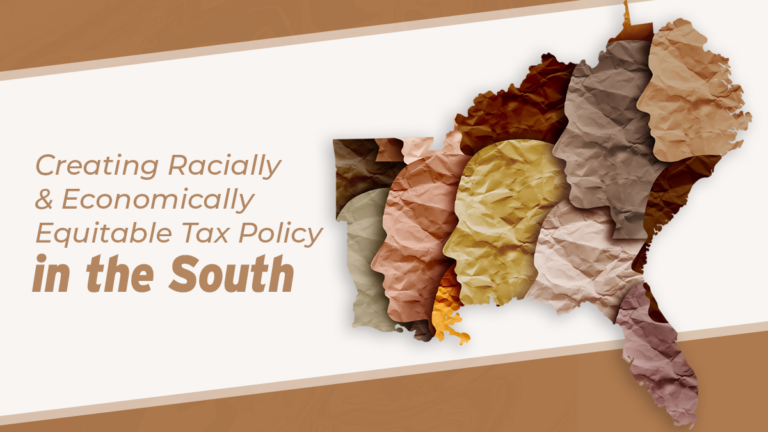
Creating Racially and Economically Equitable Tax Policy in the South
• By Kamolika Das
The South's negative outcomes on measures of wellbeing are the result of a century and a half of policy choices. Lawmakers have many options available to make concrete improvements to tax policy that would raise more revenue, do so equitably, and generate resources that could improve schools, healthcare, social services, infrastructure, and other public resources.

Institute on Taxation
and Economic Policy
ITEP is a non-profit, non-partisan tax policy organization. We conduct rigorous analyses of tax and economic proposals and provide data-driven recommendations to shape equitable and sustainable tax systems.
Subscribe to ITEP Emails
Tax research and policy news in your inbox.
Promote Fair Tax Policy
Your gift to ITEP promotes tax justice. With your help, we do research that supports taxing millionaires and billionaires, taxing big corporations and raising revenue for the things our people, our communities and our planet need.
Together, we can create a country with more economic justice, more racial justice, more climate justice… and more tax justice.