
Texas
Tax changes have been proposed or are nearing the finish line in many states. Kentucky is poised to enact an income tax cut as a bill heads to the governor’s desk. In Pennsylvania, Gov. Josh Shapiro’s budget proposal called to accelerate existing corporate tax cuts while closing corporate tax loopholes by enacting combined reporting. Ohio Gov. Mike DeWine proposed a new credit for children of working parents. And Virginia Democrats countered Gov. Glenn Youngkin’s proposed tax cuts with a plan of their own that includes an increase to the state’s Earned Income Tax Credit (EITC) and a one-time, nonrefundable tax…

Local income taxes can be an important progressive revenue raiser, as they ask more of higher-income households and are connected to ability to pay. They can raise substantial revenue to fund key public services to make cities and regions better off.
Every Texan: Current Border Militarization Operations Are a Wasteful Attempt at Deterrence
January 31, 2025
There is little return to show on past border militarization investments. Beginning in 2021, the Governor launched a multi-year campaign called Operation Lone Star that, in part, allowed his Trusteed Programs office to distribute billions of dollars in grants to once resource-starved border communities. SB 1 prepares to double down on this failed investment with […]
Trump’s Plan to Extend His 2017 Tax Provisions: Updated National and State-by-State Estimates
January 8, 2025 • By Steve Wamhoff
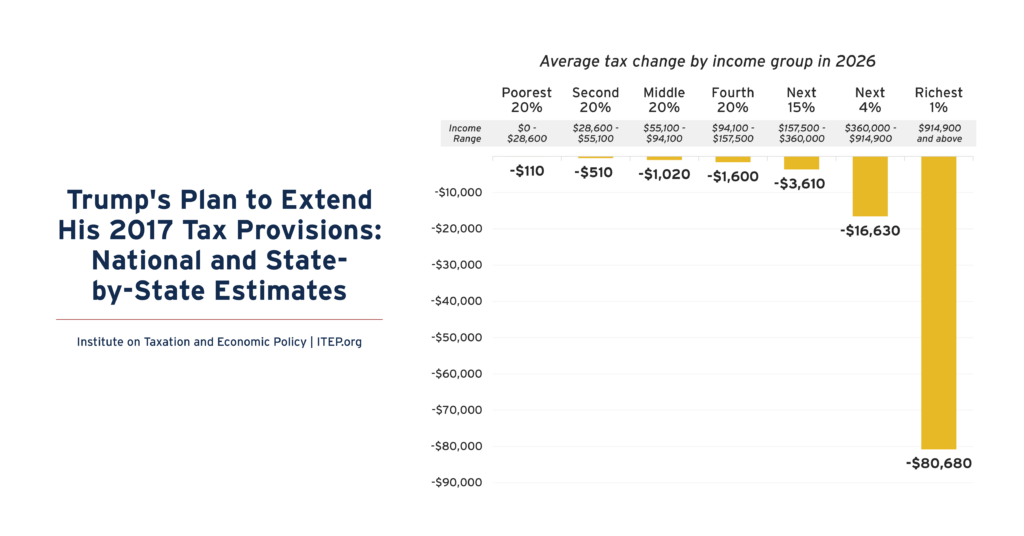
Trump’s plan to make most of the temporary provisions of his 2017 tax law permanent would disproportionately benefit the richest Americans. This includes all major provisions except the $10,000 cap on deductions for state and local taxes (SALT) paid.
The anti-tax playbook has been on full display in recent weeks as state policymakers run their offenses against public services and shared priorities. As the playbook dictates, if you have a little breathing room in your budget, propose cuts to the one major tax (personal income tax) that tends to ask more of those who […]
As Congress negotiates a bill for federal funding during the lame-duck session, lawmakers would be wise to remember that stripping funds from the IRS costs more than it saves. On the table in the appropriations bill is a $20 billion recission of funds to the nation’s tax administration. While this may look like a spending cut, it will increase deficits by $46 billion due to a drop in the agency’s capacity to enforce taxes on wealthy individuals owed under existing federal law.
On Election Day, Voters Across the Country Chose to Invest in Their States & Communities
November 19, 2024 • By Kamolika Das

On election day, voters across the country — in states red and blue and communities rural and urban — approved a wide range of state and local ballot measures on taxation and public investment. The success of these measures clearly shows that voters are willing to invest in public priorities that feel tangible and close to home.
2024 Local Tax Ballot Measures: Voters in Dozens of Communities Will Shape Local Policy
October 17, 2024 • By Rita Jefferson
Next month, voters across the country will weigh in on many local ballot measures that will have a profound effect on the adequacy of our local tax systems and whether cities and communities can fund public needs. These are in addition to statewide ballot questions, many of which have local implications this year.
Fifteen Companies Each Avoided More than $1 Billion in Taxes from a Single Trump Tax Cut
October 10, 2024 • By Joe Hughes, Spandan Marasini
The deduction for Foreign-Derived Intangible Income (FDII), one of the tax cuts included in former President Trump’s signature 2017 tax law, provides a lower effective tax rate on income earned from intangible assets, such as patents, trademarks, and other forms of intellectual property. Since the law went into effect in 2018, 15 corporations have separately reported more than $1 billion in tax benefits. Alphabet (the parent company of Google) reported the most, at more than $11 billion in tax breaks from 2018 to 2023. Other beneficiaries include large tech firms such as Meta, Microsoft, Intel, and Qualcomm.
Sen. Warren: Warren, Whitehouse, Casar, Lawmakers Slam 35 Companies for Paying Their Executives More Than They Pay in Federal Income Taxes
September 30, 2024
U.S. Senators Elizabeth Warren (D-Mass.) and Sheldon Whitehouse (D-R.I.), and Representative Greg Casar (D-Texas) led their colleagues in slamming 35 major companies that have been paying their executives more than they pay in federal income taxes. The lawmakers point to this as an additional reason why Congress must reform the tax code in 2025 to […]
ITEP’s Kamolika Das Responds to Misleading Baltimore Sun Op-ed
September 19, 2024
ITEP Local Policy Director Kamolika Das had this letter to the editor published in the Baltimore Sun on September 18: David F. Tufaro’s recent commentary about the Renew Baltimore campaign is wildly misleading (“Baltimore’s high property taxes sustain a broken system,” Sept. 15). The Renew Baltimore proposal to drastically cut and permanently cap Baltimore’s property tax […]
Trump’s Plan to Vaporize the Economy Through Mass Deportation
September 16, 2024 • By Michael Ettlinger

This op-ed originally appeared in the Boston Globe. What would happen if 22 percent of America’s farmworkers vanished from the workforce? Would workers from across the country flock to the cotton fields of Texas, the sugar fields of Florida, and the peanut farms of Georgia to take low-paying jobs in the blazing heat? Or would […]
Extending Temporary Provisions of the 2017 Trump Tax Law: Updated National and State-by-State Estimates
September 13, 2024 • By Steve Wamhoff

The TCJA Permanency Act would make permanent the provisions of the Tax Cuts and Jobs Act of 2017 that are set to expire at the end of 2025. The legislation would disproportionately benefit the richest Americans. Below are graphics for each state that show the effects of making TCJA permanent across income groups. See ITEP’s […]
State Rundown 9/5: Property Tax Policy Continues to Make Headlines
September 5, 2024 • By ITEP Staff
Property tax bills are undeniably a concern for many low- and moderate-income households across the nation...

The IRS has opened its free tax filing service called Direct File to every state for the 2025 tax filing season. Direct File was made possible by President Biden’s Inflation Reduction Act, which provided new resources for the IRS to improve customer service and ensure taxpayers claim the benefits and deductions for which they are […]

Many cities, counties, and townships across the country are in a difficult, or at least unstable, budgetary position. Localities are responding to these financial pressures in a variety of ways with some charging ahead with enacting innovative reforms like short-term rental and vacancy taxes, and others setting up local tax commissions to study the problem.
Every Texan: Undocumented Texans Paid $4.9 billion in State and Local Taxes in 2022.
August 8, 2024
Undocumented immigrants are essential contributors to Texas’ economy and robust job growth. Regardless of their citizenship or immigration status, immigrant families pay state and local taxes to support vital public services that benefit all of us, such as schools and colleges, roads, parks, and libraries. A new report from the Institute on Taxation and Economic Policy (ITEP) confirms in 2022 1.9 million undocumented Texans paid a hefty $4.9 billion in state and local taxes.
Audio: ITEP’s Marco Guzman on Taxes Paid by Texas Undocumented Immigrants
August 6, 2024
Marco appeared on Texas Public Media’s The Source on August 4, 2024. Listen to the clip here.
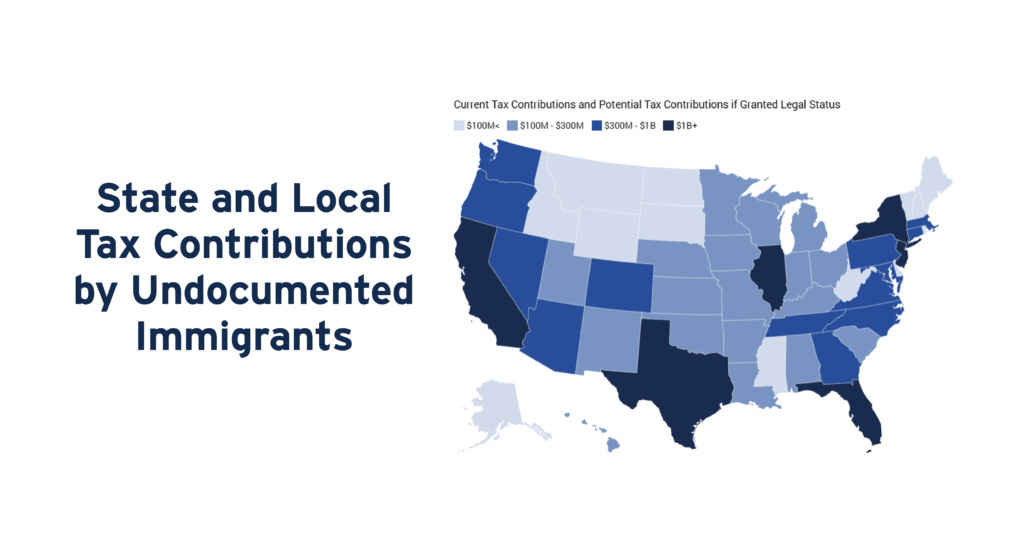
Undocumented immigrants pay taxes that help fund public infrastructure, institutions, and services in every U.S. state. Nearly 39 percent of the total tax dollars paid by undocumented immigrants in 2022 ($37.3 billion) went to state and local governments.
Study: Undocumented Immigrants Contribute Nearly $100 Billion in Taxes a Year
July 30, 2024 • By ITEP Staff
Contact: Jon Whiten ([email protected]) Immigration policies have taken center stage in public debates this year, but much of the conversation has been driven by emotion, not data. A new in-depth study from the Institute on Taxation and Economic Policy aims to help change that by quantifying how much undocumented immigrants pay in taxes – both […]

Undocumented immigrants paid $96.7 billion in federal, state, and local taxes in 2022. Providing access to work authorization for undocumented immigrants would increase their tax contributions both because their wages would rise and because their rates of tax compliance would increase.
Improving Refundable Tax Credits by Making Them Immigrant-Inclusive
July 17, 2024 • By Emma Sifre, Marco Guzman
Undocumented immigrants who work and pay taxes but don't have a valid Social Security number for either themselves or their children are excluded from federal EITC and CTC benefits. Fortunately, several states have stepped in to ensure undocumented immigrants are not left behind by the gaps in the federal EITC and CTC. State lawmakers should continue to ensure that immigrants who are otherwise eligible for these tax credits receive them.
States Should Opt Into IRS Direct File as the Program is Made Permanent
May 30, 2024 • By Jon Whiten
While there is plenty of room to expand Direct File at the federal level, states can take matters into their own hands and bring this benefit to their residents by opting into the program.
Forbes: California Is Not Actually a High-Tax State According To New Study
May 17, 2024
Depending on where you fall on the income scale, California may not actually be that high tax of a state. For many in the middle class and below, California may let you keep more of your hard-earned income than many other states, according to a new study, “Who Pays” from the Institute on Taxation and Economic Policy (ITEP). While California has the highest marginal tax rate in the nation at 13.3%, only some households pay this rate on their income. That doesn’t stop so-called low-tax states like Texas and Florida from blasting the tax policy of the Golden State.
Tax History Matters: A Q&A with Professor Andrew Kahrl, Author of ‘The Black Tax’
April 24, 2024 • By Brakeyshia Samms

In his new book, The Black Tax: 150 Years of Theft, Exploitation, and Dispossession in America, Professor Andrew Kahrl walks readers through the history of the property tax system and its structural defects that have led to widespread discrimination against Black Americans.

Institute on Taxation
and Economic Policy
ITEP is a non-profit, non-partisan tax policy organization. We conduct rigorous analyses of tax and economic proposals and provide data-driven recommendations to shape equitable and sustainable tax systems.
Subscribe to ITEP Emails
Tax research and policy news in your inbox.
Promote Fair Tax Policy
Your gift to ITEP promotes tax justice. With your help, we do research that supports taxing millionaires and billionaires, taxing big corporations and raising revenue for the things our people, our communities and our planet need.
Together, we can create a country with more economic justice, more racial justice, more climate justice… and more tax justice.