
Washington
Why California’s Cannabis Market May Not Tell You Much about Legalization in Your State
August 22, 2019 • By Carl Davis
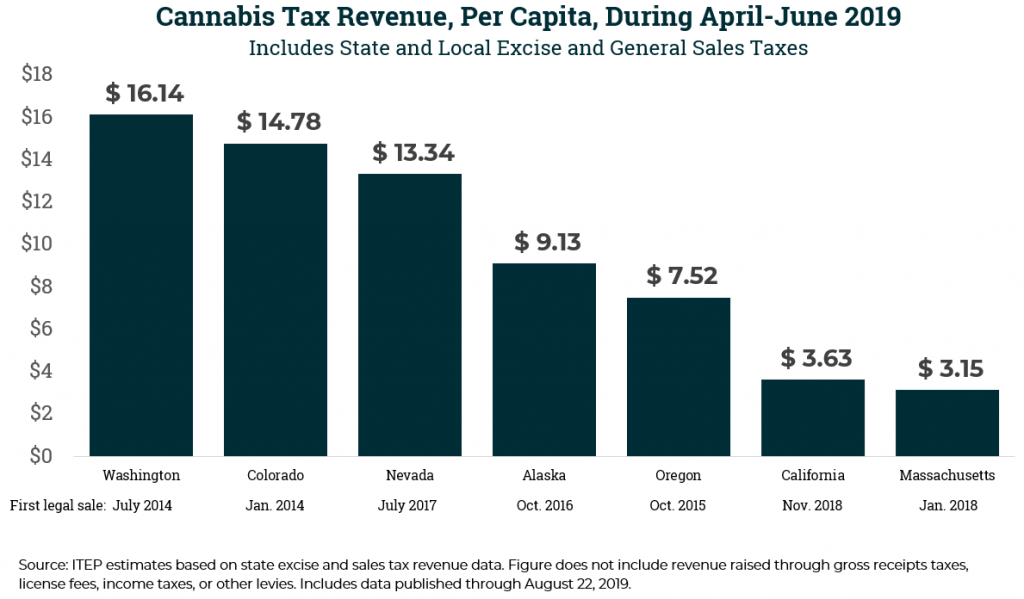
New tax data out of California, the world’s largest market for legal cannabis, tell a complicated story about the cannabis industry and its tax revenue potential. Legal cannabis markets take time to establish, and depending on local market conditions, the revenue states raise can vary significantly.
Washington Times: Trump Says He’s Considering Cut in Payroll Taxes, Calls on Fed to Cut Rates
August 20, 2019
Cutting payroll taxes that fund Social Security programs “should not be cut except in extreme situations,” said Steve Wamhoff, director of federal tax policy at the Institute on Taxation and Economic Policy. In 2011 and 2012, Congress and President Obama reduced the part of the payroll tax paid directly by employees from 6.2% to 4.2%. […]
State and Local Cannabis Tax Revenue on Pace for $1.6 Billion in 2019
August 7, 2019 • By Carl Davis
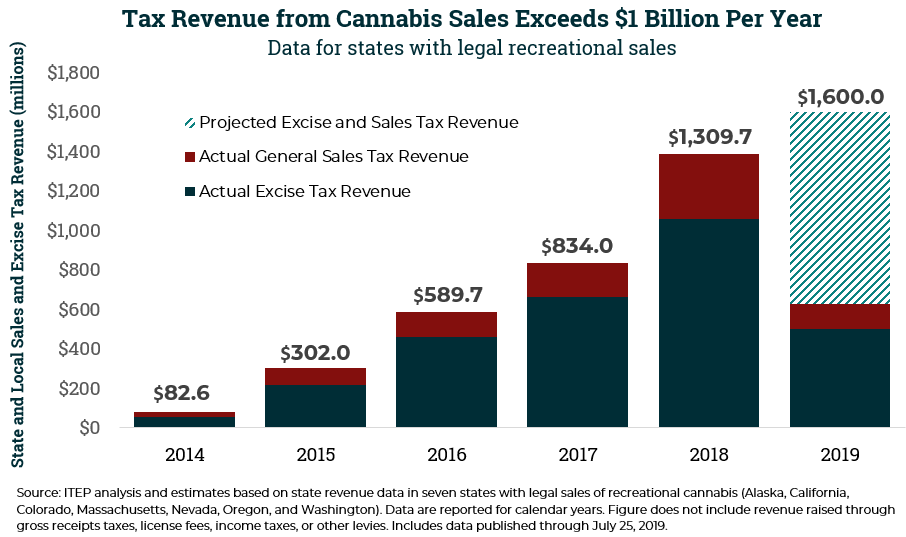
Cannabis tax revenue is becoming more significant as legal sales grow. The tax is far from a budgetary panacea, but an ITEP analysis of revenue data reported by the seven states with legal cannabis sales underway suggests that excise and sales tax revenues from the sale of the drug could reach $1.6 billion this year.
CNN: Fact Check Democratic debate, night 2
August 1, 2019
Bennet: “Since 2001, we have cut $5 trillion worth of taxes. Almost all of it has gone to the wealthiest people in America.” THE FACTS: This is exaggerated. Bennet’s claim is based on a 2018 report from the liberal Institute on Taxation and Economic Policy in Washington. It finds tax cuts under Presidents Donald Trump, […]
New York Times: Debate Fact Check: What Were They Talking About, and What Was True?
August 1, 2019
What Mr. Bennet said: “Since 2001, we have cut $5 trillion worth of taxes. Almost all of it has gone to the wealthiest people in America.” This is exaggerated. Mr. Bennet’s claim is based on a 2018 report from the liberal Institute on Taxation and Economic Policy in Washington. It finds tax cuts under Presidents […]
How Do Tax Rates on the Poor Compare to Taxes on the Rich in Your State?
August 1, 2019 • By ITEP Staff
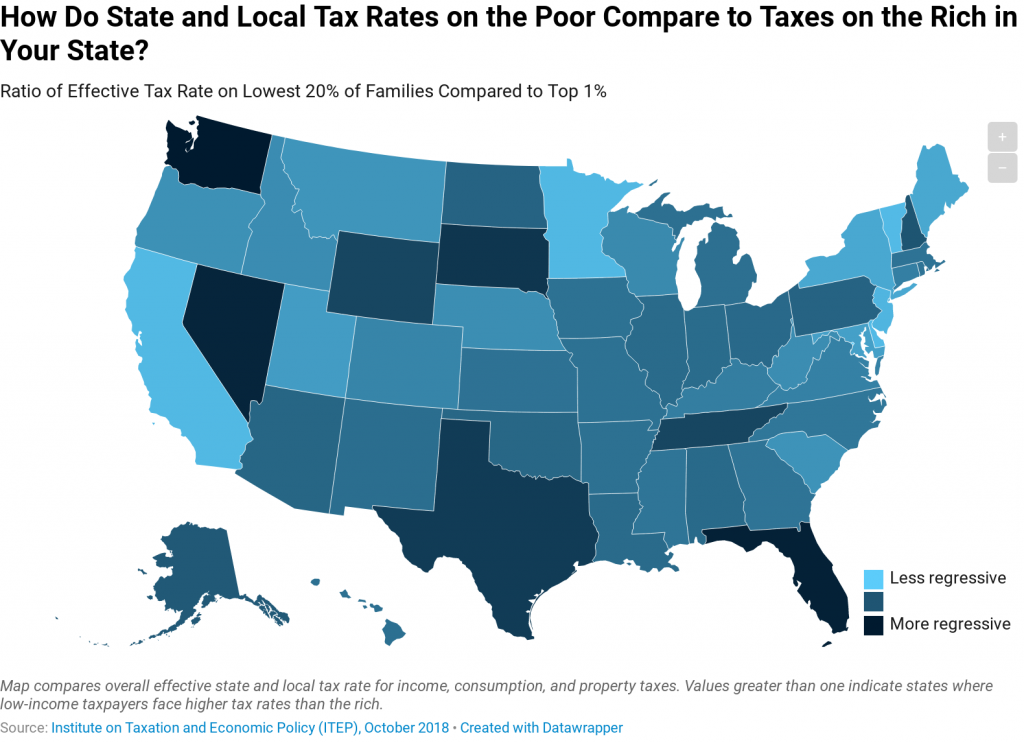
No two state tax systems are the same, but 45 states have one thing in common: Low-income residents are taxed at a higher rate than the top 1 percent. Effective tax rates for the lowest 20 percent of families range from a high of 17.8 percent in Washington State to a low of 5.5 percent in Delaware.
Washington Times: 2020 Democratic Candidates Put Trump’s Corporate Tax Rate Cut in Crosshairs
July 31, 2019
Steve Wamhoff, director of federal tax policy at the Institute on Taxation and Economic Policy, agreed that the rate alone isn’t enough. “If we raise the corporate income tax rate but we leave in place some of the rules right now that seem to be encouraging American corporations to have more tangible assets offshore, more […]
OHIO legislators passed a budget with unfortunate income tax cuts for high-income households. Other states turned their attention to unconventional ideas during their legislative off-seasons, for better and for worse. And there are many gems to be found in our “What We’re Reading” section below, including new research on the racial inequities that continue to pervade our communities and schools.
We shouldn’t wait for Washington to tax the rich. We can begin at the state level. Examining the federal policy landscape is a logical place to start, but state policymakers are missing a key opportunity if they don’t join this national conversation and take a hard look at how their tax codes are affecting individuals […]
New York Times: State and Local Taxes Are Worsening Inequality
July 21, 2019
Low-income households in Illinois pay about 14 cents in state and local taxes from every dollar of income, while the state’s most affluent households pay about 7 cents per dollar. That gap between the poor and the wealthy in Illinois is one of the largest in any state, but the poor pay taxes at higher […]
Washington Post: Trump Aides to Look for Big Spending Cuts in Second Term
July 20, 2019
… with 2018, with 60 Fortune 500 companies paying no federal taxes at all, according to a 2018 study by the Institute on Taxation and Economic Policy. Read more
We've said it before, and we'll say it again: states don't have to wait for federal lawmakers to make moves toward progressive tax policy. And so far, 2019 has been a good year for equitable and sustainable tax policy in the states. With July 1 marking the start of a new fiscal year for most states, this special edition of the Rundown looks at how discussions in 2019 have been dominated by plans to raise revenue for vital investments, tax the rich and corporations fairly, use the tax code to help workers and families and advance racial equity, and shore…
The Washington Post: States Are Doing It. So Why Hasn’t Congress Increased the Federal Gas Tax?
July 6, 2019
All told, 31 of the 50 states have raised or reformed their motor fuel taxes during the past decade, according to the Institute on Taxation and Economic Policy. What’s more, 22 states now have variable-rate policies in place to make sure that inflation does not erode this crucial revenue stream. In so doing, they are […]
Public News Service: Deadline Today for WA Initiative Requiring Voter Approval for Tax Increases
July 5, 2019
Taxes took center stage because of a finding that Washington has the most regressive tax code in the country. According to the Institute on Taxation and Economic Policy, people in the top 1% pay 3% or less of their income in taxes, while those in the bottom 20% pay nearly 18%. Read more
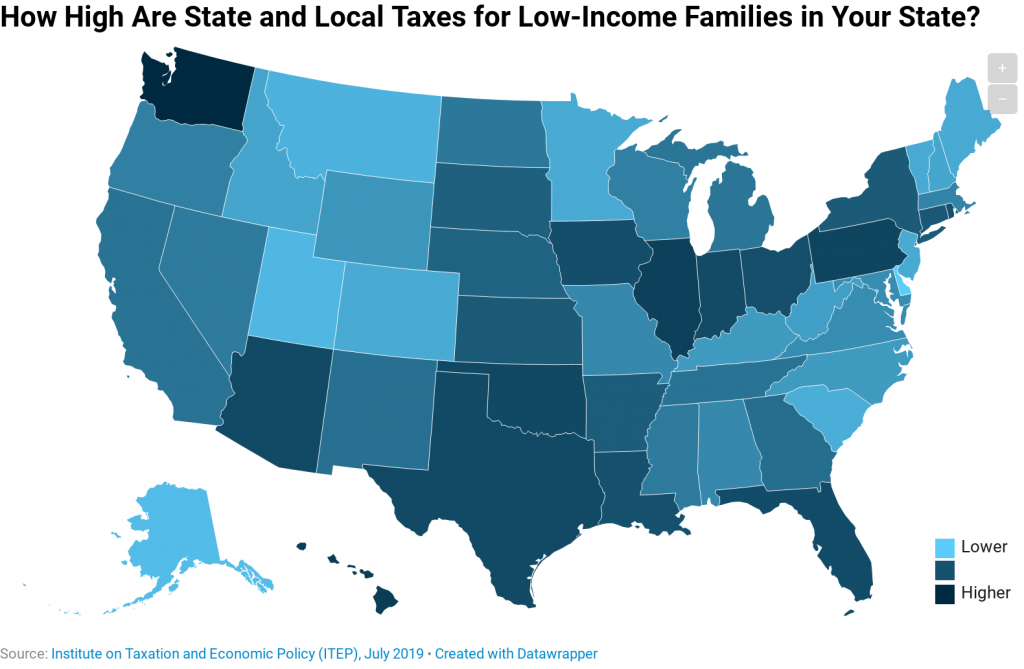
No two state tax systems are the same, but 45 states have one thing in common: Low-income residents are taxed at a higher rate than the top 1 percent. This map shows the effective tax rates for the lowest-income 20 percent in each state--ranging from a high of 17.8 percent in Washington to a low of 5.5 percent in Delaware.
Washington Post: Democratic presidential candidates engage in ‘arms race to the left’ in first debate
June 27, 2019
On taxes, many of the candidates also emphasized their more left-leaning ideas to raise rates on corporations and make the tax system more progressive, while none touted plans to keep taxes low for businesses, noted Steve Wamhoff, director of federal tax policy at the Institute on Taxation and Economic Policy. Wamhoff noted that Delaney did […]
Washington Post: Amazon Was the Only Tech Company Called Out
June 27, 2019
Income inequality has emerged as one of the top issues for Democrats in 2020, and few examples illustrate the uneven playing field in the U.S. more aptly than profitable companies avoiding paying corporate taxes. Amazon emerged as the symbol of that issue after the company received a federal tax rebate of $129 million on income […]
New House Bill Sponsored by Rep. Tlaib
June 27, 2019
Tlaib said in recent weeks that she was working on a bill that was like the EITC “on steroids.” The liberal Institute on Taxation and Economic Policy called the measure, dubbed the BOOST Act and which offers a $3,000 credit to single filers and $6,000 to married couples, the “most expansive to date” in that […]
International Business Times: Amazon News: What Joe Biden, Bernie Sanders Said About The Retail Giant On Taxes And Its New Credit Card
June 15, 2019
On Thursday, Biden posted on Twitter how Amazon pays a “lower tax rate than teachers and firefighters.” The New York Times in April noted how Amazon paid no taxes in 2018, citing a study from the left-leaning Institute on Taxation and Economic Policy. The study showed the company actually paid a -1.2% in taxes due to a $129 million tax rebate. The […]
State Rundown 6/12: Progress in Taxing the Rich, Expanding EITCs, and Taming Tax Subsidies
June 12, 2019 • By ITEP Staff
This week saw lawmakers in Ohio propose significant harmful tax cuts, leaders in California and Oregon work toward strengthening the state Earned Income Tax Credits (EITCs), and governors in Missouri and Kansas declare a truce to end the practice of bribing businesses in the Kansas City area with tax cuts to move from one side of the state line to the other. Meanwhile, Massachusetts leaders are discussing ways of raising taxes on their richest households, which our latest Just Taxes blog post notes is a promising trend this year across many states.
Washington Post: Why the U.S. Economy Is Worse than It Seems
June 4, 2019
Even more remarkably, the top 1 percent of households now hold 31 percent of the nation’s wealth (assets minus liabilities), or $30 trillion, while the entire bottom half of the nation’s households hold only about 1 percent, or $1 trillion. That comes to $23 million per household for the top 1 percent and $18,000 in […]
Washington Post: The Trump Tax Cuts Are Failing Badly
June 1, 2019
Giving companies more incentive to invest, then, won’t do much if they don’t have a reason to invest in the first place — which they haven’t recently. This raises the possibility that the Trump tax cuts won’t just be regressive but almost cartoonishly so. Consider this: According to a separate analysis by the left-leaning Institute […]
New York Times: Democrats’ Tax Cuts Target Middle Class More Than Trump’s, Study Says
May 22, 2019
Tax plans from several Democratic candidates for president would cost less than President Trump’s signature tax cuts but deliver larger benefits to most low- and middle-income Americans, according to a new analysis by the Institute on Taxation and Economic Policy, a liberal think tank in Washington. The analysis is one of the first to examine […]
Allentown Morning Call: Fortune 500 company PPL not only paid no federal taxes last year, it got a $19 million rebate; it says it has invested those savings
May 8, 2019
Sixty of America’s Fortune 500 corporations paid nothing — or got refunds — for 2018, according to a report released last month by the Institute on Taxation and Economic Policy in Washington, described as a left-leaning think tank by the Washington Post and New York Times. In PPL’s case, the institute said the company received […]
Voice of America: In the US, Death Is More Certain Than Taxes
May 8, 2019
In the corporate world, however, with the tax overhaul pushed to passage by Trump and Republican lawmakers in 2017 that cut the basic federal corporate tax rate from 35% to 21%, 60 of the biggest U.S. corporations avoided paying any taxes last year, according to the Washington-based Institute on Taxation and Economic Policy. The research […]

Institute on Taxation
and Economic Policy
ITEP is a non-profit, non-partisan tax policy organization. We conduct rigorous analyses of tax and economic proposals and provide data-driven recommendations to shape equitable and sustainable tax systems.
Subscribe to ITEP Emails
Tax research and policy news in your inbox.
Promote Fair Tax Policy
Your gift to ITEP promotes tax justice. With your help, we do research that supports taxing millionaires and billionaires, taxing big corporations and raising revenue for the things our people, our communities and our planet need.
Together, we can create a country with more economic justice, more racial justice, more climate justice… and more tax justice.