
Washington
The Washington Spectator: Tax Policy Options for the Next Administration
January 26, 2020
Bernie Sanders has proposed taxing estates worth more than $3.5 million. The Institute on Taxation and Economic Policy estimates that this would raise more than $30 billion a year. Another reform would generate a good deal more revenue—ending the so-called “step-up” provision of capital gains. When heirs receive an asset, they don’t owe taxes on […]
State tax and budget debates have arrived in a big way, with proposals from every part of the country and everywhere on the spectrum from good to bad tax policy. Just look to ARIZONA for a microcosm of nationwide debates, where education advocates have a plan to raise progressive taxes for school needs, Gov. Doug […]
Dallas Morning News: Trump slashed corporate tax rates to 21%, but many companies paid far less than that
January 13, 2020
Here’s another reason to complain: Many companies aren’t paying even the lower rate. In 2018, the first year under the new law, 379 profitable companies in the Fortune 500 paid an average effective rate of 11.3%, according to a study by the Institute on Taxation and Economic Policy, a progressive think tank in Washington. Read […]
State Rundown 1/8: States Need Clear Tax and Budget Policy Vision in 2020
January 8, 2020 • By ITEP Staff
Happy New Year readers! The Rundown is back to our usual weekly schedule as state legislative sessions and governors’ budgets and State of the State Addresses begin in earnest. Here’s to clear-eyed 20-20 vision guiding state tax and budget decisions in 2020! So far this year, the harm of Colorado’s TABOR policy and Alaska’s lack of an income tax are coming into focus in big ways. Utah advocates are hoping the benefit of hindsight will help convince voters to overturn a recently enacted tax overhaul. Lawmakers in states including Iowa, Maryland, and Virginia can clearly see a need for revenues,…
Public News Service: Will WA Lawmakers Tackle Tax Fairness in 2020?
January 3, 2020
How can Washington state create a more just society in 2020? Two experts say the state should tax its way toward that goal. The Institute on Taxation and Economic Policy ranks Washington last in the nation in terms of tax-system fairness, with low-income residents shouldering the biggest tax burden as a portion of their income. Katie Baird, […]
Washington Post: The Finance 202: Conservative Economists Say Trump’s Promises About His Tax Cuts Did Not Come True
December 19, 2019
A new report by the left-leaning Institute on Taxation and Economic Policy found 91 corporations in the Fortune 500 paid no federal taxes last year. And about 400 of the largest firms paid an average tax rate of 11 percent, half the burden prescribed by the tax law. Read more
Washington Post: House Narrowly Passes Bill That Would Restore SALT Tax Benefits to Higher-income Americans
December 19, 2019
“This mostly benefits rich people,” Steve Wamhoff, a tax analyst at the Institute on Taxation and Economic Policy (ITEP), a left-leaning think tank, said of repealing the SALT cap. “There’s a disconnect here: Many Democrats understand we have to raise more money to make the tax code more progressive,” Wamhoff said. “But this proposal, taken […]
State Rundown 12/18: Utah’s Tax Fight Wraps Up As Other States’ Ramp Up
December 18, 2019 • By ITEP Staff
With the new year and many state legislative sessions just around the corner, most state tax and budget debates are just getting started. Arkansas will be among the states working to improve their roads and other infrastructure. Massachusetts will have to deal with revenue losses due to a misguided tax-cut trigger put in place in prior years. Maryland and South Dakota will be two of many states facing teacher pay shortages and other education funding needs. And debates over the legalization and taxation of cannabis will likely continue in California, Kentucky, New Jersey, and beyond. Utah lawmakers, on the other…
Washington Examiner: Amazon, Netflix, and Starbucks Paid $0 in 2018 Federal Income Taxes
December 16, 2019
A new study by the Institute on Taxation and Economic Policy found that many of America’s largest corporations paid $0 in federal income taxes under the first year of President Trump’s tax law in 2018. Notable corporations in the study included Amazon, Netflix, Starbucks, Delta, Halliburton, and General Motors. Read more
Washington Post: Corporations Paid 11.3 Percent Tax Rate Last Year, in Steep Drop Under President Trump’s Law
December 16, 2019
About 400 of America’s largest corporations paid an average federal tax rate of about 11 percent on their profits last year, roughly half the official rate established under President Trump’s 2017 tax law, according to a report released Monday. The 2017 tax law lowered the U.S. corporate tax rate from 35 percent to 21 percent, […]
Washington Post: A New Report Hands Democrats a Major Weapon Against Trump
December 16, 2019
There is probably no more glaring example of President Trump’s massive betrayal of the economic populist nationalism that infused his campaign than the 2017 tax law. It isn’t just that he signed a massive tax cut that showered most of its benefits on the very highest earners after vowing to take on financial elites. It’s […]
How Congress Can Stop Corporations from Using Stock Options to Dodge Taxes
December 10, 2019 • By ITEP Staff
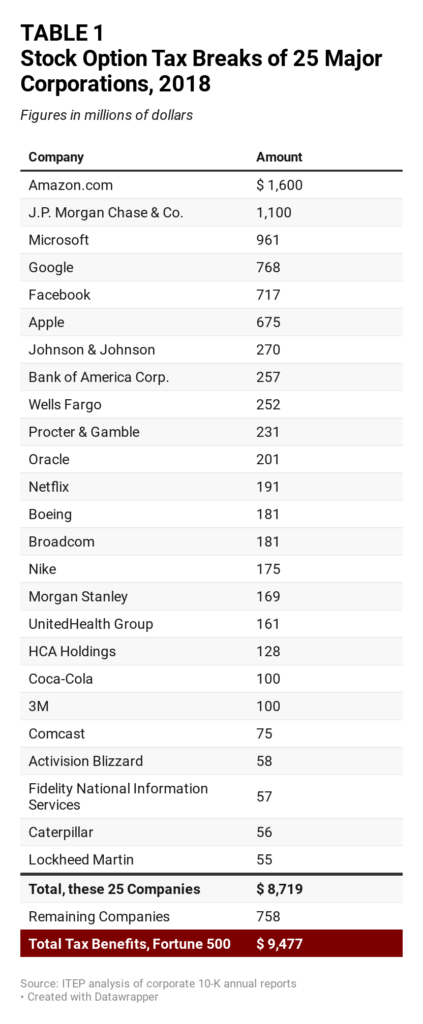
The stock option rules in effect today create a problem because they allow corporations to report a much larger expense for this compensation to the IRS than they report to investors. The result is that corporations can report larger profits to investors but smaller profits to the IRS, undermining the fundamental fairness of the tax system.
The News Tribune: Washington State Leaders Must Tax the Way to a Just Society
December 7, 2019
The inequalities in our state’s tax code are well known, and have gained us the ignoble designation of “the most unfair state and local tax system in the country.” This medal of dishonor from the Institute on Taxation and Economic Policy is based on ITEP’s assessment of how fairly the tax burden is spread among […]
The New York Times: How FedEx Cut Its Tax Bill to $0
November 17, 2019
“Something like $1.5 billion in future taxes that they had promised to pay, just vanished,” said Matthew Gardner, an analyst at the liberal Institute on Taxation and Economic Policy in Washington. “The obvious question is whether you can draw any line, any connection between the tax breaks they’re getting, ostensibly designed to encourage capital expenditures, and what […]
Washington Post: Pete Buttigieg Proposes Free College for Americans Earning Under $100,000 in his New Economic Plan
November 8, 2019
Democratic candidate Julián Castro, the former secretary of housing and urban development in the Obama administration, has also proposed expanding the EITC. Castro would go further and also make the child tax credit fully refundable, another benefit to lower-income families that Buttigieg did not include in his plan. Sens. Kamala D. Harris (D-Calif.) and Cory […]
The Washington Post: Pete Buttigieg Proposes Free College for Americans Earning Under $100,000 in His New Economic Plan
November 8, 2019
Democratic candidate Julián Castro, the former secretary for housing and urban development in the Obama administration, has also proposed expanding the EITC. Castro would go even further and also make the child tax credit fully refundable, another benefit to lower-income families that Buttigieg did not include in his plan. Sens. Kamala D. Harris (D-Calif.) and […]
State Rundown 11/6: State Voters Show Readiness to Fix Broken Tax Codes
November 6, 2019 • By ITEP Staff
Many of yesterday’s Election Day votes came down to questions of whether or not to improve on upside-down and often inadequate state and local tax systems. The status quo was maintained in Colorado, where voters failed to approve a proposition to allow the state to invest tax revenue in education and other needs, and in Texas, where a constitutional amendment was approved to prohibit the state from creating an income tax. But voters supported important reforms in other states by approving needed funding for schools in Idaho, opting to legalize and tax recreational cannabis in California. And for more on…
Benefits of a Financial Transaction Tax
October 28, 2019 • By Jessica Schieder, Lorena Roque, Steve Wamhoff

A financial transaction tax (FTT) has the potential to curb inequality, reduce market inefficiencies, and raise hundreds of billions of dollars in revenue over the next decade. Presidential candidates have proposed using an FTT to fund expanding Medicare, education, child care, and investments in children’s health. Any of these public investments would be progressive, narrowing resource gaps between the most vulnerable families and the most fortunate.
Real Change: Fishing for Equity in a Regressive Tax System
October 16, 2019
“It’s always about race, and it’s always about taxes,” said Misha Hill, a policy analyst with the Institute on Taxation and Economic Policy (ITEP). ITEP is the source of the frequently cited statistic that Washington has the most regressive tax system in the country. In fact, Hill said, there are no states in the union […]
POLITICO: Cannabis was supposed to be a tax windfall for states. The reality has been different.
October 14, 2019
In all, five of the nine states that have set up tax systems for legalized marijuana employ cultivation levies on growers, while all but Alaska charge an excise tax specifically on cannabis sales. Five states also charge the general sales tax, though not the same exact group that has a cultivator tax. The actual effective […]
POLITICO: Cannabis Was Supposed to Be a Tax Windfall for States. The Reality Has Been Different.
October 14, 2019
In all, five of the nine states that have set up tax systems for legalized marijuana employ cultivation levies on growers, while all but Alaska charge an excise tax specifically on cannabis sales. Five states also charge the general sales tax, though not the same exact group that has a cultivator tax. The actual effective […]
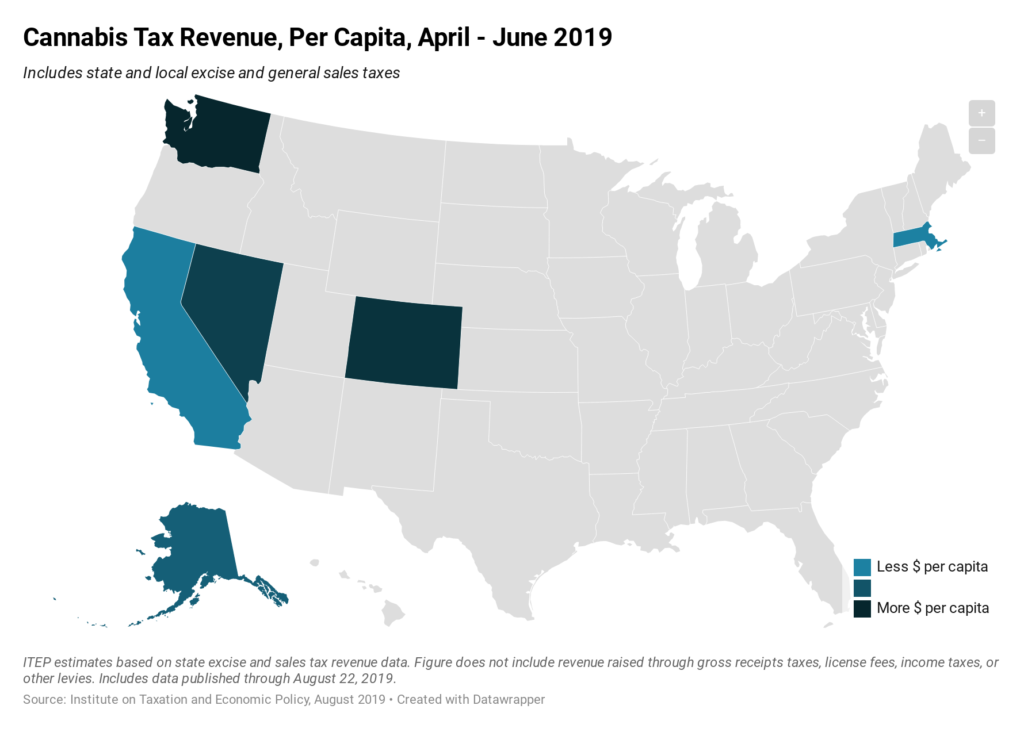
Seven states currently allow for the legal, taxable sale of recreational cannabis. The above map shows per capita revenue collections from excise and sales taxes on cannabis during the second quarter of 2019, the most recent period for which data are available in every state. The most lucrative cannabis market in the country, from a tax revenue perspective, is in Washington State where the 46 percent combined tax rate applied to cannabis is the highest in the country. Collections in California and Massachusetts, by contrast, remain low as these states are still in the early stages of establishing their legal…
The hottest, stickiest month of the year has left a grimy feeling on several state tax debates, as Idaho lawmakers find themselves unable to fund the state’s priorities after years of cutting taxes, Alaskans express their support for public investments to their governor’s polling office and then watch the governor slash them anyway, New Jersey lawmakers go to bat for ineffective and corrupt business tax subsidies, and residents of North Carolina watch their representatives pursue cheap political points over sound investments and thoughtful policy. Nonetheless, residents and advocates on the other side of these and other debates have fought long…
Washington Post: Why the U.S. Economy Is Worse Than It Seems
August 27, 2019
The situation looks very different at the high end of the economic scale. Over the past decade, the nation’s highest earners (the 95th percentile) saw their wages grow at almost four times the rate of those whose earnings put them in the middle of the pack (the 50th percentile). Even more remarkably, the top 1 […]
NPR: California Says Its Cannabis Revenue Has Fallen Short Of Estimates, Despite Gains
August 23, 2019
“After adjusting for population, the Golden State raised the second-least amount of revenue from cannabis taxes during the second quarter among states with legal sales, ahead of only Massachusetts,” according to the Institute on Taxation and Economic Policy. The result was a departure from the spikes seen in states such as Colorado, Washington and Oregon […]

Institute on Taxation
and Economic Policy
ITEP is a non-profit, non-partisan tax policy organization. We conduct rigorous analyses of tax and economic proposals and provide data-driven recommendations to shape equitable and sustainable tax systems.
Subscribe to ITEP Emails
Tax research and policy news in your inbox.
Promote Fair Tax Policy
Your gift to ITEP promotes tax justice. With your help, we do research that supports taxing millionaires and billionaires, taxing big corporations and raising revenue for the things our people, our communities and our planet need.
Together, we can create a country with more economic justice, more racial justice, more climate justice… and more tax justice.