
Tax Credits for Workers and Families
100 posts
Hidden in Plain Sight: Race and Tax Policy in 2023 State Legislative Sessions
• By Brakeyshia Samms
Race was front and center in a lot of state policy debates this year, from battles over what’s being taught in schools to disagreements over new voting laws. Less visible, but also extremely important, were the racial implications of tax policy changes. What states accomplished this year – both good and bad – will acutely affect people and families of color.

Abortion-Restricting States Skimp on Funding for Children
• By Amy Hanauer
States differ dramatically in how much they allow families to make choices about whether and when to have children and how much support they provide when families do. But there is a clear pattern: the states that compel childbirth spend less to help children once they are born.

State Tax Credits Have Transformative Power to Improve Economic Security
• By Aidan Davis
The latest analysis from the U.S. Census Bureau provides an important reminder of the compelling link between public investments and families’ economic well-being. Policy decisions can drastically reduce poverty and improve family economic stability for low- and middle-income families alike, as today’s data release shows.

States are Boosting Economic Security with Child Tax Credits in 2023
• By Aidan Davis, Neva Butkus
Fourteen states now provide Child Tax Credits to reduce poverty, boost economic security, and invest in children. This year alone, lawmakers in three states created new Child Tax Credits while lawmakers in seven states expanded existing credits. To maximize impact, lawmakers should consider making their credits fully refundable, not including an earnings requirement, setting a maximum amount per child instead of per household, setting state-specific phase-out ranges that target low- and middle-income families, indexing to…

Boosting Incomes, Improving Equity: State Earned Income Tax Credits in 2023
• By Aidan Davis, Neva Butkus
Nearly two-thirds of states (31 plus the District of Columbia and Puerto Rico) have an Earned Income Tax Credit, an effective tool that boosts low-paid workers’ incomes and helps lower-income families achieve greater economic security. This year, 12 states expanded and improved EITCs.

The Highs and Lows of 2023 State Legislative Sessions
• By Aidan Davis
Nearly one-third of states took steps to improve their tax systems this year by investing in people through refundable tax credits, and in a few notable cases by raising revenue from those most able to pay. But another third of states lost ground, continuing a trend of permanent tax cuts that overwhelmingly benefit high-income households and make tax codes less adequate and equitable.

Refundable Credits a Winning Policy Choice Again in 2023
• By Neva Butkus
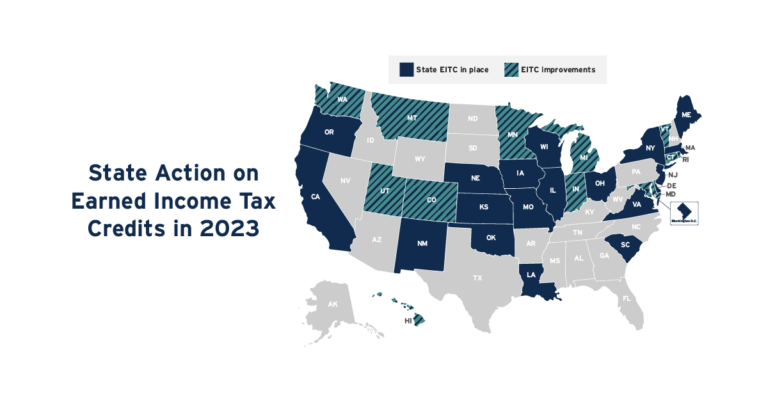
State lawmakers continue to make groundbreaking progress on state tax credits, with 17 states creating or enhancing Child Tax Credits or Earned Income Tax Credits so far this year. These policies have the potential to boost family economic security and dramatically reduce the number of children living below the poverty line.
State Action on Child Tax Credits and Earned Income Tax Credits in 2023
• By ITEP Staff
In 2023 so far, 17 states have either adopted or expanded a Child Tax Credit or Earned Income Tax Credit. Both these policies can help bolster the economic security of low- and middle-income families and position the next generation for success.

Minnesota Lawmakers Re-Envision State Tax System to Center Equity
• By Neva Butkus
Minnesota’s House, Senate and Governor’s office have each proposed their own vision as to how the state should maximize its $17.5 billion surplus and raise new revenue, and these tax plans make one thing clear: Minnesota lawmakers are serious about using tax policy to advance tax equity and improve the lives of Minnesotans.

8 Things to Know About State Taxes
• By Jon Whiten
As Tax Day approaches, it’s worth thinking about not only the taxes that we individually pay but the overall condition of our tax code as well. State tax codes, while perhaps less discussed than the federal system, are critically important. Depending on how they are designed, state taxes can improve or worsen economic and racial […]
States Prioritize Old Over Young in Push for Larger Senior Tax Subsidies
• By Carl Davis, Eli Byerly-Duke
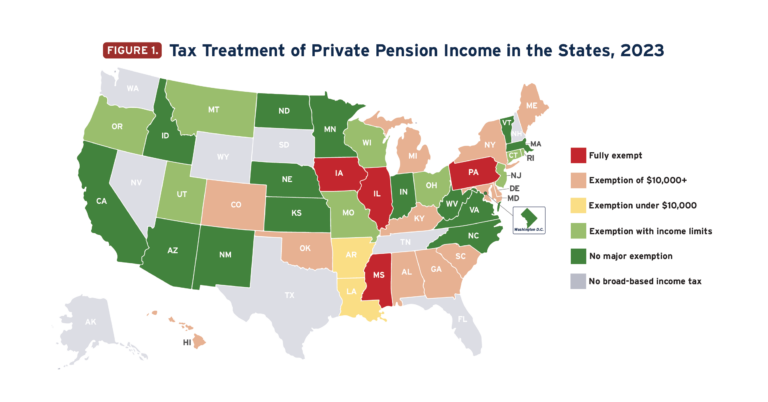
Under a well-designed income tax based on ability to pay, it is simply not necessary to offer special tax subsidies to older adults but not younger families. At the end of the day, your income tax bill should depend on what you can afford to pay, not the year you were born. It’s really as simple as that.

The Five Best Tax Ideas Coming from Governors This Year
• By Carl Davis
The word “tax” appears 97 times and counting in one recent summary of governors’ addresses to state legislators so far this year. The policy visions that governors are bringing, however, vary enormously. While there's good reason to worry about tax cuts for wealthy families and the flattening or elimination of income taxes, there are at least five great tax ideas coming directly out of governors’ offices this year.

Momentum Behind State Tax Credits for Workers and Families Continues in 2023
• By Miles Trinidad
Refundable tax credits are an important tool for improving family economic security and advancing racial equity, and there is incredible momentum heading into 2023 to boost two key state credits: the Child Tax Credit and the Earned Income Tax Credit.
States Can Halve Child Poverty with Child Tax Credits
• By Aidan Davis
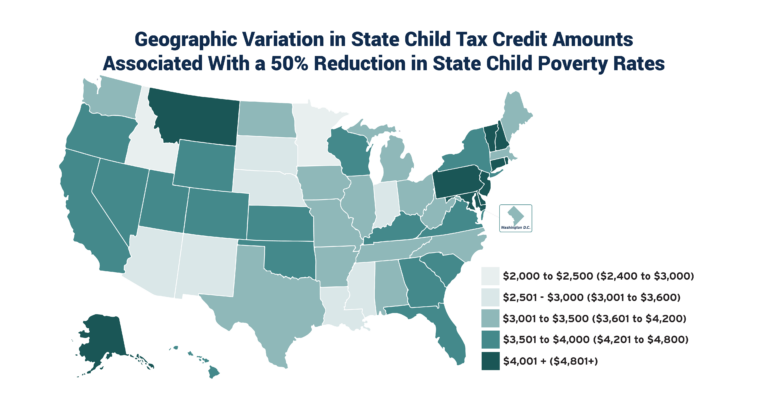
State policymakers have the tools they need to drastically reduce child poverty within their borders. A new ITEP report, coauthored with Columbia University’s Center on Poverty and Social Policy, explores state Child Tax Credit (CTC) options that would reduce child poverty by up to 50 percent. Temporary expansion of the federal CTC in 2021 reduced […]

State Child Tax Credits and Child Poverty: A 50-State Analysis
• By Aidan Davis
Regardless of future Child Tax Credit developments at the federal level, state policies can supplement the federal credit to deliver additional benefits to children and families. State credits can be specifically tailored to meet the needs of local populations while also producing long-term benefits for society as a whole
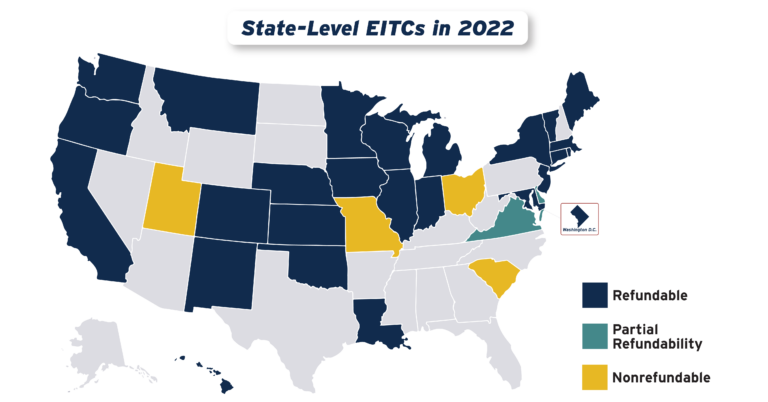
Boosting Incomes and Improving Tax Equity with State Earned Income Tax Credits in 2022
• By Aidan Davis
States continued their recent trend of advancing EITCs in 2022, with nine states plus the District of Columbia either creating or improving their credits. Utah enacted a 15 percent nonrefundable EITC, while the District of Columbia, Hawaii, Illinois, Maine, Vermont and Virginia expanded existing credits. Meanwhile, Connecticut, New York and Oregon provided one-time boosts to their EITC-eligible populations.

More States are Boosting Economic Security with Child Tax Credits in 2022
• By Aidan Davis
After years of being limited in reach, there is increasing momentum at the state level to adopt and expand Child Tax Credits. Today ten states are lifting the household incomes of families with children through yearly multi-million-dollar investments in the form of targeted, and usually refundable, CTCs.
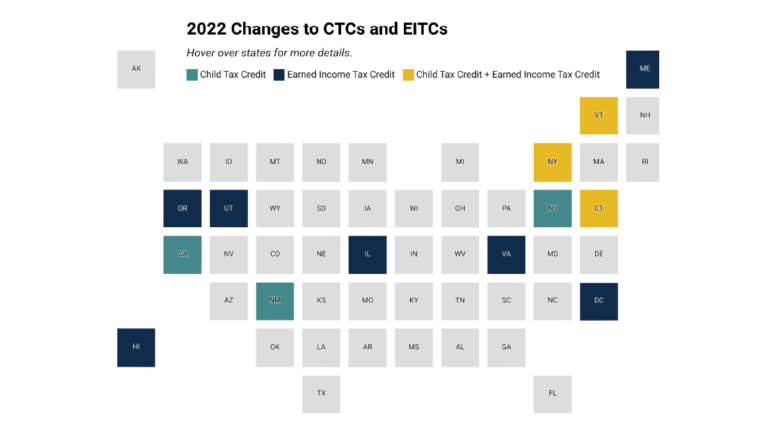
Legislative Momentum in 2022: New and Expanded Child Tax Credits and EITCs
• By Neva Butkus
State legislatures across the country made investments in their future, centering children, families, and workers by enacting and expanding state Earned Income Tax Credits (EITCs), Child Tax Credits (CTCs), and other refundable credits this session. In total, seven states either expanded or created CTCs this session. Connecticut, New Mexico, New Jersey, Rhode Island and Vermont […]

Abortion-Restricting States Do Least for Children
• By Amy Hanauer
Lawmakers have passed laws in 22 states that either immediately or soon will greatly restrict women’s rights to decide whether and when to have children. These states have some of the worst tax, spending and labor market policies for families in the U.S.

Boosting Incomes and Improving Tax Equity with State Earned Income Tax Credits in 2021
• By Aidan Davis
The EITC benefits low-income people of all races and ethnicities. But it is particularly impactful in historically excluded Black and Hispanic communities where discrimination in the labor market, inequitable educational systems, and countless other inequities have relegated a disproportionate share of people to low-wage jobs.
New Census Data Highlight Need for Permanent Child Tax Credit Expansion
• By Neva Butkus
The status quo was a choice, but the Census data released today shows that different policy choices can create drastically different outcomes for children and families. It is time for our state and federal legislators to put people first when it comes to recovery.

DC Exemplifies Trend of Tax Justice Victories on the Ground Despite Distractions in the Sky
• By Dylan Grundman O'Neill
This month, we watched billionaire space-racers with skyrocketing fortunes literally rocket themselves into the sky to look down on us from the largest gap they could put between themselves and the people, communities, and institutions that made their fortunes possible. These events have put an exclamation point on one of the clearest lessons to come […]

The Child Tax Credit in Practice: What We Know About the Payoffs of Payments (Webinar)
• By ITEP Staff
Join us for a discussion on why tax credits like the Child Tax Credit (CTC) expansion are good economic policy. You’ll hear from anti-poverty experts on why Congress should extend the policy beyond 2021 and what we can learn from an initiative providing low-income mothers in Jackson, Miss., $1,000 cash on a monthly basis, no strings attached. From theory to practice and what it means for American families, this CTC webinar will provide a unique…

State-Level EITC Victories in 2021
• By Aidan Davis
A growing group of state lawmakers are recognizing the extent to which low- and middle-income Americans are struggling and the ways in which their state and local tax systems can do more to ensure the economic security of their residents over the long run. To that end, lawmakers across the country have made strides in enacting, increasing, or expanding tax credits that benefit low- and middle-income families. Here is a summary of those changes and…

Nearly 20 Million Will Benefit if Congress Makes the EITC Enhancement Permanent
• By Aidan Davis
Overall, the EITC enhancement would provide a $12.4 billion boost in 2022 if made permanent, benefiting 19.5 million workers. It would have a particularly meaningful impact on the bottom 20 percent of eligible households who would receive more than three-fourths of the total benefit. Forty-one percent of households in the bottom 20 percent of earners would benefit, receiving an average income boost of 6.3 percent, or $740 dollars.
State and local tax policies can often make it more difficult for low- and moderate-income individuals and families to make ends meet. Through the use of a variety of targeted tax credits, state lawmakers can help improve both the fairness of their tax systems as well as the standard of living for low- and moderate-income residents. ITEP resources on tax credits for workers and families provide general and state-specific information about the mechanics of these credits and options for reform including state Earned Income Tax Credits, property tax circuit breakers and child-related tax credits.

Institute on Taxation
and Economic Policy
ITEP is a non-profit, non-partisan tax policy organization. We conduct rigorous analyses of tax and economic proposals and provide data-driven recommendations to shape equitable and sustainable tax systems.
Subscribe to ITEP Emails
Tax research and policy news in your inbox.
Promote Fair Tax Policy
Your gift to ITEP promotes tax justice. With your help, we do research that supports taxing millionaires and billionaires, taxing big corporations and raising revenue for the things our people, our communities and our planet need.
Together, we can create a country with more economic justice, more racial justice, more climate justice… and more tax justice.