Key Findings
Two tax laws, one enacted during President Trump’s first term and another enacted during his second term, slashed the federal corporate tax rate from 35 to 21 percent and left in place (and in many cases expanded) the special breaks and loopholes allowing corporations to pay effective tax rates that are even lower.
Today, the results of this tax-cutting two-step are demonstrated by the tax payments of the 706 most significant and profitable American corporations (those belonging to either the Fortune 1000 or the S&P 500) that disclosed enough information to their shareholders in 2025 to make analysis of their federal income tax payments possible.
In 2025, the first year that the second Trump tax law was in effect:
10.4%
$198 billion
114
$263 billion
25
Effective Tax Rates Reported by Profitable U.S.-Based Corporations in 2025 Reach a New Low
This study uses corporate annual financial reports to calculate the effective federal income tax rates on each of 706 companies in 2025. Each company included here had adjusted U.S. pretax income that was greater than zero in 2025 and published enough information in its annual report to allow calculation of its effective federal income tax rate. All data used in these calculations comes directly from the annual financial reports these companies file each year.
Figure 1
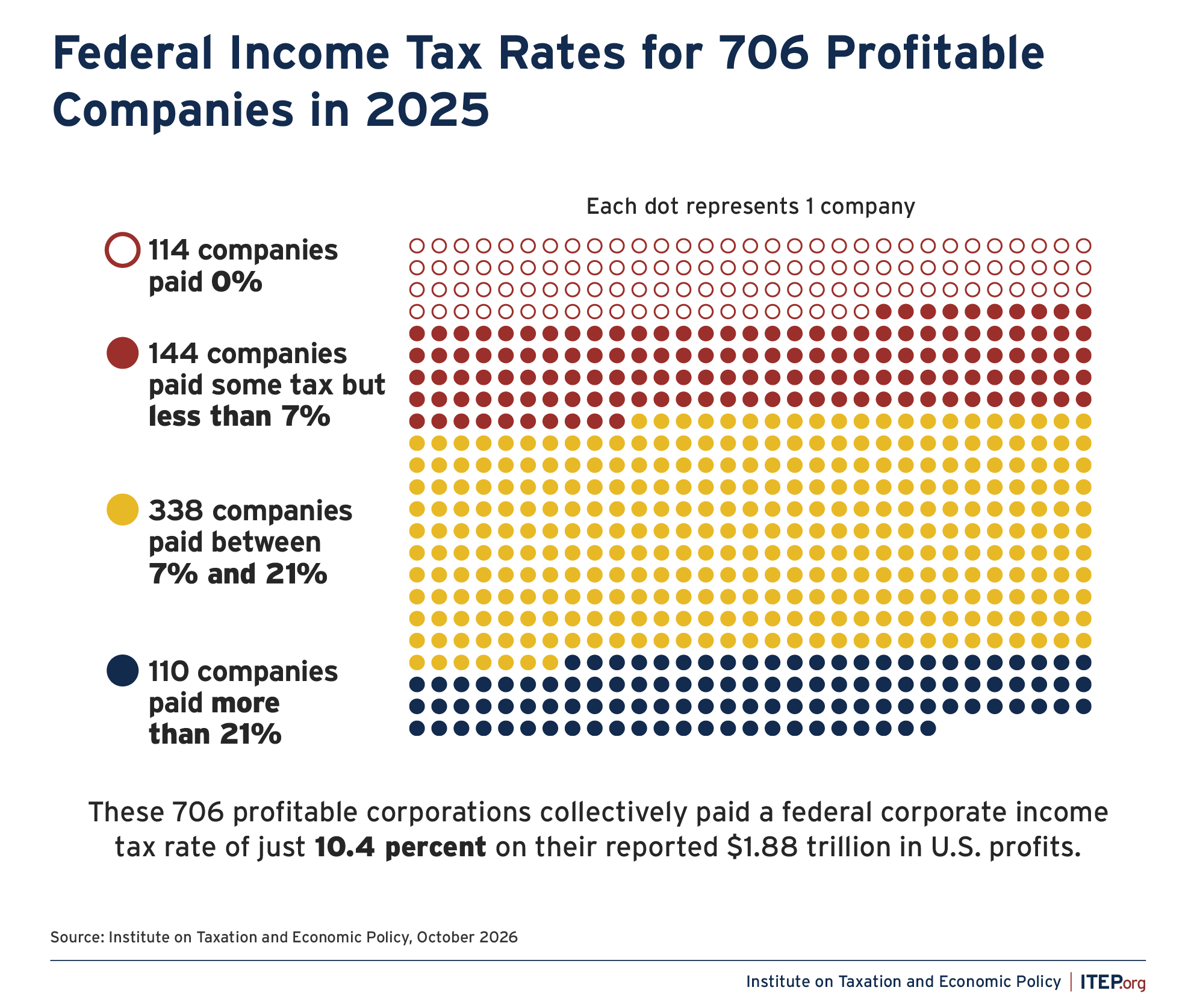
These companies collectively reported a total of $1.88 trillion in U.S. profits in 2025. They collectively disclosed current federal income tax expense (which is their best estimate of the federal income taxes they paid on their income for this tax year) of $196 billion for 2025, which comes to just 10.4 percent of the U.S. profits they reported for the year.
Figure 2
While the statutory federal corporate income tax rate is 21 percent, many special breaks and loopholes allow companies to pay effective rates that are much lower. The fact that the average effective tax rate for the companies in this study is less than half the statutory rate demonstrates that this phenomenon is widespread.
The lowest nationwide corporate tax rate ITEP and Citizens for Tax Justice have found in nearly 40 years of compiling these data
This 10.4 percent effective tax rate is, by some distance, the lowest nationwide corporate tax rate the Institute on Taxation and Economic Policy (ITEP) and Citizens for Tax Justice (CTJ) have found in nearly 40 years of compiling these data.
In the immediate wake of President Ronald Reagan’s extravagant 1981 tax cuts for corporations and the wealthy, ITEP’s first corporate tax analysis found that the effective tax rate on profitable corporations had plummeted from 17.3 to 11.2 in 1982, the first full year of implementation for Reagan’s corporate cuts. This was less than a quarter of the 46 percent statutory rate in effect at the time.
By 1986, President Ronald Reagan had fully repudiated his earlier policy of showering tax breaks on corporations, and the President’s Tax Reform Act of 1986 closed corporate loopholes that had provided tens of billions of dollars in tax breaks, so that by 1988, ITEP’s survey of large corporations found that the overall effective corporate tax rate increased to 26.5 percent. This improvement occurred even though the 1986 tax reforms cut the statutory corporate rate from 46 percent to 34 percent.
In the 1990s, however, many corporations began to find ways around the 1986 reforms, abetted by changes in tax laws and tax-avoidance schemes devised by major accounting firms. As a result, in a 2000 follow-up study, we found that the average effective corporate tax rate had fallen to 21.7 percent from 1996 through 1998, even though Congress had slightly increased the corporate tax rate to 35 percent in 1993.
Our 2004 study subsequently found that corporate tax cuts adopted in 2002 had driven the effective rate down to only 17.2 percent in 2002 and 2003. Our last study of the pre-Trump corporate tax laws, covering the period 2008 through 2015, found an average tax rate that was only slightly higher at 21.2 percent—and was still far below the statutory tax rate of 35 percent.
The 2017 corporate tax cuts pushed through by the Trump administration set the bar far lower for corporate tax payments, slashing the tax rate from 35 to just 21 percent. ITEP’s study of corporate tax rates in 2018, the first full year of implementation for the 2017 cuts, found what was at that time the second-lowest single-year effective tax rate in over 35 years, an 11.3 percent effective tax rate. This was just a hair above the 11.2 percent effective tax rate that shocked President Reagan into supporting loophole-closing reforms in the mid-1980s.
The 10.4 percent tax rate documented in our latest report blows all of these previous results out of the water and marks the first time in the Trump corporate tax era that companies have collectively paid less than half the legal tax rate.
Many Profitable Corporations Paid Less Than 7 Percent in 2025
Of the companies analyzed here, 258 paid effective tax rates less than 7 percent in 2025, meaning that they paid less than one-third of the statutory tax rate. This includes 114 corporations that didn’t pay any income tax.
These companies collectively reported a total of $684 billion in U.S. profits in 2025 and they disclosed $11.9 billion in current U.S. taxes for the year on those profits. That comes to an effective federal income tax rate of just 1.7 percent for this group overall.
These 258 ultra-low tax corporations fall into two groups. One group did pay some federal income taxes in 2025 but paid less than 7 percent. This group includes Delta Airlines, T-Mobile, ExxonMobil, Amazon, Coca-Cola, Microsoft, Uber, Meta, Salesforce, AT&T, JP Morgan Chase, Goldman Sachs, and many more.
The other group, including 114 corporations, paid nothing at all in 2025. In fact, in most cases these companies generated so many excess tax breaks that they reported negative taxes (often receiving tax rebate checks from the U.S. Treasury) totaling almost $5.4 billion. These companies’ “negative tax rates” meant that they made more profit after taxes than before taxes in 2025.
Many well-known companies are among those paying nothing in 2025, including Coinbase, Walt Disney, H&R Block, Kohl’s, Citigroup, United Airlines, DoorDash, Tesla, and many more.
Figure 3
Record Corporate Tax Subsidies in 2025
Corporate tax subsidies – defined as anything allowing profitable corporations to pay less than the statutory corporate tax rate of 21 percent on their profits – totaled $198 billion in 2025 for the 706 companies included in this report.
If the corporations analyzed in this report had paid federal income taxes equal to 21 percent of their $1.88 trillion in U.S. pretax profits, their collective tax bill for 2025 would have come to $394 billion. We can think of their total tax subsidies as the difference between that figure and what they actually paid, which brings their collective tax subsidies to $198 billion for the year.
The $198 billion in tax subsidies is the result of all tax breaks and loopholes allowing companies to pay an effective tax rate that is lower than the statutory tax rate. Some of these breaks and loopholes predate Trump, but many were enacted or expanded in the two tax laws he signed.
While almost 600 of the companies surveyed in this report used tax breaks to reduce their effective tax rates below 21 percent last year, the tax subsidies were remarkably top-heavy.
Figure 4
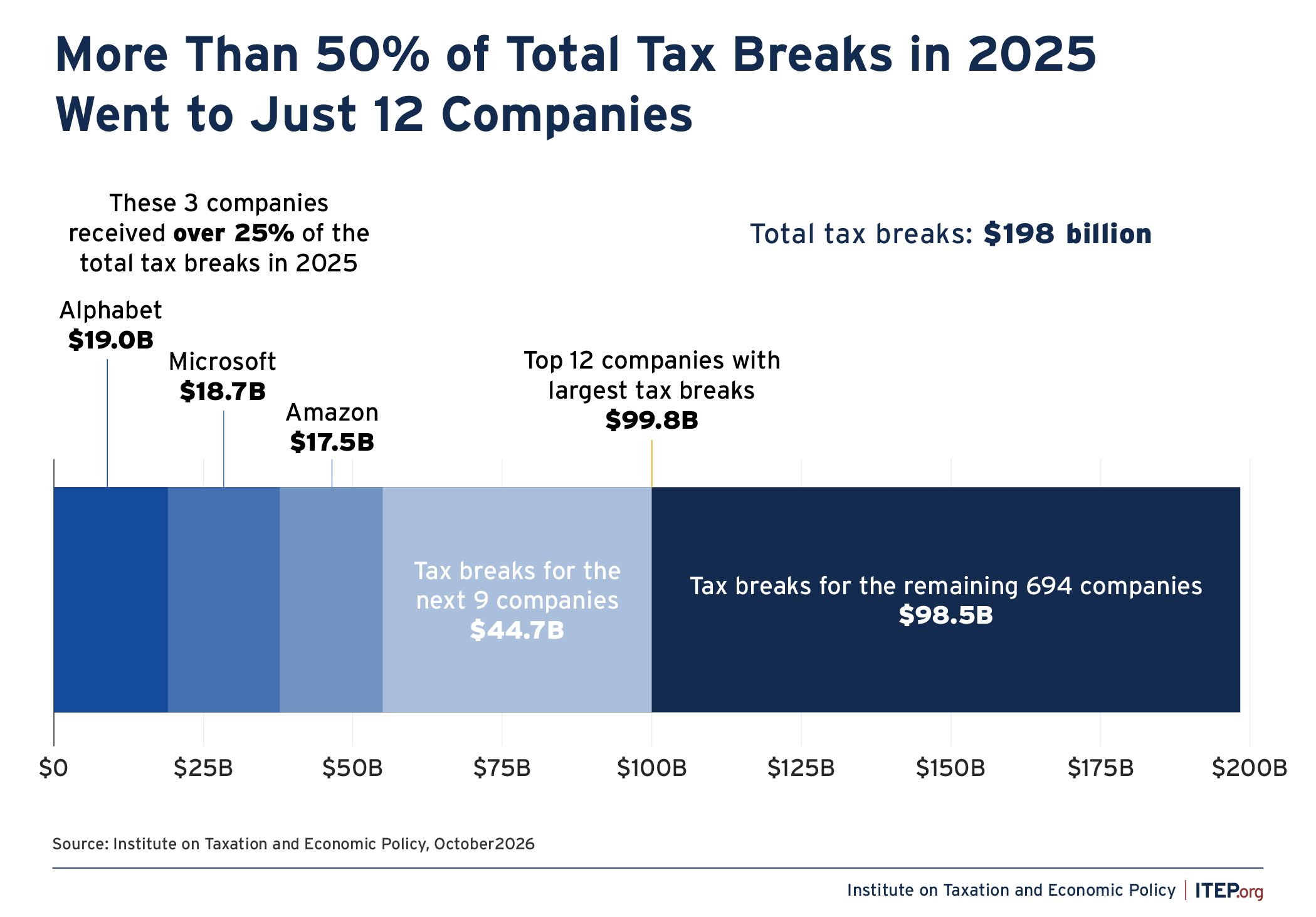
Just 25 corporations accounted for the bulk of all the corporate tax subsidies identified in this report. The tech giant Alphabet topped the list with $19 billion in tax breaks, narrowly edging out Microsoft at $18.7, and Amazon.com at $17.4. These three companies collectively raked in over a quarter of all the federal income tax breaks documented in this study for 2025. Only one other company—Meta Platforms, at $13.9 billion—got more than $10 billion of tax breaks last year.
These four giant tech companies also collectively enjoyed a quarter of the nationwide corporate profits documented in this study. Two tax breaks turbocharged by the Trump administration in 2017 and 2025, accelerated depreciation, and R&D expensing, alone saved these four companies $46 billion last year.
Figure 5
Corporations Continue to Benefit from Trump’s Massive Cut in the Statutory Corporate Tax Rate
While the companies profiled in this report raked in $198 billion by finding ways to avoid paying 21 percent of their profits in taxes last year, these savings pale in comparison to the $263 billion in tax breaks these companies got in 2025 alone from the decision made by Trump and Congressional Republicans to slash the official corporate tax rate from 35 percent to 21 percent in Trump’s first tax law. The figure below illustrates the two ways corporate taxes have hit rock bottom under President Trump.
First is the $198 billion in corporate tax subsidies described above. This is the additional amount of federal income taxes these companies would have collectively paid if they had paid an effective tax rate equal to the statutory tax rate of 21 percent rather than the 10.4 percent of their U.S. profits that they actually paid.
Figure 6
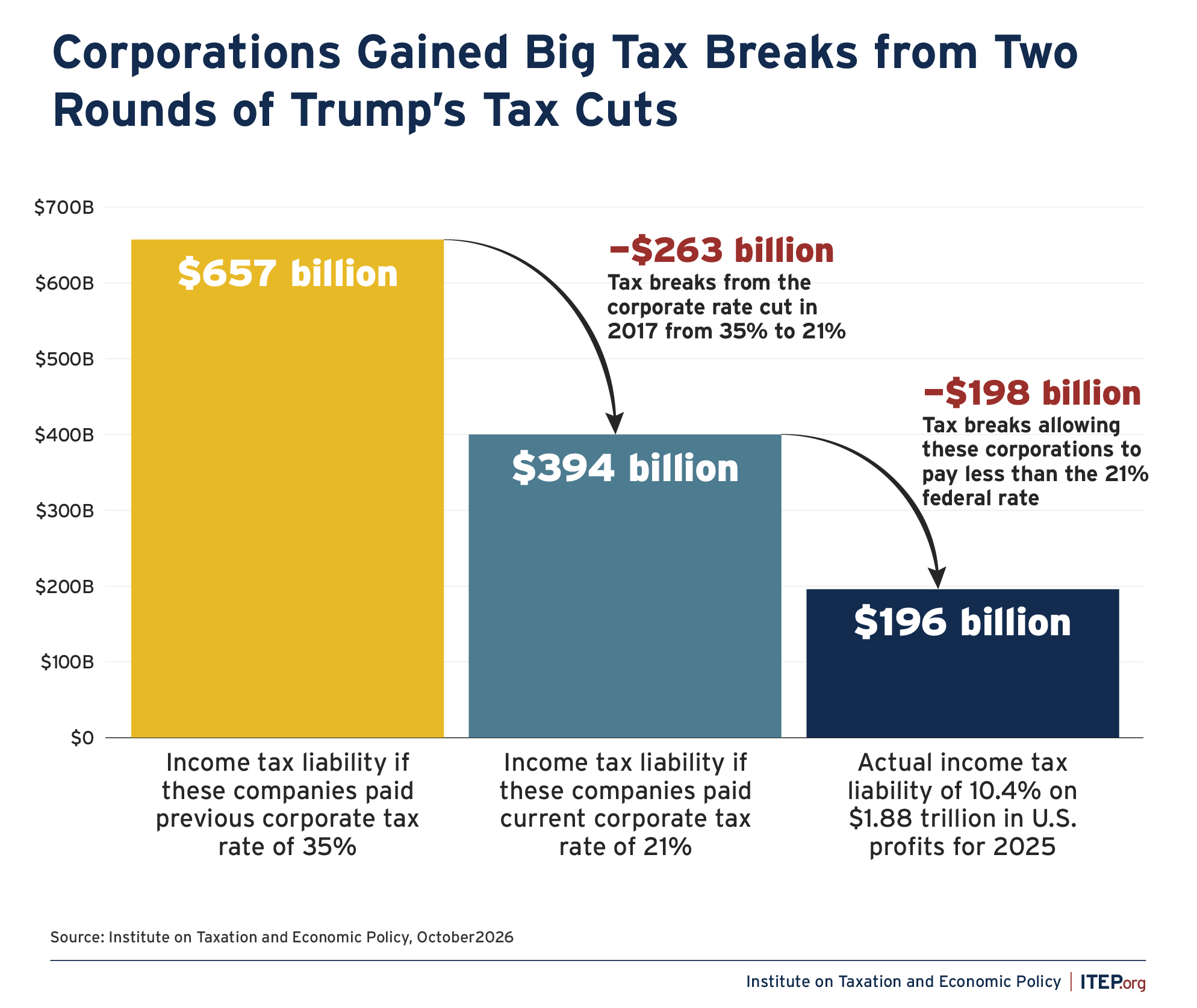
Second is the additional $263 billion that the corporations studied here would have paid in U.S. taxes if they had paid 35 percent of their profits instead of 21 percent in U.S. taxes.
How Trump’s Policies Facilitated Corporate Tax Avoidance in 2025
As already explained, the decisions of President Trump and his allies in Congress have reduced taxes for corporations in two ways. The first, by lowering the statutory federal corporate income tax rate from 35 percent to 21 percent, is probably the most easily understood by most people. The second, continuing and even expanding the list of special breaks and loopholes that allow companies to pay even less than the statutory tax rate, is more complicated but equally important. The main provisions in this category are described here.
Our detailed analysis of annual financial reports for corporations in every sector of the U.S. economy paints a picture of a corporate tax system that is now more loophole than law.
Accelerated Depreciation | Vastly Expanded Under Trump’s Tax Law
Accelerated depreciation allows businesses to deduct (depreciate for tax purposes) the cost of equipment or other assets they purchase before the useful life of the equipment or asset has ended. In other words, it allows businesses to write off the cost of capital expenditures for tax purposes more quickly than is allowed under the financial accounting rules that have been developed over generations to create an accurate picture of the revenue, expenses, and income of businesses each year.
Trump’s first tax law, enacted in 2017, vastly expanded existing accelerated depreciation (temporarily, at the time) into its most extreme form, known as expensing, which was also sometimes called 100 percent bonus depreciation. Expensing allows businesses to write off the cost of capital expenditures (spending on equipment or other assets used for the business) entirely in the year the expenditures are made.
One of the most costly business provisions in Trump’s second tax law (OBBBA) is the provision to allow expensing permanently and expand it to certain types of structures used by businesses.
The result is that a highly profitable corporation can make it appear that it does not have any taxable profits at all, so long as it is buying up equipment and building factories. Depreciation tax breaks, including the new provisions created by OBBBA, collectively reduced the federal income tax bills of the companies in our study by at least $88 billion last year.
Tax Break for Foreign Sales from U.S. Intellectual Property | Created by Trump’s Tax Laws
Trump’s 2017 law created a special deduction for profits that are deemed to be attributable to foreign sales of goods and services that incorporate U.S.-held intellectual property like patents and trademarks.
The new tax law slightly modifies and renames it. This provision, known as FDDEI (Foreign-derived deduction-eligible income), taxes this ostensibly foreign income at a rate far below the statutory 21 percent companies would pay on these profits if they were based on sales to domestic customers. FDDEI tax breaks reduced the tax payments of these companies by at least $18 billion last year, and the spotty disclosures made by many companies mean that the real cost to American taxpayers of these provisions is likely far larger.
Trump’s Second Tax Law Did Away with the Few Revenue-Raising Business Tax Provisions from His First Tax Law
The drafters of the 2017 tax law tried to at least appear as if they were restraining the overall cost of their tax cuts. They included a few provisions that raised taxes on businesses in certain ways, which they presented as offsetting some of the costs of the law’s corporate tax cuts. It is likely that the law’s drafters never really intended these revenue-raising provisions to go into effect and in fact, most were repealed or dramatically weakened under the 2025 tax law (the so-called “One Big Beautiful Bill Act,” or OBBBA). These are the two most significant examples.
Limits on Interest Deductions
OBBBA loosens the cap on how much interest on loans can be deducted. The 2017 tax law imposed a cap on the ability of large corporations to deduct interest on their bonds and other debt, limiting the deduction to 30 percent of taxable income. The 2017 law also made a technical change, scheduled to go into effect in 2021, in how taxable income for purposes of the cap was calculated, and it had the effect of tightening the limit. OBBBA restores the looser limit. This is problematic because limits on interest deductibility help prevent corporations from excessively leveraging debt to reduce their tax bills – a hallmark of private equity deals in particular.
Research Expensing
OBBBA revives a rule allowing expensing of research expenditures that might otherwise be amortized (gradually deducted), which the 2017 tax law had repealed. OBBBA also allows retroactive write-offs back to 2022 for smaller businesses, and it effectively allows even large companies to claim the write-offs for previous years in many cases. While disclosure of this tax break is spotty, we identified over $37 billion in 2025 tax breaks claimed through this provision in our study.
Research Tax Credit | Predates Trump
The federal research and development credit still operates largely as it did before President Trump first took office, subsidizing corporations’ R&D spending even for “research” that most Americans would not find especially valuable. The companies in our study collectively disclosed saving $22 billion using the R&D tax credit last year. Congress would (hopefully) never propose giving Airbnb $121 million to improve its website, but that’s effectively what the R&D credit did for Airbnb in 2025. And while Peloton, Nike, and Zillow may well use their R&D credits to improve our lives, the obvious question is whether taxpayers really need to be subsidizing these companies to think of clever new ways of selling us things.
The R&D credit is also routinely abused. A recent New York Times report finds that the tech giant Meta is claiming R&D credits for the routine costs of equipping its data centers. Because this involves no actual research or experimentation, a bipartisan group of lawmakers have written to the Treasury Secretary demanding answers – a rare case of Congress paying any attention at all to what this tax credit is subsidizing. Meta is already embroiled in litigation after the company claimed that its CEO’s compensation is eligible for the credit because Mark Zuckerberg thinks about inventing things.
Stock Options Tax Break | Predates Trump
A longstanding tax break for executive stock options, which lets companies deduct the value of options granted to a handful of their highest-paid leaders, remains a major factor in reducing many companies’ tax rates in 2025.
This tax break allows companies to write off stock-option-related expenses for tax purposes that go far beyond expenses they report to investors. The benefit of this tax break tends to go overwhelmingly to a small number of highly profitable companies in the tech sector.
This provision cut corporate tax bills by at least $22 billion among the companies surveyed here.
Many Industries Disclose Low Tax Rates, But Some Pay Close to the Statutory Rate
The tax breaks described in this report impact different types of corporations in different ways. As a result, some industries overall pay lower effective tax rates than others.
Figure 7
In dollar terms, no industry has enjoyed more federal tax breaks over the last year than big tech firms. By paying an average tax rate of 10 percent instead of 21 percent on their outsized profits, tech companies in our study raked in $68.5 billion in federal tax breaks in 2025. An earlier ITEP analysis found that much of these tax breaks were attributable to accelerated depreciation tax provisions that were turbocharged by the 2025 Trump tax cuts.
But the big tech firms are not alone in gaming the tax system. As the table above shows, other prominent industry groups collectively pay even lower tax rates, on average, than big tech.
Companies in the motor vehicle industry reported tax rates averaging 2.7 percent in 2025. General Motors disclosed a 2.8 percent tax rate last year, while Tesla’s federal income tax bill on $5.7 billion in U.S. profits was exactly zero.
Telecommunications companies reported a tax rate averaging 6.7 percent in 2025. These included Verizon at 8.5 percent, AT&T at 4.7 percent, and T-Mobile at just 0.4 percent. Depreciation tax breaks were the single largest contributor to low tax rates in this group.
Corporations in the aerospace industry paid just 7.6 percent of their profits in federal income tax last year. Five of these companies — Huntington-Ingalls, L3Harris, Parsons, Textron, and V2X — didn’t pay a dime in federal income tax last year. More than half of the $3.9 billion in tax breaks enjoyed by this industry group came from the OBBBA provision allow immediate expensing of R&D.
The retail sector, broadly defined, collectively disclosed an effective federal tax rate of just 8.7 percent last year. But this overall average is skewed by the super low tax rates facing five internet retailers within this group: Amazon, Chewy, Etsy, Expedia, and Instacart collectively reported a 1.3 percent tax rate on $91 billion of U.S. income. The other 50 more brick-and-mortar companies in this sector collectively paid a 15.4 percent federal tax rate on $101 billion of U.S. income in 2025.
Your Favorite Chain Restaurant Pays A Lower Tax Rate than You Do
Restaurants aren’t typically thought of as corporate avoiders because the biggest corporate tax breaks are meant to incentivize things restaurants don’t typically do: innovative research and development or large capital investments in machinery and equipment. But in 2025, eight of the most familiar restaurant chains you see in any strip mall across the nation used the 2025 Trump tax law provision on tips, combined with other parts of the code, to shelter three-quarters of their U.S. profits from federal corporate income taxes.
These companies are relying on a single outdated tax break—a tax credit companies claim for the payroll taxes they pay on their employees’ tips—to achieve every last dime of their income tax breaks. Originally designed to incentivize companies to track and report tips that were universally paid in cash, the credit has been rendered mostly redundant by the increasing use of credit card tips and the Trump administration’s new personal income tax deduction for some tip income.
Offshore Breaks and Loopholes Likely Allow Tax Rates on U.S. Income Lower than the Rates Calculated in This Report
There are two problems related to offshore profits that can, in some cases, obscure how much U.S. corporations are avoiding in federal income taxes. The first involves claims that corporations make about how much of their profits are earned in the United States or earned offshore. The second involves what companies tell us about the taxes they pay on their offshore profits. As explained below, both suggest that this report may overstate the federal corporate income taxes paid by some corporations. In other words, tax avoidance is likely to be even more substantial than what is shown in this analysis.
Problems with How Corporations Report Their Profits
This report analyzes U.S. corporate income taxes paid on profits generated in the U.S. and how American companies often avoid these taxes. For most corporations, this is relatively straightforward because what they tell shareholders and investors (in their annual 10-K report) regarding the profits they earn in the U.S. is believable. Even if these corporations use accounting gimmicks to tell the IRS something completely different about their U.S. profits, we find that we can generally trust what they tell their shareholders about this.
However, there are some corporations for whom this is not true. These companies seem to characterize some profits that they earn in the U.S. as offshore profits in their financial accounting (what they disclose in their 10-K to investors and shareholders) as well as in what they report to the IRS for tax purposes.
The effective tax rates calculated for each corporation in this report are U.S. taxes as a share of U.S. profits. The calculation is difficult when it is unclear whether a corporation is correctly characterizing the portion of its profits generated in the U.S. vs. generated offshore.
The pharmaceutical sector is particularly problematic in this regard, making it more difficult to analyze than the other sectors described above.
Our study includes nine pharmaceutical companies. On its face, these companies’ tax avoidance appears similar to other industries: the nine companies reported an effective federal income tax rate of 10.5 percent, almost identical to that of the other 697 companies surveyed here.
But more so than with most industries, a purely-U.S. based analysis of tax avoidance omits an important tax-dodging strategy pursued by big pharmaceutical companies: offshoring income to foreign tax havens. In some cases, this means companies are excluded from our study entirely.
For example, Merck reports $21 billion of pretax profit worldwide last year and $20 billion the year before. Yet the company claims to have lost $5 billion in the U.S. last year, with similar losses in 2024. Since we exclude domestically unprofitable companies from our analysis, Merck’s offshore tax avoidance is omitted entirely from our findings. This means that the pharmaceutical industry probably avoids even more taxes than shown in this report.
It is well-known that American corporations often use accounting gimmicks to make profits earned in countries (like the U.S.) where they could be taxed appear to be earned in offshore jurisdictions with much lower corporate taxes or no corporate tax at all. The federal corporate income tax has provisions that are supposed to prevent this kind of offshore tax avoidance, but they often appear ineffective.
Problems with How Corporations Report Taxes Paid on Offshore Profits
Among the federal provisions that are supposed to prevent offshore tax avoidance, the most important is one created in the 2017 tax law that imposes a tax (albeit at a low rate) on what the law called Global Intangible Low-Taxed Income (GILTI). The tax on GILTI was often characterized as a minimum tax on offshore profits, even though the rules taken still taxed offshore profits more generously than domestic profits.
The idea was that if an American corporation claims to earn profits in another country where it is subject to very low taxes or no taxes, there is a good chance that these profits are really earned in the U.S. or another country with a real tax system and the company used accounting gimmicks to make it appear they earned the profits in a low-tax jurisdiction. In some circumstances, these profits would be considered GILTI and subject to a U.S. tax.
GILTI was renamed Net CFC Tested Income (NCTI) by the Trump 2025 tax law. Almost without exception, companies surveyed in this report still refer to it as GILTI in 2025, and this discussion conforms to that usage.
GILTI taxes are taxes on profits that companies characterize as foreign profits, so this report does not include them in the calculations of effective tax rates (which are U.S. corporate income taxes as share of U.S. profits).
The problem is that some corporations fail to report their payments of GILTI in a way that allows us to separate them from U.S. taxes paid on U.S. profits. Companies that likely pay GILTI on their foreign income but do not disclose that amount include four of the five most profitable corporations profiled here: Alphabet, Microsoft, Amazon, and Meta.
Some other companies that do disclose large amounts of GILTI expense appear to present these amounts before offsetting foreign tax credits, which makes it impossible to know how much reported current federal income tax is actually GILTI tax paid on foreign income.
As an example, Citigroup discloses $212 million of GILTI expense in 2025 and separately discloses $349 million of foreign tax credits. Unlike many companies, Citigroup also doesn’t specify whether its GILTI tax disclosure is before or after the foreign tax credit, so we are forced to leave reported current federal income tax as the company reports it. This means it’s very possible that Citigroup’s actual current federal income tax expense is far lower than what the company discloses.
Tax Breaks the Corporations Themselves Admit Are Probably Illegal
There is a more general way in which the reported current federal tax expense presented in this report can overestimate the federal tax bills these companies face: it doesn’t include billions of dollars of tax breaks these companies claim each year that they state they probably shouldn’t get away with claiming.
The Financial Accounting Standards Board’s disclosure rules require publicly traded companies to tabulate the amount of tax breaks claimed that they believe would, more likely than not, be disallowed on audit by a properly functioning tax administration. But companies present their current tax expense as if these uncertain tax benefits, or UTBs, didn’t exist.
For example, Amazon discloses $1.22 billion of current federal income tax expense in 2025 but also discloses $1.29 billion of UTBs in the last year. If these UTBs are primarily related to federal income taxes (as opposed to foreign taxes, which are also included in the UTB tally) then Amazon’s real-world federal income tax rate will be closer to zero than the 1 percent tax rate we tabulate in this report. Other companies for whom uncertain tax benefits were larger than reported federal income tax in 2025 include Abbott Laboratories, Chevron, ExxonMobil, Lyft, Meta, and Uber.
Trump Tax Laws Have Hollowed Out the Corporate Tax Base
Our detailed analysis of annual financial reports for corporations in every sector of the U.S. economy paints a picture of a corporate tax system that is now more loophole than law.
Less than a decade after the first Trump administration pushed to sharply reduce the federal corporate income tax rate from 35 to 21 percent, the tax disclosures of 706 profitable American corporations tell us that even a 21 percent tax rate remains an accounting fiction for most profitable corporations.
The average U.S. corporation in our study is using special tax breaks to shield more than half of its domestic profits from federal income tax in 2025, while over 100 are finding ways to hide every last dime of their U.S. profits from the reach of the federal tax system. And the tax disclosures made by these companies to their shareholders point quite clearly to tax breaks enacted by the second Trump administration as a driving factor in these super-low effective tax rates.
The bonus depreciation and research expensing tax breaks that were among the costliest features of the 2025 Trump tax cuts figure prominently in the tax avoidance strategies used by the big tech companies whose profits have grown most dramatically in the last year.
This presents a stark warning to lawmakers concerned with our nation’s burgeoning budgetary woes. It also provides a clear policy solution for anyone interested in a fair and sustainable tax system—and anyone who is worried about the staggering rate of corporate investment in artificial intelligence by a handful of cash-rich, politically influential tech corporations.
At the very least, Congress should be asking why American taxpayers should be subsidizing the AI spending arms race between a handful of companies whose leaders already have the resources they need to spend billions on whatever they have in mind. Right now, there are probably very few Americans who believe that our tax code should continue doling out billions to the most profitable corporations in world history in order to automate production.
Our corporate tax laws are falling short at a moment when it’s especially vital that they work effectively. Even as the profits of a handful of tech juggernauts are exploding, corporate income tax breaks are allowing these companies to keep most of their income out of the reach of the tax system.
This is the entirely avoidable product of disastrous decisions made by the Trump administration and a willing Congress in two rounds of tax legislation in 2017 and 2025. More responsible lawmakers can remedy the gaping holes in our corporate tax laws by broadening the corporate tax base to more fairly and uniformly tax these runaway profits.
Methodological Appendix
This study assesses the health of the U.S. corporate income tax by looking at how it has affected the largest and most profitable corporations in America in fiscal year 2025. The study’s research concept and methodology closely follow the approach used in a series of reports by Citizens for Tax Justice and the Institute on Taxation and Economic Policy for the past 40 years. This latest edition in this long-running series looks at 706 of the largest corporations in America and analyzes the federal income taxes reported by each of these companies on their U.S. pretax income in fiscal year 2025. The report calculates, for each company in the study, an effective federal income tax rate (that is, current federal income tax expense as a share of pretax U.S. income) for each company. All information presented in this study is taken from the 10-K annual financial reports that publicly traded corporations are required to file each year with the Securities and Exchange Commission (SEC).
The sample selection for the companies included in this study begins with the complete universe of publicly traded, U.S.-based corporations in the Fortune 1000 (a ranking based on revenues) and the S&P 500 (a ranking based on market capitalization). From this initial list, we excluded companies that reported a U.S. pretax loss in 2025. We also excluded companies that failed to provide sufficient information to calculate U.S. pretax income, or current federal income tax, or (in some cases) both. (For example, Berkshire Hathaway does not publish an estimate of current federal income tax, even though the rules promulgated by the Financial Accounting Standards Board clearly require it.) This left us with the 706 companies included in this report.
The tax expense reported by the 706 companies included in our final sample represented over a third of total federal corporate income tax collections in fiscal year 2025. The effective tax rates published in this study are based entirely on data published by these companies in their annual financial reports. In most cases, the effective tax rate for any year is the product of three numbers: U.S. pretax income, current federal income tax, and current state income tax (which is subtracted from pretax income to get net pretax income). The effective federal income tax rate is calculated as: current federal tax / (U.S. pretax income – current state tax).
The use of current federal tax expense is important because current taxes are those the company is obligated to pay during the year and excludes “deferred” income taxes that the company owes but is allowed to postpone paying until a later year.
The pretax incomes published in this study are generally what the companies themselves reported. In some cases, the information reported by the companies does not directly state their pre-tax income, so some calculations are required using the information they do provide. For example, when companies with a small multinational presence failed to disclose the geographic split of pretax income, we calculated the U.S. and foreign income share using data on the geographic location of operating profit where available or, more frequently, we estimated foreign income using reported foreign tax.
A second infrequent calculation based on the published data relates to “noncontrolling interest income.” This is income of a company’s subsidiary that is reported on financial statements as part of income, but that is not taxable to the corporation. When substantial noncontrolling interest income was disclosed, we subtracted it from U.S. and/or foreign pretax income. When this noncontrolling income was a loss, we added it back to reported income.
A third calculation derived from the published income data relates to “goodwill impairments.” These are non-cash, non-taxable charges against income that are taken irregularly by companies to reflect a sharply diminished estimate of the company’s future earnings potential. These charges affect neither a company’s income taxes nor its cash flow. When these impairments were disclosed, we added them back to reported pretax income.
On the tax side, reported current federal income tax expense was infrequently adjusted in one way. Specifically, we subtracted the value of Global Intangible Low Taxed Income (GILTI) expense, net of foreign tax credits, in the limited number of cases where it was disclosed, because this feature of the 2017 tax law is explicitly levied against foreign income, not U.S. income.