
Arizona
ITEP Comments and Recommendations on Proposed Section 170 Regulation (REG-112176-18)
October 11, 2018 • By Carl Davis
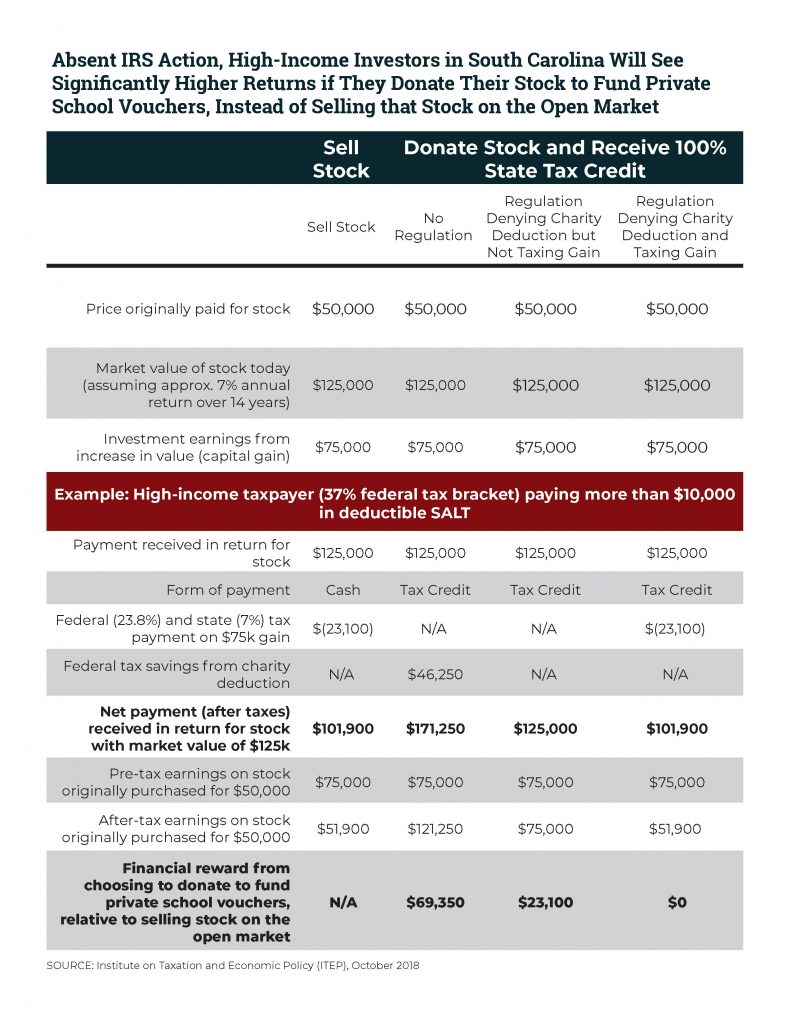
The IRS recently proposed a commonsense improvement to the federal charitable deduction. If finalized, the regulation would prevent not just the newest workarounds to the $10,000 deduction for state and local taxes (SALT), but also a longer-running tax shelter abused by wealthy donors to private K-12 school voucher programs. ITEP has submitted official comments outlining four key recommendations related to the proposed regulation.
Twelve States Offer Profitable Tax Shelter to Private School Voucher Donors; IRS Proposal Could Fix This
October 2, 2018 • By Carl Davis
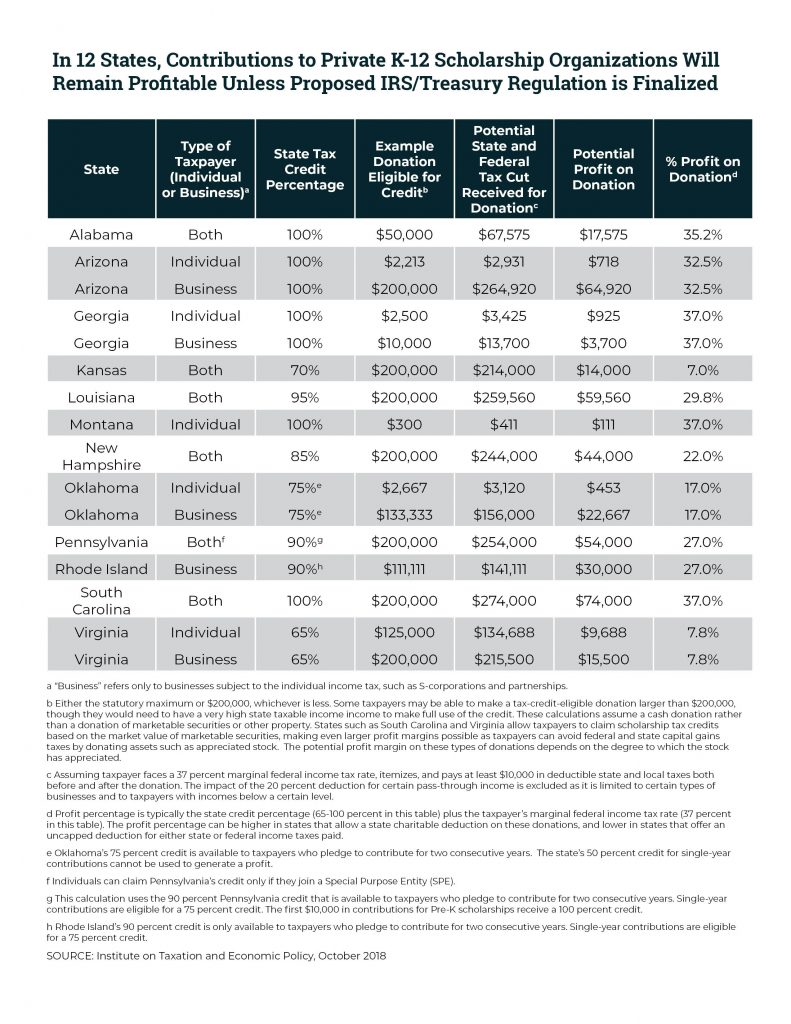
A proposed IRS regulation would eliminate a tax shelter for private school donors in twelve states by making a commonsense improvement to the federal tax deduction for charitable gifts. For years, some affluent taxpayers who donate to private K-12 school voucher programs have managed to turn a profit by claiming state tax credits and federal tax deductions that, taken together, are worth more than the amount donated. This practice could soon come to an end under the IRS’s broader goal of ending misuse of the charitable deduction by people seeking to dodge the federal SALT deduction cap.
Tax Cuts 2.0 – Arizona
September 26, 2018 • By ITEP Staff
The $2 trillion 2017 Tax Cuts and Jobs Act (TCJA) includes several provisions set to expire at the end of 2025. Now, GOP leaders have introduced a bill informally called “Tax Cuts 2.0” or “Tax Reform 2.0,” which would make the temporary provisions permanent. And they falsely claim that making these provisions permanent will benefit […]
IRS Reopens Tax Loophole Sought by Sen. Toomey, but it Won’t Work in Pennsylvania
September 20, 2018 • By Carl Davis

A recent IRS clarification, which appears to have been a pet project of Sen. Pat Toomey (R-PA), has been widely interpreted as reopening a loophole the agency had proposed closing just weeks earlier. But while the announcement creates an opening for aggressive tax avoidance in many states, Pennsylvania, ironically enough, isn’t one of them.
The Rundown is back after a few-week hiatus, with lots of state fiscal news and quality research to share! Maine lawmakers found agreement on a response to the federal tax-cut bill, states continue to sort out how they’ll collect online sales taxes in the wake of the Wayfair decision, and policymakers in several states have been working on summer tax studies and other preparations for 2019 legislative sessions. Meanwhile, work on ballot measures and candidate tax plans to go before voters in November has been even more active, particularly in Arizona, California, Florida, Hawaii, and Missouri. Our “What We’re Reading” section has lots of great research and reading on inequalities, cities turning…
State lawmakers seeking to make residential property taxes more affordable have two broad options: across-the-board tax cuts for taxpayers at all income levels, such as a homestead exemption or a tax cap, and targeted tax breaks that are given only to particular groups of low- and middle-income taxpayers. One such targeted program to reduce property taxes is called a “circuit breaker” because it protects taxpayers from a property tax “overload” just like an electric circuit breaker: when a property tax bill exceeds a certain percentage of a taxpayer’s income, the circuit breaker reduces property taxes in excess of this “overload”…
The Journal News: Gov. Andrew Cuomo’s Anti-Trump Tax Plan Crumbling in Face of IRS Regulations
September 11, 2018
Similar programs give state tax credits on 100 percent of the donations in states such as Alabama, Georgia, Arizona and South Carolina. It’s a system that has proved profitable for savvy taxpayers, said Carl Davis, research director at the Institute on Taxation and Economic Policy. Read more
CNBC: Cutting SALT–It Could Be the Last Day for This Tax Saving Strategy
August 24, 2018
There are 18 states with private school voucher tax credits, including programs in Arizona, Alabama and South Carolina. A number of them offer credits to contributing taxpayers on a dollar-for-dollar basis. “In a perverse situation, you donate $100 and you get back $137 in the form of state tax credits and deductions,” said Carl Davis, […]
The Oregonian: Trump Administration Moves to Stop Oregon, Other States from Circumventing New Tax Law
August 23, 2018
Treasury said it expects that only about 1 percent of all U.S. taxpayers would see a reduction of their tax credits for donations to a private-school voucher fund. Several states — Alabama, Arizona, Georgia, Montana and South Carolina — allow taxpayers who donate to private-school funds to get a 100 percent credit against their state […]
State Rundown 8/22: Wayfair Fallout Could Hit the Pavement Soon
August 22, 2018 • By ITEP Staff
Arizona voters learned this week that they will have an opportunity this fall to restore school funding through a progressive tax measure. The effects of the Supreme Court’s Wayfair decision could soon be seen on Michigan and Mississippi roads, as leaders in both states have proposed devoting new online sales tax revenues to infrastructure needs. And new research highlighted in our “What We’re Reading” section discredits one-size-fits-all prescriptions for state economic growth such as supply-side tax-cut orthodoxy, advocating instead for more nuanced and state-specific policymaking.
Although most state legislatures are out of session during the summer, the pursuit of better fiscal policy has no "off-season." Here at ITEP, we've been revamping the State Rundown to bring you your favorite summary of state budget and tax news in the new-and-improved format you see here. Meanwhile, leaders in Massachusetts and New Jersey have been hard at work in recent weeks and are already looking ahead their next round of budget and tax debates. Lawmakers in many states are using their summer break to prepare for next year's discussions over how to implement online sales tax legislation. And…
The Fight for Education Funding: State Revenue Needs and Responses in 2018
July 24, 2018 • By Aidan Davis

States’ need for revenue and increased investment in key public services is not unique to this legislative session. But the extent of disinvestment—particularly in education—has been a driving force behind policy discussion and state legislative action this year. In many cases ill-advised tax cuts coupled with persistent school funding cuts led states to this common fate, initiating a powerful and growing trend. Here’s how lawmakers in a handful of state responded:
New Jersey avoided a second consecutive shutdown and proved that even against staunch opposition, progressive solutions to states' fiscal issues are attainable, and Arizona voters will likely have a chance to solve their education funding crisis in a similar way. Budget and tax debates remain to be resolved, however, in Maine and Massachusetts. Meanwhile, voters are gaining a clearer picture of what questions they will be asked on ballots this fall as signature drives conclude in several states.
The Bond Buyer: Where SALT Workarounds Are Being Promoted
July 5, 2018
he $10,000 federal cap on the deductibility of state and local taxes has led to a flurry of activity in red states to promote tax credits for taxpayers’ efforts to make charitable donations to get around that cap. That’s the finding of a survey by the Institute for Taxation and Economic Policy that highlights the […]
Bloomberg BNA: Fix’ for Federal Cap on State Tax Deduction? K-12 Tax Credits
June 27, 2018
But the very same charge can be made against the tax credit programs for private K-12 schools, the Institute on Taxation and Economic Policy said in its report. These programs are now being openly promoted by tax advisers and accountants as a way to sidestep or circumvent the SALT deduction cap, according to ITEP. “In […]
The Other SALT Cap Workaround: Accountants Steer Clients Toward Private K-12 Voucher Tax Credits
June 27, 2018 • By Carl Davis
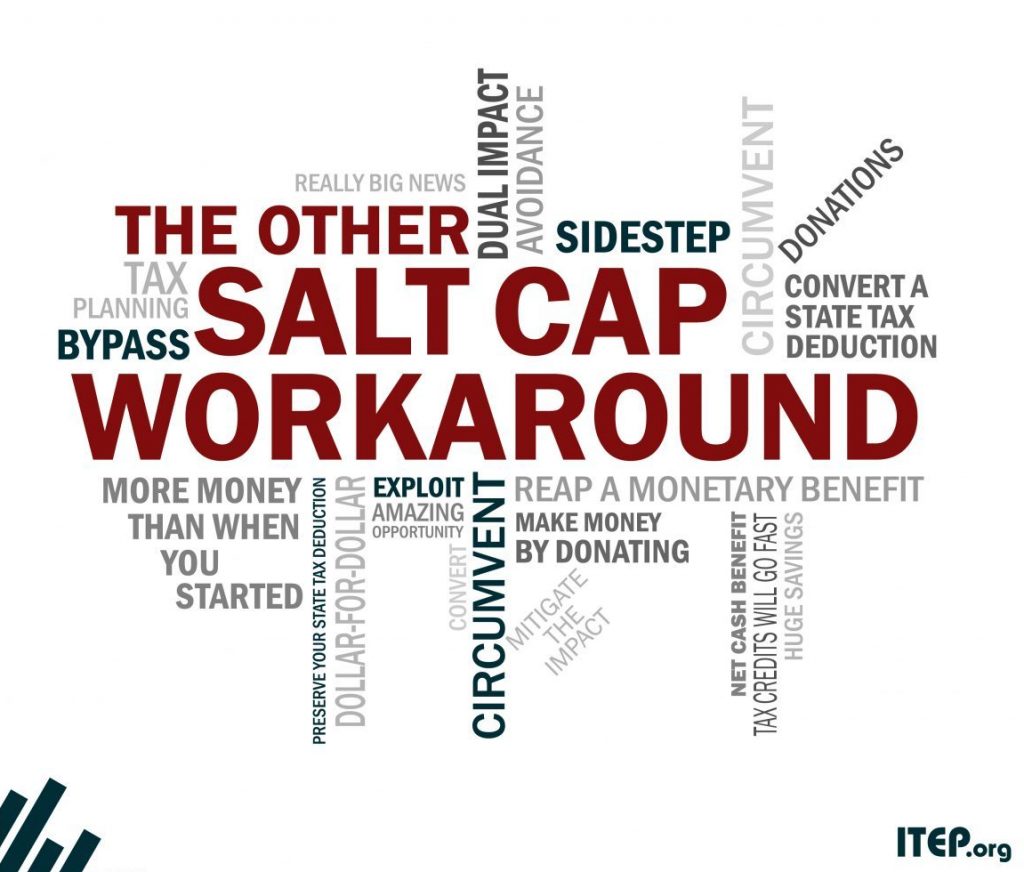
On May 23, 2018, the IRS and Treasury Department announced that they “intend to propose regulations addressing the federal income tax treatment of certain payments made by taxpayers for which taxpayers receive a credit against their state and local taxes.” They made the announcement in response to new “workaround tax credits” enacted in New York […]
State Rundown 6/13: Budget Crunch Time Sets in as State Fiscal Years Come to Close
June 13, 2018 • By ITEP Staff
With many state fiscal years ending June 30th, budget negotiations were completed recently in California, Illinois, Michigan, and North Carolina. New Jersey remains a state to watch as a government shutdown looms but leaders continue to disagree about a proposed millionaires tax, corporate taxes, and school funding. In other states looking to wealthy individuals and large corporations for needed revenues, Arizona's teacher pay crisis could be solved with a tax on its highest-income residents and a similar proposal in Massachusetts is polling well, but Seattle's new "head tax" could be on the chopping block.
Center on Budget and Policy Priorities: Arizona Proposal Would Finance School Funding Boost, Make Tax Code Less Regressive
May 30, 2018
The measure would also make Arizona’s tax code somewhat less regressive. Currently, the poorest 20 percent of households pay 12.5 percent of their annual income to state and local taxes — more than twice as much as the wealthiest 1 percent of Arizonans, who pay just 5.7 percent, according to the Institute on Taxation and […]
SALT/Charitable Workaround Credits Require a Broad Fix, Not a Narrow One
May 23, 2018 • By Carl Davis

The federal Tax Cuts and Jobs Act (TCJA) enacted last year temporarily capped deductions for state and local tax (SALT) payments at $10,000 per year. The cap, which expires at the end of 2025, disproportionately impacts taxpayers in higher-income states and in states and localities more reliant on income or property taxes, as opposed to sales taxes. Increasingly, lawmakers in those states who feel their residents were unfairly targeted by the federal law are debating and enacting tax credits that can help some of their residents circumvent this cap.
NC Teachers’ March on Raleigh and the Tax Cuts that Led Them There
May 15, 2018 • By Aidan Davis
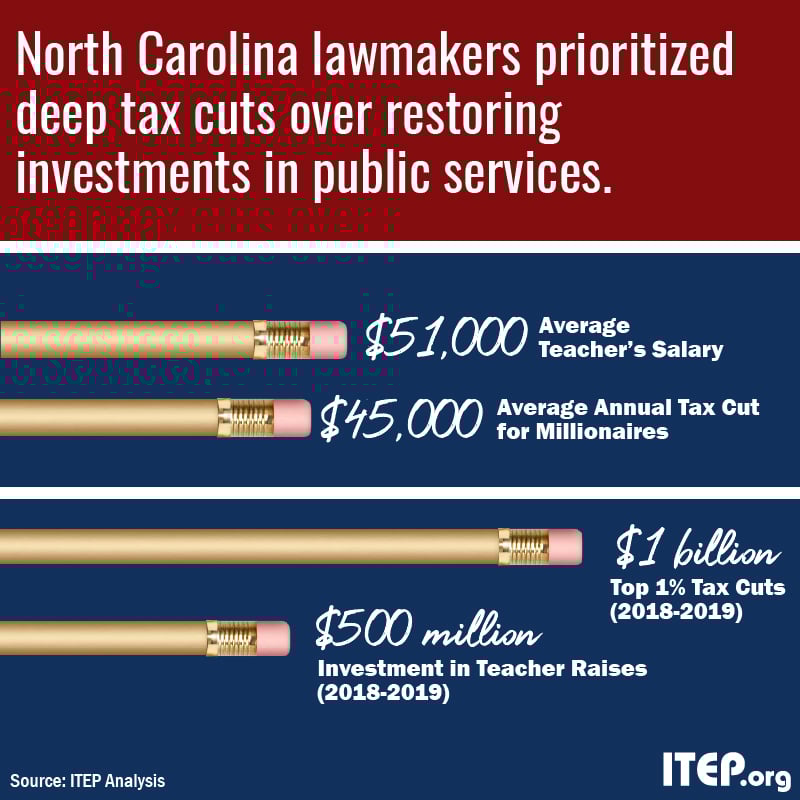
Once again, public school teachers are taking a stand for education and against irresponsible, top-heavy tax cuts that deprive states of the revenue they need to sufficiently fund public services, including education.
News & Observer: Arizona Income Tax story
May 12, 2018
Meg Wiehe, deputy director of the Institute on Taxation and Economic Policy, said the public could be more likely to support income tax hikes since federal tax debate in the fall. “People understand the consequences,” she said. “They’re starting to connect the dots of what does it mean when there’s less revenue to spend.” The […]
Millionaires Average Annual Tax Cut in North Carolina Is Comparable to Average Teacher’s Salary
May 11, 2018 • By Meg Wiehe
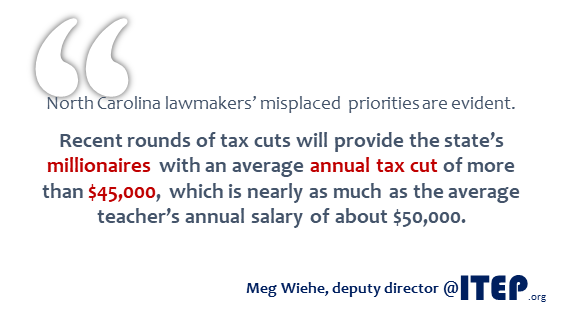
North Carolina lawmakers' misplaced priorities are evident: The recent rounds of tax cuts will provide the state’s millionaires with an average annual tax break of more than $45,000, which is nearly as much as the average teacher’s annual salary of about $50,000.
Associated Press: Arizona Voters May Be Asked Whether They Want to Tax High Earners to Fund Education
May 11, 2018
Ballot initiatives to hike taxes on the rich are rare but not unheard of. A measure in Washington state in 2010 to adopt an income tax for individuals who make more than $200,000 was overwhelmingly voted down. Meg Wiehe, deputy director of the Institute on Taxation and Economic Policy, said the public could be more […]
State Rundown 5/9: Iowa Digs a New Hole as Other States Try to Avoid or Climb Out of Theirs
May 9, 2018 • By ITEP Staff
This week we have news of a destructive tax cut plan finally approved in Iowa just as one was narrowly avoided in Kansas. Tax debates in Minnesota and Missouri will go down to the wire. And residents of Arizona and Colorado are considering progressive revenue solutions to their states' education funding crises.
Working Life Podcast: A shift in the air on tax cuts?; Arizona uprising update; Inequality is worse than you think
May 9, 2018
The teachers’ uprisings around the nation have challenged the bankrupt ideology of supply-side tax cutting—and maybe marks a shift in the public’s view of taxes and public spending. Jonathan Tasini talks about that with Meg Wiehe, deputy director of the Institute for Taxation and Economic Policy. Read more
