
2,364 posts
Scene: Policy Matters Ohio Proposes State Income Tax Overhaul to Help Low- and Middle-Income Ohioans
• By ITEP Staff
After presenting the recommendations contained within a new report Tuesday morning, Policy Matters Ohio researcher director (and the report's lead author) Zach Schiller was asked whether or not Ohio, a "center-right state," would realistically support a tax code overhaul that proposed taxing Ohio's wealthiest at a higher rate.
Policy Matters Ohio: Overhaul: A plan to rebalance Ohio’s income tax
• By ITEP Staff
Policy Matters proposes the following changes to the state income tax […] This would generate almost $2.6 billion a year, including the cost of expanding the EITC, according to analysis by the Institute on Taxation and Economic Policy (ITEP). Read more here

South Dakota v. Wayfair Decision Brings Overdue Fairness to Retail Sales Tax
• By Carl Davis
Following is a statement by Carl Davis, research director at the Institute on Taxation and Economic Policy, regarding the Supreme Court’s decision in South Dakota v. Wayfair. Mr. Davis has authored numerous policy briefs regarding how online retailers that fail to collect sales taxes deprive states of necessary sales tax revenue and maintain an unfair advantage over bricks and mortar retailers.

All Bets are Off: State-Sponsored Sports Betting Isn’t Worth the Risk
• By Misha Hill
Many state legislators and regulators are considering expanding state-sponsored gambling by allowing betting on major league sports games. But the revenue states could bring in isn’t worth the risk.
Oklahoma Policy Institute: On Immigration Rhetoric, Consider the Facts
• By ITEP Staff
These undocumented Oklahomans currently contribute about $85 million in state and local taxes per year, according to our best estimates. They pay sales tax directly when they purchase goods and services, just like the rest of us, and they pay property taxes through owning a home or paying rent. Although they are not technically eligible […]

Lottery, Casino and other Gambling Revenue: A Fiscal Game of Chance
• By ITEP Staff
Cash-strapped, tax-averse state lawmakers continue to seek unconventional revenue-raising alternatives to the income, sales, and property taxes that form the backbone of most state tax systems. However, gambling revenues are rarely as lucrative, or as long-lasting, as supporters claim.
Oklahoma Policy Institute: To Improve Public Safety and Insurance rates, Allow Undocumented Oklahomans to Drive Legally
• By ITEP Staff
Oklahoma’s approximately 95,000 undocumented immigrants are a force in Oklahoma’s economy, accounting for about 1 in 30 members of the workforce and contributing roughly $85 million in state and local taxes annually. But despite their positive economic contributions, undocumented residents face arrest and/or deportation for doing something that many Oklahomans do every day: driving. Read […]
Center for American Progress: The 7 States Suing to End DACA Would Be Harmed by a Victory in Court
• By ITEP Staff
Through their employment, DACA recipients are contributors to their localities and states as wage earners and taxpayers. A 2017 state-by-state study by the Institute on Taxation and Economic Policy showed that the 1.3 million young undocumented immigrants receiving and immediately eligible for DACA contribute significantly to state and local taxes at an estimated $2 billion […]
Oregon Center for Public Policy: Legislature Leaves Oregon Largely Defenseless Against Corporate Abuse of Tax Havens
• By ITEP Staff
The repeal of Oregon’s tax haven law flowed from the legislature’s response to the far-reaching tax law passed by Congress at the end of 2017. The federal law required corporations to pay taxes, at a reduced rate, on more than $2 trillion in profits they held abroad. The federal tax law also put in place provisions intended to deter future shifting of corporate profits to avoid taxes.
CNBC: Donate to charitable funds and nab a tax break in these states — for now
June 4, 2018
How the IRS will ultimately proceed remains to be seen, but experts agree that the agency may take a closer look at programs with generous tax credits. “It’s when you get up and above a 70 percent tax credit — that’s when taxpayers start to view these as not being charitable programs at all but […]
The Commonwealth Institute: On Federal Tax Changes, Virginia Should Continue to Conform
• By ITEP Staff
Although some filers would pay more in state taxes under conformity, many of the highest-income filers – the top one percent – will receive large state tax cuts. This is in addition to also receiving a large federal tax cut. Recent analysis of the effects in Virginia shows that the top 1 percent will receive […]
NC Budget and Tax Center: Corporations over Carolinians?
• By ITEP Staff
Big corporations and wealthy executive have been on quite a run. Corporate profits are at historic levels,[1] stock prices are through the roof, and plush executive pay has become the norm. At the same time, corporate taxes have been slashed both here in North Carolina starting in 2013 and last December at the federal level. […]
Center on Budget and Policy Priorities: Arizona Proposal Would Finance School Funding Boost, Make Tax Code Less Regressive
• By ITEP Staff
The measure would also make Arizona’s tax code somewhat less regressive. Currently, the poorest 20 percent of households pay 12.5 percent of their annual income to state and local taxes — more than twice as much as the wealthiest 1 percent of Arizonans, who pay just 5.7 percent, according to the Institute on Taxation and […]
NC Budget and Tax Center: Revenue Options to Support Children’s Educational Success
• By ITEP Staff
The General Assembly legislative session begins on May 16, the same day teachers plan a day of action to highlight the unmet needs their students face in the classroom and their communities. While the evidence is quite clear that supporting children’s educational success can generate lifelong benefits for families and the broader economy[1], the NC […]
New Jersey Policy Perspective: Fast Facts: Proposed Tax Changes Would Bring More Balance to New Jersey’s Tax Code
• By ITEP Staff
The tax changes proposed in Gov. Murphy’s first budget would bring more balance to New Jersey’s tax code by raising taxes on the wealthiest one percent while reducing them for the lowest-income New Jerseyans.[1] Updating the tax code would also raise nearly $2 billion in new revenue for targeted investments in early education, public transit, health care and other essential public services.

SALT/Charitable Workaround Credits Require a Broad Fix, Not a Narrow One
• By Carl Davis
The federal Tax Cuts and Jobs Act (TCJA) enacted last year temporarily capped deductions for state and local tax (SALT) payments at $10,000 per year. The cap, which expires at the end of 2025, disproportionately impacts taxpayers in higher-income states and in states and localities more reliant on income or property taxes, as opposed to sales taxes. Increasingly, lawmakers in those states who feel their residents were unfairly targeted by the federal law are debating…
NC Policy Watch: Governor Cooper recognizes North Carolina is in a hole, stops digging
• By ITEP Staff
Holding off on another round of tax cuts for the richest taxpayers and profitable corporations and keeping the increased standard deduction and lower rate for the majority of taxpayers will reduce the tax cuts given to the top 5 percent of taxpayers since 2013. Read more here
Most States Have Raised Gas Taxes in Recent Years
• By Carl Davis
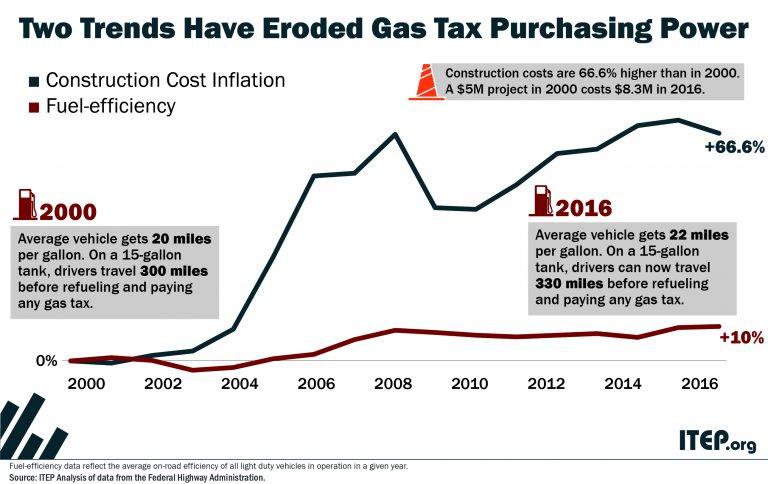
An updated version of this blog was published in April 2019. State tax policy can be a contentious topic, but in recent years there has been a remarkable level of agreement on one tax in particular: the gasoline tax. Increasingly, state lawmakers are deciding that outdated gas taxes need to be raised and reformed to fund infrastructure projects that are vital to their economies.
How Long Has It Been Since Your State Raised Its Gas Tax?
• By ITEP Staff
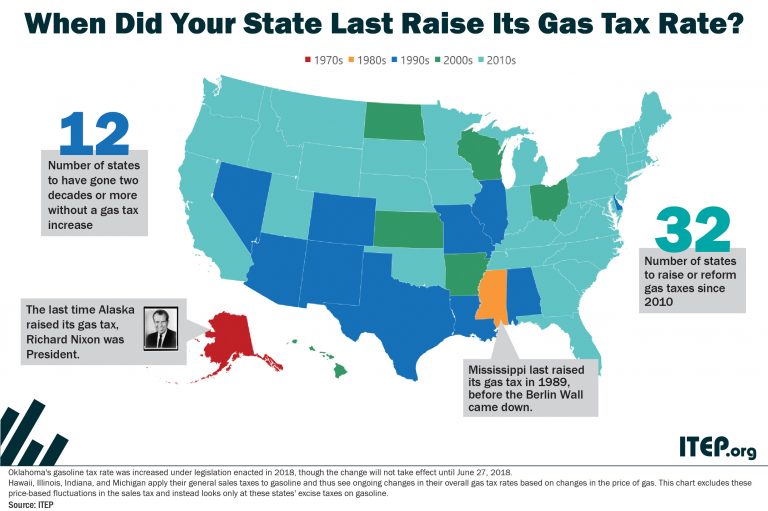
Many state governments are struggling to repair and expand their transportation infrastructure because they are attempting to cover the rising cost of asphalt, machinery, and other construction materials with fixed-rate gasoline taxes that are rarely increased.
North Carolina Justice Center: New Report Looks at How Corporate Tax Cuts Have Hurt North Carolina
• By ITEP Staff
A new report on corporate income taxes looks at how corporate taxes have been slashed at the state and federal levels, provides evidence that wealthy shareholders are the prime beneficiaries of corporate tax cuts, and shows that corporate tax cuts have not solved North Carolina’s most pressing economic problems. Unless leaders in Raleigh change course, corporations could be in line for yet another tax cut next year if a rate cut to the corporate income…
Louisiana Budget Project: Black households would bear disproportionate burden of sales tax renewal
• By ITEP Staff
Lawmakers can address this imbalance by expanding Louisiana’s EITC. An increase of the state EITC from 3.5 percent to 7 percent of the federal EITC would offset a half-cent cent sales tax renewal for families in the bottom 40 percent of income earners. An EITC increase from 3.5 percent to 10 percent would offset a […]
NBC: What Trump’s disclosure of his 500 LLCs can and can’t tell us
May 16, 2018
A 2015 report by the Institute on Taxation and Economic Policy, a non-profit, non-partisan, tax policy think tank, said Delaware’s tax code made it “a magnet for people looking to create anonymous shell companies, which individuals and corporations can use to evade an inestimable amount in federal and foreign taxes.” Read more
CNN: North Carolina teachers want better pay and they’re marching to fight for it
May 16, 2018
Mark Jewell, president of the North Carolina Association of Educators, has said the state could be spending a lot more on schools if it hadn’t shrunk revenues by lowering corporate and personal income tax rates in the past few years. He points to a 2017 report by the nonpartisan Institute on Taxation and Economic Policy, […]
Minnesota Budget Project: Governor Dayton’s Proposed Supplemental Budget Makes Investments In Education, Health And Human Services, Economic Development, Saves For The Future
• By ITEP Staff
Governor Mark Dayton released his FY 2018-19 supplemental budget proposal today, focused on making strategic investments to support Minnesota’s economic success, prioritizing working Minnesotans in responding to the federal tax bill, and leaving some of the state’s projected surplus unspent “to cushion against risk.”
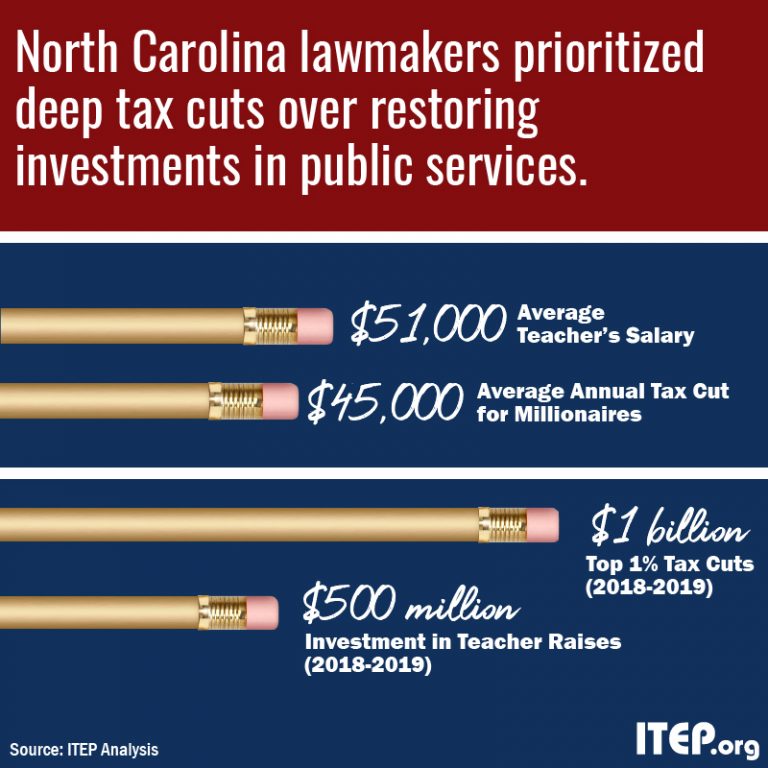
NC Teachers’ March on Raleigh and the Tax Cuts that Led Them There
• By Aidan Davis
Once again, public school teachers are taking a stand for education and against irresponsible, top-heavy tax cuts that deprive states of the revenue they need to sufficiently fund public services, including education.

Institute on Taxation
and Economic Policy
ITEP is a non-profit, non-partisan tax policy organization. We conduct rigorous analyses of tax and economic proposals and provide data-driven recommendations to shape equitable and sustainable tax systems.
Subscribe to ITEP Emails
Tax research and policy news in your inbox.
Promote Fair Tax Policy
Your gift to ITEP promotes tax justice. With your help, we do research that supports taxing millionaires and billionaires, taxing big corporations and raising revenue for the things our people, our communities and our planet need.
Together, we can create a country with more economic justice, more racial justice, more climate justice… and more tax justice.