
2,364 posts
Reducing the Cost of Child Care Through State Tax Codes in 2018
• By Aidan Davis
Families in poverty contribute over 30 percent of their income to child care compared to about 6 percent for families at or above 200 percent of poverty. Most families with children need one or more incomes to make ends meet which means child care expenses are an increasingly unavoidable and unaffordable expense. This policy brief examines state tax policy tools that can be used to make child care more affordable: a dependent care tax credit…
Options for a Less Regressive Sales Tax in 2018
• By Aidan Davis
Sales taxes are one of the most important revenue sources for state and local governments; however, they are also among the most unfair taxes, falling more heavily on low- and middle-income households. Therefore, it is important that policymakers nationwide find ways to make sales taxes more equitable while preserving this important source of funding for public services. This policy brief discusses two approaches to a less regressive sales tax: broad-based exemptions and targeted sales tax…
Property Tax Circuit Breakers in 2018
• By Aidan Davis
State lawmakers seeking to make residential property taxes more affordable have two broad options: across-the-board tax cuts for taxpayers at all income levels, such as a homestead exemption or a tax cap, and targeted tax breaks that are given only to particular groups of low- and middle-income taxpayers. One such targeted program to reduce property taxes is called a “circuit breaker” because it protects taxpayers from a property tax “overload” just like an electric circuit…

Observations from Census Data on Poverty and Income
• By Jenice R. Robinson
Today's poverty and income data show that income continues to concentrate at the top; in fact, the top 20 percent continue to capture 51.5 percent of income. Meanwhile, average income for the poorest 20 percent of households is less today than it was 18 years ago.

We Crunched Some Numbers to Show What Tax Reform for Working People Really Looks Like
• By ITEP Staff
Throughout President’s Trump’s presidential campaign and from his first day in office until now, his administration has favored and promoted policies that benefit the wealthy and corporations even as it claims to be the working people’s champion. If more recent economic data are a reflection of what we’ll see in the long-term due to the Trump Administration’s recent tax cuts, wealth will continue to accrue at the top while income remains stagnant or barely budges…
More of the Same: Tax Cuts 2.0 Will Benefit the Rich
• By Alan Essig
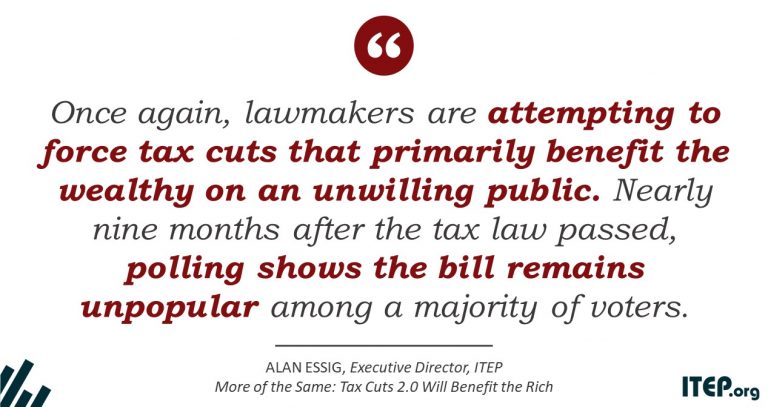
Media Contact Following is a statement from Alan Essig, executive director of the Institute on Taxation and Economic Policy, regarding the tax bill introduced today by House GOP leadership. “Once again, lawmakers are attempting to force tax cuts that primarily benefit the wealthy on an unwilling public. Nearly nine months after the tax law passed, […]
WRAL: Meg Wiehe: Capping North Carolina’s top income tax rate isn’t good for our communities
September 4, 2018
ITEP Deputy Director Meg Wiehe writes for WRAL.com that it would be unwise to constitutionally cap the North Carolina state income tax rate, pointing out that school funding in the state is already down and faltering revenues in other states have led to teacher pay crises and strikes.
Keystone Research: The State of Working Pennsylvania 2018
• By ITEP Staff
“The State of Working Pennsylvania 2018,” Keystone Research Center’s 23rd annual review of the Pennsylvania economy and labor market finds that, nearly a decade into the current national economic expansion, many Pennsylvania workers are still waiting for a raise. The report points to three factors that help explain this.
ITEP Testimony “Regarding the Final Report of the Arkansas Tax Reform and Relief Legislative Task Force”
• By Lisa Christensen Gee
Read the testimony in PDF WRITTEN TESTIMONY SUBMITTED TO: THE ARKANSAS TAX REFORM AND RELIEF TASK FORCE Lisa Christensen Gree, Senior State Tax Policy Analyst Institute on Taxation and Economic Policy Regarding the Final Report of the Arkansas Tax Reform and Relief Legislative Task Force August 22, 2018 Thank you for the opportunity to submit these […]
Kentucky Center for Economic Policy: Clean Up the Tax Code to Invest in Our Commonwealth
• By ITEP Staff
To move our tax code in the right direction, Kentucky should rejoin 32 other states with a graduated income tax based on ability to pay. Income below $37,500 single/$75,000 married should still be taxed at 5 percent, between that point and $75,000 single/$150,000 married at 6 percent and above those incomes at 7 percent, phasing […]
Press Herald: Will Maine Referendum On Home Care Result In ‘Marriage Penalty’ Tax?
August 17, 2018
Aidan Davis, senior policy analyst at the nonpartisan Institute on Taxation and Economic Policy, wrote a letter to the Secretary of State’s Office on June 15 stating that the income threshold would be double for married couples filing jointly. “We found the language of the initiative to be clear in describing that individual (not household) […]
1964: Unconditional War on Poverty; 2018: Unconditional War on the Poor
• By Misha Hill
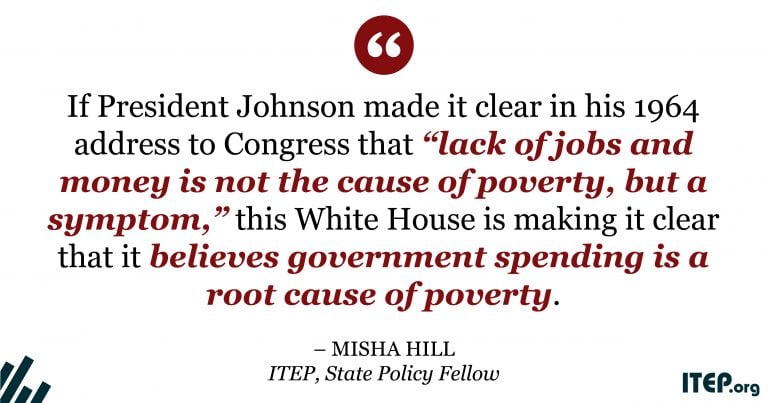
During his first State of the Union address in January 1964, Lyndon Baines Johnson declared a War on Poverty in response to a national poverty rate of more than 19 percent. The legislative result of this war was an early education program, expanded funding for secondary education, job training and work opportunity programs and the […]

Insult to Injury: Why Tax Cuts 2.0 Makes No Sense
• By ITEP Staff
In this illustrated breakdown of the Tax Cuts and Jobs Act (TCJA) and Tax Cuts 2.0, ITEP staff examine TCJA's role in growing income inequality, broken promises from corporations pledging to invest tax savings into workers and wages, and the embarrassment of riches flowing to the wealthiest Americans as a result of these “middle-class tax cuts.”
Updating Sales and Excise Taxes to Reflect Today’s Economy
• By ITEP Staff
Consumers’ growing interest in online shopping and “gig economy” services like Uber and Airbnb has forced states and localities to revisit their sales taxes, for instance. Meanwhile new evidence on the dangers and causes of obesity has led to rising interest in soda taxes, but the soda industry is fighting back. Carbon taxes are being discussed as a tool for combatting climate change. And changing attitudes toward cannabis use have spurred some states to move…
Itchy Tax Trigger Finger: Tax Foundation Says Aim Toward Foot
• By ITEP Staff
Accounting for all the possible curveballs the future economy might throw at our state is impossible. That’s why legislators bother coming together every year to assess our budget and make choices based on the best available, most current information. One dubious new style of tax change, “tax triggers”, attempts to base major future tax and revenue changes only on the information we have today. Tax triggers are dangerous and generally work by automatically kicking in…
Indiana Institute for Working Families: The Status of Working Families in Indiana: 2018 Report
• By ITEP Staff
Indiana faces a choice of whether to continue down a southward-leading path of low-road policies, or to rebuild its economy for Hoosier families. By adopting a policy agenda for working families that improves Indiana’s jobs with higher wage and labor standards; strengthens protections for Hoosier families including repairing the safety net and crafting consumer and job safeguards; and increases economic mobility through improved access to education, rebalancing the state’s regressive tax and budget structure, and…
Cleveland.com: Changes Needed in Ohio’s Tax Policy (Opinion)
• By ITEP Staff
The Institute on Taxation & Economic Policy has examined the major state tax changes since 2005. For the top 1 percent, who make at least $480,000 a year, the tax cuts average $40,790 annually. Middle-income Ohioans on average have not received a cut, while those in the poorest fifth, earning less than $22,000, got an average increase of $140.
American Federation of Teachers: A Decade of Neglect–Public Education Funding in the Aftermath of the Great Recession
• By ITEP Staff
“A Decade of Neglect: Public Education Funding in the Aftermath of the Great Recession,” details the devastating impact on schools, classrooms and students when states choose to pursue an austerity agenda in the false belief that tax cuts will pay for themselves.
Sales Tax Holidays: An Ineffective Alternative to Real Sales Tax Reform
• By Dylan Grundman O'Neill
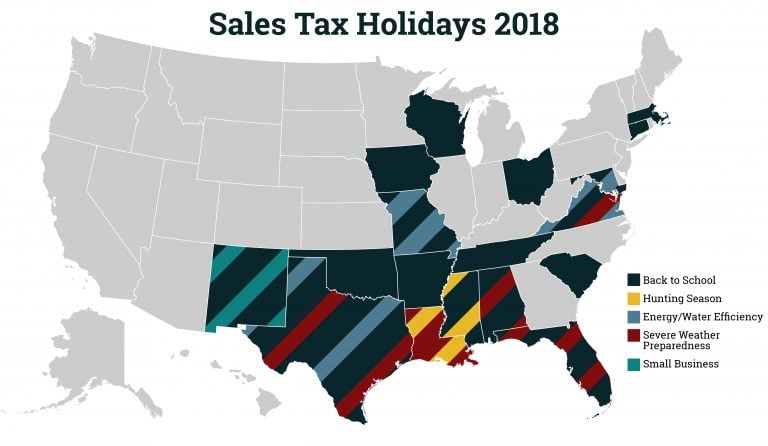
An updated version of this brief for 2019 is available here. Read this report in PDF. Overview Sales taxes are an important revenue source, composing close to half of all state tax revenues.[1] But sales taxes are also inherently regressive because the lower a family’s income, the more the family must spend on goods and […]
Federal Tax Cuts in the Bush, Obama, and Trump Years
• By Steve Wamhoff
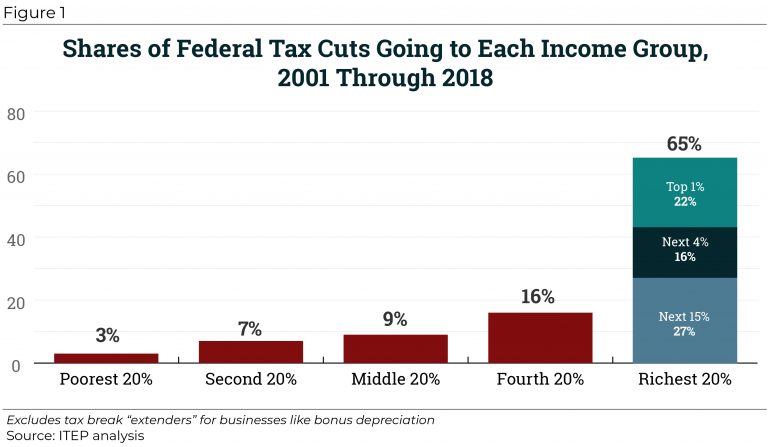
Since 2000, tax cuts have reduced federal revenue by trillions of dollars and disproportionately benefited well-off households. From 2001 through 2018, significant federal tax changes have reduced revenue by $5.1 trillion, with nearly two-thirds of that flowing to the richest fifth of Americans.

Building on Momentum from Recent Years, 2018 Delivers Strengthened Tax Credits for Workers and Families
• By Aidan Davis
Despite some challenging tax policy debates, a number of which hinged on states’ responses to federal conformity, 2018 brought some positive developments for workers and their families. This post updates a mid-session trends piece on this very subject. Here’s what we have been following:

ITEP Summer Reading (and Listening) List
• By ITEP Staff
Ah, summertime – a season synonymous with sunshine, backyard barbecues and mercury rising. Outside of our day jobs analyzing tax policy, we occasionally take a break from our screens to reconnect with the written and spoken word. However you enjoy your summer downtime – visiting your childhood home, lounging at the lake, planning the ultimate […]
Washington Post: N.J. Approaches a Government Shutdown as Democrats Feud Over Tax on Millionaires
• By ITEP Staff
New Jersey is just days away from a government shutdown over a plan to raise taxes on the rich that has divided Democrats and revealed the political difficulty of raising funds for the party's ambitious social spending goals.
The Other SALT Cap Workaround: Accountants Steer Clients Toward Private K-12 Voucher Tax Credits
• By Carl Davis
On May 23, 2018, the IRS and Treasury Department announced that they “intend to propose regulations addressing the federal income tax treatment of certain payments made by taxpayers for which taxpayers receive a credit against their state and local taxes.” They made the announcement in response to new “workaround tax credits” enacted in New York […]
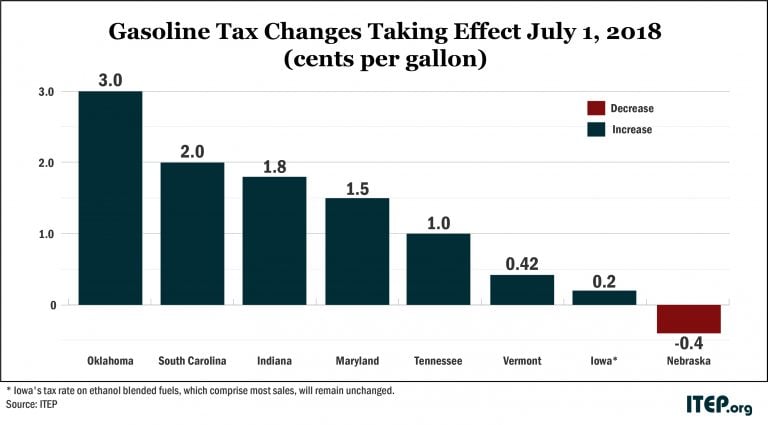
Gas Taxes Rise in Seven States, Including an Historic Increase in Oklahoma
• By Carl Davis
A rare sight is coming to Oklahoma. The last time the Sooner State raised its gas tax rate, the Berlin Wall was still standing, and Congress was debating whether to ban smoking on flights shorter than two hours. Fast forward 31 years, and Oklahoma is finally at it again. On Sunday, the state’s gas tax rate will rise by 3 cents and its diesel tax rate by 6 cents. Both taxes will now stand at…

Institute on Taxation
and Economic Policy
ITEP is a non-profit, non-partisan tax policy organization. We conduct rigorous analyses of tax and economic proposals and provide data-driven recommendations to shape equitable and sustainable tax systems.
Subscribe to ITEP Emails
Tax research and policy news in your inbox.
Promote Fair Tax Policy
Your gift to ITEP promotes tax justice. With your help, we do research that supports taxing millionaires and billionaires, taxing big corporations and raising revenue for the things our people, our communities and our planet need.
Together, we can create a country with more economic justice, more racial justice, more climate justice… and more tax justice.