
California
These Three Local EITCs Are Boosting Family Incomes at Tax Time
April 10, 2024 • By Andrew Boardman
This tax season more than 800,000 households in New York City, Maryland's Montgomery County, and San Francisco are set to receive a boost through local refundable EITCs. These credits put dollars directly into the pockets of low-income households, equipping families with resources to better make ends meet and invest in their futures. In turn, they can help build stronger, fairer, and more resilient communities.
Capital & Main: Extreme Wealth Is on the Ballot This Year — Will Americans Vote to Tax the Rich?
April 3, 2024
On March 7, President Joe Biden reintroduced proposals to increase taxes on the wealthiest Americans and the nation’s most profitable corporations. The move virtually ensures that the nation’s extreme wealth inequality — more than one in four dollars in the country is held by a tiny sliver of households with a net worth over $30 million — will be part of the national election debate. But excessive wealth may take center stage in at least 10 states, ranging from Democratic bastions such as California, Hawaii and New York to swing states such as Nevada and Pennsylvania.
Every child deserves the opportunity to succeed in society – and tax policy has a huge role to play in making that happen. Better tax policy can help prepare our young children with skills to become successful and thriving adults.
Local Mansion Taxes: Building Stronger Communities with Progressive Taxes on High-Value Real Estate
March 14, 2024 • By Andrew Boardman

More than one dozen cities and counties levy progressive taxes on high-price real estate transactions — sometimes called mansion taxes — and over a dozen more are considering such policies. By asking buyers and sellers with greater financial means to contribute more to the common good, these policies are equipping communities with resources to make progress on critical challenges of local and national concern.
Sacramento Bee: California Families Could Save Thousands of Dollars From Proposed Child Tax Break. Here’s Why
March 12, 2024
President Joe Biden’s child tax credit plan would benefit millions of California parents, saving eligible families an average of $2,980, according to data from Washington’s Institute on Taxation and Economic Policy.
Anti-tax interests finally found the end of the tax cutting appetite in a few states this week...
ITEP’s Kamolika Das Testifies on Pennsylvania’s Upside-Down Tax Code
March 4, 2024 • By Kamolika Das

Below is written testimony delivered by ITEP Local Policy Director Kamolika Das before the Pennsylvania House Finance Subcommittee on Tax Modernization & Reform on March 1, 2024. Good afternoon and thank you for this opportunity to testify. My name is Kamolika Das, I live in South Philly, and I’m the Local Tax Policy Director at […]
State legislative sessions are in full swing with New Jersey and Oklahoma both particularly active this week...
The ‘Low-Tax’ Lie: States Hyped for Low Taxes Usually Only Low-Tax for the Rich
February 20, 2024 • By Jon Whiten
It’s hard to go a week without seeing a politician or a news article hype up a state as the place that everyone is moving to – or should move to – because of low taxes. However, there’s a big problem with these proclamations: they aren’t true.
IRS Commissioner, New GAO Report Highlight Importance of Proper IRS Funding
February 16, 2024 • By Joe Hughes

A new GAO report and Commissioner Werfel’s testimony highlight the value and necessity of a well-funded and functioning IRS. Most families and businesses do their best to pay taxes accurately and on time. The nation benefits from a modern revenue agency that can make this process as easy and simple as possible and identify complex tax schemes that deprive the country of revenues.
As many of you may know, we love taxes, along with the many great things they provide for our communities...
LA Times: Taxpayer ‘Protection’ or Taxpayer ‘Deception’? A New Ballot Measure Aims to Destroy State and Local Budgets
February 14, 2024
It’s indisputable that the decline of state fiscal management in California began with the passage of Proposition 13 in 1978. The tax-cutting initiative upended the tax structure that provided most of the revenues needed by localities and school districts, undermining the locals’ control of their own spending.
State Rundown 2/8: Flowers, Chocolates, and Tax Cuts for the Wealthy?
February 8, 2024 • By ITEP Staff
While we were hoping to get progressive tax policy wins for Valentine’s Day, many state lawmakers have another idea in mind...
House SALT Proposal is Expensive, Unneeded, and Poorly Designed
February 2, 2024 • By Joe Hughes
The SALT Marriage Penalty Elimination Act passed by the House Rules Committee on February 1 is costly, decreasing tax revenue by about $8 billion in 2023. It also mostly only helps taxpayers who are already well off.

It doesn’t matter if someone with a family income of $800,000 per year thinks they aren’t rich because they can’t quit their jobs and retire to a luxury home on the beach in Malibu. They can call themselves what they want. The point is that they are richer than 99 percent of the population and can afford to pay more.
The IRS Direct File pilot is currently open to eligible taxpayers here. Millions of American families have now received their W-2s for 2023, signaling the start to a new tax filing season. The IRS has set January 29 as the first date that people can file their tax returns for the previous year, and the […]
State Rundown 1/26: Wealth Taxes Drawing Interest Early in Legislative Sessions
January 26, 2024 • By ITEP Staff
Bills are moving and state legislative sessions are picking up across the country, giving elected officials the opportunity to consider two distinct paths when it comes to tax policy...
State Tax Watch 2024
January 23, 2024 • By ITEP Staff
Updated July 15, 2024 In 2024, state lawmakers have a choice: advance tax policy that improves equity and helps communities thrive, or push tax policies that disproportionately benefit the wealthy, drain funding for critical public services, and make it harder for low-income and working families to get ahead. Despite worsening state fiscal conditions, we expect […]

The findings of Who Pays? go a long way toward explaining why so many states are failing to raise the amount of revenue needed to provide full and robust support for our public schools.
Worthwhile Ideas for a Stronger and Fairer D.C. Tax Code
January 17, 2024 • By Andrew Boardman, Kamolika Das, Marco Guzman

The nation’s capital has a once-in-a-decade opportunity to advance a stronger and fairer local tax code. New draft recommendations from a key advisory panel will help leaders make the most of the moment.
State Rundown 1/11: Sounding the Alarm on Regressive State & Local Tax Codes
January 11, 2024 • By ITEP Staff
States got a wake-up call this week as ITEP released the latest edition of our flagship Who Pays? report...
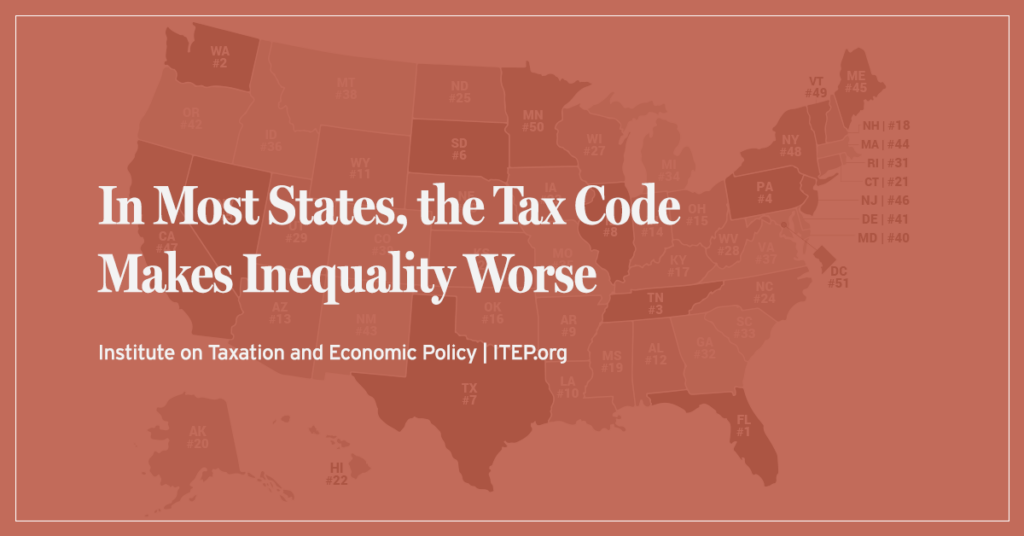
The vast majority of state and local tax systems are upside-down, with the wealthy paying a far lesser share of their income in taxes than low- and middle-income families. Yet a few states have made strides to buck that trend and have tax codes that are somewhat progressive and therefore do not worsen inequality.
Tax Systems in 44 States Exacerbate Inequality, In-Depth ‘Who Pays?’ Study Finds
January 9, 2024 • By ITEP Staff
The vast majority of state and local tax systems are upside-down, with the wealthy paying a far lesser share of their income in taxes than low- and middle-income families. That’s according to the latest edition of the Institute on Taxation and Economic Policy’s Who Pays?, the only distributional analysis of tax systems in all 50 states and the District of Columbia.
California: Who Pays? 7th Edition
January 8, 2024 • By ITEP Staff
California Download PDF All figures and charts show 2024 tax law in California, presented at 2023 income levels. Senior taxpayers are excluded for reasons detailed in the methodology. Our analysis includes nearly all (99.2 percent) state and local tax revenue collected in California. State and local tax shares of family income Top 20% Income Group […]
Even as revenue collections slow in many states, some are starting the push for 2024 tax cuts early. For instance, policymakers in Georgia and Utah are already making the case for deeper income tax cuts. Meanwhile, Arizona lawmakers are now facing a significant deficit, the consequence of their recent top-heavy tax cuts. There is another […]
