Publications

The Consequences of 18 Months of Trump-Republican Tax Policy and Rising Prices
• By Michael Ettlinger
The first 18 months of President Trump’s second term have brought major changes in U.S. tax policy and taken several actions that have boosted inflation. These changes have had significant impacts on the lives of the American people. As a result, middle-income Americans are losing an average of $1,670 in 2026 overall.
After Two Rounds of Trump Tax Cuts, Corporate America Paid Less Than Ever in 2025
• By Matthew Gardner, Steve Wamhoff, Joe Hughes, Spandan Marasini
In 2025, 706 major American corporations collectively paid a federal income tax rate of just 10.4% on $1.88 trillion in U.S. profits. This is the lowest effective rate that ITEP has uncovered in over 40 years of analyzing corporate income taxes.

How Federal Tax Policy Can Address AI
• By Steve Wamhoff, Joe Hughes, Erika Frankel
Congress could use its taxing power to ensure a fairer distribution of the fruits of labor, innovation and investment, address the specific harms (the negative externalities) of AI specifically, and acquire a public stake in the companies that are driving the AI revolution.

The ‘Black Women Best’ Framework: An Innovative Method for Showing How Inheritance Taxes Affect the Racial Wealth Gap
• By Brakeyshia Samms, Francine Lipman
The approach posits that if policies improve the economic wellbeing of Black women, they will benefit the broader economic health of the rest of the population.

While States Debate New Trump Tax Changes, Equity Must Be at the Core
• By Brakeyshia Samms
States continue to debate whether and how to link their state tax codes to the 2025 federal tax law. This is not just a technical debate.
Year One of Trump-Republican Tax Policy: The Consequences
• By Michael Ettlinger
President Trump has dramatically increased tariff taxes, enacted large tax cuts that primarily benefit the wealthy and corporations, dramatically curtailed IRS enforcement, and issued legally problematic regulations.

South Carolina’s Expensive, Regressive Tax Law Will Eliminate State’s Income Tax
• By Neva Butkus, Dylan Grundman O'Neill
South Carolina signed into law a regressive tax cut that will disproportionately benefit the state’s highest-income residents while simultaneously jeopardizing the state’s ability to pay for basic public services in the years to come.

Maryland’s New Budget Boosts Tax Revenue and Equity
• By Miles Trinidad
The final budget adopted by the Maryland General Assembly shows progress in advancing tax equity in the state while boosting state revenues to address the state’s budget deficit. To help close a $3.3 billion budget deficit, Maryland legislators enacted much-needed tax reforms and progressive revenue raisers that help meet the state’s needs while making the […]

Federal Tax Policy: What Should It Accomplish?
• By Steve Wamhoff
The U.S. needs a tax code that is more adequate, meaning any major tax legislation should increase revenue, not reduce it. The U.S. also needs a tax code that is more progressive, meaning any significant tax legislation should require more, not less, from those most able to pay.
The Pitfalls of Flat Income Taxes
• By Carl Davis, Eli Byerly-Duke
While most states have a graduated rate income tax, some state lawmakers have recently become enamored with the idea of moving toward flat rate taxes instead. What’s the difference? And are states well served by the transition? In short: A flat tax is one where each taxpayer pays the same percentage of their income whereas […]
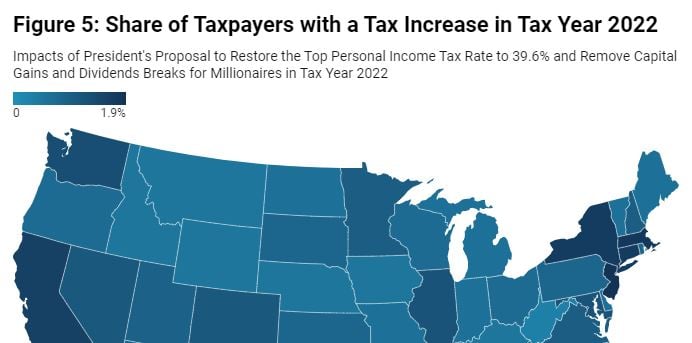
Income Tax Increases in the President’s American Families Plan
• By ITEP Staff, Matthew Gardner, Steve Wamhoff
President Biden’s American Families Plan includes revenue-raising proposals that would affect only very high-income taxpayers.[1] The two most prominent of these proposals would restore the top personal income tax rate to 39.6 percent and eliminate tax breaks related to capital gains for millionaires. As this report explains, these proposals would affect less than 1 percent of taxpayers and would be confined almost exclusively to the richest 1 percent of Americans. The plan includes other tax…
Taxes and Racial Equity: An Overview of State and Local Policy Impacts
• By ITEP Staff
Historic and current injustices, both in public policy and in broader society, have resulted in vast disparities in income and wealth across race and ethnicity. Employment discrimination has denied good job opportunities to people of color. An uneven system of public education funding advantages wealthier white people and produces unequal educational outcomes. Racist policies such as redlining and discrimination in lending practices have denied countless Black families the opportunity to become homeowners or business owners,…
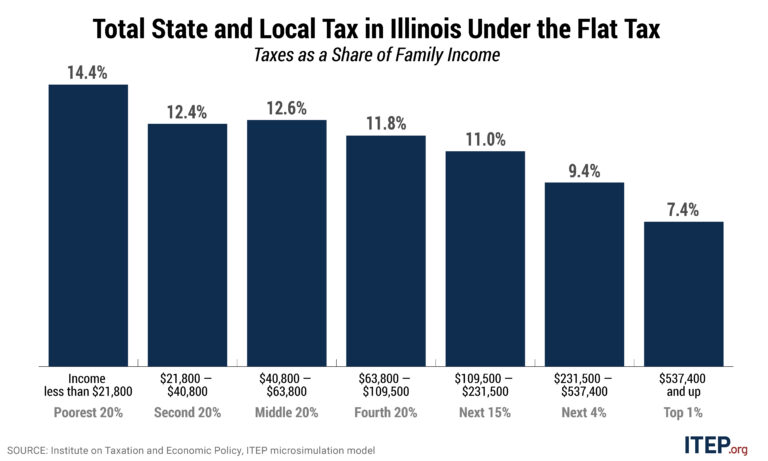
Illinois’s Flat Tax Exacerbates Income Inequality and Racial Wealth Gaps
• By Lisa Christensen Gee
Flat or graduated personal income taxes have varying effects on the annual individual tax liabilities of taxpayers at different income levels. Less examined is how tax structures affect income inequality and racial wealth gaps. This brief illustrates how Illinois’s historic flat income tax structure compares to the proposed Fair Tax through a multi-year retrospective analysis. It shows that Illinois’s flat income tax in lieu of a graduated rate tax used by most states amounts to…
Tax Justice is…
• By Amy Hanauer
Racial justice requires tax justice. Economic justice requires tax justice. Climate and health justice require, yes, tax justice.
The Case For Progressive Revenue Policies
• By ITEP Staff
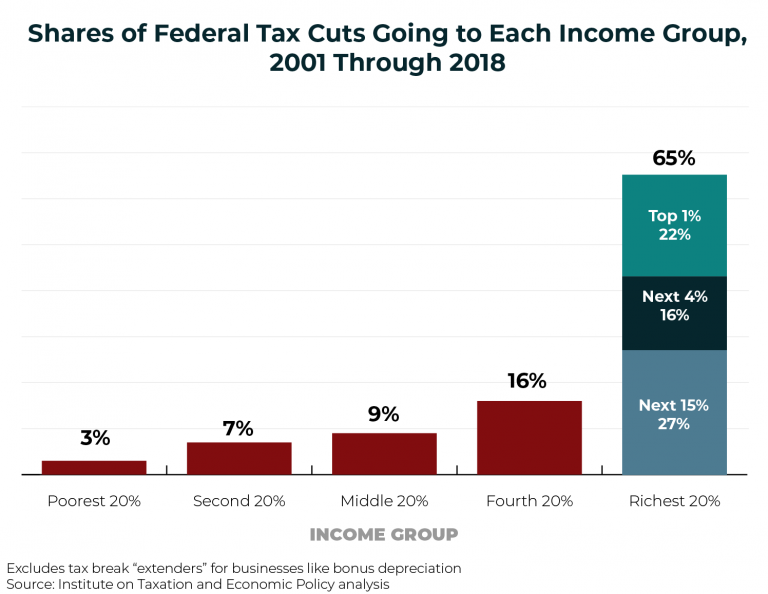
Income inequality is a national challenge. And inadequate federal revenue is a challenge that the nation will eventually have to reckon with. This chart book makes a strong case for why federal lawmakers should seriously consider progressive revenue-raising options.
Race, Wealth and Taxes: How the Tax Cuts and Jobs Act Supercharges the Racial Wealth Divide
• By Meg Wiehe
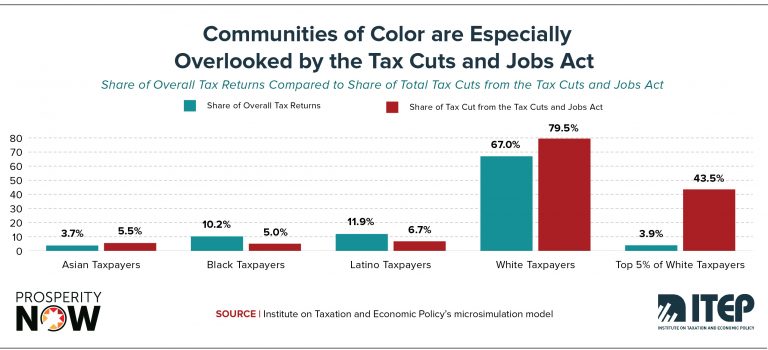
A newly released report by Prosperity Now and the Institution on Taxation and Economic Policy, Race, Wealth and Taxes: How the Tax Cuts and Jobs Act Supercharges the Racial Wealth Divide, finds that the TCJA not only adds unnecessary fuel to the growing problem of overall economic inequality, but also supercharges an already massive racial wealth divide to an alarming extent.

Institute on Taxation
and Economic Policy
ITEP is a non-profit, non-partisan tax policy organization. We conduct rigorous analyses of tax and economic proposals and provide data-driven recommendations to shape equitable and sustainable tax systems.
Subscribe to ITEP Emails
Tax research and policy news in your inbox.
Promote Fair Tax Policy
Your gift to ITEP promotes tax justice. With your help, we do research that supports taxing millionaires and billionaires, taxing big corporations and raising revenue for the things our people, our communities and our planet need.
Together, we can create a country with more economic justice, more racial justice, more climate justice… and more tax justice.