Publications
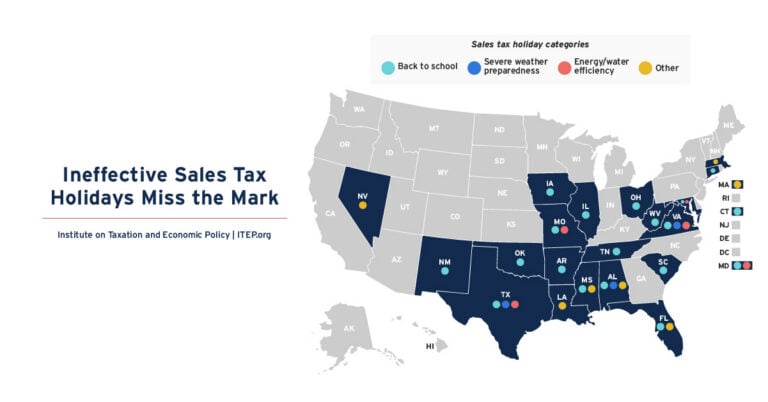
Ineffective Sales Tax Holidays Miss the Mark
• By Miles Trinidad
Twenty states have sales tax holidays in 2026. These sales tax holidays will cost states and localities nearly $600 million in lost revenue this year, and they're poorly targeted and too temporary to meaningfully change the regressive nature of a state’s tax system.

A Resilient Framework for Corporate Tax Reform
• By Steve Wamhoff
The next time Congress is serious about making the wealthiest pay their fair share in federal taxes, they will need to make three key changes to the federal corporate income tax so that it applies effectively to all the businesses that generate their income.

What the Biden Administration Can Do on Its Own, Without Congress, to Fix the Tax Code
• By Steve Wamhoff
The Biden administration has several options to address tax reform even when Congress is unable or unwilling to help.
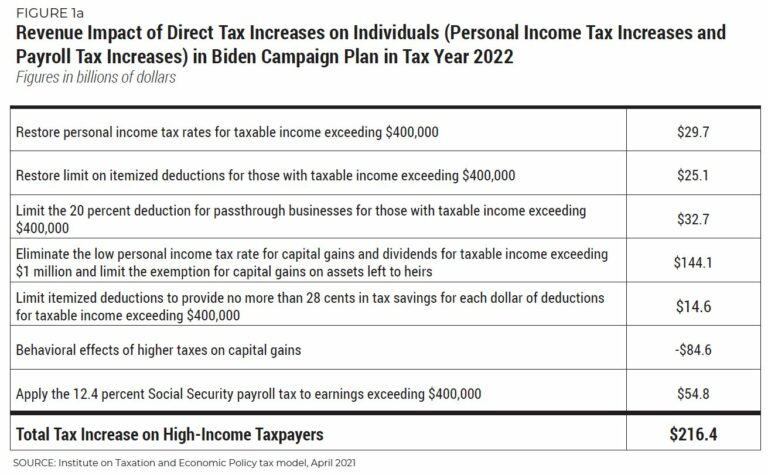
National and State-by-State Estimates of President Biden’s Campaign Proposals for Revenue
• By ITEP Staff, Matthew Gardner, Steve Wamhoff
During his presidential campaign, Joe Biden proposed to change the tax code to raise revenue directly from households with income exceeding $400,000. More precisely, Biden proposed to raise personal income taxes on unmarried individuals and married couples with taxable income exceeding $400,000, and he also proposed to raise payroll taxes on individual workers with earnings exceeding $400,000. Just 2 percent of taxpayers would see a direct tax hike (an increase in either personal income taxes,…

Benefits of a Financial Transaction Tax
• By Jessica Schieder, Lorena Roque, Steve Wamhoff
A financial transaction tax (FTT) has the potential to curb inequality, reduce market inefficiencies, and raise hundreds of billions of dollars in revenue over the next decade. Presidential candidates have proposed using an FTT to fund expanding Medicare, education, child care, and investments in children’s health. Any of these public investments would be progressive, narrowing resource gaps between the most vulnerable families and the most fortunate.
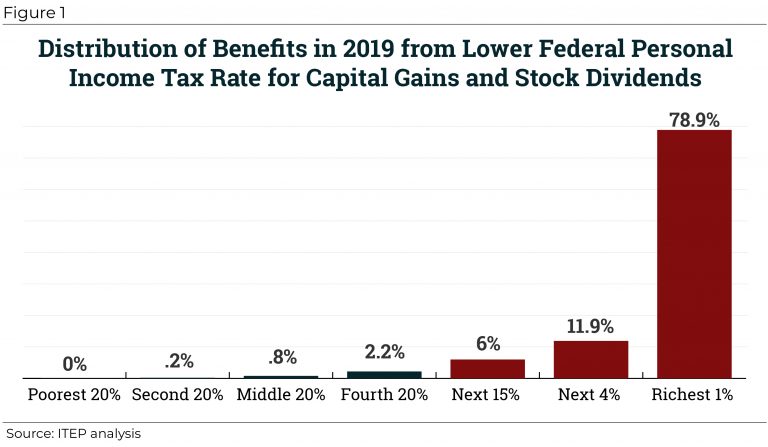
Congress Should Reduce, Not Expand, Tax Breaks for Capital Gains
• By Steve Wamhoff
Even though income derived from capital gains receives a special lower tax rate and is therefore undertaxed, some proponents of lower taxes on the wealthy claim that capital gains are overtaxed due to the effects of inflation. But existing tax breaks for capital gains more than compensate for any problem related to inflation. Congress should repeal or restrict special tax provisions for capital gains rather than creating even more breaks.
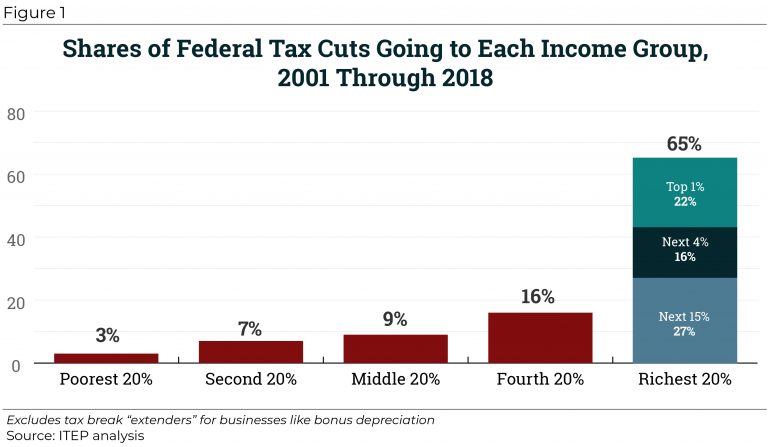
Federal Tax Cuts in the Bush, Obama, and Trump Years
• By Steve Wamhoff
Since 2000, tax cuts have reduced federal revenue by trillions of dollars and disproportionately benefited well-off households. From 2001 through 2018, significant federal tax changes have reduced revenue by $5.1 trillion, with nearly two-thirds of that flowing to the richest fifth of Americans.

ITEP Testimony on “Post Tax Reform Evaluation of Recently Expired Tax Provisions”
• By Richard Phillips
Statement of Richard Phillips, Senior Policy Analyst Institute on Taxation and Economic Policy Before the Committee on Ways and Means Subcommittee on Tax Policy Hearing on “Post Tax Reform Evaluation of Recently Expired Tax Provisions”

How True Tax Reform Would Eliminate Breaks for Real Estate Investors Like Donald Trump
• By ITEP Staff
The federal tax code includes several loopholes and special breaks that advantage wealthy real estate investors like President Donald Trump. Under current law, real estate investors can claim losses much more quickly and easily than other taxpayers, but they also have several methods to delay or avoid reporting any profits to the IRS.
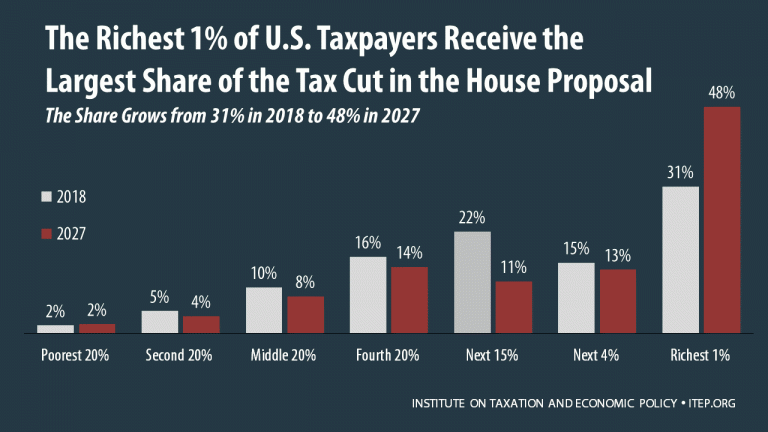
Analysis of the House Tax Cuts and Jobs Act
• By Matthew Gardner, Meg Wiehe, Steve Wamhoff
The Tax Cuts and Jobs Act, which was introduced on Nov. 2 in the House of Representatives, would raise taxes on some Americans and cut taxes on others while also providing significant savings to foreign investors.

9 Things You Should Know About the Tax Debate
• By Richard Phillips
A Chart Book on the U.S. Tax System
Fact Sheet: The Consequences of Adopting a Territorial Tax System
• By Steve Wamhoff
President Trump and Republican leaders in Congress have proposed a “territorial” tax system, which would allow American corporations to pay no U.S. taxes on most profits they book offshore. This would worsen the already substantial problem of corporate tax avoidance and result in more jobs and investment leaving the U.S. Lawmakers should know some key facts about the territorial approach.
Comment Letter on Tax Reform to Senate Finance Chairman
• By Alan Essig
This letter outlines ITEP’s two broad objectives for meaningful federal tax reform and discusses six recommendations that would achieve them.
What Real Tax Reform Should Look Like
• By ITEP Staff
If lawmakers truly want to create an environment in which economic mobility is possible for more working people, budget-busting tax cuts are the wrong way to achieve this goal. Dramatic tax giveaways would force cuts to programs that provide early education, health care, job training, affordable housing, nutrition assistance, and other vital services that promote economic mobility. Further, current tax proposals from Congress and the Trump Administration defy what most Americans would consider true reform…
Ryan Tax Plan Reserves Most Tax Cuts for Top 1 percent, Costs $4 Trillion Over 10 Years
• By ITEP Staff
A new distributional analysis of Republican Speaker of the House Paul Ryan’s “A Better Way” policies finds that the plan would: • Add $4 trillion to the national debt over a decade. • Overwhelmingly benefit the top 1 percent of tax payers while resulting in a net loss for the bottom 95 percent of taxpayers. • Slash corporate […]

Institute on Taxation
and Economic Policy
ITEP is a non-profit, non-partisan tax policy organization. We conduct rigorous analyses of tax and economic proposals and provide data-driven recommendations to shape equitable and sustainable tax systems.
Subscribe to ITEP Emails
Tax research and policy news in your inbox.
Promote Fair Tax Policy
Your gift to ITEP promotes tax justice. With your help, we do research that supports taxing millionaires and billionaires, taxing big corporations and raising revenue for the things our people, our communities and our planet need.
Together, we can create a country with more economic justice, more racial justice, more climate justice… and more tax justice.