
Louisiana
Trends We’re Watching in 2019: Consumption Taxes: the Good, Bad and the Ugly
February 7, 2019 • By ITEP Staff
Consumption taxes are a significant source of state and local revenue, and we expect that lawmakers will continue to adjust state consumption tax levies to adapt to budget needs and a changing economy.
State Rundown 1/31: Governors and Teachers Dominate Headlines, Much More in Fine Print
January 31, 2019 • By ITEP Staff
Gubernatorial addresses and the prospect of teacher strikes continued to take center stage in state fiscal news this week, as governors of Connecticut, Maryland, and Utah gave speeches that all included significant tax proposals. Meanwhile, teachers walked out in Virginia, and many other states debated school funding increases to avoid similar results. State policymakers have many other debates on their hands as well, including what to do with online sales tax revenue, how to cut property taxes without undermining schools, whether and how to legalize and tax cannabis, and whether to update gas taxes for infrastructure investments.
State Rundown 1/24: States Reflect on MLK’s Dream and Teacher Uprisings
January 24, 2019 • By ITEP Staff
This week, as Americans in every state celebrated Martin Luther King Jr. Day and reflected on his dream of peaceful protest and racial and economic justice, many eyes were on the teachers’ strike pressing for parts of this dream amid the “curvaceous slopes of California.” Governors and lawmakers in many states—including Arizona, Georgia, Indiana, Louisiana, Nevada, New Mexico, South Carolina, and Wisconsin—discussed ways to raise pay for teachers and/or enhance education investments generally.
State Rundown 12/19: Time to Rest and Recharge for Big Year Ahead
December 19, 2018 • By ITEP Staff
With many people enjoying time off over the next couple weeks, and the longest nights of the year coming over the weekend, now is a good time to get plenty of rest and relaxation in advance of what is likely to be a very busy 2019 for state fiscal policy and other debates. Among those debates, Kentucky lawmakers will be returning to topics they could not resolve in a brief special session held this week, New Jersey and New York will both be deciding how to legalize and tax cannabis, and gas tax updates will be on the agenda in…
State Rundown 12/5: Familiar Questions Returning to Fore as 2019 Approaches
December 5, 2018 • By ITEP Staff
State lawmakers are preparing their agendas for 2019 and looking at all sorts of tax and budget policies in the process, raising many familiar questions. Oregon legislators, for example, will try to fill in the blanks in a proposal to boost investments in education that left out detail on how to fund them, while their counterparts in Texas face the inverse problem of a proposed property tax cut that fails to clarify how schools could be protected from cuts. Similar school finance debates will play out in many other states. Alabama, Kansas, and Louisiana will look at gas tax updates,…
State Rundown 11/16: Election Results Clarify Agendas as Real Work Begins
November 16, 2018 • By ITEP Staff
State policymakers, voters, and observers have been reflecting on this year’s campaigns and looking ahead to how the policy opportunities in their states have shifted as a result. For example, Arkansas’s governor sees a fresh chance to slash income taxes on the state’s wealthiest residents, while the governor-elect of Illinois will be doing just the opposite, launching into a promised effort to shore up the state’s budget by asking the wealthy to pay more. New York and Virginia residents may end up with buyers’ remorse after Amazon accepted their combined $2 billion tax subsidy offers for its HQ2 project. And…
Louisiana Budget Project: Tax Code Is Holding Louisiana Back
November 15, 2018
Years of efforts to reform Louisiana’s regressive and overly complicated tax code have run aground in the state Legislature. The result: Louisianans pay the second-highest sales taxes in the nation, while the tax code is riddled with costly exemptions and deductions. The state’s broken tax structure is a major reason why the state lurched from budget crisis to budget crisis over the last decade and has struggled to fund critical programs and services like higher education and health care. The Advocate’s editorial board shares its thoughts on the latest report from the Institute on Taxation and Economic Policy.
Louisiana Budget Project: Race Equity and Taxes in Louisiana
November 9, 2018
Louisiana’s upside-down tax structure means the highest income-earners pay less than the poorest families, when measured as a percentage of income. The Institute on Taxation and Economic Policy’s “Who Pays” report lays this out in careful detail, and the latest edition breaks down the tax distribution by race. The conclusion: Black households pay a higher percentage of their income in state and local taxes than white households. Louisiana has work to do to make the tax structure fairer and reduce racial inequalities.
Louisiana Budget Project: Louisiana’s Regressive Tax Structure
November 5, 2018
Poor and middle-income families in Louisiana pay state and local taxes at a higher rate than the wealthiest families. That’s the key takeaway from the latest state-by-state breakdown of tax distribution by income groups from the Institute on Taxation and Economic Policy (ITEP). Louisiana’s tax structure is the 14th most regressive in the nation.
Comments to be delivered during IRS hearing on “Contributions in Exchange for State or Local Tax Credits” (REG-112176-18)
November 5, 2018 • By Carl Davis
ITEP views this proposal as a sensible improvement, and one that is actually overdue, to the way the charitable deduction is administered. At the end of my remarks I will discuss a few ways that the regulation could be improved. But the core point I want to emphasize is that the general approach taken here, where quid pro quo rules are applied in a broad-based fashion to all significant state and local tax credits, is the correct one.
The New Orleans Advocate: James Gill: Louisiana’s Tax System Isn’t the Most Unfair in the Nation, But It’s not for Lack of Trying
November 3, 2018
According to a study just released by the Institute on Taxation and Economic Policy in Washington, Washington State sets the regressive standard, while we rank 14th. If your income is $17,100 or less in Louisiana, you'll pay 11.9 percent of it in taxes. That number shrinks the further you go up on the income scale and is roughly halved by the time you reach fat-cat territory. Sales and excise taxes take 9.2 percent from the poorest, and 1.2 percent from the richest.
State Rundown 10/31: Trick or Treat Advice to Savor for Tonight
October 31, 2018 • By ITEP Staff
Look out for potholes if you’re out trick-or-treating in Alabama tonight, where crumbling infrastructure figures to be a dominant debate in the coming legislative session. And be prepared to share the streets with disgruntled teachers if you‘re in Louisiana, where teachers are walking out to protest regressive tax policies that are sucking the lifeblood from the state’s schools. Meanwhile, Wisconsin residents are sharing scary stories of grotesquely large business tax subsidies and the “dark store” tax loophole they’ll be voting on next week. And you better expect the unexpected if you’re in Delaware, where Gov. John Carney shocked everyone by vetoing two broadly supported tax bills last week.
Louisiana Budget Project: Louisiana’s Tax Code is Still Regressive
October 17, 2018
The wealthiest households in Louisiana continue to pay state and local taxes at a lower rate than those in the middle class and below, according to a new analysis that breaks down the tax rates by income brackets in every state. The report, Who Pays? A Distributional Analysis of the Tax Systems in All 50 States found that households with incomes in the lowest 20 percent pay nearly twice as much of their income in taxes as households in the top 1 percent. Louisiana has the 14th most regressive tax code in the country, according to the report by the…
Louisiana Budget Project: Who Pays Taxes in Louisiana?
October 17, 2018
When it comes to paying for government services, Louisiana asks a lot more of those with the fewest resources than it does of its wealthiest citizens, according to new analysis by the Institute on Taxation and Economic Policy. Thanks to a heavy reliance on sales taxes and tax exemptions that favor the wealthy, the less you earn in Louisiana, the more of you pay in taxes as a percentage of income.
Louisiana Budget Project: Analysis: Louisiana’s Regressive Tax Structure Disproportionately Affects Low-income Residents
October 17, 2018
A new study released Wednesday by the Institute on Taxation and Economic Policy and the Louisiana Budget Project finds that Louisiana has the 14th most unfair state and local tax system in the country, with the lowest-income Louisianans paying almost two times more in taxes as a percent of their income compared to the state’s wealthiest residents.
Louisiana: Who Pays? 6th Edition
October 17, 2018 • By ITEP Staff
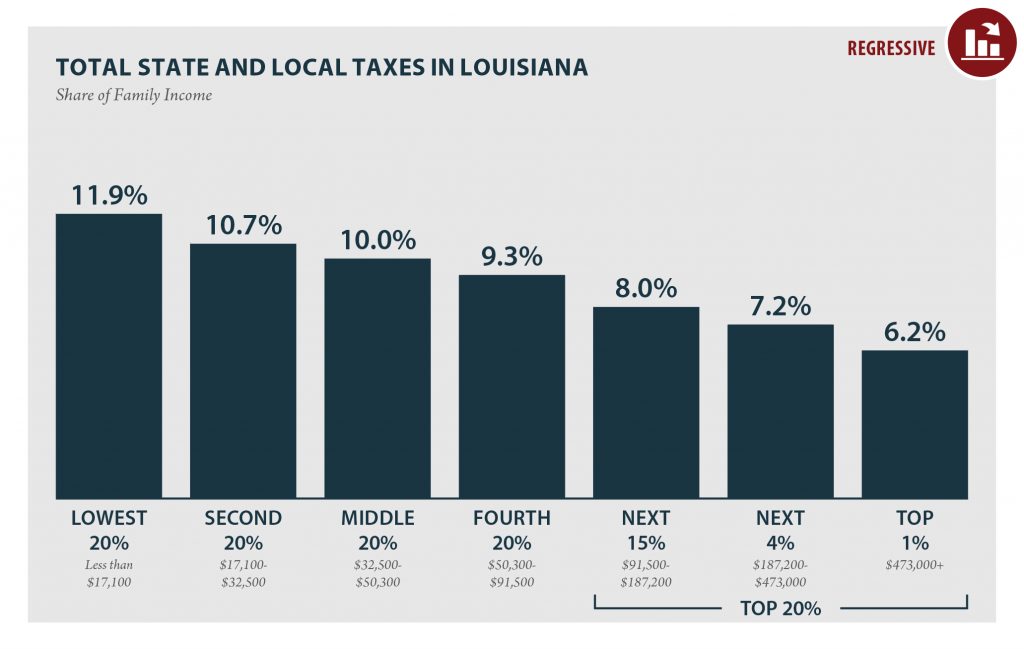
LOUISIANA Read as PDF LOUISIANA STATE AND LOCAL TAXES Taxes as Share of Family Income Top 20% Income Group Lowest 20% Second 20% Middle 20% Fourth 20% Next 15% Next 4% Top 1% Income Range Less than $17,100 $17,100 to $32,500 $32,500 to $50,300 $50,300 to $91,500 $91,500 to $187,200 $187,200 to $473,000 over $473,000 […]
Louisiana Budget Project: Federal Tax Cut Worsening Racial Wealth Divide
October 12, 2018
While President Trump and Republicans in Congress heralded the Tax Cut and Jobs Act of 2017 as a major tax cut for the middle class, the numbers don’t bear that out. A new analysis by researchers at Prosperity Now and the Institute on Taxation and Economic Policy reveals just how much of the federal tax cut benefits went to the highest income earners, and the crumbs that were left over for low and middle-class households.
State Rundown 10/12: Local Jurisdictions Fighting for Revenues, Independence
October 12, 2018 • By ITEP Staff
Voters all around the country are educating themselves for the upcoming elections, notably this week around ballot initiatives in Arizona and Colorado and competing gubernatorial tax proposals in Georgia and Illinois. But not all eyes are on the elections, as the relationship between state and local policy made news in Delaware, Idaho, North Dakota, and Ohio.
ITEP Comments and Recommendations on Proposed Section 170 Regulation (REG-112176-18)
October 11, 2018 • By Carl Davis
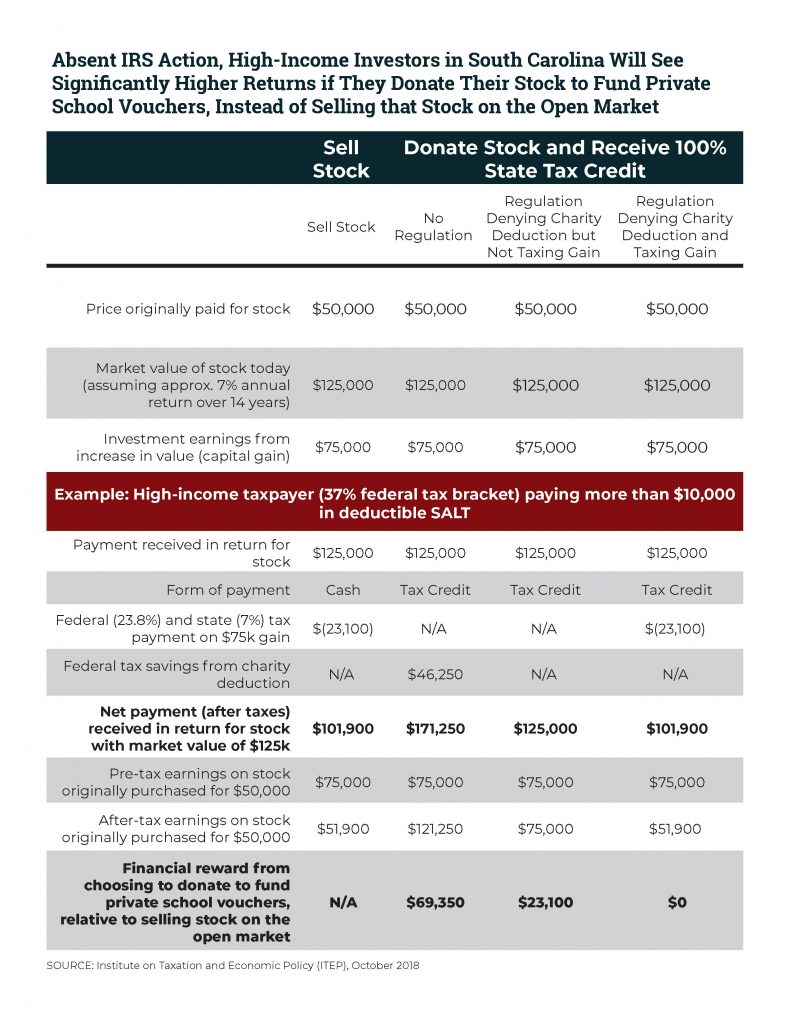
The IRS recently proposed a commonsense improvement to the federal charitable deduction. If finalized, the regulation would prevent not just the newest workarounds to the $10,000 deduction for state and local taxes (SALT), but also a longer-running tax shelter abused by wealthy donors to private K-12 school voucher programs. ITEP has submitted official comments outlining four key recommendations related to the proposed regulation.
Twelve States Offer Profitable Tax Shelter to Private School Voucher Donors; IRS Proposal Could Fix This
October 2, 2018 • By Carl Davis
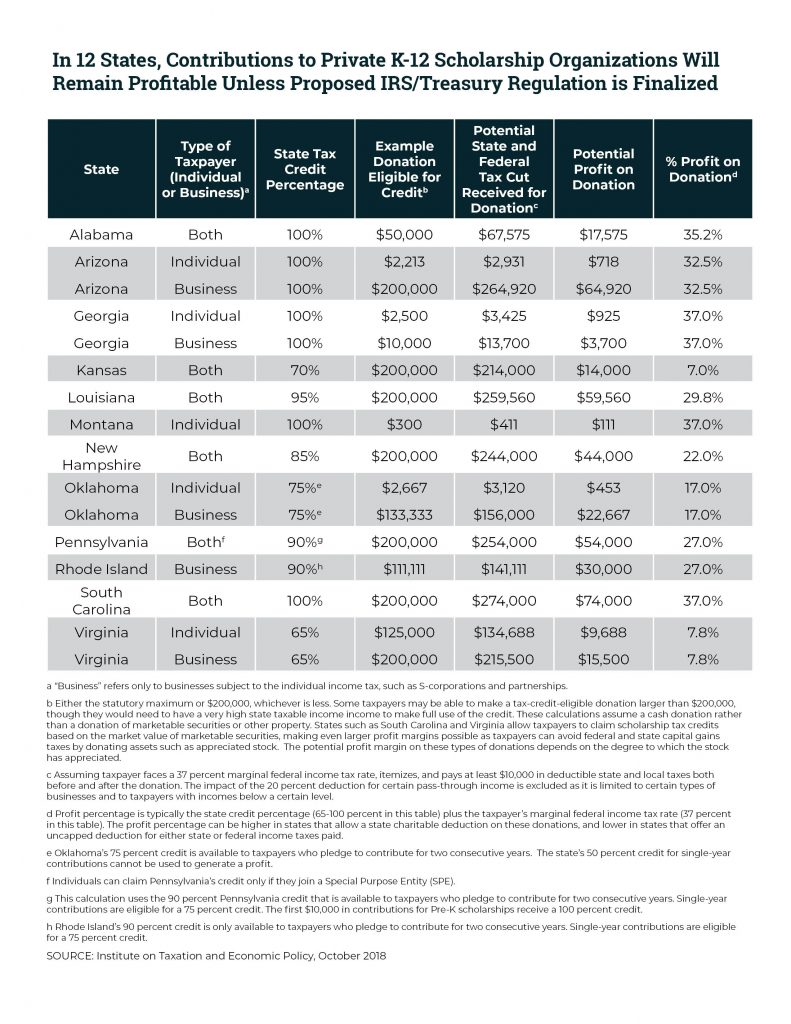
A proposed IRS regulation would eliminate a tax shelter for private school donors in twelve states by making a commonsense improvement to the federal tax deduction for charitable gifts. For years, some affluent taxpayers who donate to private K-12 school voucher programs have managed to turn a profit by claiming state tax credits and federal tax deductions that, taken together, are worth more than the amount donated. This practice could soon come to an end under the IRS’s broader goal of ending misuse of the charitable deduction by people seeking to dodge the federal SALT deduction cap.
Tax Cuts 2.0 – Louisiana
September 26, 2018 • By ITEP Staff
The $2 trillion 2017 Tax Cuts and Jobs Act (TCJA) includes several provisions set to expire at the end of 2025. Now, GOP leaders have introduced a bill informally called “Tax Cuts 2.0” or “Tax Reform 2.0,” which would make the temporary provisions permanent. And they falsely claim that making these provisions permanent will benefit […]
State Rundown 9/26: States Cleaning Up from Florence, Gearing Up for November
September 26, 2018 • By ITEP Staff
Affordable housing efforts made news in Minnesota and Virginia this week, as tax breaks for homeowners and other victims of Hurricane Florence were made available in multiple states. Meanwhile, New Jersey is still looking into legalizing and taxing cannabis, and Wyoming continues to consider a corporate income tax. And gubernatorial candidates and ballot initiative efforts will give voters in many states much to consider in the November elections.
State Tax Codes Can Help Mitigate Poverty and Impact of Federal Tax Cuts on Low- and Middle-Income Families
September 20, 2018 • By Misha Hill
The national poverty rate declined by 0.4 percentage points to 12.3 percent in 2017. According to the U.S. Census, this was not a statistically significant change from the previous year. 39.7 million Americans, including 12.8 million children, lived in poverty in 2017. Median household income also increased for the third consecutive year, but this was […]
State Tax Codes as Poverty Fighting Tools: 2018 Update on Four Key Policies in All 50 States
September 17, 2018 • By Aidan Davis, Misha Hill
This report presents a comprehensive overview of anti-poverty tax policies, surveys tax policy decisions made in the states in 2018, and offers recommendations that every state should consider to help families rise out of poverty. States can jumpstart their anti-poverty efforts by enacting one or more of four proven and effective tax strategies to reduce the share of taxes paid by low- and moderate-income families: state Earned Income Tax Credits, property tax circuit breakers, targeted low-income credits, and child-related tax credits.
Rewarding Work Through State Earned Income Tax Credits in 2018
September 17, 2018 • By ITEP Staff

The Earned Income Tax Credit (EITC) is a policy designed to bolster the earnings of low-wage workers and offset some of the taxes they pay, providing the opportunity for struggling families to step up and out of poverty toward meaningful economic security. The federal EITC has kept millions of Americans out of poverty since its enactment in the mid-1970s. Over the past several decades, the effectiveness of the EITC has been magnified as many states have enacted and later expanded their own credits. The effectiveness of the EITC as an anti-poverty policy can be increased by expanding the credit at…
