
Louisiana
State Rundown 10/13: Haven Sent Edition
• By ITEP Staff
The release of the ‘Pandora Papers’ showed once again that states and their tax systems play an important role in wealth inequality, and in this case, worsening it...
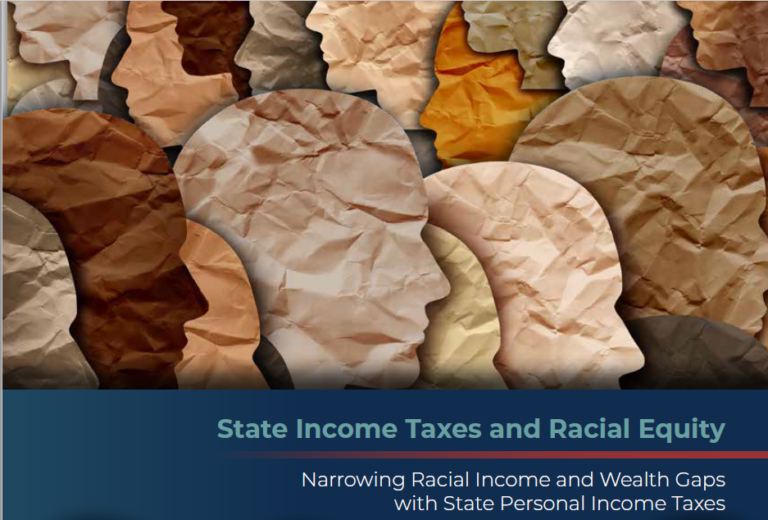
State Income Taxes and Racial Equity: Narrowing Racial Income and Wealth Gaps with State Personal Income Taxes
• By Carl Davis, Jessica Schieder, Marco Guzman
10 state personal income tax reforms that offer the most promising routes toward narrowing racial income and wealth gaps through the tax code.
State Rundown 9/29: Where There’s Smoke, There’s Revenue?
• By ITEP Staff
One of the few industries to excel during the economic downturn brought on by the pandemic has been the marijuana business, and lawmakers around the country are taking notice as they try to ensure that sales in their state are both legal and subject to tax...
New Census Data Highlight Need for Permanent Child Tax Credit Expansion
• By Neva Butkus
The status quo was a choice, but the Census data released today shows that different policy choices can create drastically different outcomes for children and families. It is time for our state and federal legislators to put people first when it comes to recovery.

Neva Butkus
• By ITEP Staff
Neva supports researchers and advocates in their fight for equitable and adequate state tax systems through policy analysis, research and collaboration. Prior to ITEP, Neva was a Senior Policy Analyst at the Louisiana Budget Project where her research and advocacy included issues of corporate tax policy, working family tax credits, unemployment insurance, and K-12 finance policy.
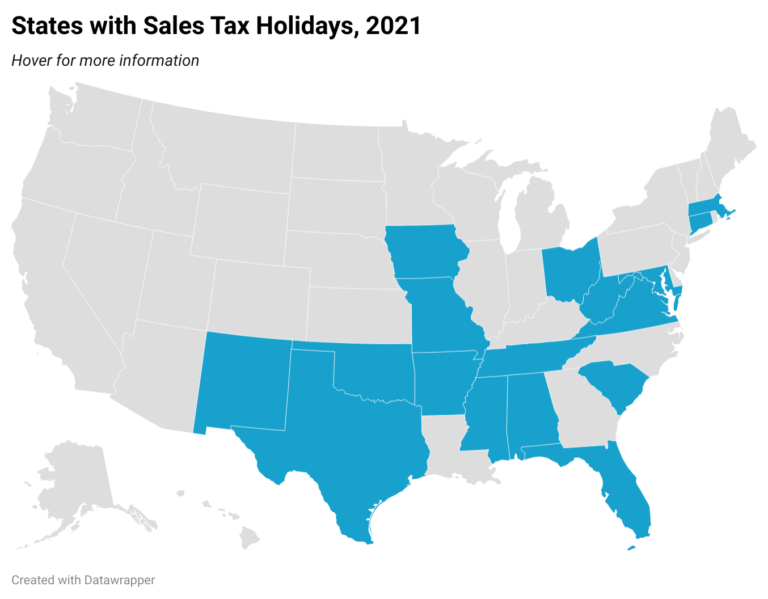
Sales Tax Holidays: An Ineffective Alternative to Real Sales Tax Reform
• By Dylan Grundman O'Neill
Policymakers tout sales tax holidays as a way for families to save money while shopping for “essential” goods. On the surface, this sounds good. However, a two- to three-day sales tax holiday for selected items does nothing to reduce taxes for low- and moderate-income taxpayers during the other 362 days of the year. Sales taxes are inherently regressive. In the long run, sales tax holidays leave a regressive tax system unchanged, and the benefits of…
State Rundown 6/24: Late June State Fiscal Debates Unusually Active
• By ITEP Staff
Delayed legislative sessions and protracted federal aid debates have made for a busier June than normal for state fiscal debates. Arizona, New Hampshire, and North Carolina legislators, for example, are still pushing for expensive and regressive tax cuts in their states while they remain in session...
State Rundown 6/16: Progressive Tax Policy Keeps Racking Up Wins
• By ITEP Staff
Taxing rich households and large corporations to fund vital investments in education and other shared priorities has long been a winner in the eyes of the American public, and more recently has also enjoyed a string of victories in state legislatures and at the ballot box. That win streak continued this week as Arizona’s voter-approved tax surcharge on the rich and Seattle, Washington’s payroll tax on high-profit, high-salary businesses both survived court challenges, and Massachusetts…
State Rundown 6/7: Remaining State Legislative Sessions Are Heating up as Budget Deadlines Loom
• By ITEP Staff
Just as an early summer heatwave brought soaring temperatures this past weekend through much of the lower 48 states, several state legislative sessions are heating up as legislators scramble to make tough budget decisions. Massachusetts lawmakers are voting on a fiery new "millionaires' tax" that would support transportation and education revenue needs, and Connecticut will likely restore its state Earned Income Tax Credit (EITC) back to 30 percent. Illinois’s decision to cut back corporate tax…
State Rundown 5/27: State Legislatures Step Back, Advocates Push Forward
• By ITEP Staff
As more and more state legislatures wrap up their sessions and we reflect on the whirlwind that is this past year, it’s easy to focus on the steps back that states like Oklahoma have taken and Nebraska, North Carolina, and Arizona are trying to take. We have had some significant wins in states over the course of the year, but not every development will be a good one. However, we know advocates are on the…
State Rundown 5/20: You Learn Something New Every Tax Day
• By ITEP Staff
“Tax Day” was earlier this week but the debates, research, and advocacy that determine our taxes and how they are used take place every day of the year...
State Rundown 5/13: States Get Federal Aid and Guidance as Many Sessions Wind Down
• By ITEP Staff
We had our noses buried in new American Rescue Plan guidance...when we heard the refreshing news that Missouri leaders are on the verge of modernizing their tax code, not only by becoming the final state to apply sales taxes to online purchases, but also by enacting an Earned Income Tax Credit (EITC)...Meanwhile, tax debates are also highly active in California, Colorado, Louisiana, Maine, and Nebraska. We also share some of our own reporting on recent…
State Rundown 4/29: How You Like Them Washington Apples?
• By ITEP Staff
North Carolina lawmakers may have approved a massive tax subsidy giveaway to Apple, but we won’t let that news spoil our barrel this week. Nor will we be discouraged by Connecticut Gov. Ned Lamont’s threats to upset the apple cart full of positive progressive tax reforms state lawmakers recently came together to approve...Why all the optimism? Because the apple of our eye this week is Washington State, where advocates and lawmakers succeeded in a decade-long…
State Rundown 4/21: Spring Has Sprung, or Has It?
• By ITEP Staff
Just as a recent cold snap reminded us that spring has not fully sprung yet, this week’s news has been full of reminders that state fiscal debates aren’t quite finished either...
State Rundown 4/14: More Progressive Wins in the Headlines this Week, but Mind the Fine Print
• By ITEP Staff
Two significant victories headlined state tax debates in the past week, as New Mexico leaders improved existing targeted tax credits to give bigger boosts and reach more families in need, and West Virginia lawmakers unanimously shut down a destructive effort to eliminate the state’s progressive income tax. These developments follow last week’s major wins for progressive taxation and targeted assistance in New York, and more good news is likely soon as Washington legislators continue to…
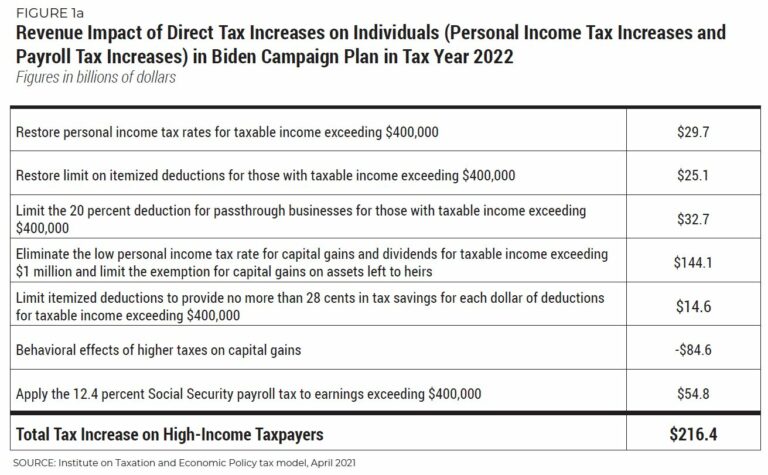
National and State-by-State Estimates of President Biden’s Campaign Proposals for Revenue
• By ITEP Staff, Matthew Gardner, Steve Wamhoff
During his presidential campaign, Joe Biden proposed to change the tax code to raise revenue directly from households with income exceeding $400,000. More precisely, Biden proposed to raise personal income taxes on unmarried individuals and married couples with taxable income exceeding $400,000, and he also proposed to raise payroll taxes on individual workers with earnings exceeding $400,000. Just 2 percent of taxpayers would see a direct tax hike (an increase in either personal income taxes,…
Louisiana Budget Project: Who Pays? Racial Injustice in Louisiana’s Tax System
• By ITEP Staff
Historic and current injustices – both in public policy and in society more broadly – have resulted in vast disparities in income across race and ethnicity in Louisiana. Unfortunately, our tax system plays an active role in worsening these disparities by asking those with the least to contribute the largest share of their income to […]
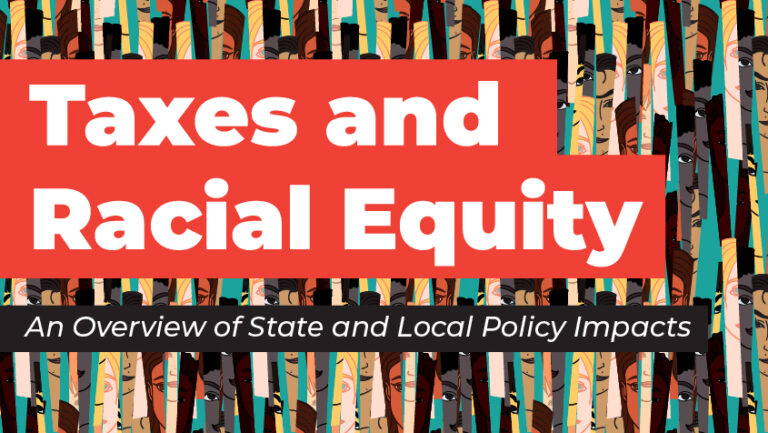
Taxes and Racial Equity: An Overview of State and Local Policy Impacts
• By ITEP Staff
Historic and current injustices, both in public policy and in broader society, have resulted in vast disparities in income and wealth across race and ethnicity. Employment discrimination has denied good job opportunities to people of color. An uneven system of public education funding advantages wealthier white people and produces unequal educational outcomes. Racist policies such as redlining and discrimination in lending practices have denied countless Black families the opportunity to become homeowners or business owners,…
State Rundown 3/10: Federal Pandemic Aid Means States Can Focus on the Big Picture
• By ITEP Staff
State and local policymakers will be preoccupied for a short time with celebrating and deciphering the federal pandemic relief package approved today, but ultimately the federal aid should free them to focus on even bigger concerns such as tax codes that often fail to adequately fund core priorities even in good years and exacerbate the economic and racial inequities that this pandemic has laid bare.
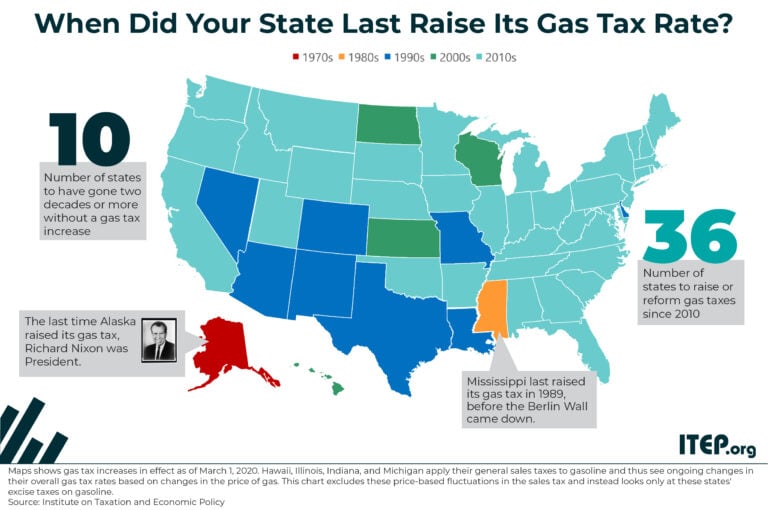
How Long Has It Been Since Your State Raised Its Gas Tax?
• By Carl Davis
Many state governments are struggling to repair and expand their transportation infrastructure because they are attempting to cover the rising cost of asphalt, machinery, and other construction materials with fixed-rate gasoline taxes that are rarely increased.
Comparing Flat-Rate Income Tax Options for Alaska
• By Carl Davis
Alaska lawmakers are facing an unprecedented fiscal crisis. The state is more dependent than any other on oil tax and royalty revenues but declines in oil prices and production levels have sapped much of the vitality of these revenue sources. One way of diversifying the state’s revenue stream and narrowing the yawning gap between state revenues and expenses would be to reinstitute a statewide personal income tax. Alaska previously levied such a tax until 1980.…
Law 360: La. Gov. Won’t Support Gas Tax Hike This Year Due To Virus
January 29, 2021
A January report from the American Petroleum Institute said Louisiana’s total per-gallon state taxes and fees of 20.01 cents on fuel rank below the national average of 36.83 cents for gasoline and 37.85 cents for diesel. Carl Davis, research director at the left-leaning Institute on Taxation and Economic Policy, told Law360 in November that Louisiana’s […]
State Rundown 1/22: Somewhere Between a Flurry and a Blizzard of State Tax Activity So Far
• By ITEP Staff
You won’t find any images of Bernie Sanders and his mittens photoshopped into this week’s Rundown, but you will find the latest news on state fiscal debates, including proposals to generate needed funding by raising taxes on high-income households and profiting businesses in California, Delaware, Hawaii, Maryland, and Washington, as well as misguided efforts to slash taxes in Arizona, Iowa, South Carolina, Utah, and West Virginia. Also in the news are thoughtful improvements to targeted…

State Tax Policy: Innovations to Embrace, Schemes to Avoid
• By Amy Hanauer
Better tax policies will help communities emerge from the current staggering fiscal crisis with tax structures that reduce inequality at a time when rich people are thriving and public services are under siege. Preserving public spending will boost the economy and improve lives–and cutting these essentials will not only hurt people but also deepen the downturn, a lesson we learned in the Great Recession’s slow recovery. Other states should take note.
The Center Square: Louisiana Tax Holiday May Save Shoppers $4.5 Million, Though Some Question the Value
November 19, 2020
“The conservative Tax Foundation and the progressive-leaning Institute on Taxation and Economic Policy don’t agree on much when it comes to taxes,” the Louisiana Budget Project countered in comments posted Thursday. “But both groups understand that ‘sales tax holidays’ – a favorite trope of politicians – are bad economic policy.” Sales tax holidays do not promote economic […]
