
New York
New ITEP Report Shows Few Taxpayers in Each State Paying More Under Biden’s Tax Plan
October 7, 2020 • By Steve Wamhoff
An ITEP report finds that taxes that people pay directly would stay the same or go down in 2022 for 98.1 percent of Americans under President-elect Joe Biden’s tax plan.
New 50-State Analysis of Biden Revenue-Raising Tax Proposals
October 7, 2020 • By ITEP Staff
A state-by-state analysis of President-elect Joe Biden’s proposal to raise taxes for filers with income of more than $400,000 finds that in 2022, just 1.9 percent of all taxpayers would face a direct tax increase. This would vary only slightly by state. For example, in West Virginia, 0.6 percent of taxpayers would see an increase, and in Connecticut, 3.7 percent of taxpayers’ taxes would increase.
Donald Trump and Taxes: Fast and Loose with Loopholes or Fraud?
September 30, 2020 • By Matthew Gardner

The president’s apparent abuse of everything from hair-care deductions to consulting fees for family members raises questions about whether Trump was fast and loose with tax loopholes or whether the IRS simply wasn’t enforcing the law. Either way, Trump successfully flouting or pushing the limits of the law shouldn’t come as a surprise: Congress has cut IRS funding, in real terms in each of the last 10 years.

Congress is certainly to blame both for providing a ridiculously lenient tax code for the super-wealthy and for preventing the IRS from enforcing even the existing weak limits in the law on tax avoidance. But make no mistake, one person is primarily responsible for the farce that is Donald Trump’s tax dodging, and that is Donald Trump. For years, he has actively and loudly supported special tax breaks and tax shelters, making him anything but a passive bystander to their creation.
WGN NewsNation: President Trump calls income tax report ‘fake news,’ says he’s still under IRS audit
September 29, 2020
Matt Gardner is with the Institute of Taxation and Economic Policy in Washington. He spoke with NewsNation’s Dean Reynolds about the New York Times report. “This isn’t news that the president has avoided taxes,” Gardner said. “What’s new and really interesting to me about the latest report is that for the first time we have […]
Washington Post: A pug, a cat and a baby have paid more in taxes than Trump reportedly has
September 29, 2020
Undocumented immigrants paid more than $11 billion in taxes in 2017, according to the Institute on Taxation and Economic Policy. That same year, Trump paid just $750, according to the New York Times story. Read more
CBS News: 7 takeaways from New York Times report on President Trump’s tax returns
September 29, 2020
At the same time Ivanka Trump was an executive officer of the Trump companies, she both profited from the hotels and the consulting fees, the Times story noted. The IRS in the past has pursued penalties against some companies that have sought to avoid taxes by paying consulting fees to people who weren’t, in fact, […]
It’s Time to Change the Tax Laws to Make Donald Trump and Corporate Giants Pay Up
September 29, 2020 • By Amy Hanauer

It’s time for a new approach. Trump’s egregious tax avoidance further exposes a system that preserves an enormous and growing economic divide. Congress has gutted IRS funding so that we don’t have the resources to audit wealthy tax avoiders. And lobbyists continue to secure giveaways for corporate clients that do nothing for our communities.
Associated Press: Trump Went Even Further Than Other Uber-rich to Shrink Taxes
September 29, 2020
So say tax experts in the wake of a New York Times report Sunday that found that Trump paid only $750 in taxes in both 2016 and 2017 — and none at all in 11 of the 18 years that the newspaper examined. “The things that Trump did are typical of wealthy businesspeople and particularly […]
ITEP: New York Times’ Trump Tax Revelation Confirms What We Already Know
September 27, 2020 • By Steve Wamhoff
"The New York Times revelation of Trump’s years of dodging taxes confirms something we already know. There are two tax systems: one that most of us follow, and another far more generous one for the very rich."
State Rundown 9/23: Tax Justice Advanced in New Jersey, On the Ballot in Illinois
September 23, 2020 • By ITEP Staff
New Jersey leaders grabbed the biggest headlines of the week by finally agreeing to implement a much-needed and long-discussed millionaires tax to shore up the budget and improve tax fairness. And Illinois residents can begin voting tomorrow to enact a graduated income tax there. Relatedly, ITEP Research Director Carl Davis updated our research debunking the myth that progressive taxes interfere with economic growth. Cannabis legalization and taxation was a hot topic as well, as lawmakers in Vermont reached an agreement to move forward on the matter and others in Connecticut, Kansas, and New Hampshire worked toward the same.
Another Reason to Tax the Rich? States with High Top Tax Rates Doing as Well, if Not Better, than States Without Income Taxes
September 23, 2020 • By Carl Davis
ITEP updated a 2017 study that examined the economic performance of the nine states with the highest top marginal tax rates compared to the nine states with no state income tax. Economies in states with the highest top marginal rates grew faster. States facing budget shortfalls should first look at raising taxes on those most able to pay (incomes at the top have grown during this economic crisis) before considering harmful budget cuts.
New York Times: Morning Newsletter
September 18, 2020
Many states have tax systems that are regressive: They take a greater share of income from the poor than the rich. And because a disproportionate share of the richest taxpayers are white, these state tax systems also widen racial wealth gaps. In Illinois, for example, the lowest-earning fifth of the population pays 14.4 percent of […]
Yahoo! Finance: Salt Cap Isn’t Scaring Away Blue State Millionaires
September 15, 2020
The $10,000 cap on state and local tax deductions imposed as part of the 2017 Republican tax law is not causing high-income taxpayers to flee high-tax blue states, according to Carl Davis, research director at the progressive Institute on Taxation and Economic Policy. In a blog post last week, Davis said that new IRS data […]
Boosting Incomes and Improving Tax Equity with State Earned Income Tax Credits in 2020
September 15, 2020 • By Aidan Davis

The Earned Income Tax Credit (EITC) is a policy designed to bolster the incomes of low-wage workers and offset some of the taxes they pay, providing the opportunity for families struggling to afford the high cost of living to step up and out of poverty toward meaningful economic security. The federal EITC has kept millions of Americans out of poverty since its enactment in the mid-1970s. Over the past several decades, the effectiveness of the EITC has been amplified as many states have enacted and expanded their own credits.

Racial justice requires tax justice. Economic justice requires tax justice. Climate and health justice require, yes, tax justice.
State Rundown 9/11: Benefits of Progressive Taxation Getting Well-Deserved Attention
September 11, 2020 • By ITEP Staff
Readers may want to start with our “What We’re Reading” section this week, which is full of good reading on how progressive taxation is needed to fund vital public services, helpful for state and local economic growth, and popular among voters as well. In that spirit, leaders in both New Jersey and New York are looking at small taxes on stock trades to help improve their budgets and tax codes. These last couple of weeks have also featured more state fiscal action than is typical this time of year, for example in North Carolina, where lawmakers decided to use federal…
Millionaire Population Swells in Blue States Despite Migration Fearmongering
September 3, 2020 • By Carl Davis
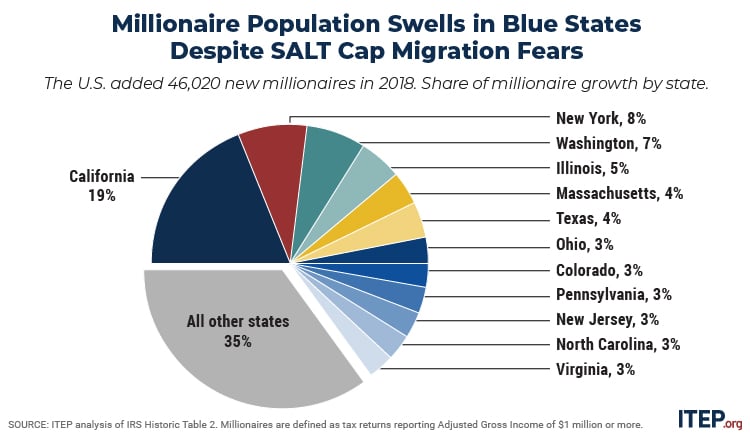
Although the 2017 Tax Cuts and Jobs Act has created a slew of problems, it is now clear that a mass migration of top earners out of higher-tax blue states is not one of them.
The Rich Are Weathering the Pandemic Just Fine: Tax Them
September 3, 2020 • By Carl Davis, ITEP Staff, Meg Wiehe
Reductions in critical state and local investments, including health care and education, would only exacerbate the economic crisis brought on by COVID-19 and worsen racial and income inequality for years to come. Higher taxes on top earners are among the best options for addressing pandemic-related state revenue shortfalls in the coming months.
State Rundown 8/26: Progressive Revenue Ideas Featured in Many States’ Fiscal Debates
August 26, 2020 • By ITEP Staff
Voters could significantly change the tax landscape through ballot measures this November regarding oil taxes in Alaska and a high-income surcharge for education funding in Arizona. Legislators are doing their part to bring progressive tax ideas to the fore as well, including a possible wealth tax in California, a millionaires tax in New Jersey, and a pied-a-terre proposal in New York. And Nebraska lawmakers reached a property tax and business tax subsidy compromise before closing out their session, but did not identify progressive revenue sources to fund it and will likely be back at the bargaining table before long.
New York Times: Letter to the Editor
August 25, 2020
It’s not surprising that millionaire and billionaire donations to President Trump’s re-election campaign have tapered off. Yes, he promised — and provided — billions in tax cuts for the wealthiest. Read more
Missed Opportunity: Flimsy Paper Touts Flawed Program
August 25, 2020 • By Amy Hanauer, ITEP Staff, Lorena Roque

Republicans continue to tout Opportunity Zones as their main vehicle to assist poor people, most recently with a deeply flawed report from President Trump’s White House Council of Economic Advisors and a mention from Donald Trump Jr. in his opening night convention speech. The report purports to compare—as a way of cutting poverty—tax breaks for investors vs food, cash or health insurance coverage for struggling families.
New York Times: Apple reaches $2 trillion in value
August 20, 2020
Apple has increased its buybacks since it used the Trump administration’s 2017 tax law to bring back most of the $252 billion it had once held abroad. (The law saved it $43 billion in taxes on the move, according to the Institute on Taxation and Economic Policy, a research group in Washington.) Apple has $194 […]
This week, voters in Missouri approved Medicaid expansion, Nevada lawmakers moved to amend their Constitution to raise taxes on the state’s mining industry, and leaders in California and New York continued to push for needed revenues through tax increases on their richest households.
Sales Tax Holidays: An Ineffective Alternative to Real Sales Tax Reform
July 29, 2020 • By Dylan Grundman O'Neill
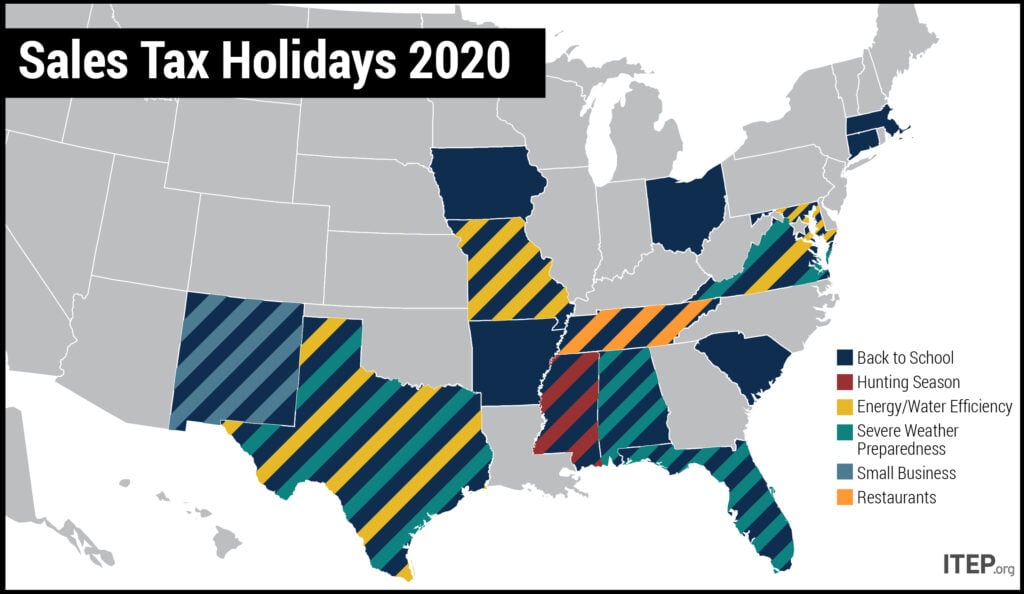
Lawmakers in many states have enacted “sales tax holidays” (16 states will hold them in 2020) to provide a temporary break on paying the tax on purchases of clothing, school supplies, and other items. These holidays may seem to lessen the regressive impacts of the sales tax, but their benefits are minimal while their downsides are significant—and amplified in the context of the COVID-19 pandemic. This policy brief looks at sales tax holidays as a tax reduction device.
