
New York
New York Times: Back-to-School Sales Tax ‘Holidays’ Lure Shoppers Despite Slim Savings
July 19, 2019
But the tax holidays put a damper on state revenue and don’t necessarily deliver the business results they promise, said Dylan Grundman, a senior policy analyst at the Institute on Taxation and Economic Policy. “People shift purchases, but don’t increase their overall spending,” Mr. Grundman said. “So the boost to business doesn’t really materialize.” Read […]
Sales Tax Holidays: An Ineffective Alternative to Real Sales Tax Reform
July 17, 2019 • By Dylan Grundman O'Neill
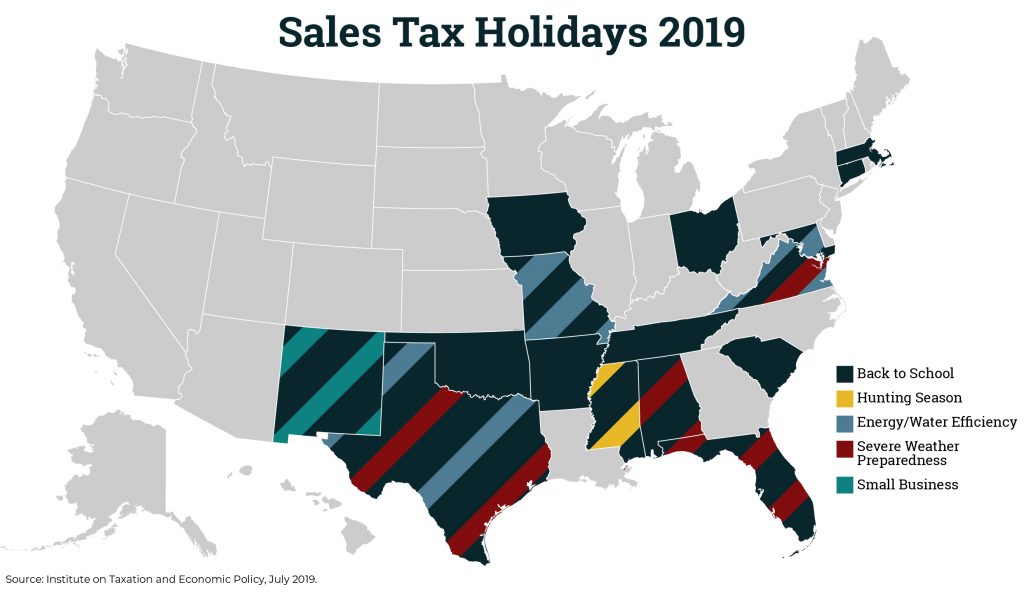
Lawmakers in many states have enacted “sales tax holidays” (16 states will hold them in 2019), to provide a temporary break on paying the tax on purchases of clothing, school supplies, and other items. While these holidays may seem to lessen the regressive impacts of the sales tax, their benefits are minimal. This policy brief looks at sales tax holidays as a tax reduction device.
We've said it before, and we'll say it again: states don't have to wait for federal lawmakers to make moves toward progressive tax policy. And so far, 2019 has been a good year for equitable and sustainable tax policy in the states. With July 1 marking the start of a new fiscal year for most states, this special edition of the Rundown looks at how discussions in 2019 have been dominated by plans to raise revenue for vital investments, tax the rich and corporations fairly, use the tax code to help workers and families and advance racial equity, and shore…
Missouri’s Creative Approach to Ending the “Race to the Bottom” in State Business Taxes
July 10, 2019 • By Matthew Gardner
Each year, state and local governments spend billions of dollars on targeted tax incentives—special tax breaks ostensibly designed to encourage businesses to relocate, expand or simply stay where they are. A law enacted by the Missouri legislature creates a template for states to work bilaterally to put the brakes on the “race to the bottom” in state business taxes.
Calling Progressive Tax Proposals “Extreme” Are Taunts Meant to Distract
June 18, 2019 • By Steve Wamhoff

Dismissing calls for progressive taxes as “radical,” “extreme,” or “socialism” are taunts meant to distract from the real question: Why should we ignore the bottom half of Americans, whose share of the economic pie shrank and now have negative net worth, while allowing the wealthy and powerful, whose net worth more than tripled, to dictate our public policies?
Fox Business: Ocasio-Cortez Criticizes Amazon’s Bezos for Paying Workers’ Starvation Wages’
June 16, 2019
Concerns were also triggered by the tax breaks and subsidies Amazon – one of the world’s most valuable companies by market cap – would be given for building its second headquarters in New York. Last year, Amazon did not pay a single dollar in federal income taxes despite nearly doubling its profit from 2017 ($5.6 […]
International Business Times: Amazon News: What Joe Biden, Bernie Sanders Said About The Retail Giant On Taxes And Its New Credit Card
June 15, 2019
On Thursday, Biden posted on Twitter how Amazon pays a “lower tax rate than teachers and firefighters.” The New York Times in April noted how Amazon paid no taxes in 2018, citing a study from the left-leaning Institute on Taxation and Economic Policy. The study showed the company actually paid a -1.2% in taxes due to a $129 million tax rebate. The […]
CNBC: Joe Biden’s Twitter fight with Amazon perfectly sums up the battle over America’s new tax code
June 14, 2019
Biden’s tweet linked to a New York Times story that cited data from the left-leaning Institute on Taxation and Economic Policy on companies that earned billions of dollars last year but paid no federal taxes. The analysis showed that Amazon topped the list, with pretax profits of nearly $11 billion. In fact, the group found […]
States are putting evidence into practice with multiple efforts to improve services and tax codes through more progressive taxes on the wealthy. Clear evidence has spread widely this year, informing a national conversation about progressive taxation and leading lawmakers in multiple states to eschew supply-side superstition and act on real evidence instead. Taxing the rich works, and in this Just Taxes blog we review state-level efforts to put these proven findings into effect.
New SALT Workaround Regulations Narrow a Tax Shelter, but Work Remains to Close it Entirely
June 11, 2019 • By Carl Davis

Today the Internal Revenue Service (IRS) released its final regulations cracking down on a tax shelter long favored by private and religious K-12 schools, and more recently adopted by some “blue state” lawmakers in the wake of the 2017 Trump tax cut. The regulations come more than a year after the IRS first announced the […]

After states implemented laws that allow taxpayers to circumvent the new $10,000 cap on deductions for state and local taxes (SALT), the IRS has proposed regulations to address this practice. It’s a safe bet the IRS will try to crack down on the newest policies that provide tax credits for donations to public education and other public services, but it remains to be seen whether new regulations will put an end to a longer-running practice of exploiting tax loopholes in some states that allow public money to be funneled to private schools.
Unlike Trump-GOP Tax Law, There Are Tax Plans That Would Actually Deliver on Promise to Help Working People
May 24, 2019 • By Alan Essig

Using the tax code to boost the economic security of low- and moderate-income families is a proven strategy. These bold proposals would go much further than any policy currently on the books, and their approach directly contrasts with longstanding supply-side theories that call for continual tax cuts to those who are already economically faring far better than everyone else.
New York Times: Democrats’ Tax Cuts Target Middle Class More Than Trump’s, Study Says
May 22, 2019
Tax plans from several Democratic candidates for president would cost less than President Trump’s signature tax cuts but deliver larger benefits to most low- and middle-income Americans, according to a new analysis by the Institute on Taxation and Economic Policy, a liberal think tank in Washington. The analysis is one of the first to examine […]
State Rundown 5/16: Tensions Remain High Over Budgets and School Finances in Several States
May 16, 2019 • By ITEP Staff
Tax and budget negotiations remain at standstills in Louisiana and Minnesota, as school funding debates and teacher protests again captured headlines in several states. Oregon lawmakers, for example, finally passed a mixed-bag tax package that won’t improve tax equity but will raise much-needed revenue for education. Meanwhile their counterparts in Nebraska continue to debate highly […]
State Rundown 5/9: Illinois Moves Closer to a Progressive Income Tax
May 9, 2019 • By ITEP Staff
Lawmakers in Illinois and Ohio have advanced major tax proposals but cannot rest just yet, as they must still get past the other legislative chamber. Their counterparts in Michigan, Minnesota, Nebraska, and Oregon, meanwhile, are all at impasses over education funding, as those in Texas left their school funding disagreement unresolved at least until they reconvene...in 2021. And in an era of many states pre-empting smaller jurisdictions by revoking local decision-making powers, leaders in Colorado and Delaware made moves in the opposite direction, entrusting cities and school districts with more local control.
Allentown Morning Call: Fortune 500 company PPL not only paid no federal taxes last year, it got a $19 million rebate; it says it has invested those savings
May 8, 2019
Sixty of America’s Fortune 500 corporations paid nothing — or got refunds — for 2018, according to a report released last month by the Institute on Taxation and Economic Policy in Washington, described as a left-leaning think tank by the Washington Post and New York Times. In PPL’s case, the institute said the company received […]
Teachers in North Carolina and South Carolina are walking out and rallying this week for increased education funding, teacher and staff pay, and other improvements to benefit students—if you’re unsure why be sure to check out research on the teacher shortage and pay gap under “What We’re Reading” below. Meanwhile, budget debates have recently wrapped up in Indiana, Iowa, Massachusetts, New Hampshire, and Washington. And major tax debates are kicking into high gear in both Louisiana and Nebraska.
New York Times: Apple Plans to Buy $75 Billion More of Its Own Stock
April 30, 2019
When it repatriated its cash under the new tax law, Apple paid $43 billion less than it would have under previous rates, bigger savings than any other American company, according to the Institute on Taxation and Economic Policy, a research group in Washington. Apple has also saved billions of dollars under the lower corporate tax rate. Apple says it is spending billions in the United States, hiring new workers, building data centers, expanding offices in Texas and investing in some outside manufacturers.
New York Times: Profitable Giants Like Amazon Pay $0 in Corporate Taxes. Some Voters Are Sick of It.
April 29, 2019
The list of profitable companies that pay no corporate taxes, compiled by the Institute on Taxation and Economic Policy, a left-leaning think tank, also includes Goodyear and three other Ohio companies, including the Akron-based electric utility FirstEnergy. The company, which has the naming rights to the Cleveland Browns’ stadium, paid no taxes last year on $1.5 billion in income, according to the analysis, and will receive additional tax credits that can be used in the future. In a win for consumers, some of that will be returned to the utility’s customers.
New York Times: Dealbook Briefing
April 24, 2019
“There’s a general rule that you’re not supposed to be able to claim losses for more than you put into a deal,” Steve Wamhoff, director of federal tax policy at the Institute on Taxation and Economic Policy, a left-leaning think tank, told Businessweek. “Real estate is the exception.” Read more

In early April, a diverse but mostly black crowd took to the streets in the Shaw neighborhood of Washington D.C. to protest T-Mobile’s decision to order Metro PCS to cease playing gogo music. This tale is a shining example of why economic investment—especially taxpayer-incentivized investment—in underserved communities is fraught with controversy. Who ultimately benefits after developers pour millions of dollars into these communities? And, as this controversy reveals, are the usually black and brown denizens of these neighborhoods and businesses that may have catered to them no longer welcome once economic development reaches a critical mass?
The Case for Extending State-Level Child Tax Credits to Those Left Out: A 50-State Analysis
April 17, 2019 • By Aidan Davis, Meg Wiehe
As of 2017, 11.5 million children in the United States were living in poverty. A national, fully-refundable Child Tax Credit (CTC) would effectively address persistently high child poverty rates at the national and state levels. The federal CTC in its current form falls short of achieving this goal due to its earnings requirement and lack of full refundability. Fortunately, states have options to make state-level improvements in the absence of federal policy change. A state-level CTC is a tool that states can employ to remedy inequalities created by the current structure of the federal CTC. State-level CTCs would significantly reduce…
New York Post: Want to get out of taxes? Just make $79B
April 16, 2019
While millions of Americans had to cut Uncle Sam a check this year to pay their tax bill, 60 of the Fortune 500 companies paid zero taxes on their revenue, a new report finds. In 2018, 60 of America’s biggest corporations zeroed out their federal income taxes on $79 billion in US pretax income. Instead […]
Newark Star-Ledger: Tax Day 2019 More Taxing for 400k NJ Households
April 16, 2019
Only California, New York, Texas and Florida saw a greater number of households paying more in taxes, according to the report, based on data from the Institute on Taxation and Economic Policy. Read more
New York Times: Their Tax Rate Is Zero
April 15, 2019
Amazon. Delta Air Lines. Chevron. IBM. General Motors. Molson Coors. Eli Lilly. What do these companies have in common? They paid no federal taxes last year. Thanks to President Trump’s 2017 tax law, the number of Fortune 500 companies that pay no federal taxes roughly doubled last year, to 60, according to an analysis by […]
