
New York
Trends We’re Watching in 2018, Part 5: 21st Century Consumption Taxes
April 20, 2018 • By Misha Hill
We're highlighting the progress of a few newer trends in consumption taxation. This includes using the tax code to discourage consumption of everything from plastic bags to carbon and collecting revenue from emerging industries like ride sharing services and legalized cannabis sales.

The U.S. Supreme Court is scheduled to consider a case next week (South Dakota v. Wayfair, Inc.) that has the potential to significantly improve states and localities’ ability to enforce their sales tax laws on Internet purchases.
What to Expect if the Supreme Court Allows for Online Sales Tax Collection
April 11, 2018 • By Carl Davis

Online shopping is hardly a new phenomenon. And yet states and localities still lack the authority to require many Internet retailers to collect the sales taxes that their locally based, brick and mortar competitors have been collecting for decades.
Extensions of the New Tax Law’s Temporary Provisions Would Mainly Benefit the Wealthy
April 10, 2018 • By Matthew Gardner, Steve Wamhoff
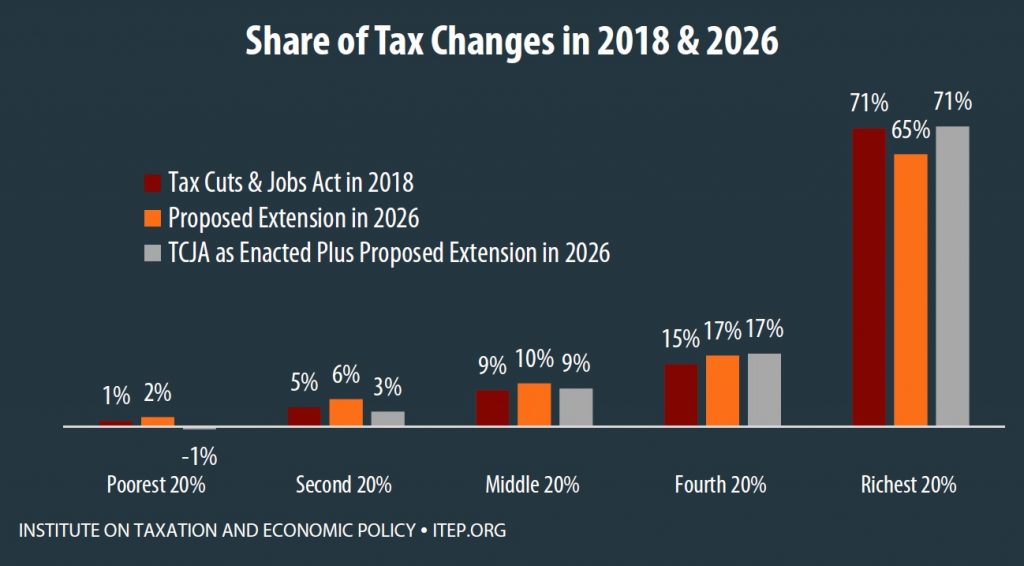
This analysis finds that extending the temporary tax provisions in 2026 would not be aimed at helping the middle-class any more than TCJA as enacted helps the middle-class in 2018.
CNBC: Trump Organization’s Online Store Adds Virginia to Short List of States Collecting Tax on Its Sales, Bringing Total to 3
April 9, 2018
“You have Trump Tower New York and the Trump Store in Trump Tower pointing people to the site, essentially being salespeople,” Carl Davis, research director of the nonpartisan Institute on Taxation and Economic Policy, told CNBC. A spokesman for the New York Department of Taxation and Finance said secrecy laws prevent it from commenting on […]
Is the Trump Organization’s Sales Tax Avoidance More Aggressive Than Amazon’s?
April 6, 2018 • By Carl Davis
In recent weeks, President Trump has been raking Amazon over the coals for failing to collect state and local sales taxes on many of the company’s sales—a criticism that has some merit. But a new story first reported by James Kosur at RedStateDisaster, and then picked up today by the Wall Street Journal, provides fascinating insight into the sales tax collection habits of the Trump Organization’s “official retail website,” TrumpStore.com.
This week, Kentucky legislators passed a bill shifting taxes onto low- and middle-income families, Oklahoma legislators reached a deal on education funding, and their counterparts in Kansas proffered multiple proposals for their education funding needs. Meanwhile, tax debates are coming down to the wire in Iowa, Missouri, and Nebraska, and responses to the federal tax-cut bill were settled on in Maryland, New York, and Wisconsin.
Washington Times: Andrew Cuomo complains about tax breaks for wealthy — then signs off on N.Y. loopholes
April 5, 2018 • By Matthew Gardner
Matthew Gardner, a senior fellow at the left-leaning Institute on Taxation and Economic Policy, said this appears to be another example of wealthy Americans “gaming” the tax system through special loopholes. “The whole point is to help New Yorkers to avoid a tax hike, and in particular to help wealthy New Yorkers avoid a tax […]
Cities Fail to Disclose Tax Incentives in Bids for Amazon’s HQ2
April 3, 2018 • By Guest Blogger

The Amazon HQ2 project would be the biggest in U.S. history as measured in projected jobs, yet little is known about the incentives cities have offered Amazon to lure its second headquarters. This lack of disclosure prevents public participation in the deal, including raising important questions about whether tax incentives that cities are offering are in the best short- and long-term interest of their residents. This is the main finding of Public Auction, Private Dealings: Will Amazon’s HQ2 Veer to Secrecy Create A Missed Opportunity for Inclusive, Accountable Development?, a Good Jobs First study released today.
State Rundown 3/30: Several Major Tax Debates Will March on into April
March 30, 2018 • By ITEP Staff
This week, after the recent teacher strike in West Virginia, teacher pay crises brought on by years of irresponsible tax cuts also made headlines in Arizona and Oklahoma. Maine and New York lawmakers continue to hash out how they will respond to the federal tax bill. And their counterparts in Missouri and Nebraska attempt to push forward their tax cutting agendas.
New York Times: Silicon Valley Warms to Trump After a Chilly Start
March 30, 2018
But Silicon Valley’s favorite thing about Mr. Trump is almost certainly his new tax code. Many tech companies lobbied for corporate tax reform for years before Mr. Trump signed the new tax bill. Tech giants immediately reaped the benefits. Under the new rules, Apple saved $43.7 billion in taxes, according to the Institute on Taxation […]
New York Times: The Facts Behind Trump’s Tweet on Amazon, Taxes and the Postal Service
March 30, 2018
Mr. Trump has made similar claims before about Amazon’s tax payments, both as president and a private citizen. After he mentioned it in August 2017, The New York Times reported: If Mr. Trump’s point was that Amazon did not collect sales taxes — which are owed by the purchaser and collected by the retailer — […]
New York Times: Still Angry at The Washington Post’s Coverage, Trump Bashes Jeff Bezos’ Amazon
March 30, 2018
There was also some irony in the criticism coming from Trump, who has boasted about his dexterity in avoiding paying taxes. “This is the guy who said that not paying taxes ‘makes me smart,’” said Matt Gardner, senior fellow at the Institute on Taxation and Economic Policy, a nonpartisan research organization. Read more
New York Times: As Amazon Steps Up Tax Collections, Some Cities Are Left Out
March 27, 2018
When Amazon agreed last year to begin collecting sales tax in New Mexico, state officials celebrated what they said could be tens of millions of dollars in annual tax revenue. But they aren’t cheering in Albuquerque City Hall. A year after that announcement, New Mexico’s largest city hasn’t seen a dime from Amazon. That’s because […]
Trends We’re Watching in 2018, Part 3: Improvements to Tax Credits for Workers and Families
March 26, 2018 • By Aidan Davis
This has been a big year for state action on tax credits that support low-and moderate-income workers and families. And this makes sense given the bad hand low- and middle-income families were dealt under the recent Trump-GOP tax law, which provides most of its benefits to high-income households and wealthy investors. Many proposed changes are part of states’ broader reaction to the impact of the new federal law on state tax systems. Unfortunately, some of those proposals left much to be desired.
Amazon and Other E-Retailers Get a Free Pass from Some Local-Level Sales Taxes
March 26, 2018 • By Carl Davis
A new ITEP analysis reveals that in seven states (Alabama, Alaska, Idaho, Iowa, Mississippi, New Mexico, and Pennsylvania), the nation’s largest e-retailer, Amazon.com, is either not collecting local-level sales taxes or is charging a lower tax rate than local retailers. In other states, such as Colorado and Illinois, Amazon is collecting local tax because it has an in-state presence, but localities cannot collect taxes from other e-retailers based outside the state.
Christian Science Monitor: In Blue States, ‘Tax the Rich’ Isn’t So Simple Anymore
March 16, 2018
The upset that governors like Cuomo and others are voicing is understandable, says Meg Wiehe, deputy director of the Institute on Taxation and Economic Policy, a left-leaning research group. These states see they’re getting the short end of the stick from the federal law, and they suspect that Republican motives were at least partly political. […]
With many state legislative sessions about halfway through, the ripple effects of the federal tax-cut bill took a back seat this week as states focused their energies on their own tax and budget issues. Major proposals were released in Nebraska and New Jersey, one advanced in Missouri, and debates wrapped up in Florida, Utah, and Washington. Oklahoma and Vermont are considering ways to improve education funding, while California, New York, and Vermont look to require more of their most fortunate residents. And check in on "what we're reading" for resources on the online sales tax debate, the role of property…
Trends We’re Watching in 2018, Part 2: State Revenue Shortfalls and the Impact on Education and Other Services
March 12, 2018 • By Aidan Davis
Many states struggle with a need for revenue, yet their lawmakers show little will to raise taxes to fund public services. Revenue shortfalls can prove to be a moving target. Some states with expected shortfalls are now seeing rosier forecasts. But as estimates come in above or below projections, states continue to grapple with how and whether to raise the revenue necessary to adequately fund key programs. Here are a few trends that are leading to less than cushy state coffers this year.
This week was very active for state tax debates. Georgia, Idaho, and Oregon passed bills reacting to the federal tax cut, as Maryland and other states made headway on their own responses. Florida lawmakers sent a harmful "supermajority" constitutional amendment to voters. New Jersey now has two progressive revenue raising proposals on the table (and a need for both). Louisiana ended one special session with talks of yet another. And online sales taxes continued to make news nationally and in Kansas, Nebraska, and Pennsylvania.
Trends We’re Watching in 2018, Part 1: State Responses to Federal Tax Cut Bill
March 5, 2018 • By Dylan Grundman O'Neill
Over the next few weeks we will be blogging about what we’re watching in state tax policy during 2018 legislative sessions. And there is no trend more pervasive in states this year than the need to sort through and react to the state-level impact of federal tax changes enacted late last year.
Preventing State Tax Subsidies for Private K-12 Education in the Wake of the New Federal 529 Law
February 23, 2018 • By Ronald Mak

This policy brief explains the federal and various state-level breaks for 529 plans and explores the potential impact that the change in federal treatment of 529 plans will have on state revenues.
This week, major tax packages relating to the federal tax-cut bill made news in Georgia, Iowa, and Louisiana, as Minnesota and Oregon lawmakers also continue to work out how their states will be affected. New Mexico's legislative session has finished without significant tax changes, while Idaho and Illinois's sessions are beginning to heat up, and Vermont's school funding system is under the microscope.

Any politician can score points by railing against President Trump and his wildly unfair, loophole-ridden tax law. But if New York’s working people find out they will be subjected to a new and complicated set of state tax rules all to help the richest 5 percent, they’ll wonder why a better solution that targets corporations and high-income earners who just received a sizable federal tax break, was not found. In the wake of the Trump-GOP tax law, this is a missed opportunity for lawmakers in New York to increase taxes on those who just benefited from a substantial tax cut.
New York Times: When Calling an Uber Can Pay off for Cities and States
February 20, 2018
The new fees and taxes are often part of broader regulatory measures as states and localities scramble to update tax codes and laws that have not kept up with the proliferation of app-based ride services. For instance, a Georgia state tax applies to rides in taxis but not ride-hailing cars even though they essentially do […]
