
OBBBA
ITEP analysis of the One Big Beautiful Bill Act, also known as OBBBA, OBBA or the Trump tax law. This archive collects research, commentary and data on how the 2025 federal tax and spending law affects working families, low-income households, wealthy taxpayers, corporations, state revenues, Medicaid, SNAP, the Child Tax Credit, the SALT deduction, clean energy tax credits and the federal budget.
Follow ITEP’s latest analysis of who benefits from OBBBA, who pays, and how the law reshapes the tax code. Articles in this archive examine the law’s distributional impact, its effects on inequality and public services, and the choices facing state lawmakers as federal tax changes flow through state tax systems.

Our tax policies enable people like Elon Musk and Donald Trump to accumulate more wealth than anyone could ever use in a lifetime. They then use it to steer elections and shape public policy to further enrich themselves and others like them. We should defeat the enormously destructive tax bill in Congress and instead craft tax policy that taxes the rich, makes our democracy more fair, and returns resources to the rest of the country.
Analysis of Tax Provisions in the House Reconciliation Bill: National and State Level Estimates
May 22, 2025 • By Carl Davis, Jessica Vela, Joe Hughes, Steve Wamhoff
The poorest fifth of Americans would receive 1 percent of the House reconciliation bill's net tax cuts in 2026 while the richest fifth of Americans would receive two-thirds of the tax cuts. The richest 5 percent alone would receive a little less than half of the net tax cuts that year.
The House of Representatives unveiled a sprawling piece of tax legislation earlier this week that would extend temporary tax changes enacted in 2017 and layer various kinds of tax cuts and increases on top. The JCT analysis makes clear that the House tax plan would be regressive, meaning it would offer larger tax cuts as a share of income to high-income taxpayers than to either middle-class or working-class families. It also makes clear that most of the tax cuts would go to families with above-average incomes.
Trump Megabill Will Encourage Dynastic Wealth Hoarding by Further Weakening the Estate Tax
May 15, 2025 • By Jon Whiten

The tax and spending megabill signed into law by President Trump on July 4 will cut nearly $200 billion from food assistance, affecting tens of millions adults and children, while providing an estate tax cut costing roughly the same amount to a few thousand people who will leave behind more than $7 million to their heirs.
Trump’s Proposed Higher Tax Rate on the Richest Taxpayers Would Affect Very Little of Their Income
May 10, 2025 • By Carl Davis, Steve Wamhoff
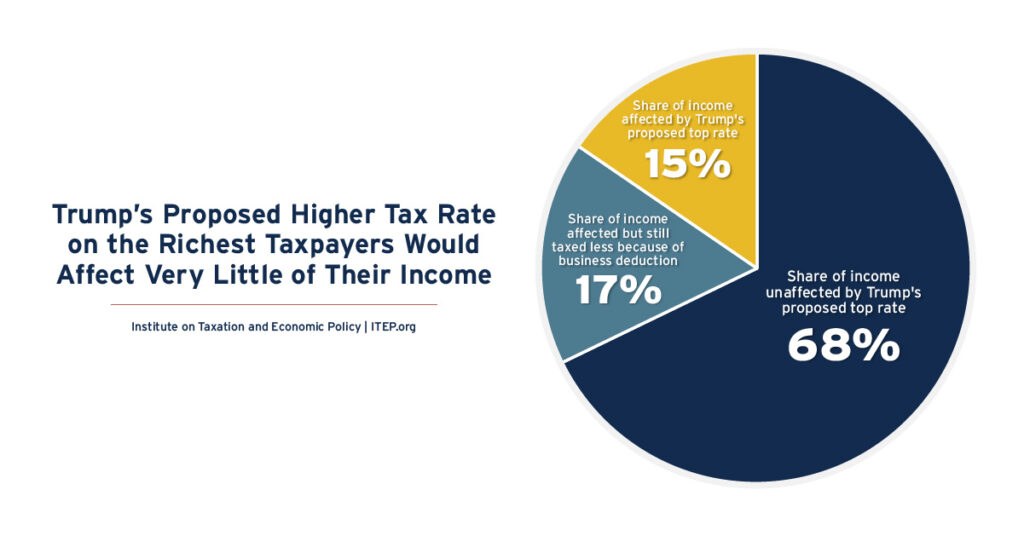
President Donald Trump has proposed allowing the top rate to revert from 37 percent to 39.6 percent for taxable income greater than $5 million for married couples and $2.5 million for unmarried taxpayers. But many other special breaks in the tax code would ensure that most income of very well-off people would never be subject to Trump’s 39.6 percent tax rate.
Want to know more about the tax and spending megabill that President Trump recently signed into law? We've got you covered.

The tariffs proposed by Donald Trump, which are far larger than any on the books today, would significantly raise the prices faced by American consumers across the income scale.
It’s Tax Day. You’ve Paid Your Share, but the Billionaires Haven’t.
April 15, 2025 • By Amy Hanauer

You likely had most of your federal taxes deducted from your paychecks throughout the year. This is not true, however, for mega-millionaires and billionaires, some of whom are practically running our government right now.
Sharp Turn in Federal Policy Brings Significant Risks for State Tax Revenues
April 9, 2025 • By Carl Davis

Summary The new presidential administration and Congress have indicated that they intend to bring about a dramatic federal retreat in funding for health care, food assistance, education, and other services that will push more of the responsibility for providing these essential services to the states. Meeting these new obligations would be a challenging task for […]
Senate Republicans Rig Congressional Rules to Make Their Tax Cuts Appear Cost-Free
April 4, 2025 • By Steve Wamhoff

This week, members of Congress are arguing about whether extending Trump’s 2017 tax cuts would cost trillions of dollars over a decade or cost nothing.
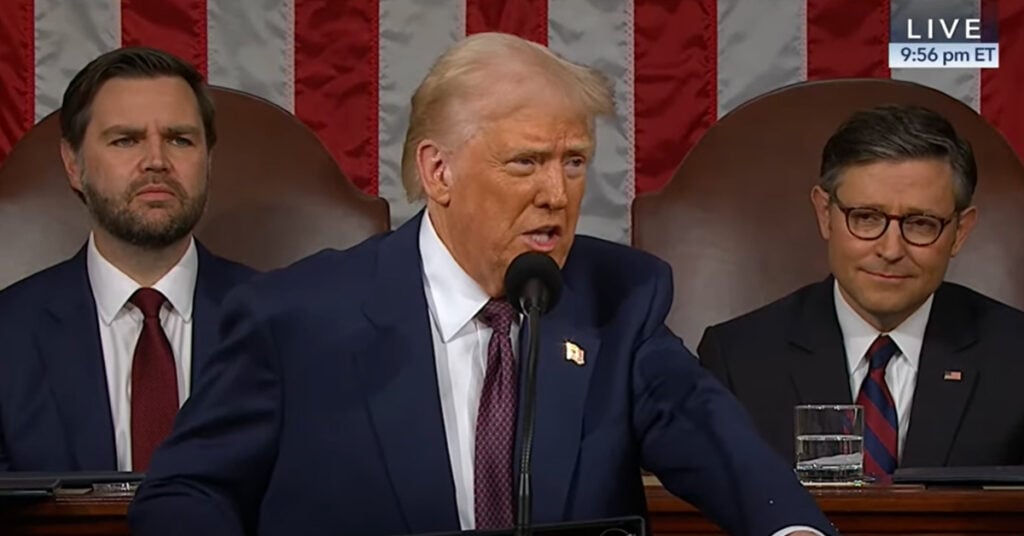
In last night’s address to Congress, President Trump spent more time insulting Americans, lying, and bragging than he did talking about taxes. But regardless of what President Trump and Elon Musk talk about most loudly and angrily, there is one clear policy that they and the corporations and billionaires that support them will try hardest […]
The budget resolution passed by House Republicans will enrich the richest, blow up the deficit, and decimate vital public services. The budget resolution allows Congress to pass reconciliation legislation with $4.5 trillion in tax cuts that would mostly flow to the wealthiest families in the country. Congressional Republicans have no way to pay for the massive tax cuts promised by President Trump during his campaign other than to dismantle fundamental parts of the government and increase the federal budget deficit.
The Five Biggest Corporations Represented at Trump’s Inauguration Could Save $75 Billion from One Tax Break Before Congress
February 11, 2025 • By Matthew Gardner, Spandan Marasini

New financial reports indicate five of America’s biggest corporations—Alphabet, Amazon, Apple, Meta, and Tesla—could win $75 billion in tax breaks if Congress and the President satisfy demands from corporate lobbyists to reinstate a provision repealed under the 2017 Trump tax law.
Trump and Congress’ Tax Package Likely to Worsen Racial Inequities
January 29, 2025 • By Brakeyshia Samms

While the country transitions to a new, yet familiar, presidential administration, lawmakers must keep in mind: fighting racial injustice should still be one of the focal points of this year’s tax debates. In theory, the debate over extending much of 2017’s Trump tax law represents an opportunity to advance racial equity. In practice, the tax package is likely to do the opposite, worsening racial inequities that already exist.
Different Approaches to the Trump Tax Law’s Cap on Deductions for State and Local Taxes (SALT)
January 17, 2025 • By Steve Wamhoff

President Trump and the Republican majorities in the House and Senate may not extend the $10,000 cap on federal income tax deductions for state and local taxes (SALT), the one part of the 2017 law that significantly limits tax breaks for the rich. And, depending on which proposal they settle on, leaving out the existing cap on SALT deductions could add between $10 billion and over $100 billion each year to the total cost of their tax plan.
Congress Could — But Won’t — Pass a Tax Package That Pays for Itself
January 17, 2025 • By Joe Hughes
If Republican lawmakers were serious about deficit-neutral tax reform, they would focus on increasing taxes for the ultra-wealthy and large corporations. The absence of such proposals in their plan reveals their true priority: delivering enormous tax cuts to the wealthiest Americans while average working families receive crumbs.
Trump’s Plan to Extend His 2017 Tax Provisions: Updated National and State-by-State Estimates
January 8, 2025 • By Steve Wamhoff
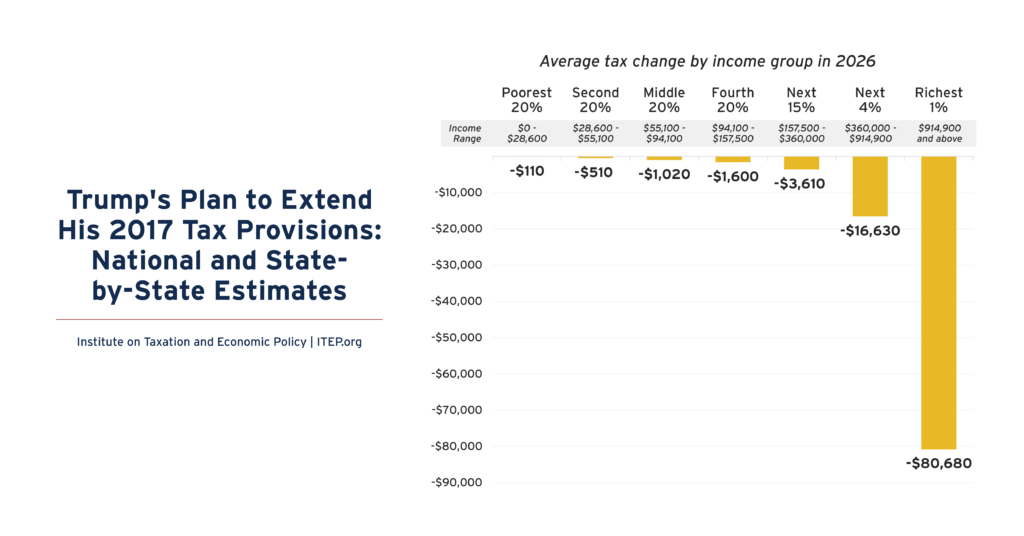
Trump’s plan to make most of the temporary provisions of his 2017 tax law permanent would disproportionately benefit the richest Americans. This includes all major provisions except the $10,000 cap on deductions for state and local taxes (SALT) paid.

As we close out 2024, we want to lift up the tax charts we published this year that received the most engagement from readers. Covering federal, state, and local tax work, here are our top charts of 2024.
How Would the Harris and Trump Tax Plans Affect Different Income Groups?
October 23, 2024 • By Jon Whiten
Presidential candidates Kamala Harris and Donald Trump have put forward a wide range of different tax proposals during this year’s campaign. We have now fully analyzed the distributional impacts of the major proposals of both Vice President Harris and former President Trump in separate analyses. In all, the tax proposals announced by Harris would, on average, lead to a tax cut for all income groups except the richest 1 percent of Americans, while the proposals announced by Trump would, on average, lead to a tax increase for all income groups except the richest 5 percent of Americans.
The tax proposals from Vice President Kamala Harris would, on average, lead to a tax increase for the richest 1 percent of Americans and a tax cut for all other income groups.
A Distributional Analysis of Donald Trump’s Tax Plan
October 7, 2024 • By Carl Davis, Erika Frankel, Galen Hendricks, Joe Hughes, Matthew Gardner, Michael Ettlinger, Steve Wamhoff

Former President Donald Trump has proposed a wide variety of tax policy changes. Taken together, these proposals would, on average, lead to a tax cut for the richest 5 percent of Americans and a tax increase for all other income groups.
Extending Temporary Provisions of the 2017 Trump Tax Law: Updated National and State-by-State Estimates
September 13, 2024 • By Steve Wamhoff

The TCJA Permanency Act would make permanent the provisions of the Tax Cuts and Jobs Act of 2017 that are set to expire at the end of 2025. The legislation would disproportionately benefit the richest Americans. Below are graphics for each state that show the effects of making TCJA permanent across income groups. See ITEP’s […]
After the dust settles on this year’s election, one of the most pressing issues confronting the next Congress and President will be how to deal with the expiration of the 2017 Trump tax cuts and, more specifically, who will pay for the cost of extending some or all of those cuts. Among the more widely accepted ideas circulating on the right is to raise income taxes on single parents, more than four in five of whom are women and a disproportionate share of whom are people of color.
Corporate Taxes Before and After the Trump Tax Law
May 2, 2024 • By Matthew Gardner, Michael Ettlinger, Spandan Marasini, Steve Wamhoff
The Trump tax law slashed taxes for America’s largest, consistently profitable corporations. These companies saw their effective tax rates fall from an average of 22.0 percent to an average of 12.8 percent after the Trump tax law went into effect in 2018.
Biden Is Right: Corporate Tax Avoidance Has Big Problems That We Can Fix
April 1, 2024 • By Jon Whiten
Sensible reforms to the corporate tax system can help both crack down on corporate tax avoidance and ensure companies that are flourishing are paying their share for the public infrastructure that forms the building blocks of their success.
