
Delaware
How the Revised Senate Tax Bill Would Affect Delaware Residents’ Federal Taxes
November 13, 2017 • By ITEP Staff
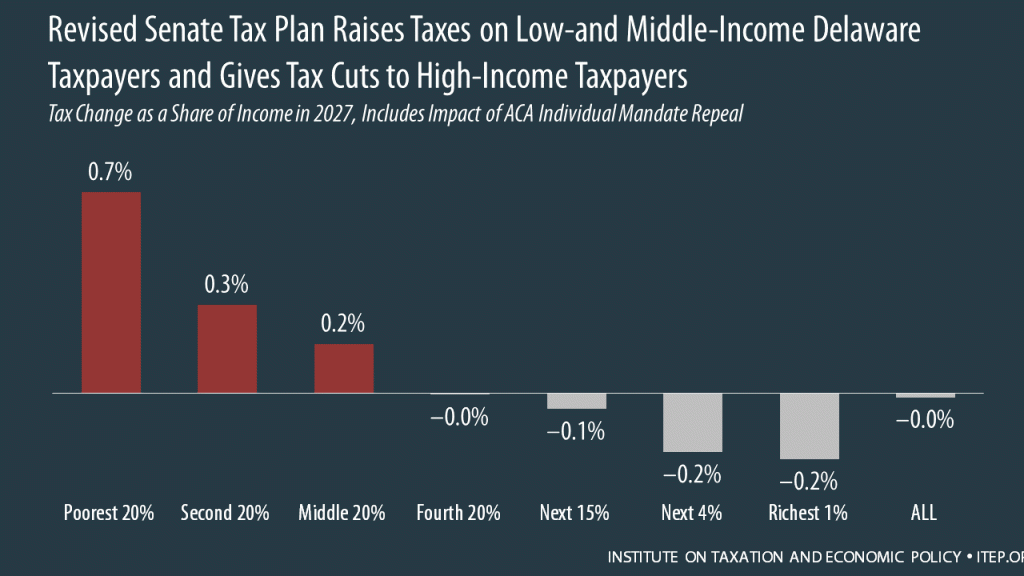
The Senate tax bill released last week would raise taxes on some families while bestowing immense benefits on wealthy Americans and foreign investors. In Delaware, 42 percent of the federal tax cuts would go to the richest 5 percent of residents, and 9 percent of households would face a tax increase, once the bill is fully implemented.
Analysis of the House Tax Cuts and Jobs Act
November 6, 2017 • By Matthew Gardner, Meg Wiehe, Steve Wamhoff
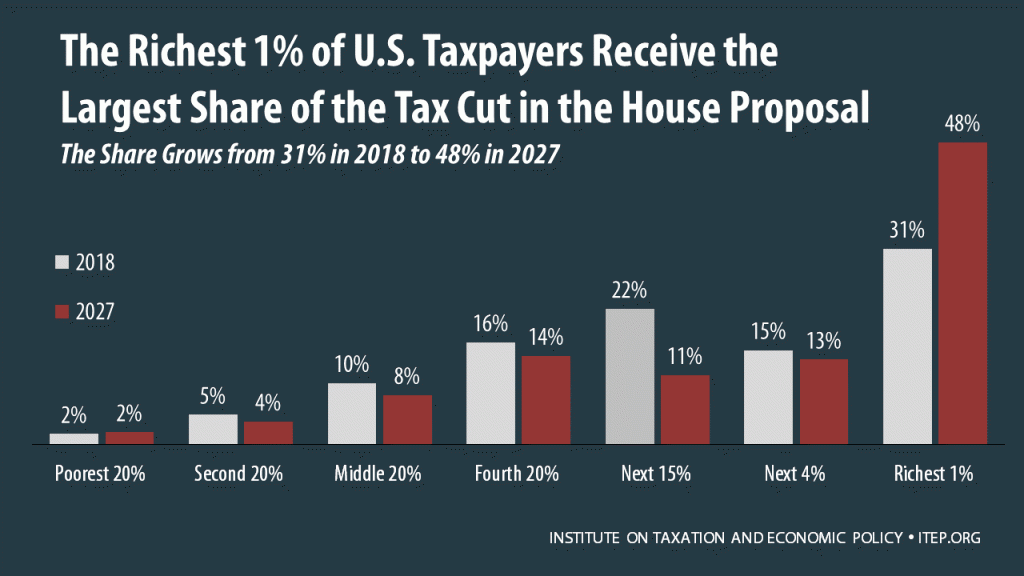
The Tax Cuts and Jobs Act, which was introduced on Nov. 2 in the House of Representatives, would raise taxes on some Americans and cut taxes on others while also providing significant savings to foreign investors.
How the House Tax Proposal Would Affect Delaware Residents’ Federal Taxes
November 6, 2017 • By ITEP Staff
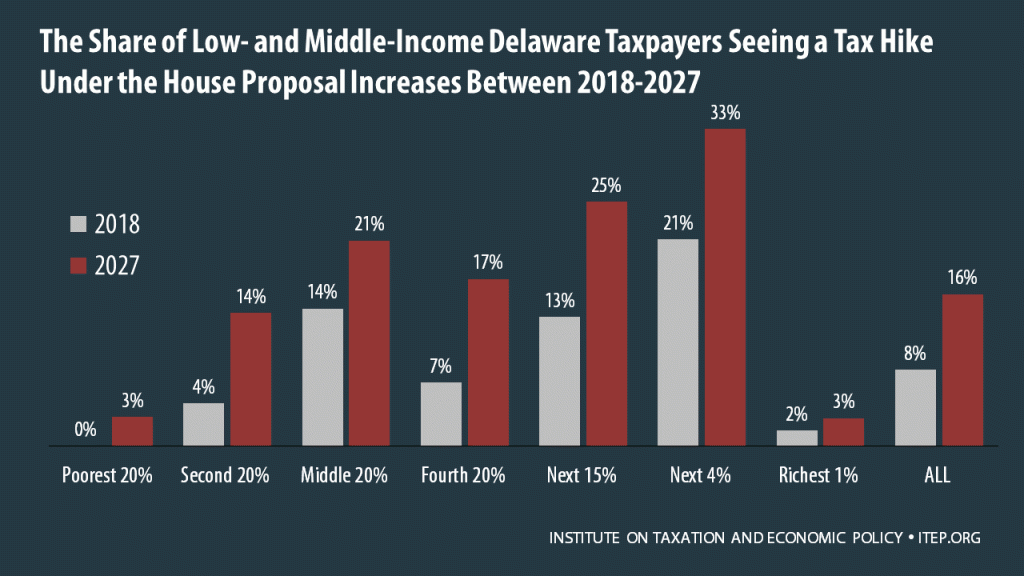
The Tax Cuts and Jobs Act, which was introduced on November 2 in the House of Representatives, includes some provisions that raise taxes and some that cut taxes, so the net effect for any particular family’s federal tax bill depends on their situation. Some of the provisions that benefit the middle class — like lower tax rates, an increased standard deduction, and a $300 tax credit for each adult in a household — are designed to expire or become less generous over time. Some of the provisions that benefit the wealthy, such as the reduction and eventual repeal of the estate…
State Rundown 10/25: Marijuana Taxes a Bright Spot amid Underperforming State Revenues
October 25, 2017 • By ITEP Staff
This week in state tax news saw Alaska begin yet another special session, Louisiana lawmakers holding meetings to begin preparing for the state’s looming (self-imposed) fiscal cliff, and Alabama policymakers beginning a study of school finance (in)adequacy and (in)equity. Meanwhile, state revenue performance is poor well into 2017 in many states, though Montana, Nevada, and Oregon are all enjoying modest but welcome revenue bumps from legalized marijuana.
Benefits of GOP-Trump Framework Tilted Toward the Richest Taxpayers in Each State
October 4, 2017 • By Steve Wamhoff
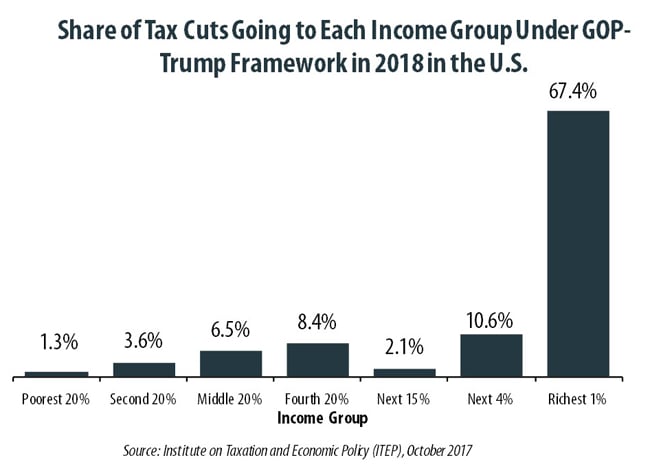
The “tax reform framework” released by the Trump administration and Congressional Republican leaders on September 27 would affect states differently, but every state would see its richest residents grow richer if it is enacted. In all but a handful of states, at least half of the tax cuts would flow to the richest one percent of residents if the framework took effect.
GOP-Trump Tax Framework Would Provide Richest One Percent in Delaware with 52.9 Percent of the State’s Tax Cuts
October 4, 2017 • By ITEP Staff
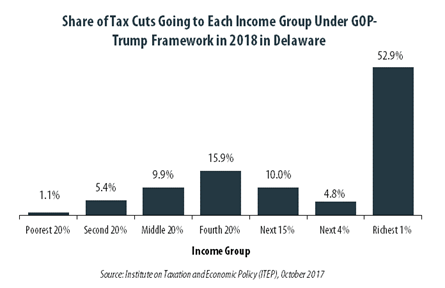
The “tax reform framework” released by the Trump administration and congressional Republican leaders on September 27 would not benefit everyone in Delaware equally. The richest one percent of Delaware residents would receive 52.9 percent of the tax cuts within the state under the framework in 2018. These households are projected to have an income of at least $497,100 next year. The framework would provide them an average tax cut of $49,370 in 2018, which would increase their income by an average of 2.7 percent.

Astonishingly, tax policies in virtually every state make it harder for those living in poverty to make ends meet. When all the taxes imposed by state and local governments are taken into account, every state imposes higher effective tax rates on poor families than on the richest taxpayers.
Rewarding Work Through State Earned Income Tax Credits in 2017
September 11, 2017 • By ITEP Staff
The Earned Income Tax Credit (EITC) is a policy designed to bolster the earnings of low-wage workers and offset some of the taxes they pay, providing the opportunity for struggling families to step up and out of poverty toward meaningful economic security. The federal EITC has kept millions of Americans out of poverty since its enactment in the mid-1970s. Over the past several decades, the effectiveness of the EITC has been magnified as many states have enacted and later expanded their own credits.
Nearly Half of Trump’s Proposed Tax Cuts Go to People Making More than $1 Million Annually
August 17, 2017 • By ITEP Staff
A tiny fraction of the U.S. population (one-half of one percent) earns more than $1 million annually. But in 2018 this elite group would receive 48.8 percent of the tax cuts proposed by the Trump administration. A much larger group, 44.6 percent of Americans, earn less than $45,000, but would receive just 4.4 percent of the tax cuts.
In Delaware 40.5 Percent of Trump’s Proposed Tax Cuts Go to People Making More than $1 Million
August 17, 2017 • By ITEP Staff
A tiny fraction of the Delaware population (0.5 percent) earns more than $1 million annually. But this elite group would receive 40.5 percent of the tax cuts that go to Delaware residents under the tax proposals from the Trump administration. A much larger group, 44.3 percent of the state, earns less than $45,000, but would receive just 6.0 percent of the tax cuts.
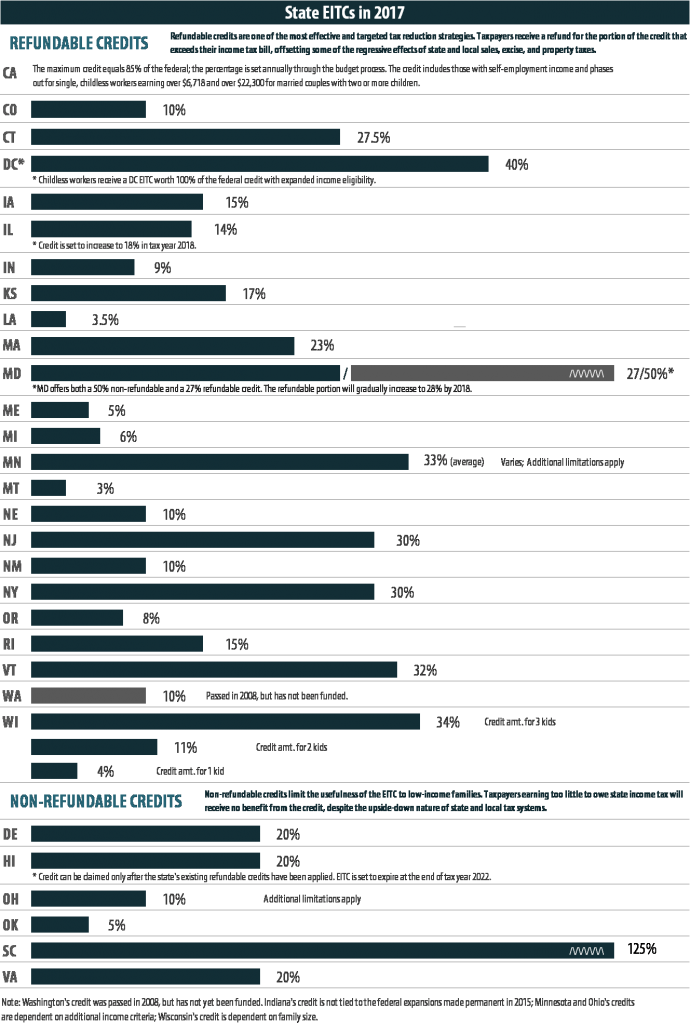
The Earned Income Tax Credit (EITC) is a policy designed to bolster the earnings of low-wage workers and offset some of the taxes they pay, providing the opportunity for struggling families to step up and out of poverty toward meaningful economic security. The federal EITC has kept millions of Americans out of poverty since its enactment in the mid-1970s. Over the past several decades, the effectiveness of the EITC has been magnified as many states have enacted and later expanded their own credits.
Trump Tax Proposals Would Provide Richest One Percent in Delaware with 46.6 Percent of the State’s Tax Cuts
July 20, 2017 • By ITEP Staff
Earlier this year, the Trump administration released some broadly outlined proposals to overhaul the federal tax code. Households in Delaware would not benefit equally from these proposals. The richest one percent of the state’s taxpayers are projected to make an average income of $1,798,100 in 2018. They would receive 46.6 percent of the tax cuts that go to Delaware’s residents and would enjoy an average cut of $84,310 in 2018 alone.
Trump’s $4.8 Trillion Tax Proposals Would Not Benefit All States or Taxpayers Equally
July 20, 2017 • By Matthew Gardner, Steve Wamhoff
The broadly outlined tax proposals released by the Trump administration would not benefit all taxpayers equally and they would not benefit all states equally either. Several states would receive a share of the total resulting tax cuts that is less than their share of the U.S. population. Of the dozen states receiving the least by this measure, seven are in the South. The others are New Mexico, Oregon, Maine, Idaho and Hawaii.
State Rundown 7/11: Some Legislatures Get Long Holiday Weekends, Others Work Overtime
July 11, 2017 • By ITEP Staff
Illinois and New Jersey made national news earlier this month after resolving their contentious budget stalemates. But they weren’t the only states working through (and in some cases after) the holiday weekend to resolve budget issues.

What do terrorists, opioid and human traffickers, corrupt government officials and tax evaders have in common? They all depend on the secrecy provided by anonymous shell corporations to allow them to finance and profit from their crimes. Momentum is building in the House and Senate to pass legislation that would strike against illicit finance in the United States and around the world by bringing an end to the anonymity provided by U.S. incorporation.
State Rundown 6/28: States Scramble to Finish Budgets Before July Deadlines
June 28, 2017 • By ITEP Staff
This week, several states attempt to wrap up their budget debates before new fiscal years (and holiday vacations) begin in July. Lawmakers reached at least short-term agreement on budgets in Alaska, New Hampshire, Rhode Island, and Vermont, but such resolution remains elusive in Connecticut, Delaware, Illinois, Maine, Pennsylvania, Washington, and Wisconsin.
Explaining our Analysis of Washington State’s Highly Regressive Tax Code
June 22, 2017 • By Carl Davis
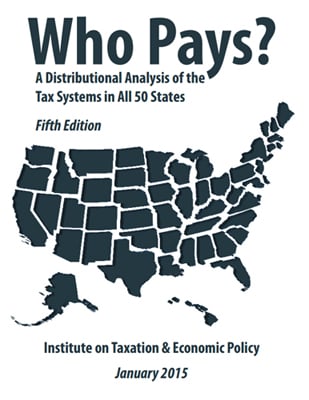
Supporters of creating a local personal income tax in Seattle are rightly concerned about the lopsided nature of their state’s tax code. In a 50-state study titled Who Pays?, produced using our microsimulation tax model, we found that Washington State’s tax system is the most regressive in the nation.
State Rundown 6/21: Crunch Time for Many States with New Fiscal Year on Horizon
June 21, 2017 • By Meg Wiehe
This week several states rush to finalize their budget and tax debates before the start of most state fiscal years on July 1. West Virginia lawmakers considered tax increases as part of a balanced approach to closing the state’s budget gap but took a funding-cuts-only approach in the end. Delaware legislators face a similar choice, […]
This week, Kansas lawmakers continued work on fixing the fiscal mess created by tax cuts in recent years, as legislators in Louisiana, Minnesota, Oklahoma, and West Virginia attempted to wrap up difficult budget negotiations before their sessions come to an end, and Delaware lawmakers advanced a corporate tax increase as one piece of a plan to close that state's budget shortfall. Our "what we're reading" section this week is also packed with articles about state and local effects of the Trump budget, new 50-state research on property taxes, and more.
This week saw tax debates heat up in many states. Late-session discovered revenue shortfalls, for example, are creating friction in Delaware, New Jersey, and Oklahoma, while special sessions featuring tax debates continue in Louisiana, New Mexico, and West Virginia. Meanwhile the effort to revive Alaska's personal income tax has cooled off.
Bloomberg BNA: Q and A with ITEP’s Meg Wiehe
May 10, 2017
Bloomberg BNA: Tell us a little bit about yourself and your work at the Institute on Taxation and Economic Policy (ITEP)? Wiehe: I am ITEP Deputy Director, my primary responsibility being to plan and execute state policy work, so I have a real bird’s eye view for what is happening in all 50 states, plus […]
3 Percent and Dropping: State Corporate Tax Avoidance in the Fortune 500, 2008 to 2015
April 27, 2017 • By Aidan Davis, Matthew Gardner, Richard Phillips
The trend is clear: states are experiencing a rapid decline in state corporate income tax revenue. Despite rebounding and even booming bottom lines for many corporations, this downward trend has become increasingly apparent in recent years. Since our last analysis of these data, in 2014, the state effective corporate tax rate paid by profitable Fortune 500 corporations has declined, dropping from 3.1 percent to 2.9 percent of their U.S. profits. A number of factors are driving this decline, including: a race to the bottom by states providing significant “incentives” for specific companies to relocate or stay put; blatant manipulation of…
State Rundown 4/12: Season in Transition as Some States Close, Others Open Tax Debates
April 12, 2017 • By ITEP Staff
This week in state tax news we see Louisiana‘s session getting started, budgets passed in New York and West Virginia, Kansas lawmakers taking a rest after defeating a harmful flat tax proposal, and Nebraska legislators preparing for full debate on major tax cuts. Nevada lawmakers may make tax decisions related to tampons, diapers, marijuana, and […]
In the Tax Justice Digest we recap the latest reports, blog posts, and analyses from Citizens for Tax Justice and the Institute on Taxation and Economic Policy. Here’s a rundown of what we’ve been working on lately. Corporations Offshore Cash Hoard Grows to $2.6 Trillion U.S. corporations now hold a record $2.6 trillion offshore, a […]
State Rundown 3/29: More States Looking to Raise or Protect Revenues Amid Fiscal and Federal Uncertainty
March 29, 2017 • By ITEP Staff
This week we see West Virginia, Georgia, Minnesota, and Nebraska continue to deliberate regressive tax cut proposals, as the District of Columbia considers cancelling tax cut triggers it put in place in prior years, and lawmakers in Hawaii, Washington, Kansas, and Delaware ponder raising revenues to shore up their budgets. Meanwhile, gas tax debates continue […]

Institute on Taxation
and Economic Policy
ITEP is a non-profit, non-partisan tax policy organization. We conduct rigorous analyses of tax and economic proposals and provide data-driven recommendations to shape equitable and sustainable tax systems.
Subscribe to ITEP Emails
Tax research and policy news in your inbox.
Promote Fair Tax Policy
Your gift to ITEP promotes tax justice. With your help, we do research that supports taxing millionaires and billionaires, taxing big corporations and raising revenue for the things our people, our communities and our planet need.
Together, we can create a country with more economic justice, more racial justice, more climate justice… and more tax justice.