
Louisiana

State Rundown 5/1: Teacher Uprisings Continue on May Day
• By ITEP Staff
Teachers in North Carolina and South Carolina are walking out and rallying this week for increased education funding, teacher and staff pay, and other improvements to benefit students—if you’re unsure why be sure to check out research on the teacher shortage and pay gap under “What We’re Reading” below. Meanwhile, budget debates have recently wrapped up in Indiana, Iowa, Massachusetts, New Hampshire, and Washington. And major tax debates are kicking into high gear in both…
State Rundown 4/18: It’s Peak Season for State Fiscal Debates
• By ITEP Staff
Tax and budget debates are now mostly complete in Alabama, Arkansas, and Colorado, but just starting or just getting interesting in several other states. Delaware and Massachusetts lawmakers, for example, are looking at progressive income tax increases on wealthy households, and New Hampshire may use a progressive tax on capital gains to simultaneously improve its upside-down tax code and invest in education. Nebraska and Texas, on the other hand, are also looking to improve school…
The Case for Extending State-Level Child Tax Credits to Those Left Out: A 50-State Analysis
• By Aidan Davis, Meg Wiehe
As of 2017, 11.5 million children in the United States were living in poverty. A national, fully-refundable Child Tax Credit (CTC) would effectively address persistently high child poverty rates at the national and state levels. The federal CTC in its current form falls short of achieving this goal due to its earnings requirement and lack of full refundability. Fortunately, states have options to make state-level improvements in the absence of federal policy change. A state-level…
State Rundown 4/4: Ohio Gas Tax and Maryland Minimum Wage Get Needed Updates
• By ITEP Staff
Transportation funding was a hot topic this week, as OHIO lawmakers responsibly voted to update their gas tax and offset some of its impact on lower-income families with an Earned Income Tax Credit (EITC) boost, while NEW YORK enacted the nation’s first “congestion pricing” charge, and LOUISIANA and VIRGINIA leaders looked at gas tax updates as well—a trend ITEP’s Carl Davis explored in depth today here. Broad tax packages are also being hashed out in LOUISIANA,…
State Rundown 3/27: Spring Bringing Smart State Tax Policy So Far
• By ITEP Staff
Though a long winter and a rough start to spring weather have wreaked havoc in much of the country, lawmakers are off to a good start in the world of state fiscal policy so far. In the last week, a progressive revenue package was passed in the nick of time in NEW MEXICO, a service-sapping tax cut was vetoed in KANSAS, and a regressive and unsustainable tax shift was soundly defeated in NORTH DAKOTA. Meanwhile, gas tax updates…
State Rundown 2/27: Temperatures and Tax Fights Continue to Polarize
• By ITEP Staff
As another polar vortex heads for large swaths of the country, state tax debates this week were highly polarized in another way. Lawmakers and advocates in MICHIGAN, OHIO, OREGON, UTAH, and elsewhere fought to enact or improve state Earned Income Tax Credits to give a boost to low- and middle-income working families. But the opposite extreme was heavily represented as well, as others pushed for regressive tax cuts for wealthy individuals and corporations, including in…
Trends We’re Watching in 2019: Consumption Taxes: the Good, Bad and the Ugly
• By ITEP Staff
Consumption taxes are a significant source of state and local revenue, and we expect that lawmakers will continue to adjust state consumption tax levies to adapt to budget needs and a changing economy.
State Rundown 1/31: Governors and Teachers Dominate Headlines, Much More in Fine Print
• By ITEP Staff
Gubernatorial addresses and the prospect of teacher strikes continued to take center stage in state fiscal news this week, as governors of Connecticut, Maryland, and Utah gave speeches that all included significant tax proposals. Meanwhile, teachers walked out in Virginia, and many other states debated school funding increases to avoid similar results. State policymakers have many other debates on their hands as well, including what to do with online sales tax revenue, how to cut…
State Rundown 1/24: States Reflect on MLK’s Dream and Teacher Uprisings
• By ITEP Staff
This week, as Americans in every state celebrated Martin Luther King Jr. Day and reflected on his dream of peaceful protest and racial and economic justice, many eyes were on the teachers’ strike pressing for parts of this dream amid the “curvaceous slopes of California.” Governors and lawmakers in many states—including Arizona, Georgia, Indiana, Louisiana, Nevada, New Mexico, South Carolina, and Wisconsin—discussed ways to raise pay for teachers and/or enhance education investments generally.
State Rundown 12/19: Time to Rest and Recharge for Big Year Ahead
• By ITEP Staff
With many people enjoying time off over the next couple weeks, and the longest nights of the year coming over the weekend, now is a good time to get plenty of rest and relaxation in advance of what is likely to be a very busy 2019 for state fiscal policy and other debates. Among those debates, Kentucky lawmakers will be returning to topics they could not resolve in a brief special session held this week,…
State Rundown 12/5: Familiar Questions Returning to Fore as 2019 Approaches
• By ITEP Staff
State lawmakers are preparing their agendas for 2019 and looking at all sorts of tax and budget policies in the process, raising many familiar questions. Oregon legislators, for example, will try to fill in the blanks in a proposal to boost investments in education that left out detail on how to fund them, while their counterparts in Texas face the inverse problem of a proposed property tax cut that fails to clarify how schools could…
State Rundown 11/16: Election Results Clarify Agendas as Real Work Begins
• By ITEP Staff
State policymakers, voters, and observers have been reflecting on this year’s campaigns and looking ahead to how the policy opportunities in their states have shifted as a result. For example, Arkansas’s governor sees a fresh chance to slash income taxes on the state’s wealthiest residents, while the governor-elect of Illinois will be doing just the opposite, launching into a promised effort to shore up the state’s budget by asking the wealthy to pay more. New…
Louisiana Budget Project: Tax Code Is Holding Louisiana Back
• By ITEP Staff
Years of efforts to reform Louisiana’s regressive and overly complicated tax code have run aground in the state Legislature. The result: Louisianans pay the second-highest sales taxes in the nation, while the tax code is riddled with costly exemptions and deductions. The state’s broken tax structure is a major reason why the state lurched from budget crisis to budget crisis over the last decade and has struggled to fund critical programs and services like higher…
Louisiana Budget Project: Race Equity and Taxes in Louisiana
• By ITEP Staff
Louisiana’s upside-down tax structure means the highest income-earners pay less than the poorest families, when measured as a percentage of income. The Institute on Taxation and Economic Policy’s “Who Pays” report lays this out in careful detail, and the latest edition breaks down the tax distribution by race. The conclusion: Black households pay a higher percentage of their income in state and local taxes than white households. Louisiana has work to do to make the tax structure…
Louisiana Budget Project: Louisiana’s Regressive Tax Structure
• By ITEP Staff
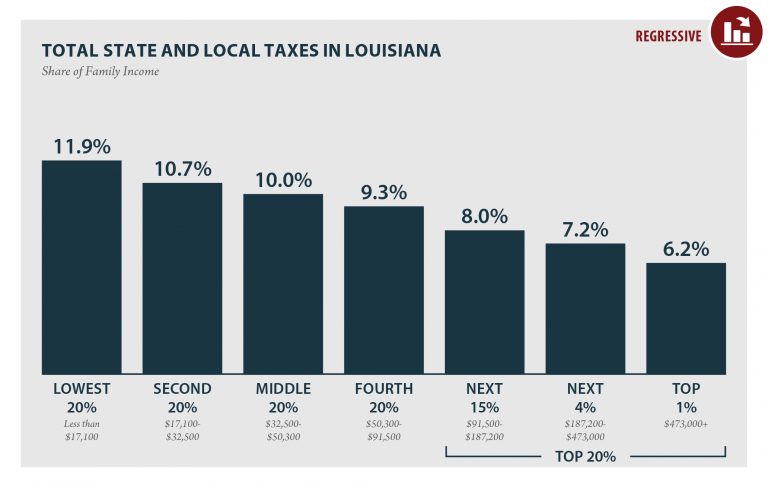
Poor and middle-income families in Louisiana pay state and local taxes at a higher rate than the wealthiest families. That’s the key takeaway from the latest state-by-state breakdown of tax distribution by income groups from the Institute on Taxation and Economic Policy (ITEP). Louisiana’s tax structure is the 14th most regressive in the nation.
Comments to be delivered during IRS hearing on “Contributions in Exchange for State or Local Tax Credits” (REG-112176-18)
• By Carl Davis
ITEP views this proposal as a sensible improvement, and one that is actually overdue, to the way the charitable deduction is administered. At the end of my remarks I will discuss a few ways that the regulation could be improved. But the core point I want to emphasize is that the general approach taken here, where quid pro quo rules are applied in a broad-based fashion to all significant state and local tax credits, is…
The New Orleans Advocate: James Gill: Louisiana’s Tax System Isn’t the Most Unfair in the Nation, But It’s not for Lack of Trying
November 3, 2018
According to a study just released by the Institute on Taxation and Economic Policy in Washington, Washington State sets the regressive standard, while we rank 14th. If your income is $17,100 or less in Louisiana, you'll pay 11.9 percent of it in taxes. That number shrinks the further you go up on the income scale and is roughly halved by the time you reach fat-cat territory. Sales and excise taxes take 9.2 percent from the…
State Rundown 10/31: Trick or Treat Advice to Savor for Tonight
• By ITEP Staff
Look out for potholes if you’re out trick-or-treating in Alabama tonight, where crumbling infrastructure figures to be a dominant debate in the coming legislative session. And be prepared to share the streets with disgruntled teachers if you‘re in Louisiana, where teachers are walking out to protest regressive tax policies that are sucking the lifeblood from the state’s schools. Meanwhile, Wisconsin residents are sharing scary stories of grotesquely large business tax subsidies and the “dark store” tax loophole they’ll be voting on next week. And…
Louisiana Budget Project: Louisiana’s Tax Code is Still Regressive
• By ITEP Staff
The wealthiest households in Louisiana continue to pay state and local taxes at a lower rate than those in the middle class and below, according to a new analysis that breaks down the tax rates by income brackets in every state. The report, Who Pays? A Distributional Analysis of the Tax Systems in All 50 States found that households with incomes in the lowest 20 percent pay nearly twice as much of their income in…
Louisiana Budget Project: Who Pays Taxes in Louisiana?
• By ITEP Staff
When it comes to paying for government services, Louisiana asks a lot more of those with the fewest resources than it does of its wealthiest citizens, according to new analysis by the Institute on Taxation and Economic Policy. Thanks to a heavy reliance on sales taxes and tax exemptions that favor the wealthy, the less you earn in Louisiana, the more of you pay in taxes as a percentage of income.
Louisiana Budget Project: Analysis: Louisiana’s Regressive Tax Structure Disproportionately Affects Low-income Residents
• By ITEP Staff
A new study released Wednesday by the Institute on Taxation and Economic Policy and the Louisiana Budget Project finds that Louisiana has the 14th most unfair state and local tax system in the country, with the lowest-income Louisianans paying almost two times more in taxes as a percent of their income compared to the state’s wealthiest residents.
Louisiana: Who Pays? 6th Edition
• By ITEP Staff
LOUISIANA Read as PDF LOUISIANA STATE AND LOCAL TAXES Taxes as Share of Family Income Top 20% Income Group Lowest 20% Second 20% Middle 20% Fourth 20% Next 15% Next 4% Top 1% Income Range Less than $17,100 $17,100 to $32,500 $32,500 to $50,300 $50,300 to $91,500 $91,500 to $187,200 $187,200 to $473,000 over $473,000 […]

Louisiana Budget Project: Federal Tax Cut Worsening Racial Wealth Divide
• By ITEP Staff
While President Trump and Republicans in Congress heralded the Tax Cut and Jobs Act of 2017 as a major tax cut for the middle class, the numbers don’t bear that out. A new analysis by researchers at Prosperity Now and the Institute on Taxation and Economic Policy reveals just how much of the federal tax cut benefits went to the highest income earners, and the crumbs that were left over for low and middle-class households.
State Rundown 10/12: Local Jurisdictions Fighting for Revenues, Independence
• By ITEP Staff
Voters all around the country are educating themselves for the upcoming elections, notably this week around ballot initiatives in Arizona and Colorado and competing gubernatorial tax proposals in Georgia and Illinois. But not all eyes are on the elections, as the relationship between state and local policy made news in Delaware, Idaho, North Dakota, and Ohio.
ITEP Comments and Recommendations on Proposed Section 170 Regulation (REG-112176-18)
• By Carl Davis
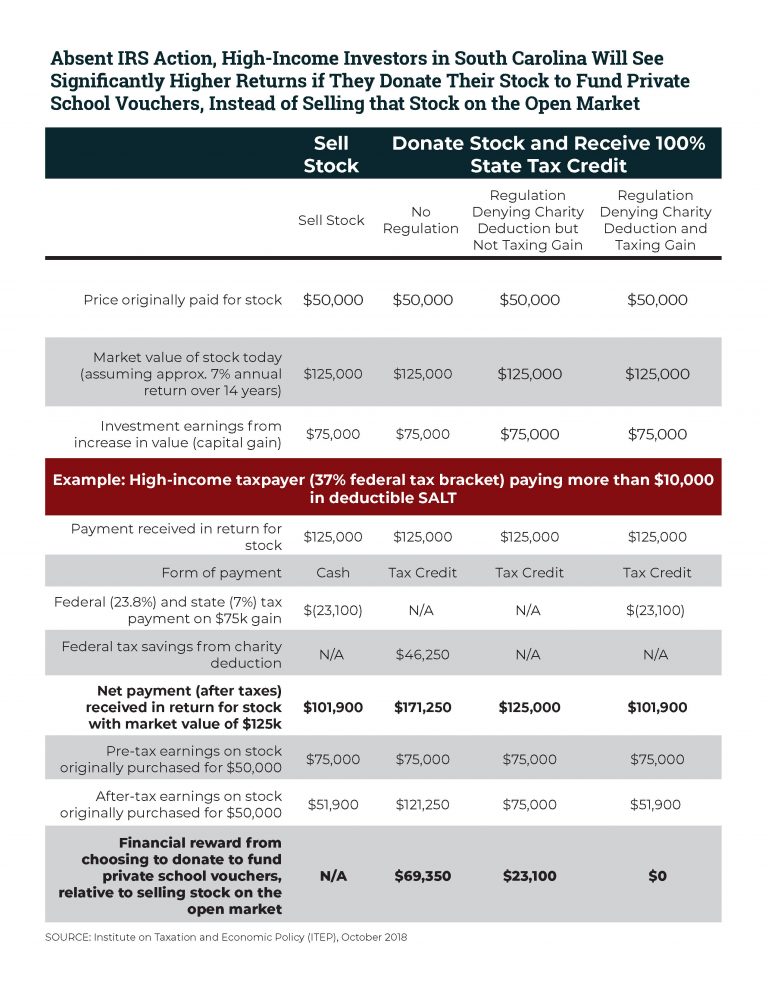
The IRS recently proposed a commonsense improvement to the federal charitable deduction. If finalized, the regulation would prevent not just the newest workarounds to the $10,000 deduction for state and local taxes (SALT), but also a longer-running tax shelter abused by wealthy donors to private K-12 school voucher programs. ITEP has submitted official comments outlining four key recommendations related to the proposed regulation.

Institute on Taxation
and Economic Policy
ITEP is a non-profit, non-partisan tax policy organization. We conduct rigorous analyses of tax and economic proposals and provide data-driven recommendations to shape equitable and sustainable tax systems.
Subscribe to ITEP Emails
Tax research and policy news in your inbox.
Promote Fair Tax Policy
Your gift to ITEP promotes tax justice. With your help, we do research that supports taxing millionaires and billionaires, taxing big corporations and raising revenue for the things our people, our communities and our planet need.
Together, we can create a country with more economic justice, more racial justice, more climate justice… and more tax justice.