
Massachusetts
Five Things to Know About Tax Foundation’s Critique of Maryland’s Worldwide Combined Reporting Proposal
• By Carl Davis, Matthew Gardner
Maryland lawmakers are considering enacting worldwide combined reporting (WWCR), also known as complete reporting. This policy offers a more accurate, and less gameable, way to calculate the amount of profit subject to state corporate tax. Enacting WWCR in Maryland would represent a huge step toward eliminating state corporate tax avoidance as it neutralizes a wide […]
Our Taxes Can Set Kids Up for Success
• By Brakeyshia Samms
Every child deserves the opportunity to succeed in society – and tax policy has a huge role to play in making that happen. Better tax policy can help prepare our young children with skills to become successful and thriving adults.
States Move to Tax the Top in 2024
• By Marco Guzman, Miles Trinidad
These forward-thinking states are demonstrating the wide variety of options for policymakers who want to raise more from the wealthiest people, rein in corporate tax avoidance, create fair tax codes and build strong communities.
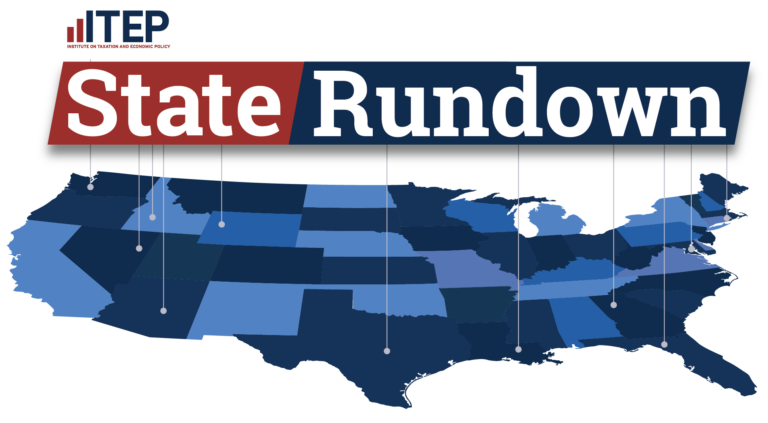
State Rundown 3/14: Sessions are Heating Up
• By ITEP Staff
Many state legislative sessions are in the final stretch...
ITEP’s Marco Guzman Testifies in Favor of Tax Fairness Bills in Connecticut
• By Marco Guzman
Good afternoon, Senator Fonfara, Representative Horn, and members of the Committee, and thank you for this opportunity to testify. My name is Marco Guzman and I'm a senior policy analyst with the Institute on Taxation and Economic Policy, or ITEP, and we’re a nonprofit research organization that focuses on state, local, and federal tax policy issues.
State Rundown 3/6: Tax Cuts Aren’t Forever, or for Evers
• By ITEP Staff
Anti-tax interests finally found the end of the tax cutting appetite in a few states this week...
ITEP’s Kamolika Das Testifies on Pennsylvania’s Upside-Down Tax Code
• By Kamolika Das
Below is written testimony delivered by ITEP Local Policy Director Kamolika Das before the Pennsylvania House Finance Subcommittee on Tax Modernization & Reform on March 1, 2024. Good afternoon and thank you for this opportunity to testify. My name is Kamolika Das, I live in South Philly, and I’m the Local Tax Policy Director at […]
Moving the Needle Toward Tax Fairness in the States
• By Jon Whiten
While many state lawmakers have spent the past few years debating deep and damaging tax cuts that disproportionately help the rich, more forward-thinking lawmakers have improved tax equity by raising new revenue from the well-off and creating or expanding refundable tax credits for low- and moderate-income families.
Massachusetts Budget & Policy Center: Ending the Tax Penalty Against Working Immigrants
• By ITEP Staff
In recent years, lawmakers have enacted some important legislation helping Massachusetts residents, regardless of their immigration status, to take full part in commerce and civic life. Laws providing access to drivers’ licenses and in-state tuition, for instance, have opened opportunities that support employment and advance economic growth. Yet tens of thousands of workers, and their families, who pay taxes in Massachusetts are prevented from receiving the Earned Income Tax Credit (EITC) because they are ineligible…
State Rundown 2/28: States Keep Busy While Washington Stalls
• By ITEP Staff
State legislative sessions are in full swing with New Jersey and Oklahoma both particularly active this week...
The ‘Low-Tax’ Lie: States Hyped for Low Taxes Usually Only Low-Tax for the Rich
• By Jon Whiten
It’s hard to go a week without seeing a politician or a news article hype up a state as the place that everyone is moving to – or should move to – because of low taxes. However, there’s a big problem with these proclamations: they aren’t true.
IRS Commissioner, New GAO Report Highlight Importance of Proper IRS Funding
• By Joe Hughes
A new GAO report and Commissioner Werfel’s testimony highlight the value and necessity of a well-funded and functioning IRS. Most families and businesses do their best to pay taxes accurately and on time. The nation benefits from a modern revenue agency that can make this process as easy and simple as possible and identify complex tax schemes that deprive the country of revenues.
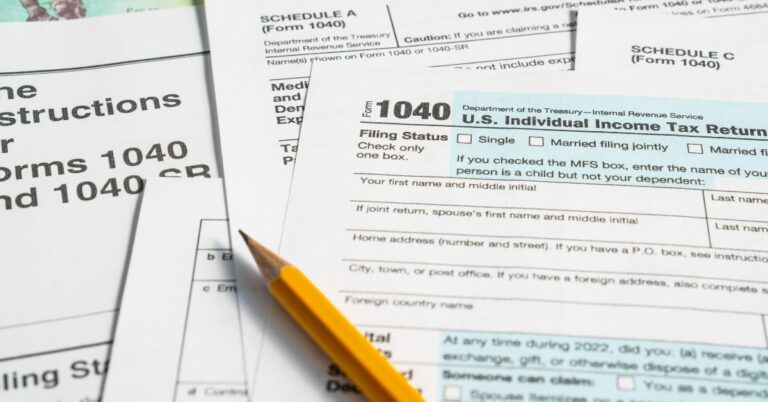
Three Things to Know This Tax Filing Season
• By Joe Hughes
The IRS Direct File pilot is currently open to eligible taxpayers here. Millions of American families have now received their W-2s for 2023, signaling the start to a new tax filing season. The IRS has set January 29 as the first date that people can file their tax returns for the previous year, and the […]
State Rundown 1/26: Wealth Taxes Drawing Interest Early in Legislative Sessions
• By ITEP Staff
Bills are moving and state legislative sessions are picking up across the country, giving elected officials the opportunity to consider two distinct paths when it comes to tax policy...
State Tax Watch 2024
• By ITEP Staff
Updated July 15, 2024 In 2024, state lawmakers have a choice: advance tax policy that improves equity and helps communities thrive, or push tax policies that disproportionately benefit the wealthy, drain funding for critical public services, and make it harder for low-income and working families to get ahead. Despite worsening state fiscal conditions, we expect […]

How the Fairness of State Tax Codes Affects Public Education
• By Carl Davis
The findings of Who Pays? go a long way toward explaining why so many states are failing to raise the amount of revenue needed to provide full and robust support for our public schools.
Massachusetts Budget & Policy Center: How Much Does the Millionaire Tax Improve Tax Fairness? How Does Massachusetts Compare Now to Other States?
• By ITEP Staff
A new 50-state analysis from the Institute on Taxation and Economic Policy (ITEP) finds that Massachusetts’ recently adopted millionaire tax makes Massachusetts’ state and local tax system much more equitable. Even under current law, however, those with incomes over $1 million still will pay a smaller share of their income in state and local taxes […]
In Most States, the Tax Code Makes Inequality Worse
• By Carl Davis
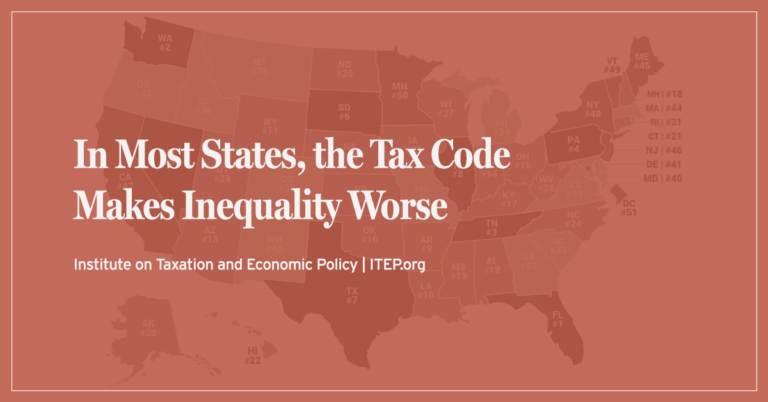
The vast majority of state and local tax systems are upside-down, with the wealthy paying a far lesser share of their income in taxes than low- and middle-income families. Yet a few states have made strides to buck that trend and have tax codes that are somewhat progressive and therefore do not worsen inequality.
Tax Systems in 44 States Exacerbate Inequality, In-Depth ‘Who Pays?’ Study Finds
• By ITEP Staff
The vast majority of state and local tax systems are upside-down, with the wealthy paying a far lesser share of their income in taxes than low- and middle-income families. That’s according to the latest edition of the Institute on Taxation and Economic Policy’s Who Pays?, the only distributional analysis of tax systems in all 50 states and the District of Columbia.
Massachusetts: Who Pays? 7th Edition
• By ITEP Staff
Massachusetts Download PDF All figures and charts show 2024 tax law in Massachusetts, presented at 2023 income levels. Senior taxpayers are excluded for reasons detailed in the methodology. Our analysis includes nearly all (99.8 percent) state and local tax revenue collected in Massachusetts. As seen in Appendix D, recent tax policy changes have significantly lessened […]
Hidden in Plain Sight: Race and Tax Policy in 2023 State Legislative Sessions
• By Brakeyshia Samms
Race was front and center in a lot of state policy debates this year, from battles over what’s being taught in schools to disagreements over new voting laws. Less visible, but also extremely important, were the racial implications of tax policy changes. What states accomplished this year – both good and bad – will acutely affect people and families of color.

Abortion-Restricting States Skimp on Funding for Children
• By Amy Hanauer
States differ dramatically in how much they allow families to make choices about whether and when to have children and how much support they provide when families do. But there is a clear pattern: the states that compel childbirth spend less to help children once they are born.
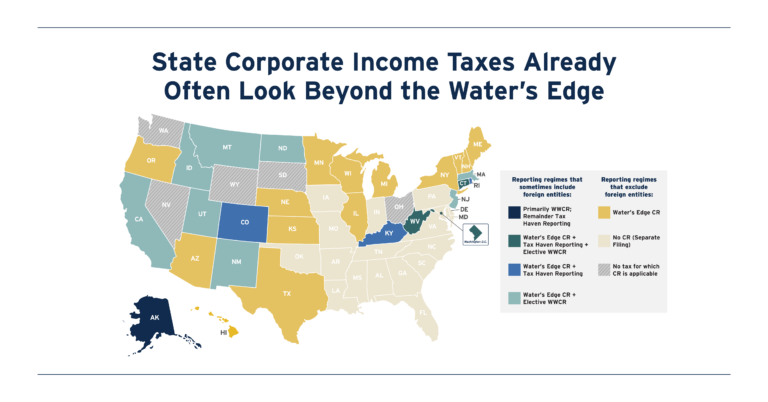
Far From Radical: State Corporate Income Taxes Already Often Look Beyond the Water’s Edge
• By Carl Davis, Matthew Gardner
State lawmakers are increasingly interested in reforming their corporate tax bases to start from a comprehensive measure of worldwide profit. This provides a more accurate, and less gameable, starting point for calculating profits subject to state corporate tax. Mandating this kind of filing system, known as worldwide combined reporting (WWCR), would be transformative, as it would all but eliminate state corporate tax avoidance done through the artificial shifting of profits into low-tax countries.
Free Tax Filing Option from the IRS Would Benefit People of Color, Contrary to Corporate Warnings
• By Brakeyshia Samms
There's a patchwork of programs and preparers for people of color to turn to when filing taxes, and most come from corporations that profit from providing a service that the government could provide more effectively and efficiently for free. The Direct File program can change that and is a great step forward in the IRS’ work addressing racism in the tax code.
State Rundown 10/26: Off-Year Ballot Measures and State & Local Tax Policy
• By ITEP Staff
November elections are creeping closer and closer and while that typically means a new batch of lawmakers are elected, it also means voters have another chance to help shape state and local tax policy...

Institute on Taxation
and Economic Policy
ITEP is a non-profit, non-partisan tax policy organization. We conduct rigorous analyses of tax and economic proposals and provide data-driven recommendations to shape equitable and sustainable tax systems.
Subscribe to ITEP Emails
Tax research and policy news in your inbox.
Promote Fair Tax Policy
Your gift to ITEP promotes tax justice. With your help, we do research that supports taxing millionaires and billionaires, taxing big corporations and raising revenue for the things our people, our communities and our planet need.
Together, we can create a country with more economic justice, more racial justice, more climate justice… and more tax justice.