
Texas
Explaining our Analysis of Washington State’s Highly Regressive Tax Code
June 22, 2017 • By Carl Davis
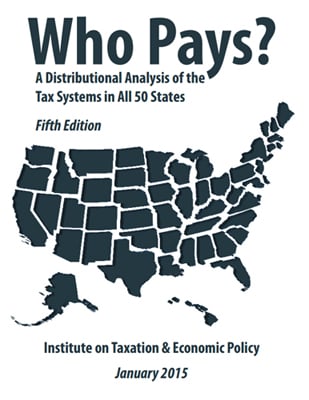
Supporters of creating a local personal income tax in Seattle are rightly concerned about the lopsided nature of their state’s tax code. In a 50-state study titled Who Pays?, produced using our microsimulation tax model, we found that Washington State’s tax system is the most regressive in the nation.
This week, we celebrate a victory in Kansas where lawmakers rolled back Brownback's tax cuts for the richest taxpayers. Governors in West Virginia and Alaska promote compromise tax plans. Texas heads into special session and Vermont faces another budget veto, while Louisiana and New Mexico are on the verge of wrapping up. Voters in Massachusetts may soon be able to weigh in on a millionaire's tax, the California Senate passed single-payer health care, and more!
State Rundown 5/3: Lawmakers See Value in State EITCs, Danger in Tax Cut Triggers
May 3, 2017 • By ITEP Staff
This week, Kansas lawmakers found that they’ll have to roll back Gov. Brownback’s tax cuts and then some to adequately fund state needs. Nebraska legislators took notice of their southern neighbors’ predicament and rejected a major tax cut. Both Hawaii and Montana‘s legislatures sent new state EITCs to their governors, and West Virginia began an […]
3 Percent and Dropping: State Corporate Tax Avoidance in the Fortune 500, 2008 to 2015
April 27, 2017 • By Aidan Davis, Matthew Gardner, Richard Phillips
The trend is clear: states are experiencing a rapid decline in state corporate income tax revenue. Despite rebounding and even booming bottom lines for many corporations, this downward trend has become increasingly apparent in recent years. Since our last analysis of these data, in 2014, the state effective corporate tax rate paid by profitable Fortune 500 corporations has declined, dropping from 3.1 percent to 2.9 percent of their U.S. profits. A number of factors are driving this decline, including: a race to the bottom by states providing significant “incentives” for specific companies to relocate or stay put; blatant manipulation of…
State Rundown 4/27: States Finally Reaching Resolution on Gas Taxes
April 27, 2017 • By ITEP Staff
This week, transportation funding debates finally concluded with gas tax updates in Indiana, Montana, and Tennessee, and appear to be nearing an end in South Carolina. Meanwhile, Louisiana and Oregon lawmakers debated new Gross Receipts Taxes, and Texas legislators considered eliminating the state’s franchise tax. — Meg Wiehe, ITEP Deputy Director, @megwiehe Louisiana Gov. Bel Edward’s Commercial Activities Tax (CAT) was pulled from committee early this week without a vote due to opposition, […]
Tax Justice Digest: Trickle-down revived, corps aren’t paying state taxes, young immigrants and taxes, etc.
April 27, 2017 • By ITEP Staff
In the Tax Justice Digest we recap the latest reports, blog posts, and analyses from Citizens for Tax Justice and the Institute on Taxation and Economic Policy. Here’s a rundown of what we’ve been working on lately. Here we go again The Trump Administration on Wednesday released a tax sketch that is a roadmap for […]
Charleston Gazette-Mail: Cutting WV Income Tax Likely to Backfire
April 11, 2017
There are nine states with no income tax: Alaska, Florida, Nevada, South Dakota, Texas, Washington, Wyoming, New Hampshire and Tennessee. Only Texas has seen job growth — as a result of being the center of the oil industry. The others have not; job growth has trailed population growth in the other eight. This is based […]
Testimony before the Alaska House Labor & Commerce Committee On House Bill 36
April 4, 2017 • By Matthew Gardner
Thank you for the opportunity to testify on the changes House Bill 36 would make to Alaska's tax treatment of pass-through income. The taxation of pass-through business entities has been a focal point of state and federal tax reform debates for over a quarter century, with a dual focus on minimizing the role of tax laws in determining the choice of business entity and on ensuring that the income of all business entities is subject to at least a minimal tax. My testimony makes two main points: 1. Alaska is one of a small number of states that do not…
What to Watch in the States: State Earned Income Tax Credits (EITC) on the Move
March 24, 2017 • By Misha Hill
While every state’s tax system is regressive, meaning lower income people pay a higher tax rate than the rich, some states aim to improve tax fairness through a state Earned Income Tax Credit (EITC). Federal lawmakers established the in 1975 to bolster the earnings of low-wage workers, especially workers with children and offset some of […]
This week in state tax news saw major changes debated in Hawaii and West Virginia and proposed in North Carolina, a harmful flat tax proposal in Georgia, new ideas for ignoring revenue shortfalls in Mississippi and Nebraska, an unexpected corporate tax proposal from the governor of Louisiana, gas tax bills advance in South Carolina and […]
Dallas News: For Trump loyalist and the neighbors she hates, immigration policy more than politics
March 22, 2017
Nationwide, undocumented immigrants pay about $11.7 billion a year in state and local income, sales and property taxes, including about $1.5 billion in Texas, according to the nonpartisan Institute on Taxation and Economic Policy. And more than 4 million people who do not have Social Security numbers – most of them undocumented immigrants – file […]
A growing number of Americans are getting rides or booking short-term accommodations through online platforms such as Uber and Airbnb. This is nothing new in concept; brokers have operated for hundreds of years as go-betweens for producers and consumers. The ease with which this can be done through the Internet, however, has led to millions of people using these services, and to some of the nation's fastest-growing, high-profile businesses. The rise of this on-demand sector, sometimes referred to as the "gig economy" or, by its promoters, the "sharing economy," has raised a host of questions. For state and local governments,…
The Guardian: Fixing America’s failing infrastructure won’t be easy, despite Trump’s pledge
March 8, 2017
But a recent report by the Texas A&M Transportation Institute analyzing transportation in 471 urban areas showed that although vehicle miles had increased, fuel consumption had not risen above its pre-recession level by 2014, meaning fewer dollars had flowed into highway coffers. Read more
Daily Bulletin: Undocumented immigrants contribute billions in local, state taxes
March 8, 2017
Undocumented residents in the United States pay an estimated $11.74 billion annually in state and local taxes, an amount that would increase significantly if these immigrants were given a pathway to citizenship, according to a new report from the Institute on Taxation and Economic Policy. On average, the nation’s estimated 11 million undocumented residents pay […]
Every state levies taxes on gasoline and diesel fuel, usually just called "gas taxes." These taxes are an important source of state revenue--particularly for transportation--but their poor design has resulted in sluggish revenue growth that fails to keep pace with state infrastructure needs. This ITEP Policy Brief explains how state gas taxes work, their importance as a transportation revenue source, the problems confronting gas taxes, and the types of gas tax reforms that are needed to overcome these problems.
Bloomberg: Texas Prepares to Battle Its Sanctuary Cities
February 8, 2017
The Institute on Taxation and Economic Policy estimates that undocumented immigrants in Texas pay about $1.5 billion in state and local taxes. (Texas has no state income tax, but it has a 6.25 percent state sales and use tax.) Read more
This week’s Rundown brings news of tax cuts passed in Arkansas and advanced in Idaho, proposals to exempt feminine hygiene products from sales taxes in Nevada and Michigan, revenue shortfalls forcing tough choices in Louisiana and Maine, and more governors’ state of the state addresses and budget proposals setting the stage for yet more tax […]
Below is a list of notable resources for information on state taxes and revenues: Alabama Alabama Department of Revenue Alabama Department of Finance – Executive Budget Office Alabama Department of Revenue – Tax Incentives for Industry Alabama Legislative Fiscal Office Alaska Alaska Department of Revenue – Tax Division Alaska Office of Management & Budget Alaska […]
Over the next few weeks we will be blogging about what we’re watching in state tax policy during 2017 legislative sessions. In this “What to Watch in the States” series, we will look at the following: State responses to short- and long-term revenue deficits Boosting funding for infrastructure, though sometimes at the expense of other […]
Fairness Matters: A Chart Book on Who Pays State and Local Taxes
January 26, 2017 • By Carl Davis, Meg Wiehe
When states shy away from personal income taxes in favor of higher sales and excise taxes, high-income taxpayers benefit at the expense of low- and moderate-income families who often face above-average tax rates to pick up the slack. This chart book demonstrates this basic reality by examining the distribution of taxes in states that have pursued these types of policies. Given the detrimental impact that regressive tax policies have on economic opportunity, income inequality, revenue adequacy, and long-run revenue sustainability, tax reform proponents should look to the least regressive, rather than most regressive, states in crafting their proposals.
This week brings more news of states facing budget crunches, a new state looking to eliminate income taxes, and plans to raise gas taxes to fund transportation projects. Be sure to check out the What We’re Reading section for a look at how repealing federal health reform could add to those crunches and a review […]
Austin American-Statesman: Wood: The flaws in Trump’s mass deportation plan
November 28, 2016
“Opponents of undocumented immigrants often assume that these workers don’t contribute to the economy and leech off public services; this simply isn’t true. Many of these people work and contribute to the economy. Research from the Institute on Taxation and Economic Policy indicates that out of the $11.64 billion in taxes paid by undocumented workers […]
mySA: Immigrants bring immense value
October 18, 2016
“And though there are competing analyses about whether unlawfully present immigrants contribute more to the economy than they cost in education and health expenses, what cannot be denied is that, according to the nonpartisan Institute on Taxation and Economic Policy, illegal immigrants contribute more than $11.6 billion to state and local coffers each year and […]
Politifact: Tom DeLay says most illegal immigrants draw ‘welfare benefits,’ send children to public schools
October 3, 2016
“Tanya Broder, a staff attorney for the National Immigration Law Center, said by phone that ‘undocumented immigrants have the same tax obligations as any other resident.’ Broder emailed a 2015 report by the Institute on Taxation and Economic Policy, a nonpartisan think tank, which drew on its analysis of state tax laws to estimate that […]
Despite this unlevel playing field states create for their poorest residents through existing policies, many state policymakers have proposed (and in some cases enacted) tax increases on the poor under the guise of "tax reform," often to finance tax cuts for their wealthiest residents and profitable corporations.

Institute on Taxation
and Economic Policy
ITEP is a non-profit, non-partisan tax policy organization. We conduct rigorous analyses of tax and economic proposals and provide data-driven recommendations to shape equitable and sustainable tax systems.
Subscribe to ITEP Emails
Tax research and policy news in your inbox.
Promote Fair Tax Policy
Your gift to ITEP promotes tax justice. With your help, we do research that supports taxing millionaires and billionaires, taxing big corporations and raising revenue for the things our people, our communities and our planet need.
Together, we can create a country with more economic justice, more racial justice, more climate justice… and more tax justice.