
Tax Analyses
90 posts
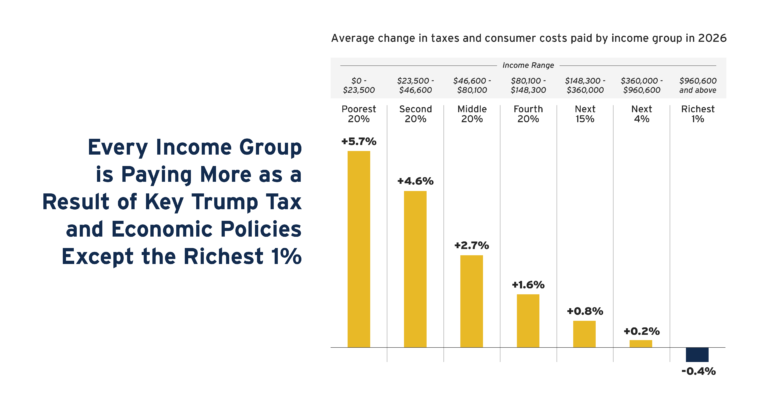
Impact of Key Trump Policies on Taxes and Costs: National and State Estimates
• By Steve Wamhoff
The major tax and economic policies of President Trump’s second term have increased taxes and household costs for most Americans except the richest 1%.

The Impact of Proposed New Tax Credit Restrictions for Immigrant Filers: An Updated Analysis of the DACA Recipient Population
• By Carl Davis, Erika Frankel, Emma Sifre
New Treasury Department public regulations would drastically reduce tax credit claims by DACA recipients and their families, among others. We find that 158,000 people in households with at least one DACA recipient will suffer financial harm, and that more than half of the impacted individuals are U.S. citizens.

Five Things to Know About the Trump Administration’s New Effort to Deny Tax Credits to Lawfully Present Immigrants
• By Carl Davis
Today the Trump administration proposed new regulations seeking to drastically reduce the tax credits that certain immigrant tax filers can claim. The affected credits include the Earned Income Tax Credit (EITC), Additional Child Tax Credit, American Opportunity Tax Credit, and the Adoption Tax Credit.

Congress Should Reject Proposed Tax Breaks for Crypto
• By Steve Wamhoff
Crypto provides no clear benefit and instead harms society in several ways. Even if crypto was useful in some way that outweighed the harms it causes, there is no reason to make exceptions that treat it more generously than other types of assets or transactions.
The Impact of Proposed New Tax Credit Restrictions for Immigrant Filers: An Analysis of the DACA Recipient Population
• By Carl Davis, Erika Frankel, Emma Sifre
We find that 337,000 people in households with at least one DACA recipient will suffer financial harm, and that nearly two-thirds (66 percent) of the impacted individuals are U.S. citizens.

The Impact of Proposed New Tax Credit Restrictions for Immigrant Filers: An Analysis of State EITCs
• By Neva Butkus
Immigrants and their families in as many as 30 states are at risk of seeing their state tax credits such as the Earned Income Tax Credit (EITC) and Child Tax Credit (CTC) reduced unless state lawmakers act.

The ‘Black Women Best’ Framework: An Innovative Method for Showing How Inheritance Taxes Affect the Racial Wealth Gap
• By Brakeyshia Samms, Francine Lipman
The approach posits that if policies improve the economic wellbeing of Black women, they will benefit the broader economic health of the rest of the population.

While States Debate New Trump Tax Changes, Equity Must Be at the Core
• By Brakeyshia Samms
States continue to debate whether and how to link their state tax codes to the 2025 federal tax law. This is not just a technical debate.

Analysis of Sen. Chris Van Hollen’s Approach to Tax Policy
• By Steve Wamhoff
Sen. Chris Van Hollen has recently introduced the Working Americans’ Tax Cut Act, which offers a generous middle-class tax cut paid for with a new tax on millionaires.

How Will the Trump Megabill Change Americans’ Taxes in 2026?
• By Steve Wamhoff, Michael Ettlinger, Carl Davis, Jon Whiten
The megabill will raise taxes on the poorest 40 percent of Americans, barely cut them for the middle 20 percent, and cut them tremendously for the wealthiest Americans next year.

There Were Far Cheaper and Fairer Options Than the Trump Megabill
• By Steve Wamhoff, Joe Hughes, Jessica Vela
Congress and the president could have spent less than half that much money on a tax bill that does more for working-class and middle-class households.

Analysis of Tax Provisions in the Trump Megabill as Signed into Law: National and State Level Estimates
• By Steve Wamhoff, Carl Davis, Joe Hughes, Jessica Vela
President Trump has signed into law the tax and spending “megabill” that largely favors the richest taxpayers and provides working-class Americans with relatively small tax cuts that will in many cases be more than offset by Trump's tariffs.

Top 1% to Receive $1 Trillion Tax Cut from Trump Megabill Over the Next Decade
• By Carl Davis
The Trump megabill will give the top 1 percent tax cuts totaling $1.02 trillion over the next decade. For comparison, the bill’s cuts to the Medicaid health care program will total $930 billion over the same period.
Analysis of Tax Provisions in the Senate Reconciliation Bill: National and State Level Estimates
• By Carl Davis, Jessica Vela, Joe Hughes, Steve Wamhoff
Compared to its House counterpart, the Senate bill makes certain tax provisions more generous, including corporate tax breaks that it makes permanent rather than temporary. But the bottom line for both is the same. Both bills give more tax cuts to the richest 1 percent than to the entire bottom 60 percent of Americans, and both bills particularly favor high-income people living in more conservative states.
Analysis of Tax Provisions in the House Reconciliation Bill: National and State Level Estimates
• By Carl Davis, Jessica Vela, Joe Hughes, Steve Wamhoff
The poorest fifth of Americans would receive 1 percent of the House reconciliation bill's net tax cuts in 2026 while the richest fifth of Americans would receive two-thirds of the tax cuts. The richest 5 percent alone would receive a little less than half of the net tax cuts that year.

The House Tax Plan, By the Numbers
• By Carl Davis
The House of Representatives unveiled a sprawling piece of tax legislation earlier this week that would extend temporary tax changes enacted in 2017 and layer various kinds of tax cuts and increases on top. The JCT analysis makes clear that the House tax plan would be regressive, meaning it would offer larger tax cuts as a share of income to high-income taxpayers than to either middle-class or working-class families. It also makes clear that most…

The Impact of Trump’s Tariffs
• By ITEP Staff
The tariffs proposed by Donald Trump, which are far larger than any on the books today, would significantly raise the prices faced by American consumers across the income scale.

Different Approaches to the Trump Tax Law’s Cap on Deductions for State and Local Taxes (SALT)
• By Steve Wamhoff
President Trump and the Republican majorities in the House and Senate may not extend the $10,000 cap on federal income tax deductions for state and local taxes (SALT), the one part of the 2017 law that significantly limits tax breaks for the rich. And, depending on which proposal they settle on, leaving out the existing cap on SALT deductions could add between $10 billion and over $100 billion each year to the total cost of…
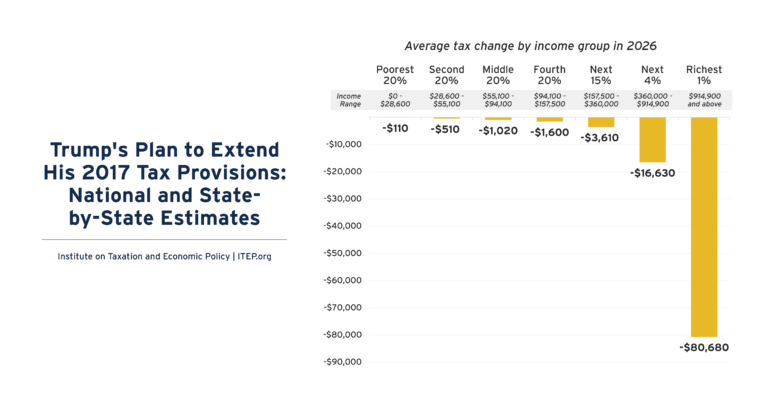
Trump’s Plan to Extend His 2017 Tax Provisions: Updated National and State-by-State Estimates
• By Steve Wamhoff
Trump’s plan to make most of the temporary provisions of his 2017 tax law permanent would disproportionately benefit the richest Americans. This includes all major provisions except the $10,000 cap on deductions for state and local taxes (SALT) paid.
How Would the Harris and Trump Tax Plans Affect Different Income Groups?
• By Jon Whiten
Presidential candidates Kamala Harris and Donald Trump have put forward a wide range of different tax proposals during this year’s campaign. We have now fully analyzed the distributional impacts of the major proposals of both Vice President Harris and former President Trump in separate analyses. In all, the tax proposals announced by Harris would, on average, lead to a tax cut for all income groups except the richest 1 percent of Americans, while the proposals…

A Distributional Analysis of Kamala Harris’ Tax Plan
• By Steve Wamhoff
The tax proposals from Vice President Kamala Harris would, on average, lead to a tax increase for the richest 1 percent of Americans and a tax cut for all other income groups.

A Distributional Analysis of Donald Trump’s Tax Plan
• By Carl Davis, Erika Frankel, Galen Hendricks, Joe Hughes, Matthew Gardner, Michael Ettlinger, Steve Wamhoff
Former President Donald Trump has proposed a wide variety of tax policy changes. Taken together, these proposals would, on average, lead to a tax cut for the richest 5 percent of Americans and a tax increase for all other income groups.

Extending Temporary Provisions of the 2017 Trump Tax Law: Updated National and State-by-State Estimates
• By Steve Wamhoff
The TCJA Permanency Act would make permanent the provisions of the Tax Cuts and Jobs Act of 2017 that are set to expire at the end of 2025. The legislation would disproportionately benefit the richest Americans. Below are graphics for each state that show the effects of making TCJA permanent across income groups. See ITEP’s […]
Voucher Boondoggle: House Advances Plan to Give the Wealthy $1.20 for Every $1 They Steer to Private K-12 Schools
• By Carl Davis
The U.S. House Ways & Means Committee has advanced a new school voucher bill. H.R. 9462—the Educational Choice for Children Act of 2024—would create an unprecedented tax incentive designed to fund private, mostly religious, K-12 schools.
House SALT Proposal is Expensive, Unneeded, and Poorly Designed
• By Joe Hughes
The SALT Marriage Penalty Elimination Act passed by the House Rules Committee on February 1 is costly, decreasing tax revenue by about $8 billion in 2023. It also mostly only helps taxpayers who are already well off.
ITEP staff uses the ITEP Microsimulation model to produce quantitative analyses of current and proposed federal tax policies, creating distributional analyses (analyzing the effect on taxpayers according to their income group), producing revenue estimates (how much a tax policy would affect annual federal revenue collection), and even breaking down the impact of federal policies on each of the 50 states and the District of Columbia.

Institute on Taxation
and Economic Policy
ITEP is a non-profit, non-partisan tax policy organization. We conduct rigorous analyses of tax and economic proposals and provide data-driven recommendations to shape equitable and sustainable tax systems.
Subscribe to ITEP Emails
Tax research and policy news in your inbox.
Promote Fair Tax Policy
Your gift to ITEP promotes tax justice. With your help, we do research that supports taxing millionaires and billionaires, taxing big corporations and raising revenue for the things our people, our communities and our planet need.
Together, we can create a country with more economic justice, more racial justice, more climate justice… and more tax justice.