
Tax Analyses
Senator Collins Pushes Hard for a Property Tax Deduction that Very Few of Her Constituents Will Be Able to Claim
December 1, 2017 • By Carl Davis
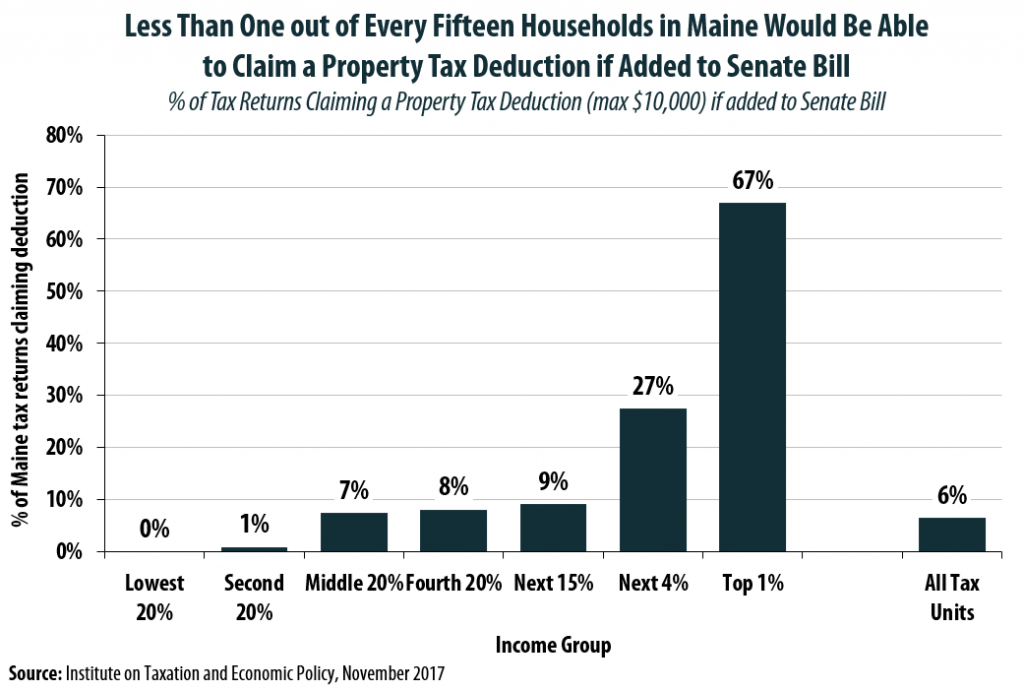
Adding a property tax deduction back into the Senate bill may sound like a compromise, but a new analysis performed using the ITEP Microsimulation Tax Model reveals that the amount of state and local taxes deducted by Maine residents would plummet by 90 percent under this change, from $2.58 billion to just $262 million in 2019. In short, this change is much more symbolic than substantive.
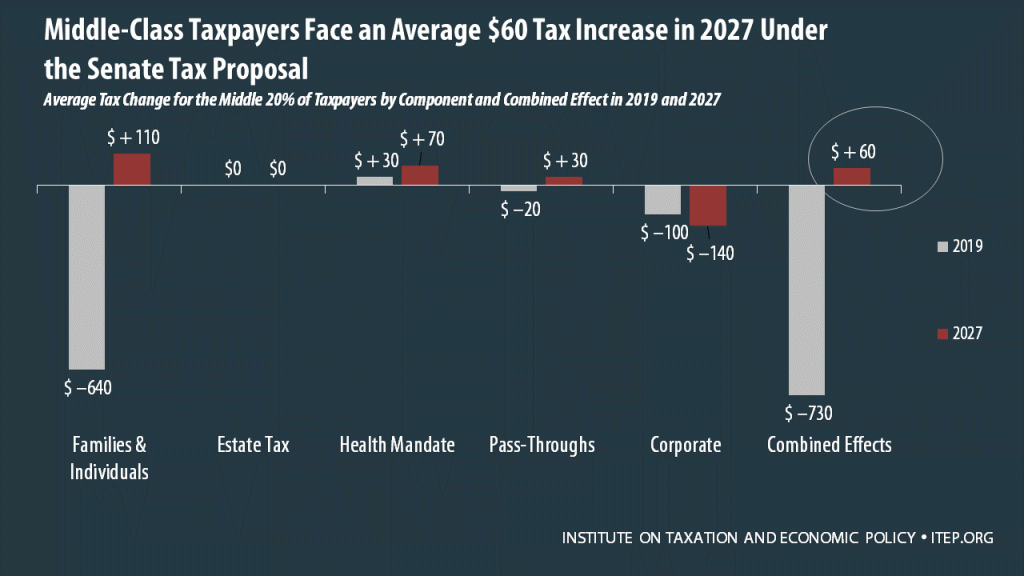
A recent ITEP study concluded that the tax bill before the Senate would raise taxes on at least 29 percent of Americans and cause the populations of 19 states to pay more in federal taxes in 2027 than they do today, while providing foreign investors with more benefits than American households. This report delves deeper by breaking out impacts of different components of the Senate tax plan on U.S. taxpayers in 2019 and 2027. This approach leads to several conclusions.
Benefits of GOP-Trump Framework Tilted Toward the Richest Taxpayers in Each State
October 4, 2017 • By Steve Wamhoff
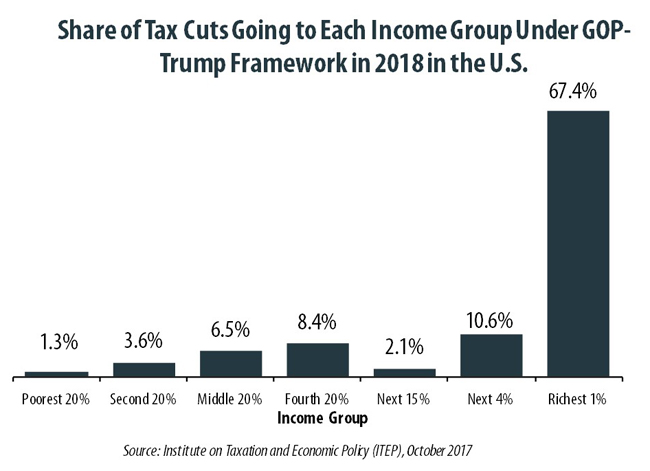
The “tax reform framework” released by the Trump administration and Congressional Republican leaders on September 27 would affect states differently, but every state would see its richest residents grow richer if it is enacted. In all but a handful of states, at least half of the tax cuts would flow to the richest one percent of residents if the framework took effect.
Nearly Half of Trump’s Proposed Tax Cuts Go to People Making More than $1 Million Annually
August 17, 2017 • By ITEP Staff
A tiny fraction of the U.S. population (one-half of one percent) earns more than $1 million annually. But in 2018 this elite group would receive 48.8 percent of the tax cuts proposed by the Trump administration. A much larger group, 44.6 percent of Americans, earn less than $45,000, but would receive just 4.4 percent of the tax cuts.
Trump Touts Tax Cuts for the Wealthy as a Plan for Working People
July 26, 2017 • By Steve Wamhoff

Unless the administration takes a radically different direction on tax reform from what it has already proposed, its tax plan would be a monumental giveaway to the top 1 percent. The wealthiest one percent of households would receive 61 percent of all the Trump tax breaks, and would receive an average of $145,400 in 2018 alone.
Trump’s $4.8 Trillion Tax Proposals Would Not Benefit All States or Taxpayers Equally
July 20, 2017 • By Matthew Gardner, Steve Wamhoff
The broadly outlined tax proposals released by the Trump administration would not benefit all taxpayers equally and they would not benefit all states equally either. Several states would receive a share of the total resulting tax cuts that is less than their share of the U.S. population. Of the dozen states receiving the least by this measure, seven are in the South. The others are New Mexico, Oregon, Maine, Idaho and Hawaii.

All Americans pay taxes. Most of us pay federal and state income taxes. Everyone who works pays federal payroll taxes. Everyone who buys gasoline pays federal and state gas taxes. Everyone who owns or rents a home directly or indirectly pays property taxes. Anyone who shops pays sales taxes in most states.
A new Institute on Taxation and Economic Policy analysis of tax provisions in the American Health Care Act provides a 50-state breakdown of how taxpayers would be affected by the Republican plan to repeal the net investment tax and additional Medicare tax, each of which apply only to the best-off Americans. Repealing these taxes would, […]
GOP Healthcare Bill Cuts Insurance Coverage for Millions to Pay for Tax Cuts for the Wealthy; ITEP State-By-State Estimates
March 22, 2017 • By Richard Phillips
The House GOP’s American Health Care Act is being pushed quickly through the legislative process, with a vote on the House floor scheduled for as early as Thursday. The Republican legislation seeks to pay for the cost of repealing highly progressive taxes enacted as part of the Affordable Care Act by making substantial cuts to […]
Affordable Care Act Repeal Includes a $31 Billion Tax Cut for a Handful of the Wealthiest Taxpayers: 50-State Breakdown
March 17, 2017 • By Matthew Gardner
Congressional Republicans have proposed legislation that would repeal the Affordable Care Act (ACA), including rolling back a number of tax changes that were enacted to pay for the ACA's health care expansions. Among these tax changes are two targeted income tax increases that took effect in 2013, each of which apply only to a small number of the wealthiest Americans: the net investment tax and additional Medicare tax. Repealing these two taxes would cost over $31 billion a year if implemented in tax year 2016, and 85 percent of the benefit from repealing these taxes would go to the best…
Ryan Tax Plan Reserves Most Tax Cuts for Top 1 percent, Costs $4 Trillion Over 10 Years
June 29, 2016 • By ITEP Staff
A new distributional analysis of Republican Speaker of the House Paul Ryan’s “A Better Way” policies finds that the plan would: • Add $4 trillion to the national debt over a decade. • Overwhelmingly benefit the top 1 percent of tax payers while resulting in a net loss for the bottom 95 percent of taxpayers. • Slash corporate […]

In recent months, the Tax Foundation has used its Taxes and Growth Model (TAG Model) to estimate the impact that a variety of tax policy changes would have on the nation's economy--including tax plans proposed by current presidential candidates. The Tax Foundation describes the underlying "logic" of its TAG Model as being rooted in the assumption that "taxes have a major impact on economic growth." More specifically, the TAG Model has concluded that proposals to lower taxes for high-income individuals and businesses would dramatically grow the economy, and that proposals to raise taxes would significantly slow economic growth.
The Camp Tax Plan Is a Regressive $1.7 Trillion Tax Cut
April 7, 2014 • By ITEP Staff
The Chairman of the House Ways and Means Committee, Dave Camp (R-Mich.), has a tax overhaul plan that would cut the top personal income tax rate down from about 40 percent to 35 percent and slash the corporate tax rate from 35 percent to 25 percent. Camp claims his plan would still break even revenue-wise […]
The Effects of Replacing Most Federal Taxes with a National Sales Tax
September 15, 2004 • By ITEP Staff
Recently, there has been renewed discussion of the possibility of replacing most federal taxes with a national retail sales tax. Such an idea was broached in the 1990s, but political interest waned when it was discovered that it would take a sales-tax rate well in excess of 50 percent to replace existing federal revenues. In […]
ITEP staff uses the ITEP Microsimulation model to produce quantitative analyses of current and proposed federal tax policies, creating distributional analyses (analyzing the effect on taxpayers according to their income group), producing revenue estimates (how much a tax policy would affect annual federal revenue collection), and even breaking down the impact of federal policies on each of the 50 states and the District of Columbia.

Institute on Taxation
and Economic Policy
ITEP is a non-profit, non-partisan tax policy organization. We conduct rigorous analyses of tax and economic proposals and provide data-driven recommendations to shape equitable and sustainable tax systems.
Subscribe to ITEP Emails
Tax research and policy news in your inbox.
Promote Fair Tax Policy
Your gift to ITEP promotes tax justice. With your help, we do research that supports taxing millionaires and billionaires, taxing big corporations and raising revenue for the things our people, our communities and our planet need.
Together, we can create a country with more economic justice, more racial justice, more climate justice… and more tax justice.