
Trump Tax Policies
110 posts

The Trump Tax Law Further Tilted an Already Uneven Playing Field
• By Jessica Schieder
Proponents sold the Tax Cuts and Jobs Act (TCJA) as a way to spur new investment, increase workers’ paychecks, and reverse the off-shoring of jobs. Testimony presented during a House Ways and Means hearing held today reflected on how—more than a year after the law’s passage—each of those pitches ring hollow.
Corporate Profits ?, Corporate Federal Tax Collections ?
• By Matthew Gardner
Data released Friday by the U.S. Treasury Department should give great pause to all who care about the federal government’s ability to raise revenue in a fair, sustainable way. In the wake of the 2017 corporate tax overhaul, corporate tax collections have fallen at a rate never seen during a period of economic growth.

Fact-Checking on Trump Tax Law Needs a Fact Check
• By Carl Davis
The Tax Cuts and Jobs Act (TCJA), enacted by President Trump and Congressional Republicans at the end of 2017, has caused quite a bit of confusion, and a recent “Fact Checker” column by the Washington Post’s Glenn Kessler does not help. TCJA created real problems that can't be resolved without real tax reform. To begin that process fact checkers, lawmakers, and everyone else need to be clear about what TCJA did, and did not, do…

Why We Should Talk about Progressive Taxes Despite Billionaires’ Objections
• By Jenice R. Robinson
It was the tone-deaf remark heard ‘round the world. Last week on CNBC’s Squawk Box, Commerce Secretary Wilbur Ross suggested that furloughed government employees who hadn’t been paid in a month could go to a bank and get a loan to make ends meet. This was not a gaffe. It’s hard to fathom how a […]

Five Things to Know on the One-Year Anniversary of the Tax Cuts and Jobs Act
• By Richard Phillips
While it has only been a year since passage of the Tax Cuts and Jobs Act (TCJA), it’s clear the law largely is both a debacle and a boondoggle. Below are the five takeaways about the legacy and continuing effect of the TCJA. 1. The Tax Cuts and Jobs Act will substantially increase income, wealth, and racial inequality. 2. The Tax Cuts and Jobs Act will continue to substantially increase the deficit. 3. The Tax…

Morgan Stanley Report Confirms Tax Cut Promises Made Are Promises Unkept
• By Matthew Gardner
Almost a year after lawmakers hastily enacted the Tax Cuts and Jobs Act, evidence continues to mount that it is providing far more tax cuts than jobs. A new Morgan Stanley report estimates that U.S. companies repatriated between $50 billion and $100 billion of offshore cash in the third quarter of 2018. This means companies […]
Tax Cuts 2.0 Resources
• By ITEP Staff
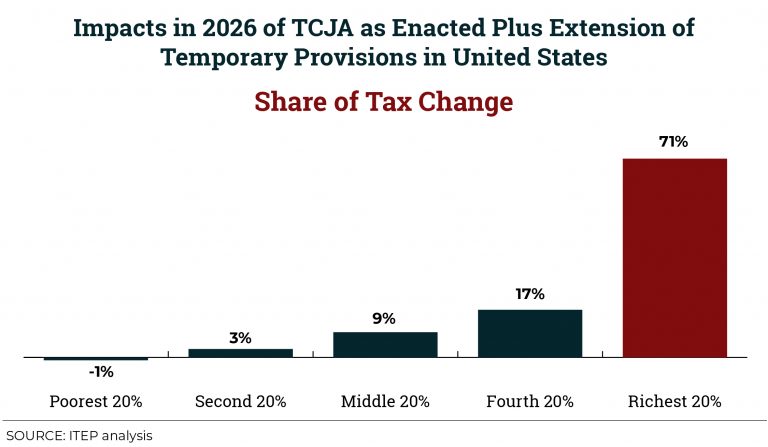
The $2 trillion 2017 Tax Cuts and Jobs Act (TCJA) includes several provisions set to expire at the end of 2025. GOP leaders wrote the bill this way to adhere to their own rule that limits how much a piece of legislation can add to the federal debt. But it’s clear that proponents planned all along to make those provisions permanent. Less than a month after the law passed, the White House and Republican leaders…
65 Percent of Federal Tax Cuts Since 2000 Have Gone to Richest 20 Percent
• By ITEP Staff
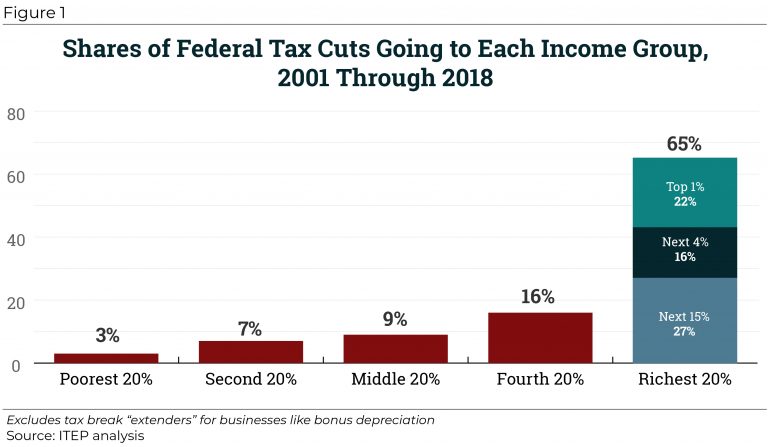
Since 2000, Congress has passed several rounds of tax cuts that have increased the federal deficit by nearly $6 trillion and disproportionately benefited the top 20 percent of households, which received nearly two-thirds (65 percent) of the value of all tax changes.

Why We’re Not Eternally Grateful for $1,000 Crumbs
• By Jenice R. Robinson
Two narratives that intentionally obscure who benefits from the tax law are emerging. One focuses on the personal income tax cuts that will result in an increase in net take-home pay for many employees once their employers adjust withholding. Anecdotes abound of working people getting a $100 or more increase, after taxes, per paycheck, but the reality is that most workers will receive a lot less than that. Meanwhile, the wealthiest 1 percent of households…

They Can’t Help Themselves: GOP Leaders Reveal True Intent Behind Tax Overhaul
• By Jenice R. Robinson
The hand-written scrawls in the margins of the hastily written 500-page Senate tax bill had barely dried when lawmakers began to reveal the true motivation behind their rush to fundamentally overhaul the nation’s tax code.
ITEP research is pivotal in explaining the effect of the 2017 Tax Cuts and Jobs Act and other Trump administration tax policy proposals at both the state and national levels, including how current law contributes to regressivity in the tax code and rising inequality.

Institute on Taxation
and Economic Policy
ITEP is a non-profit, non-partisan tax policy organization. We conduct rigorous analyses of tax and economic proposals and provide data-driven recommendations to shape equitable and sustainable tax systems.
Subscribe to ITEP Emails
Tax research and policy news in your inbox.
Promote Fair Tax Policy
Your gift to ITEP promotes tax justice. With your help, we do research that supports taxing millionaires and billionaires, taxing big corporations and raising revenue for the things our people, our communities and our planet need.
Together, we can create a country with more economic justice, more racial justice, more climate justice… and more tax justice.