
Colorado
State Rundown 5/7: State Fiscal Responses to Pandemic Starting to Get Real
• By ITEP Staff
State lawmakers are starting to use fiscal policy levers to address the COVID-19 pandemic, but the actions vary greatly and are just a start. Mississippi, for example, is one state still clarifying who has authority to determine how federal aid dollars are spent. Colorado, Georgia, Missouri, and Ohio are among the many states identifying painful funding cuts they will likely make to shared priorities like health care. The Louisiana House and the Minnesota Senate each…
Colorado Sun:Coloradans in the U.S. illegally — and their citizen families — were denied coronavirus aid. Will the state step in?
May 4, 2020
According to the Institute on Taxation and Economic Policy, there are 4.35 million ITIN filers in the country, 89,500 of whom live in Colorado. Additionally, there are about 70,000 children with ITINs in the state, according to the nonprofit Colorado Fiscal Institute. Read more
State Rundown 4/29: State Responses and Federal Aid Could Be Among “May Flowers” to Come
• By ITEP Staff
April has brought relentless showers of troublesome tax and budget news as the COVID-19 pandemic wreaked havoc on communities and the public services and institutions that both support and depend on them. There is hope, however, that these troubles have opened the eyes of policymakers and that May will bring more clarity and strong action in the form of federal fiscal relief as well as home-grown state and local responses.
State Rundown 4/22: Earth Day Lessons from Pangea to Pandemic
• By ITEP Staff
In different ways, Earth Day and the COVID-19 pandemic convey a similar lesson: people around the world face shared struggles and disparate impacts, which they must work together to overcome through both emergency action and systemic change. In keeping with that lesson, state fiscal policy news this week was strikingly similar around the country, as states take account of the major threat posed by the pandemic to their budgets and attempt to grapple with its…
Bloomberg: Pot, Liquor ‘Essential’ to Keep Up Spirits, Revenue During Virus
April 10, 2020
The state of Washington raised the most cannabis tax revenue last year—$67.31 per person, according to the Institute on Taxation and Economic Policy. That compares with $60.11 per person raised in Colorado, $53.50 in Nevada, $38.83 in Alaska, $31.75 in Oregon, $15.93 in California, and $12.92 in Massachusetts, the institute said. Read more
State Rundown 4/3: States Welcome Federal Aid, Seek Further Solutions
• By ITEP Staff
States and families got good news this week as Congress came together to pass major aid to help during the COVID-19 coronavirus pandemic. But that bright spot came amid an onslaught of very difficult news about the public health crisis and the economic and fiscal fallout accompanying it. This week’s Rundown brings you the latest on these developments and state and local responses to them.

Colorado Fiscal Institute: Protection From a Pandemic: The Federal Response to COVID-19 in Colorado
• By ITEP Staff
The federal response contains important provisions designed to help individuals and families, businesses, and state and local governments respond to this unprecedented event. This report aims to provide a summary of these provisions and how they will affect Colorado specifically. Read more
State Rundown 3/26: Pandemic’s Health and Fiscal Fallout Continues to Grow
• By ITEP Staff
This week’s Rundown brings you the most useful reading and resources about how states are affected by and responding to the COVID-19 pandemic. These include: landing pages for the most up-to-date lists of state policy responses; ITEP’s own materials on state policy options and the federal response bills; insights on how a race-forward approach can improve these efforts at all levels; updates on state fiscal troubles and legislative postponements; and the developing picture of which…

It’s Time for Some State Fiscal Policy Triage
• By Carl Davis, Dylan Grundman O'Neill, ITEP Staff
The COVID-19 novel coronavirus’s effects on public health and economies at all scales are creating a daunting situation for state budgets as well. Lawmakers can choose and prioritize their responses through a straightforward approach similar to that taken by health professionals: marshal and reinforce available resources, triage response options to prioritize the most vital services and most vulnerable people, and enact or strengthen the policies that will help address longer-term issues as well as immediate…
ITEP Testimony Regarding Connecticut Senate Bill 16, An Act Concerning the Adult Use of Cannabis
• By Carl Davis
This testimony explains the advantages of the cannabis tax structure proposed in Connecticut’s Senate Bill 16 and offers additional background information as well as ideas for potential changes to the bill.

Trends We’re Watching in 2020
• By ITEP Staff
State lawmakers have plenty to keep them busy on the tax policy front in 2020. Encouraging trends we’re watching this year include opportunities to enact and enhance refundable tax credits and increase the tax contributions of high-income households, each of which would improve tax equity and help to reduce income inequality.
State Rundown 1/30: Flip-Flops and Steady Marches in State Tax Debates
• By ITEP Staff
State tax and budget debates can turn on a dime sometimes, as in Utah this past week, where lawmakers unanimously repealed a tax package they had just approved in a special session last month. Delaware lawmakers are hoping to avoid the similarly abrupt end to their last effort to improve their Earned Income Tax Credit (EITC) by crafting a bill that Gov. John Carney will have no reason to unexpectedly veto as he did two years ago. But at other times, these debates just can’t change fast…
State Rundown 1/22: “Only Light Can Do That”
• By ITEP Staff
This week as Americans celebrate Martin Luther King Jr.’s messages of resisting oppression and fighting for progress, state policymakers can look to some bright spots where tax and budget debates are bending toward justice. Among those highlights, Hawaii leaders are considering improvements to minimum wage policy, early childhood education, and affordable housing; Kansas Gov. Laura Kelly is seeking to reduce sales taxes applied to food and restore the state’s grocery tax credit; and advocates in…
The Colorado Sun: Colorado progressives have a new target in their pursuit of a tax overhaul: the rich. Here’s why.
January 16, 2020
More progressive taxes aren’t a panacea for income inequality, either. With a top rate of 12.3%, plus a 1% millionaire tax, California has the most progressive tax code in the country, according to the left-leaning Institute on Taxation and Economic Policy. It is also the seventh most unequal, with the wealthiest 1% making 30 times […]
State Rundown 1/15: State Tax Proposals Are All Over the Map
• By ITEP Staff
State tax and budget debates have arrived in a big way, with proposals from every part of the country and everywhere on the spectrum from good to bad tax policy. Just look to ARIZONA for a microcosm of nationwide debates, where education advocates have a plan to raise progressive taxes for school needs, Gov. Doug […]
State Rundown 1/8: States Need Clear Tax and Budget Policy Vision in 2020
• By ITEP Staff
Happy New Year readers! The Rundown is back to our usual weekly schedule as state legislative sessions and governors’ budgets and State of the State Addresses begin in earnest. Here’s to clear-eyed 20-20 vision guiding state tax and budget decisions in 2020! So far this year, the harm of Colorado’s TABOR policy and Alaska’s lack of an income tax are coming into focus in big ways. Utah advocates are hoping the benefit of hindsight will…
State Rundown 11/27: Don’t Forget to Thank Taxes!
• By ITEP Staff
In the last few weeks, Florida Gov. Ron DeSantis has served up his budget proposal, which advocates are eager to dig into and hoping to contribute to with a delectable Earned Income Tax Credit proposal of their own. Utah lawmakers have been cooking up tax ideas as well, but haven’t yet decided when to come to the table to debate them. And Maryland leaders finalized their menu of needed education reforms, now moving on to…
State Rundown 11/6: State Voters Show Readiness to Fix Broken Tax Codes
• By ITEP Staff
Many of yesterday’s Election Day votes came down to questions of whether or not to improve on upside-down and often inadequate state and local tax systems. The status quo was maintained in Colorado, where voters failed to approve a proposition to allow the state to invest tax revenue in education and other needs, and in Texas, where a constitutional amendment was approved to prohibit the state from creating an income tax. But voters supported important…
State Rundown 10/24: State Tax Talk Makes Like a Tree and Gets Colorful
• By ITEP Staff
As autumn brings a colorful display of foliage to many states, so too are tax proposals taking on interesting hues as states move from the summer off-season toward 2020 legislative sessions. Ohio lawmakers are blue in the face from debating and re-debating tax and budget issues there. Maryland residents again showed they can’t be called yellow-bellied when it comes to footing the bill for needed education improvements, showing their broad support for higher taxes to…
State Rundown 10/10: Always Something Old, Something New in State Tax Debates
• By ITEP Staff
Creative thinking from Pennsylvania lawmakers has helped them discover that the Wayfair ruling allowing states to collect sales tax from online retailers can also help them identify and tax corporate profits earned in their borders. Similarly, New York leaders had the vision to put bold environmental goals in place and identify a carbon price as a potential pay-for. Gubernatorial candidates in Mississippi and Kentucky showed less ingenuity, proposing tax cuts even though Mississippi is still…

State Tax Codes as Poverty Fighting Tools: 2019 Update on Four Key Policies in All 50 States
• By Aidan Davis
This report presents a comprehensive overview of anti-poverty tax policies, surveys tax policy decisions made in the states in 2019 and offers recommendations that every state should consider to help families rise out of poverty. States can jump start their anti-poverty efforts by enacting one or more of four proven and effective tax strategies to reduce the share of taxes paid by low- and moderate-income families: state Earned Income Tax Credits, property tax circuit breakers,…
State Rundown 9/12: Work Continues to Flip the Script on Backwards Tax Codes
• By ITEP Staff
Residents of several states are spending their palindrome week reading ballot initiatives forwards and backwards to decide whether or not to support them, including measures to improve education funding in California and Idaho, allow Alaska and Colorado to invest more in public services, and constitutionally prohibit income taxation in Texas. New Jersey lawmakers are giving the same thorough treatment to the state’s corporate tax subsidies. And advocates in Chicago, Illinois, have a bold proposal to…
State Rundown 8/29: August or Ugh-ust Summer Tax Debates?
• By ITEP Staff
The hottest, stickiest month of the year has left a grimy feeling on several state tax debates, as Idaho lawmakers find themselves unable to fund the state’s priorities after years of cutting taxes, Alaskans express their support for public investments to their governor’s polling office and then watch the governor slash them anyway, New Jersey lawmakers go to bat for ineffective and corrupt business tax subsidies, and residents of North Carolina watch their representatives pursue…
NPR: California Says Its Cannabis Revenue Has Fallen Short Of Estimates, Despite Gains
August 23, 2019
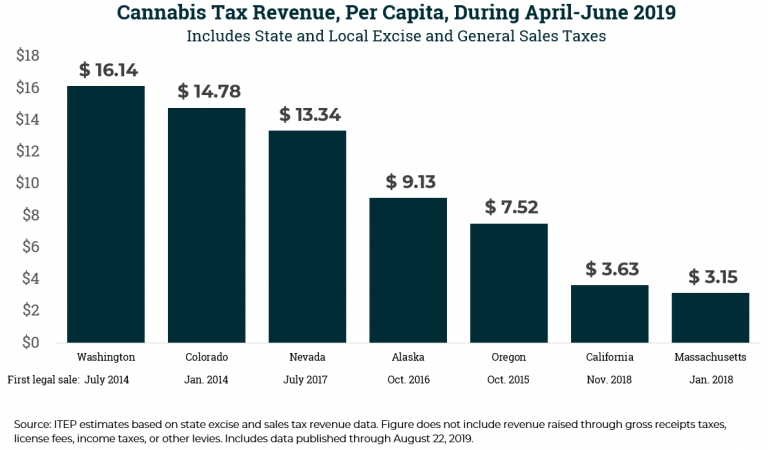
“After adjusting for population, the Golden State raised the second-least amount of revenue from cannabis taxes during the second quarter among states with legal sales, ahead of only Massachusetts,” according to the Institute on Taxation and Economic Policy. The result was a departure from the spikes seen in states such as Colorado, Washington and Oregon […]
Why California’s Cannabis Market May Not Tell You Much about Legalization in Your State
• By Carl Davis
New tax data out of California, the world’s largest market for legal cannabis, tell a complicated story about the cannabis industry and its tax revenue potential. Legal cannabis markets take time to establish, and depending on local market conditions, the revenue states raise can vary significantly.
