
Colorado
Governing: High on Pot Taxes
August 20, 2019
But even with maximized revenue, pot taxes will likely only account for about 1 percent of overall state budgets, according to the Institute on Taxation and Economic Policy. The $266 million Colorado collected in 2018, for instance, pales next to the state’s $15 billion in total revenues and $32 billion budget. Read more
State Rundown 8/15: A Tax-Subsidy Cease-Fire in Kansas and Missouri
• By ITEP Staff
Over the last couple of weeks, leaders in Kansas and Missouri reached a historic agreement to stop giving away tax subsidies just to entice companies a couple of miles across their shared state line. Meanwhile, policymakers in Alaska resolved a stand-off over education funding...by cutting education funding slightly less. And California voters may be voting in 2020 on a stronger reform to the notoriously inequitable property tax effects of “Proposition 13.”
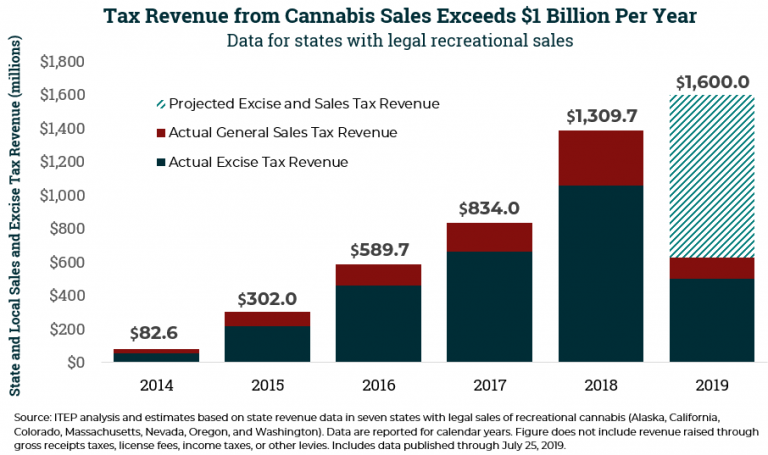
State and Local Cannabis Tax Revenue on Pace for $1.6 Billion in 2019
• By Carl Davis
Cannabis tax revenue is becoming more significant as legal sales grow. The tax is far from a budgetary panacea, but an ITEP analysis of revenue data reported by the seven states with legal cannabis sales underway suggests that excise and sales tax revenues from the sale of the drug could reach $1.6 billion this year.
State Rundown 7/26: The Dog Days of Tax
• By ITEP Staff
OHIO legislators passed a budget with unfortunate income tax cuts for high-income households. Other states turned their attention to unconventional ideas during their legislative off-seasons, for better and for worse. And there are many gems to be found in our “What We’re Reading” section below, including new research on the racial inequities that continue to pervade our communities and schools.
State Rundown Special Edition: Fiscal Year Wrap-Up
• By ITEP Staff
We've said it before, and we'll say it again: states don't have to wait for federal lawmakers to make moves toward progressive tax policy. And so far, 2019 has been a good year for equitable and sustainable tax policy in the states. With July 1 marking the start of a new fiscal year for most states, this special edition of the Rundown looks at how discussions in 2019 have been dominated by plans to raise…
State Rundown 6/27: States Look at Raising Incomes at the Bottom, Taxes at the Top
• By ITEP Staff
Low-income working families got good news and bad news this week, as Earned Income Tax Credit (EITC) enhancements passed in California and advanced in Oregon, while minimum wage increases failed in Pennsylvania, Rhode Island, and Wisconsin. Meanwhile, the momentum for taxing wealth and the very rich continued to grow, as more one-percenters called for enacting progressive taxes, and Inequality.org held a star-studded conference on why and how to do so.
State Rundown 6/19: Juneteenth Highlights Role of State Policy in Racial Equity Fight
• By ITEP Staff
As Americans observe Juneteenth today–the day two years after the Emancipation Proclamation on which news of the end of the Civil War and slavery reached some of the last slaves in Texas—most people’s attention should be on celebrating victories, remembering losses, gathering strength to continue the fight for racial justice, and the accompanying Congressional reparations hearings. In comparison, state tax debates over matters such as reluctance to invest in infrastructure in Michigan and Missouri, approval of income tax cuts in Wisconsin, and a budget standoff in New Jersey may seem…
KEYE TV: Colorado made $1B in marijuana tax revenue: What could this mean for federal legalization?
June 13, 2019
Tax experts explained that government revenue from cannabis is not a panacea for solving the country’s budget issues, but it could certainly help. According to a study by Carl Davis, the research director at the Institute on Taxation and Economic Policy, a federal push to legalize marijuana and regulate commercial sales could potentially generate nearly […]
State Rundown 6/5: Illinois Gets Busy
• By ITEP Staff
Illinois made big news in several tax and budget areas recently, including sending a graduated income tax amendment to voters in 2020, as well as legalizing and taxing cannabis and updating gas and cigarette taxes for infrastructure improvements. Connecticut made smaller waves with sales tax reforms, a plastic bag tax, and a progressive mansion tax. Property tax credits were proposed in both Maine and New Jersey. And Nevada extended a business tax to give teachers…
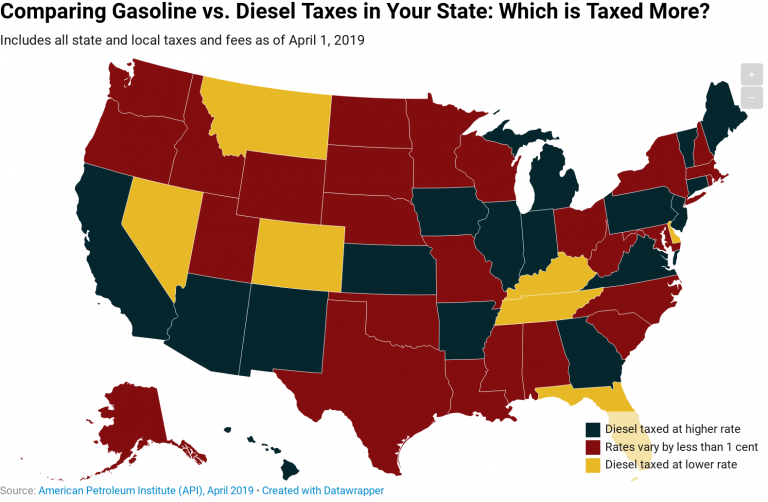
Gasoline vs. Diesel Taxes in Your State: Which is Taxed More?
• By ITEP Staff
Twenty-six states and the District of Columbia tax these two fuel types at the same rate or very similar rates, as of April 2019, according to data from the American Petroleum Institute.
State Rundown 5/9: Illinois Moves Closer to a Progressive Income Tax
• By ITEP Staff
Lawmakers in Illinois and Ohio have advanced major tax proposals but cannot rest just yet, as they must still get past the other legislative chamber. Their counterparts in Michigan, Minnesota, Nebraska, and Oregon, meanwhile, are all at impasses over education funding, as those in Texas left their school funding disagreement unresolved at least until they reconvene...in 2021. And in an era of many states pre-empting smaller jurisdictions by revoking local decision-making powers, leaders in Colorado…
State Rundown 5/1: Teacher Uprisings Continue on May Day
• By ITEP Staff
Teachers in North Carolina and South Carolina are walking out and rallying this week for increased education funding, teacher and staff pay, and other improvements to benefit students—if you’re unsure why be sure to check out research on the teacher shortage and pay gap under “What We’re Reading” below. Meanwhile, budget debates have recently wrapped up in Indiana, Iowa, Massachusetts, New Hampshire, and Washington. And major tax debates are kicking into high gear in both…
State Rundown 4/18: It’s Peak Season for State Fiscal Debates
• By ITEP Staff
Tax and budget debates are now mostly complete in Alabama, Arkansas, and Colorado, but just starting or just getting interesting in several other states. Delaware and Massachusetts lawmakers, for example, are looking at progressive income tax increases on wealthy households, and New Hampshire may use a progressive tax on capital gains to simultaneously improve its upside-down tax code and invest in education. Nebraska and Texas, on the other hand, are also looking to improve school…
The Case for Extending State-Level Child Tax Credits to Those Left Out: A 50-State Analysis
• By Aidan Davis, Meg Wiehe
As of 2017, 11.5 million children in the United States were living in poverty. A national, fully-refundable Child Tax Credit (CTC) would effectively address persistently high child poverty rates at the national and state levels. The federal CTC in its current form falls short of achieving this goal due to its earnings requirement and lack of full refundability. Fortunately, states have options to make state-level improvements in the absence of federal policy change. A state-level…
State Rundown 4/4: Ohio Gas Tax and Maryland Minimum Wage Get Needed Updates
• By ITEP Staff
Transportation funding was a hot topic this week, as OHIO lawmakers responsibly voted to update their gas tax and offset some of its impact on lower-income families with an Earned Income Tax Credit (EITC) boost, while NEW YORK enacted the nation’s first “congestion pricing” charge, and LOUISIANA and VIRGINIA leaders looked at gas tax updates as well—a trend ITEP’s Carl Davis explored in depth today here. Broad tax packages are also being hashed out in LOUISIANA,…
State Rundown 3/14: Tax Fairness Proposed in Illinois
• By ITEP Staff
More than three billion dollars could be raised under a major progressive tax plan proposed by Illinois Gov. J.B. Pritzker this week, the point being to simultaneously improve the state’s upside-down tax code and address its notorious budget gap issues. One state, Utah, may already be looking at a special session to revisit the sales tax reform debate that ended this week without resolution, in contrast to Alabama and Arkansas, where leaders finally resolved years-long…
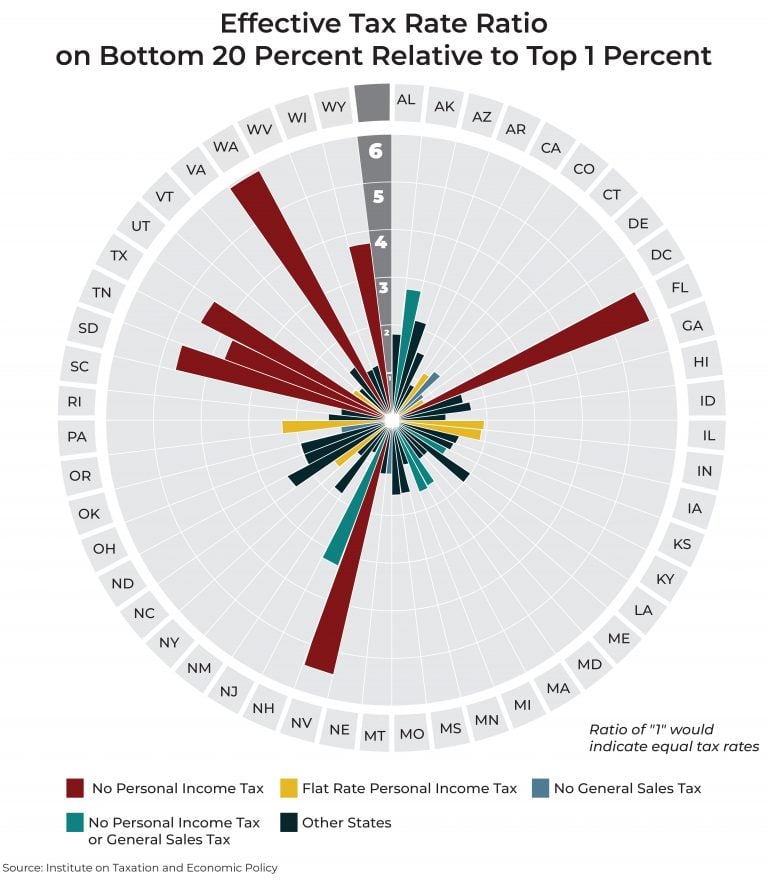
Fairness Matters: A Chart Book on Who Pays State and Local Taxes
• By ITEP Staff
There is significant room for improvement in state and local tax codes. State tax codes are filled with top-heavy exemptions and deductions and often fail to tax higher incomes at higher rates. States and localities have come to rely too heavily on regressive sales taxes that fail to reflect the modern economy. And overall tax collections are often inadequate in the short-run and unsustainable in the long-run. These types of shortcomings provide compelling reason to…
State Rundown 2/14: We ♥ Taxes!
• By ITEP Staff
Happy Valentine’s Day to all lovers of quality research, sound fiscal policy, and progressive tax reforms! This week, some leaders in ARKANSAS displayed their infatuation with the rich by advancing regressive tax cuts, but others in the state are trying to show some love to low- and middle-income families instead. WISCONSIN lawmakers are devoted to tax reductions for the middle class but have not yet decided how to express those feelings. NEBRASKA legislators are playing…
Trends We’re Watching in 2019: Attempting to Double Down on Failed Trickle-Down Regressive Tax Cuts
• By Lisa Christensen Gee
It’s always troubling for those concerned with adequate and fair public finance systems when states prioritize tax cuts at the cost of divesting in important public priorities and exacerbating underlying tax inequalities. But it’s even more nerve-racking when it happens on the eve of what many consider to be an inevitable economic downturn.
Trends We’re Watching in 2019: The Use of Targeted Tax Breaks to Help Address Poverty and Inequality
• By Aidan Davis
Continuing to build upon the momentum of previous years, states are taking steps to create and improve targeted tax breaks meant to lift their most in-need state residents up and out of poverty. Most notably, a range of states are exploring ways to restore, enhance or create state Earned Income Tax Credits (EITC). EITCs are an effective tool to help struggling families with low wages make ends meet and provide necessities for their children. The…
State Rundown 1/31: Governors and Teachers Dominate Headlines, Much More in Fine Print
• By ITEP Staff
Gubernatorial addresses and the prospect of teacher strikes continued to take center stage in state fiscal news this week, as governors of Connecticut, Maryland, and Utah gave speeches that all included significant tax proposals. Meanwhile, teachers walked out in Virginia, and many other states debated school funding increases to avoid similar results. State policymakers have many other debates on their hands as well, including what to do with online sales tax revenue, how to cut…
State Rundown 1/24: States Reflect on MLK’s Dream and Teacher Uprisings
• By ITEP Staff
This week, as Americans in every state celebrated Martin Luther King Jr. Day and reflected on his dream of peaceful protest and racial and economic justice, many eyes were on the teachers’ strike pressing for parts of this dream amid the “curvaceous slopes of California.” Governors and lawmakers in many states—including Arizona, Georgia, Indiana, Louisiana, Nevada, New Mexico, South Carolina, and Wisconsin—discussed ways to raise pay for teachers and/or enhance education investments generally.
Bloomberg: Cannabis Excise Tax Revenue Could Eclipse Alcohol Revenue in 2019
January 23, 2019
Excise tax revenue from marijuana sales is expected to surpass alcohol excise collections in 2019, according to the co-author of a new report. Carl Davis, a research director at the Institute on Taxation and Economic Policy, noted in his report that state and local retail marijuana excise tax collections already rivaled alcohol tax collections in […]
Politico Morning Tax: The Broad View on Pot
January 23, 2019
There’s been plenty of coverage of states legalizing recreational marijuana and then overestimating how much revenue they’ll see. But a new report from the liberal Institute on Taxation and Economic Policy notes that while legalized pot will likely never be the central component of a state’s revenue stream, there’s still plenty of potential there. For […]

Five Years in, Cannabis Tax Haul Rivals or Exceeds Alcohol Taxes in Many States
• By ITEP Staff
A first-of-its-kind look at state excise taxes on legal cannabis sales finds that taxing the substance can be a meaningful source of state revenue but cautions that achieving sustainable revenues over time will be difficult under the price-based tax structures adopted in most states thus far.
