
Hawaii
State Rundown 11/8: Top Tax Takeaways from Tuesday
• By ITEP Staff
Tuesday’s elections shook up statehouses, governors’ offices, and tax laws in many states, and in this week’s Rundown we bring you the top 3 election state tax policy stories to emerge. First, voters in Kansas and other states sent a message that regressive tax cuts and supply-side economics have not succeeded and are not welcome among their state fiscal policies. Meanwhile, residents of many other states, including most notably Illinois, voted for representatives who reflect their preference for equitable, sustainable…
State Rundown 10/25: Ballot Initiative Special
• By ITEP Staff
In this special edition of the Rundown we bring you a voters’ guide to help make sense of tax-related ballot questions that will go before voters in many states in November. Interests in Arizona, Florida, North Carolina, Oregon, and Washington state have placed process-related questions on those states’ ballots in attempts to make it even harder to raise revenue or improve progressivity of their state and/or local tax codes. In response to underfunded schools and…

The Garden Island: Gap Keeps Growing Between Rich, Poor
• By ITEP Staff
The study finds that those in the bottom fifth of the income spectrum in Hawaii pay 15 percent of their income in state and local taxes, while those in the top 1 percent pay only 8.9 percent, “which exacerbates inequality in our state,” according to a press release about the study.
Hawaii Public Radio: Hawaii Tax System Places Larger Burden on Low Income Residents
• By ITEP Staff
Low-income residents in Hawaii are paying a higher share of their income in taxes than higher level earners. That is the conclusion of a recent report from the Institute on Taxation and Economic Policy titled Who Pays? The Hawaii tax system is considered highly regressive, due to heavy reliance on the General Excise Tax, or GET. This is despite a progressive, graded state income tax and the lowest property taxes in the nation.
Hawai’i Budget & Policy Center: Hawaii’s Tax System Exacerbates Inequality
• By ITEP Staff
A new report out from the Institute on Taxation and Economic Policy (ITEP) provides the vital statistics for each state’s tax system. It lays out, in clear and compelling numbers, the sobering message that Hawaiʻi taxes—and those in the United States on average—increase inequality between rich and poor.
Big Island Now: STUDY: Hawai‘i’s Low-Income Taxpayers Carry 2nd Highest Tax Rate
• By ITEP Staff
The main cause of the heavy tax burden on those making the least in Hawaiʻi is the General Excise Tax (GET). Families in the lowest fifth spend 10.5% of their meager incomes on the GET, while the top 1% spend only 1.2% of their large earnings. In other words, those at the bottom spend 8.75 times more of their income on the GET than do those at the top.
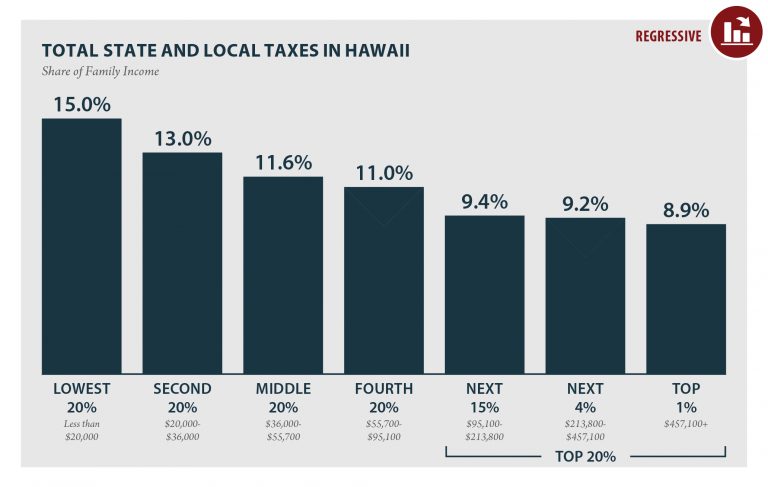
Hawaii: Who Pays? 6th Edition
• By ITEP Staff
HAWAII Read as PDF HAWAII STATE AND LOCAL TAXES Taxes as Share of Family Income Top 20% Income Group Lowest 20% Second 20% Middle 20% Fourth 20% Next 15% Next 4% Top 1% Income Range Less than $20,000 $20,000 to $36,000 $36,000 to $55,700 $55,700 to $95,100 $95,100 to $213,800 $213,800 to $457,100 over $457,100 […]
State Rundown 10/4: Ballot/Election Season in Full Swing
• By ITEP Staff
South Carolina lawmakers have finally passed a federal conformity bill in response to last year’s federal tax-cut legislation. Voters in many states are hearing a lot about tax-related questions they’ll see on the ballot in November, particularly residents of Florida, Montana, and Oregon, where corporate donors and other anti-tax interests are spending major sums to alter policy in their states. And states continue to work on ensuring they can collect online sales taxes and, in…

Tax Cuts 2.0 – Hawaii
• By ITEP Staff
The $2 trillion 2017 Tax Cuts and Jobs Act (TCJA) includes several provisions set to expire at the end of 2025. Now, GOP leaders have introduced a bill informally called “Tax Cuts 2.0” or “Tax Reform 2.0,” which would make the temporary provisions permanent. And they falsely claim that making these provisions permanent will benefit […]
State Rundown 9/19: Don’t Call it a Comeback
• By ITEP Staff
The Rundown is back after a few-week hiatus, with lots of state fiscal news and quality research to share! Maine lawmakers found agreement on a response to the federal tax-cut bill, states continue to sort out how they’ll collect online sales taxes in the wake of the Wayfair decision, and policymakers in several states have been working on summer tax studies and other preparations for 2019 legislative sessions. Meanwhile, work on ballot measures and candidate tax plans to go before…
State Tax Codes as Poverty Fighting Tools: 2018 Update on Four Key Policies in All 50 States
• By Aidan Davis, Misha Hill
This report presents a comprehensive overview of anti-poverty tax policies, surveys tax policy decisions made in the states in 2018, and offers recommendations that every state should consider to help families rise out of poverty. States can jumpstart their anti-poverty efforts by enacting one or more of four proven and effective tax strategies to reduce the share of taxes paid by low- and moderate-income families: state Earned Income Tax Credits, property tax circuit breakers, targeted…

Rewarding Work Through State Earned Income Tax Credits in 2018
• By ITEP Staff
The Earned Income Tax Credit (EITC) is a policy designed to bolster the earnings of low-wage workers and offset some of the taxes they pay, providing the opportunity for struggling families to step up and out of poverty toward meaningful economic security. The federal EITC has kept millions of Americans out of poverty since its enactment in the mid-1970s. Over the past several decades, the effectiveness of the EITC has been magnified as many states…
Property Tax Circuit Breakers in 2018
• By Aidan Davis
State lawmakers seeking to make residential property taxes more affordable have two broad options: across-the-board tax cuts for taxpayers at all income levels, such as a homestead exemption or a tax cap, and targeted tax breaks that are given only to particular groups of low- and middle-income taxpayers. One such targeted program to reduce property taxes is called a “circuit breaker” because it protects taxpayers from a property tax “overload” just like an electric circuit…

All Bets are Off: State-Sponsored Sports Betting Isn’t Worth the Risk
• By Misha Hill
Many state legislators and regulators are considering expanding state-sponsored gambling by allowing betting on major league sports games. But the revenue states could bring in isn’t worth the risk.

Lottery, Casino and other Gambling Revenue: A Fiscal Game of Chance
• By ITEP Staff
Cash-strapped, tax-averse state lawmakers continue to seek unconventional revenue-raising alternatives to the income, sales, and property taxes that form the backbone of most state tax systems. However, gambling revenues are rarely as lucrative, or as long-lasting, as supporters claim.

SALT/Charitable Workaround Credits Require a Broad Fix, Not a Narrow One
• By Carl Davis
The federal Tax Cuts and Jobs Act (TCJA) enacted last year temporarily capped deductions for state and local tax (SALT) payments at $10,000 per year. The cap, which expires at the end of 2025, disproportionately impacts taxpayers in higher-income states and in states and localities more reliant on income or property taxes, as opposed to sales taxes. Increasingly, lawmakers in those states who feel their residents were unfairly targeted by the federal law are debating…
State Rundown 4/27: Arbor Day Brings Some Fruitful Tax Developments, Some Shady Proposals
• By ITEP Staff
This Arbor Day week, the seeds of discontent with underfunded school systems and underpaid teachers continued to spread, with walkouts occurring in both Arizona and Colorado. And recognizing the need to see the forest as well as the trees, the Arizona teachers have presented revenue solutions to get to the true root of the problem. In the plains states, tax cut proposals continue to pop up like weeds in Kansas and threaten to spread to…
Trends We’re Watching in 2018, Part 5: 21st Century Consumption Taxes
• By Misha Hill
We're highlighting the progress of a few newer trends in consumption taxation. This includes using the tax code to discourage consumption of everything from plastic bags to carbon and collecting revenue from emerging industries like ride sharing services and legalized cannabis sales.

What to Expect if the Supreme Court Allows for Online Sales Tax Collection
• By Carl Davis
Online shopping is hardly a new phenomenon. And yet states and localities still lack the authority to require many Internet retailers to collect the sales taxes that their locally based, brick and mortar competitors have been collecting for decades.
State Rundown 3/30: Several Major Tax Debates Will March on into April
• By ITEP Staff
This week, after the recent teacher strike in West Virginia, teacher pay crises brought on by years of irresponsible tax cuts also made headlines in Arizona and Oklahoma. Maine and New York lawmakers continue to hash out how they will respond to the federal tax bill. And their counterparts in Missouri and Nebraska attempt to push forward their tax cutting agendas.
Hawaii News Now: Nonprofit to State on Tax Savings for Low-Income Families: Check Your Math
March 29, 2018
The state miscalculated the benefits of the federal tax overhaul to low-income families in Hawaii, a new analysis concludes. The source of the confusion: The scope of the tax savings that the child tax credit benefit would offer very low-income families (those earning up to $10,000 a year).
Honolulu Star Advertiser: New Tax Benefits Likely Overstated for Hawaii’s Poorest
March 29, 2018
A nonpartisan Washington, D.C.-based nonprofit, the Institute on Taxation and Economic Policy, has estimated that Hawaii’s richest 1 percent, represented by households earning over $554,230, would save $39,420 on average next year under the new law. The group also figured that Hawaii taxpayers earning less than $26,620 would save $130 on average in taxes.
Hawai’i Budget & Policy Center: Effects of Federal Tax Cuts in Hawai‘i: Correcting the Record
• By ITEP Staff
Although corporate taxes are not reported on individual income tax forms, corporate tax cuts benefit those who own stocks, and the vast majority are owned by upper-income individuals. For that reason, ITEP included corporate tax breaks in its analysis of the federal tax law.

Trends We’re Watching in 2018, Part 3: Improvements to Tax Credits for Workers and Families
• By Aidan Davis
This has been a big year for state action on tax credits that support low-and moderate-income workers and families. And this makes sense given the bad hand low- and middle-income families were dealt under the recent Trump-GOP tax law, which provides most of its benefits to high-income households and wealthy investors. Many proposed changes are part of states’ broader reaction to the impact of the new federal law on state tax systems. Unfortunately, some…
State Rundown 3/8: March Tax Debates “In Like a Lion”
• By ITEP Staff
This week was very active for state tax debates. Georgia, Idaho, and Oregon passed bills reacting to the federal tax cut, as Maryland and other states made headway on their own responses. Florida lawmakers sent a harmful "supermajority" constitutional amendment to voters. New Jersey now has two progressive revenue raising proposals on the table (and a need for both). Louisiana ended one special session with talks of yet another. And online sales taxes continued to…
