
New Jersey
No Need for the MythBusters, the Millionaire Tax Flight Myth is Busted Again
May 1, 2018 • By Dacey Anechiarico

One of the most repeated myths in state tax policy is called “millionaire tax flight,” where millionaires are allegedly fleeing states with high income tax rates for states with lower rates. This myth has been used as an argument in state tax debates for years but Cristobal Young argues in his book, “The Myth of the Millionaire Tax Flight,” that both Democrats and Republicans are “searching for a crisis that does not really exist,” and that there is no evidence to support this myth.
State Rundown 4/27: Arbor Day Brings Some Fruitful Tax Developments, Some Shady Proposals
April 27, 2018 • By ITEP Staff
This Arbor Day week, the seeds of discontent with underfunded school systems and underpaid teachers continued to spread, with walkouts occurring in both Arizona and Colorado. And recognizing the need to see the forest as well as the trees, the Arizona teachers have presented revenue solutions to get to the true root of the problem. In the plains states, tax cut proposals continue to pop up like weeds in Kansas and threaten to spread to Iowa and Missouri, where lawmakers are running out of time but are still hoping their efforts to pass destructive tax cuts will bear fruit.
Washington Post: Democrats’ Tax Plan Looks an Awful Lot Like a Big Giveaway to the Wealthy
April 26, 2018
Some Democratic-led states are also moving forward with plans that would offset the tax benefits for the rich, with New Jersey Gov. Phil Murphy (D) acting swiftly to enact a millionaire’s tax, according to Meg Wiehe, deputy director of ITEP, who noted Murphy has acknowledged the workaround may help the rich. Cuomo has rebuffed similar […]
State Rundown 12/31/9999: IRS Glitch and Legislative Impasses Extend Tax Season
April 20, 2018 • By ITEP Staff
This week the IRS website asked some would-be tax filers to return after December 31, 9999. State legislators don't have quite that much time, but are struggling to wrap up their tax debates on schedule as well. Iowa legislators, for example, are ironically still debating tax cuts despite having run out of money to cover their daily expenses for the year. Nebraska's session wrapped up, but its tax debate continues in the form of a call for a special session and the threat of an unfunded tax cut going before voters in November. Mississippi's tax debate has been revived by…
Trends We’re Watching in 2018, Part 5: 21st Century Consumption Taxes
April 20, 2018 • By Misha Hill

We're highlighting the progress of a few newer trends in consumption taxation. This includes using the tax code to discourage consumption of everything from plastic bags to carbon and collecting revenue from emerging industries like ride sharing services and legalized cannabis sales.
New Jersey Policy Perspectives: Undocumented Immigrants Pay Taxes: County Breakdown of Taxes Paid
April 16, 2018
While undocumented immigrants in New Jersey now face greater threats from the federal government than ever before, new data at the state and county level released by the Institute on Taxation and Economic Policy make clear that the Garden State’s undocumented immigrants are an important economic benefit to this immigrant-rich state. Read more here
Dallas Morning News: NJ Gov. Murphy to Texas Gov. Abbott: Back off from our people and companies Filed under Commentary at 4 days ago
April 16, 2018
We are also not fixated on cutting taxes for the wealthy at the expense of the middle class. According to the Institute on Taxation and Economic Policy, Texas is home to the third-most unfair state and local tax system in the country, with middle-class and working families paying disproportionately higher rates than the wealthiest Texans. […]
Newark Star-Ledger: The 15 Mostly Red States That Mooch off NJ the Most
April 15, 2018
Under the Republican tax bill, New Jersey and five other states, four of which now pay more to Washington than they receive in services, will contribute a greater share of federal income taxes than they do now, according to the Institute on Taxation and Economic Policy, a progressive research group. Read more
State Rundown 4/13: Teacher Strikes, Special Sessions, Federal Cuts Haunting States
April 13, 2018 • By ITEP Staff
This Friday the 13th is a spooky one for many state lawmakers, as past bad fiscal decisions have been coming back to haunt them in the form of teacher strikes and walk-outs in Arizona, Kentucky, and Oklahoma. Meanwhile, policymakers in Maryland, Nebraska, New Jersey, Oregon, and Utah all attempted to exorcise negative consequences of the federal tax-cut bill from their tax codes. And our What We're Reading section includes yet another stake to the heart of the millionaire tax-flight myth and other good reads.
What to Expect if the Supreme Court Allows for Online Sales Tax Collection
April 11, 2018 • By Carl Davis

Online shopping is hardly a new phenomenon. And yet states and localities still lack the authority to require many Internet retailers to collect the sales taxes that their locally based, brick and mortar competitors have been collecting for decades.
Extensions of the New Tax Law’s Temporary Provisions Would Mainly Benefit the Wealthy
April 10, 2018 • By Matthew Gardner, Steve Wamhoff
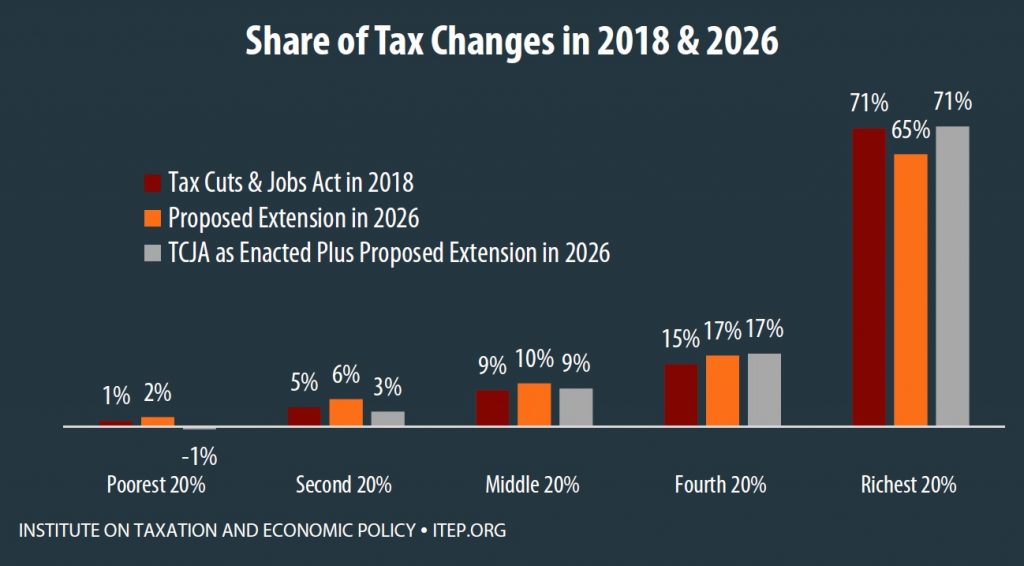
This analysis finds that extending the temporary tax provisions in 2026 would not be aimed at helping the middle-class any more than TCJA as enacted helps the middle-class in 2018.
Washington Times: Andrew Cuomo complains about tax breaks for wealthy — then signs off on N.Y. loopholes
April 5, 2018 • By Matthew Gardner
Matthew Gardner, a senior fellow at the left-leaning Institute on Taxation and Economic Policy, said this appears to be another example of wealthy Americans “gaming” the tax system through special loopholes. “The whole point is to help New Yorkers to avoid a tax hike, and in particular to help wealthy New Yorkers avoid a tax […]
Teachers’ Strikes Are Emblematic of Larger Tax Challenges for States
March 30, 2018 • By Meg Wiehe

As other researchers as well as journalists have noted, teachers striking or threatening to strike over low wages and overall lack of investment isn’t simply a narrative about schools and public workers’ pay. It is illustrative of a broader conflict over tax laws and how states and local jurisdictions fund critical public services that range from K-12 education, public safety, roads and bridges, health care, parks, to higher education.
Trends We’re Watching in 2018, Part 3: Improvements to Tax Credits for Workers and Families
March 26, 2018 • By Aidan Davis

This has been a big year for state action on tax credits that support low-and moderate-income workers and families. And this makes sense given the bad hand low- and middle-income families were dealt under the recent Trump-GOP tax law, which provides most of its benefits to high-income households and wealthy investors. Many proposed changes are part of states’ broader reaction to the impact of the new federal law on state tax systems. Unfortunately, some of those proposals left much to be desired.
Christian Science Monitor: In Blue States, ‘Tax the Rich’ Isn’t So Simple Anymore
March 16, 2018
The upset that governors like Cuomo and others are voicing is understandable, says Meg Wiehe, deputy director of the Institute on Taxation and Economic Policy, a left-leaning research group. These states see they’re getting the short end of the stick from the federal law, and they suspect that Republican motives were at least partly political. […]
With many state legislative sessions about halfway through, the ripple effects of the federal tax-cut bill took a back seat this week as states focused their energies on their own tax and budget issues. Major proposals were released in Nebraska and New Jersey, one advanced in Missouri, and debates wrapped up in Florida, Utah, and Washington. Oklahoma and Vermont are considering ways to improve education funding, while California, New York, and Vermont look to require more of their most fortunate residents. And check in on "what we're reading" for resources on the online sales tax debate, the role of property…
New Jersey Policy Perspective: Op-Ed: Tax Law Requires More Than ‘SALT Cap’ Workarounds
March 14, 2018
If you live in a high-wealth and high-tax state like New Jersey, the news gets worse. For the first time in 100 years, taxpayers may no longer deduct their full state and local taxes (“SALT” for short) from the income on which federal taxes are owed. The deductible ceiling is set at $10,000, so if you pay more than that with property and income taxes combined, your taxable income will increase by a bit.
This week was very active for state tax debates. Georgia, Idaho, and Oregon passed bills reacting to the federal tax cut, as Maryland and other states made headway on their own responses. Florida lawmakers sent a harmful "supermajority" constitutional amendment to voters. New Jersey now has two progressive revenue raising proposals on the table (and a need for both). Louisiana ended one special session with talks of yet another. And online sales taxes continued to make news nationally and in Kansas, Nebraska, and Pennsylvania.
Trends We’re Watching in 2018, Part 1: State Responses to Federal Tax Cut Bill
March 5, 2018 • By Dylan Grundman O'Neill
Over the next few weeks we will be blogging about what we’re watching in state tax policy during 2018 legislative sessions. And there is no trend more pervasive in states this year than the need to sort through and react to the state-level impact of federal tax changes enacted late last year.
State Rundown 2/28: February a Long Month for State Tax Debates
February 28, 2018 • By ITEP Staff
February may be the shortest month but it has been a long one for state lawmakers. This week saw Arizona, Idaho, Oregon, and Utah seemingly approaching final decisions on how to respond to the federal tax-cut bill, while a bill that appeared cleared for take-off in Georgia hit some unexpected turbulence. Other states are still studying what the federal bill means for them, and many more continue to debate tax and budget proposals independently of the federal changes. And be sure to check our "What We're Reading" section for news on corporate tax credits from multiple states.
Preventing State Tax Subsidies for Private K-12 Education in the Wake of the New Federal 529 Law
February 23, 2018 • By Ronald Mak

This policy brief explains the federal and various state-level breaks for 529 plans and explores the potential impact that the change in federal treatment of 529 plans will have on state revenues.
New Jersey Policy Perspective: Op-Ed: How to Counter the GOP Tax Plan with Bold Action
February 14, 2018
The new federal tax law has generated a lot of press, sparked a fair amount of outrage and led many elected officials scrambling to respond with sound policies. Unfortunately, there seems to be widespread confusion about the winners and losers under the new law – confusion that is complicating efforts to clean up New Jersey’s tax code and raise new resources to invest in critical public services.
State Rundown 1/31: Low-Income Families’ Taxes Getting Some Much-Needed Attention
January 31, 2018 • By ITEP Staff
This week was promising for advocates of Earned Income Tax Credits (EITCs) and other tax breaks for workers and their families, which are making headway in Alabama, Maine, Massachusetts, Missouri, Utah, and Wisconsin. The week also saw the unveiling of a tax cut plan in Missouri, a budget-balancing tax increase package in Oklahoma, the end of an unproductive film tax credit in West Virginia, and a very busy week for tax policy in Utah.
State Rundown 1/25: States Begin Tax Debates while Still Racing to Understand Federal Bill
January 25, 2018 • By ITEP Staff
State legislative sessions are in full swing this week as states grapple with revenue shortfalls and the ramifications of the federal tax cut bill. Lawmakers in Alaska and Louisiana, for example, are debating how to handle their revenue shortfalls, and a tax cut proposal in Idaho has been received tepidly. And be sure to peruse our "What We're Reading" section for helpful perspectives on how states are affected by the federal tax cut bill.
NJPP: A Grain of ‘SALT’: New Jersey Needs More Than Workarounds to Respond to GOP Tax Plan
January 25, 2018
That’s because these workarounds would disproportionately benefit the wealthiest households in New Jersey, to make no mention of the fact that the Trump administration is unlikely to allow them to stand.
