
Ohio
Analysis of the House Tax Cuts and Jobs Act
• By Matthew Gardner, Meg Wiehe, Steve Wamhoff
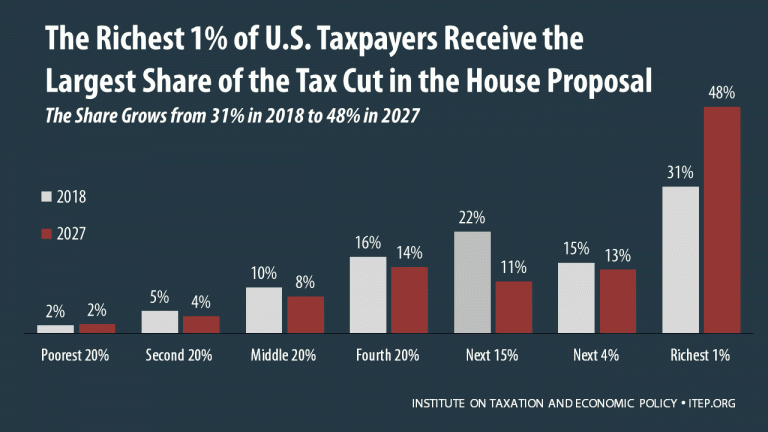
The Tax Cuts and Jobs Act, which was introduced on Nov. 2 in the House of Representatives, would raise taxes on some Americans and cut taxes on others while also providing significant savings to foreign investors.
How the House Tax Proposal Would Affect Ohio Residents’ Federal Taxes
• By ITEP Staff
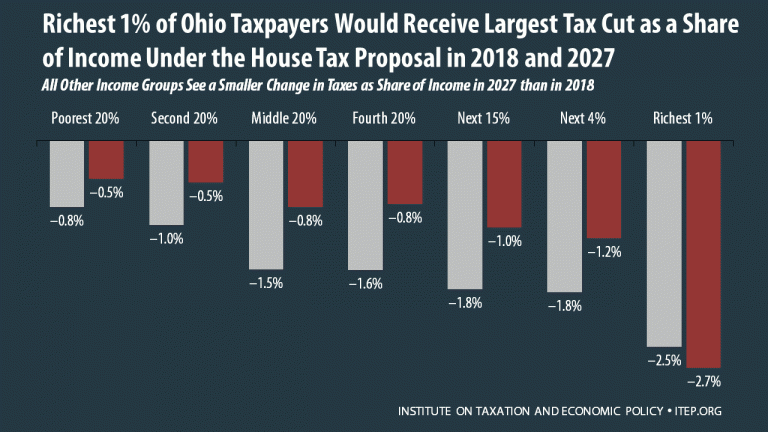
The Tax Cuts and Jobs Act, which was introduced on November 2 in the House of Representatives, includes some provisions that raise taxes and some that cut taxes, so the net effect for any particular family’s federal tax bill depends on their situation. Some of the provisions that benefit the middle class — like lower tax rates, an increased standard deduction, and a $300 tax credit for each adult in a household — are designed to…
CNN: How Trump’s Policies Could Hurt the Rust Belt
October 25, 2017
Rust Belt states Ohio, Michigan and Indiana are not home to large populations of $1 million household income earners. Rather, they’re in the middle or bottom of the pack, according a summary from the Institute on Taxation and Economic Policy. States with a higher percentage of millionaire earners voted for Hillary Clinton in the 2016 […]

The Jig Is Up: Republican Budget Resolution Finally Admits That Deficit Will Soar Under GOP Tax Plan
• By Alan Essig
For some lawmakers, annual deficits matter a lot—unless the nation is paying for tax cuts for the wealthy via deficit spending. Last night, Republican lawmakers demonstrated that previous grandstanding about the nation’s debt is much ado about nothing. The Senate approved a budget resolution on a party-line vote that would 1. fast-track legislation adding $1.5 trillion to the deficit over 10 years by cutting taxes, and 2. make it easy to enact this measure without…
Benefits of GOP-Trump Framework Tilted Toward the Richest Taxpayers in Each State
• By Steve Wamhoff
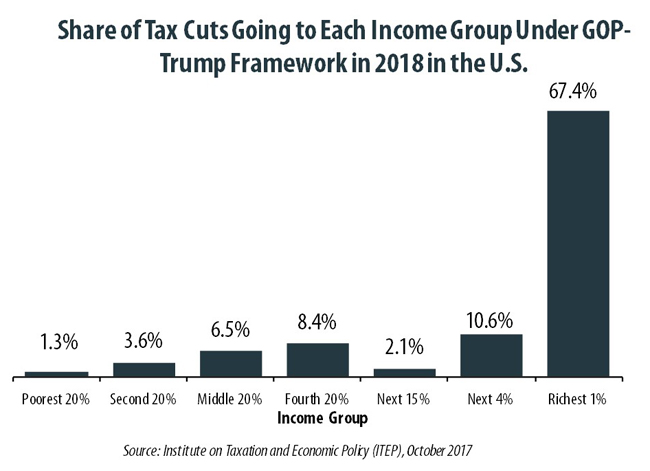
The “tax reform framework” released by the Trump administration and Congressional Republican leaders on September 27 would affect states differently, but every state would see its richest residents grow richer if it is enacted. In all but a handful of states, at least half of the tax cuts would flow to the richest one percent of residents if the framework took effect.

GOP-Trump Tax Framework Would Provide Richest One Percent in Ohio with 57.5 Percent of the State’s Tax Cuts
• By ITEP Staff
The “tax reform framework” released by the Trump administration and congressional Republican leaders on September 27 would not benefit everyone in Ohio equally. The richest one percent of Ohio residents would receive 57.5 percent of the tax cuts within the state under the framework in 2018. These households are projected to have an income of at least $483,100 next year. The framework would provide them an average tax cut of $56,280 in 2018, which would…

State Tax Codes as Poverty Fighting Tools
• By ITEP Staff
Astonishingly, tax policies in virtually every state make it harder for those living in poverty to make ends meet. When all the taxes imposed by state and local governments are taken into account, every state imposes higher effective tax rates on poor families than on the richest taxpayers.

Census Data Shows Importance of Refundable Tax Credits in Reducing Poverty, But Lawmakers Move to Restrict Them
• By Steve Wamhoff
The annual poverty data released by the Census Bureau today continues to show that federal refundable tax credits are the second most important anti-poverty program after Social Security. But this could change if the House Republicans have their way. The budget resolution approved by Republicans on the House Budget Committee in July would place new […]
Rewarding Work Through State Earned Income Tax Credits in 2017
• By ITEP Staff
The Earned Income Tax Credit (EITC) is a policy designed to bolster the earnings of low-wage workers and offset some of the taxes they pay, providing the opportunity for struggling families to step up and out of poverty toward meaningful economic security. The federal EITC has kept millions of Americans out of poverty since its enactment in the mid-1970s. Over the past several decades, the effectiveness of the EITC has been magnified as many states…
Turning Loopholes into Black Holes: Trump’s Territorial Tax Proposal Would Increase Corporate Tax Avoidance
• By Matthew Gardner, Steve Wamhoff
The problem of offshore tax avoidance by American corporations could grow much worse under President Donald Trump’s proposal to adopt a “territorial” tax system, which would exempt the offshore profits of American corporations from U.S. taxes. This change would increase the already substantial benefits American corporations obtain when they use accounting gimmicks to make their profits appear to be earned in a foreign country that has no corporate income tax or has one that is…
Nearly Half of Trump’s Proposed Tax Cuts Go to People Making More than $1 Million Annually
• By ITEP Staff
A tiny fraction of the U.S. population (one-half of one percent) earns more than $1 million annually. But in 2018 this elite group would receive 48.8 percent of the tax cuts proposed by the Trump administration. A much larger group, 44.6 percent of Americans, earn less than $45,000, but would receive just 4.4 percent of the tax cuts.
In Ohio 39.1 Percent of Trump’s Proposed Tax Cuts Go to People Making More than $1 Million
• By ITEP Staff
A tiny fraction of the Ohio population (0.5 percent) earns more than $1 million annually. But this elite group would receive 39.1 percent of the tax cuts that go to Ohio residents under the tax proposals from the Trump administration. A much larger group, 47.6 percent of the state, earns less than $45,000, but would receive just 6.3 percent of the tax cuts.
State Rundown 7/27: State Legislative Debates Winding Down but Tax Talk Continues
• By ITEP Staff
While only a few states still remain mired in overtime budget debates, there is plenty of budget and tax news from around the country this week. Efforts are underway to repeal gas tax increases in California and challenge a local income tax in Seattle, Washington. And New Jersey legislators' law to modernize its tax code to tax Airbnb rentals has been vetoed for now.

Reviving U.S. Manufacturing, One Cheesecake Factory at a Time
• By Matthew Gardner
In the latest example of how the tax code has been abused and distorted, the Cheesecake Factory is claiming the manufacturing tax deduction, apparently for manufacturing cheesecakes, burgers, and other treats.
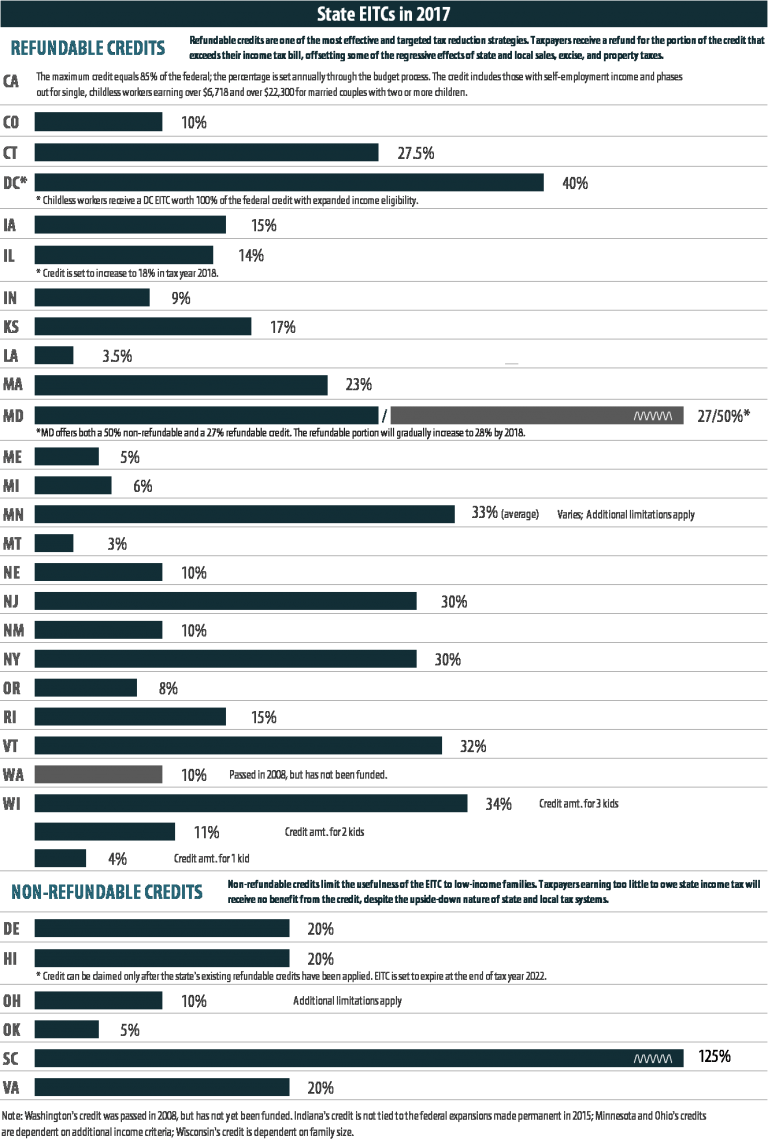
Rewarding Work Through State Earned Income Tax Credits
• By Aidan Davis
The Earned Income Tax Credit (EITC) is a policy designed to bolster the earnings of low-wage workers and offset some of the taxes they pay, providing the opportunity for struggling families to step up and out of poverty toward meaningful economic security. The federal EITC has kept millions of Americans out of poverty since its enactment in the mid-1970s. Over the past several decades, the effectiveness of the EITC has been magnified as many states…
Trump Tax Proposals Would Provide Richest One Percent in Ohio with 47.2 Percent of the State’s Tax Cuts
• By ITEP Staff
Earlier this year, the Trump administration released some broadly outlined proposals to overhaul the federal tax code. Households in Ohio would not benefit equally from these proposals. The richest one percent of the state’s taxpayers are projected to make an average income of $1,485,800 in 2018.
Trump’s $4.8 Trillion Tax Proposals Would Not Benefit All States or Taxpayers Equally
• By Matthew Gardner, Steve Wamhoff
The broadly outlined tax proposals released by the Trump administration would not benefit all taxpayers equally and they would not benefit all states equally either. Several states would receive a share of the total resulting tax cuts that is less than their share of the U.S. population. Of the dozen states receiving the least by this measure, seven are in the South. The others are New Mexico, Oregon, Maine, Idaho and Hawaii.
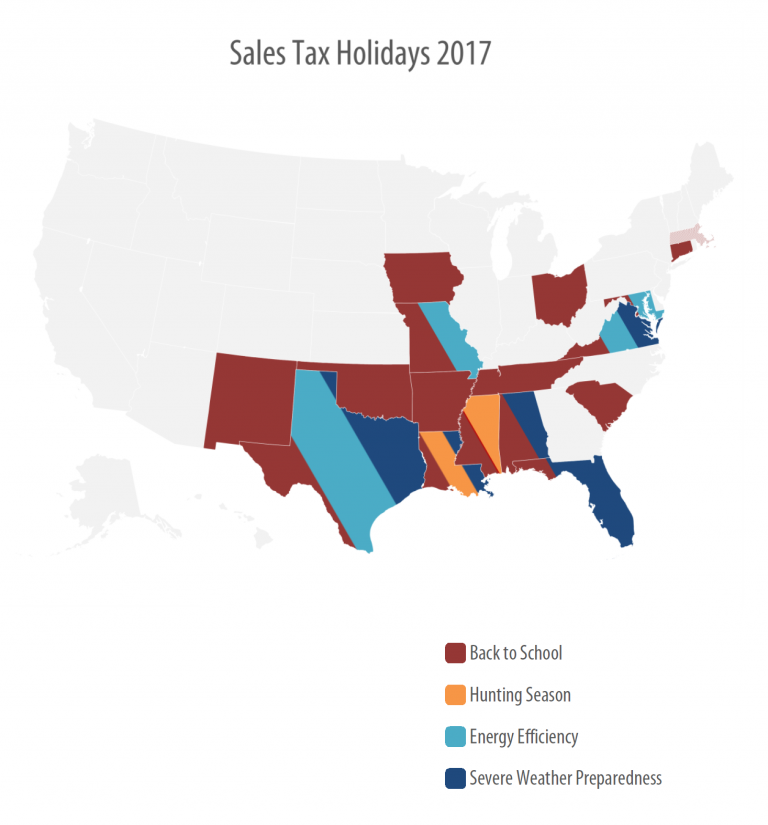
Sales Tax Holidays: An Ineffective Alternative to Real Sales Tax Reform
• By ITEP Staff
Sales taxes are an important revenue source, composing close to half of all state tax revenues. But sales taxes are also inherently regressive because the lower a family’s income, the more the family must spend on goods and services subject to the tax. Lawmakers in many states have enacted “sales tax holidays” (at least 16 states will hold them in 2017), to provide a temporary break on paying the tax on purchases of clothing, school…
State Rundown 7/11: Some Legislatures Get Long Holiday Weekends, Others Work Overtime
• By ITEP Staff
Illinois and New Jersey made national news earlier this month after resolving their contentious budget stalemates. But they weren’t the only states working through (and in some cases after) the holiday weekend to resolve budget issues.
State Rundown 6/21: Crunch Time for Many States with New Fiscal Year on Horizon
• By Meg Wiehe
This week several states rush to finalize their budget and tax debates before the start of most state fiscal years on July 1. West Virginia lawmakers considered tax increases as part of a balanced approach to closing the state’s budget gap but took a funding-cuts-only approach in the end. Delaware legislators face a similar choice, […]
State Rundown 6/14: Some States Wrapping Up Tax Debates, Others Looking Ahead to Next Round
• By ITEP Staff
This week lawmakers in California and Nevada resolved significant tax debates, while budget and tax wrangling continued in West Virginia, and structural revenue shortfalls were revealed in Iowa and Pennsylvania. Airbnb increased the number of states in which it collects state-level taxes to 21. We also share interesting reads on state fiscal uncertainty, the tax experiences of Alaska and Wyoming, the future of taxing robots, and more!
State Rundown 6/7: Kansas Success Story and Other State News
• By ITEP Staff
This week, we celebrate a victory in Kansas where lawmakers rolled back Brownback's tax cuts for the richest taxpayers. Governors in West Virginia and Alaska promote compromise tax plans. Texas heads into special session and Vermont faces another budget veto, while Louisiana and New Mexico are on the verge of wrapping up. Voters in Massachusetts may soon be able to weigh in on a millionaire's tax, the California Senate passed single-payer health care, and more!
State Rundown 5/24: Several States Scramble to Finalize Budgets
• By ITEP Staff
This week, Kansas lawmakers continued work on fixing the fiscal mess created by tax cuts in recent years, as legislators in Louisiana, Minnesota, Oklahoma, and West Virginia attempted to wrap up difficult budget negotiations before their sessions come to an end, and Delaware lawmakers advanced a corporate tax increase as one piece of a plan to close that state's budget shortfall. Our "what we're reading" section this week is also packed with articles about state…

3 Percent and Dropping: State Corporate Tax Avoidance in the Fortune 500, 2008 to 2015
• By Aidan Davis, Matthew Gardner, Richard Phillips
The trend is clear: states are experiencing a rapid decline in state corporate income tax revenue. Despite rebounding and even booming bottom lines for many corporations, this downward trend has become increasingly apparent in recent years. Since our last analysis of these data, in 2014, the state effective corporate tax rate paid by profitable Fortune 500 corporations has declined, dropping from 3.1 percent to 2.9 percent of their U.S. profits. A number of factors are…

State Rundown 4/27: States Finally Reaching Resolution on Gas Taxes
• By ITEP Staff
This week, transportation funding debates finally concluded with gas tax updates in Indiana, Montana, and Tennessee, and appear to be nearing an end in South Carolina. Meanwhile, Louisiana and Oregon lawmakers debated new Gross Receipts Taxes, and Texas legislators considered eliminating the state’s franchise tax. — Meg Wiehe, ITEP Deputy Director, @megwiehe Louisiana Gov. Bel Edward’s Commercial Activities Tax (CAT) was pulled from committee early this week without a vote due to opposition, […]

Institute on Taxation
and Economic Policy
ITEP is a non-profit, non-partisan tax policy organization. We conduct rigorous analyses of tax and economic proposals and provide data-driven recommendations to shape equitable and sustainable tax systems.
Subscribe to ITEP Emails
Tax research and policy news in your inbox.
Promote Fair Tax Policy
Your gift to ITEP promotes tax justice. With your help, we do research that supports taxing millionaires and billionaires, taxing big corporations and raising revenue for the things our people, our communities and our planet need.
Together, we can create a country with more economic justice, more racial justice, more climate justice… and more tax justice.